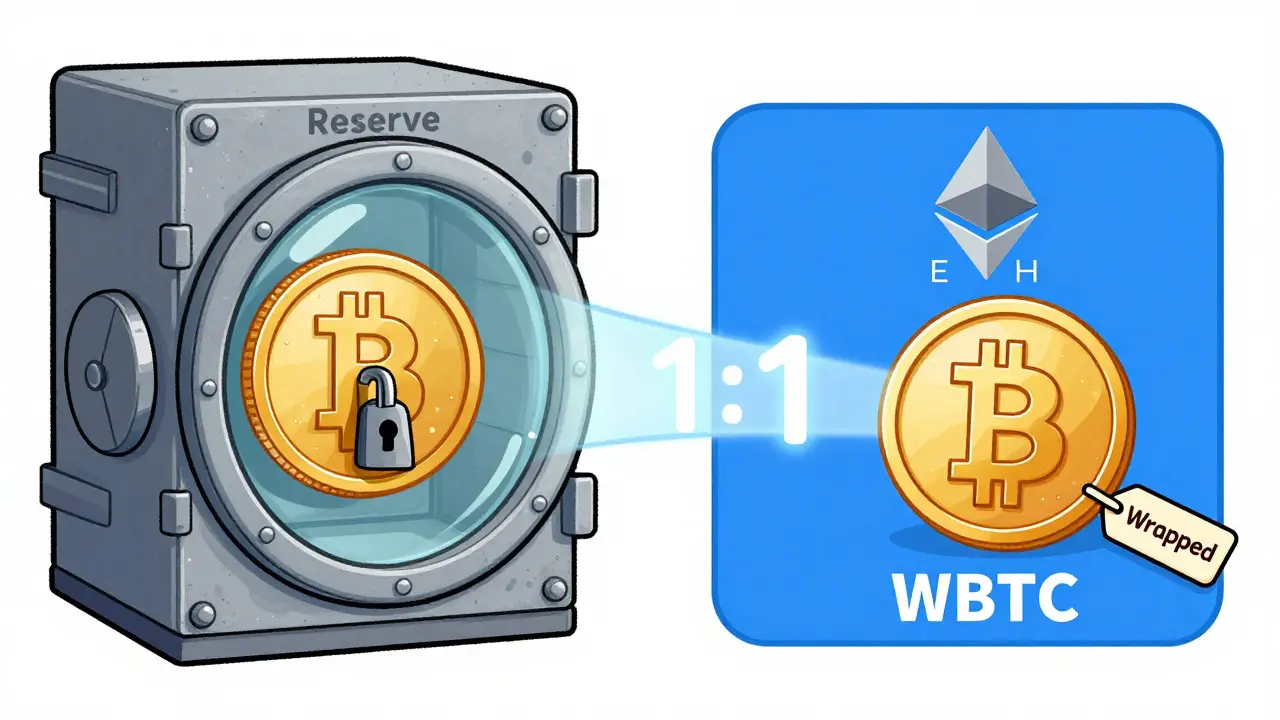
Imagine trying to spend Bitcoin on Ethereum. It sounds impossible because they are separate networks with different rules. Yet, billions of dollars move between these chains every day. The secret isn't magic; it's a system called wrapped tokens. But here is the catch: for this system to work, you have to trust that someone actually holds the real Bitcoin while you hold a digital receipt on another chain. This relationship between wrapped token supply and the underlying reserves is the backbone of cross-chain finance.
If the supply of wrapped tokens exceeds the actual reserves, the peg breaks. If the reserves vanish, your token becomes worthless paper. Understanding how this mechanism works is no longer just for developers; it’s essential for anyone holding assets in decentralized finance (DeFi). Let’s look at how this lock-and-mint process keeps the crypto economy stable.
The Lock-and-Mint Mechanism Explained
At its core, a wrapped token is a synthetic asset. It represents a native cryptocurrency from one blockchain on a completely different network. To create this representation, the system uses a strict 1:1 ratio. For every one unit of the wrapped token minted, exactly one unit of the original asset must be locked away in a secure reserve.
Wrapped Bitcoin (WBTC) is the most prominent example of this mechanism, allowing Bitcoin holders to participate in Ethereum-based DeFi protocols like Aave and Uniswap without selling their BTC. Launched in January 2019 by a joint initiative involving Kyber, Ren, and BitGo, WBTC was designed to solve the liquidity isolation problem between blockchains.
Here is how the process works in practice:
- Locking: You send your native Bitcoin to a custodian wallet. In the case of WBTC, this custodian is primarily BitGo, which uses multi-signature security to protect the funds.
- Minting: Once the Bitcoin is confirmed as received, the smart contract on the Ethereum network mints an equivalent amount of WBTC. This new token is an ERC-20 standard token, meaning it behaves exactly like other Ethereum assets.
- Circulation: You now hold WBTC. You can trade it, lend it, or use it as collateral in DeFi applications. The value remains pegged to Bitcoin because the underlying BTC is still sitting in the vault.
- Burning: When you want your Bitcoin back, you send the WBTC to a burn address. The smart contract destroys the WBTC, signaling the custodian to release the equivalent amount of native BTC from the reserve.
This cycle ensures that the total supply of wrapped tokens never exceeds the amount of assets held in reserve. It’s a simple concept, but the execution requires immense trust in the intermediaries managing the vaults.
Who Guards the Reserves? Custodians and DAOs
The biggest question in wrapped tokens is: who do you trust with your money? Unlike fully decentralized systems where code is law, wrapped tokens rely on centralized entities to manage the physical storage of the underlying assets. This creates a hybrid model that blends blockchain technology with traditional financial custody.
For WBTC, the ecosystem is governed by a Decentralized Autonomous Organization (DAO) consisting of 15 major entities, including Ledger, BitGo, and Kyber. These members vote on critical decisions, such as approving new merchants who can initiate minting requests. While this adds a layer of decentralization compared to a single company running the show, it still relies on human oversight and legal frameworks.
| Feature | Custodial Model (e.g., WBTC) | Decentralized Model (e.g., renBTC) | Exchange-Wrapped (e.g., BTCB) |
|---|---|---|---|
| Custody | Multi-sig wallets managed by professional firms (BitGo) | Distributed across nodes in a virtual machine (RenVM) | Held internally by the exchange (Binance) |
| Transparency | Monthly third-party audits (Armanino) | On-chain verification via smart contracts | Limited; relies on exchange statements |
| Speed | 30-60 minutes for mint/burn | Faster, but higher technical complexity | Near-instant within exchange ecosystem |
| Market Share | ~90% of wrapped Bitcoin market | ~15% of wrapped Bitcoin market | ~7% of wrapped Bitcoin market |
The custodial model dominates because institutions prefer familiar security standards. BitGo, for instance, is a regulated entity with deep experience in institutional crypto custody. However, this centralization is a double-edged sword. If the custodian fails, gets hacked, or faces regulatory seizure, the entire wrapped token ecosystem could freeze. This risk became painfully clear during the 2022 collapse of FTX, where users realized that "reserves" on centralized platforms were often not what they seemed.
Verifying the Peg: Audits and On-Chain Proof
Trust is good, but proof is better. In the early days of crypto, users had to take companies' word for it when they claimed to hold reserves. Today, transparency mechanisms have evolved significantly. For WBTC, the primary method of verification is regular third-party attestation.
Every month, the accounting firm Armanino publishes an attestation report confirming that the number of WBTC tokens in circulation matches the amount of Bitcoin held in the BitGo cold storage wallets. This isn't just a casual check; it’s a formal audit that provides a high degree of confidence in the 1:1 peg. As of 2024, these reports consistently show a variance of less than 0.01%, proving the system’s integrity.
However, monthly audits leave gaps. What if something goes wrong between reports? To address this, newer technologies are integrating real-time verification. Chainlink, a decentralized oracle network, has integrated with WBTC to provide on-chain proof of reserves. This allows smart contracts to automatically verify the backing status without waiting for a PDF report from an accountant. This shift toward continuous, automated verification is crucial for maintaining market stability during periods of high volatility.
Vitalik Buterin, co-founder of Ethereum, has noted that while custodial wrapped tokens are a "necessary evil," the industry must move toward trustless bridges. Until then, transparent reserve verification is non-negotiable. Users should always look for projects that publish regular, independent audits rather than relying solely on internal statements.
Risks and Vulnerabilities in the System
No financial system is perfect, and wrapped tokens carry specific risks that investors need to understand. The primary danger is counterparty risk. Even with strong audits, you are trusting a centralized entity to hold your assets. If that entity is compromised, your wrapped token may lose its value.
Another risk is smart contract vulnerability. The code that handles minting and burning must be flawless. If there is a bug in the ERC-20 contract, attackers could drain the reserves or mint infinite tokens, breaking the peg. Security firms like CertiK regularly audit these contracts, but zero-day exploits remain a possibility. In 2023, several smaller wrapped token projects suffered hacks due to poor coding practices, highlighting the importance of using established, battle-tested protocols like WBTC or WETH.
Network congestion also poses a practical issue. During times of high demand on Ethereum, gas fees spike, and transaction confirmations slow down. Users have reported waiting up to 17 hours to unwrap their tokens during peak traffic periods. This isn't a loss of value, but it locks up capital temporarily, which can be problematic for traders needing quick access to funds.
The Future: Moving Toward Trustless Bridges
The current custodial model is widely seen as a transitional solution. The ultimate goal for the blockchain industry is trustless interoperability, where assets move between chains without any middlemen. Several developments point in this direction.
In late 2024, the WBTC DAO announced plans to migrate to a multi-custodian model. Instead of relying solely on BitGo, the reserves will be distributed among multiple qualified custodians. This reduces single-point-of-failure risk and aligns more closely with decentralized principles. Additionally, the Ethereum Foundation is funding research into account abstraction (EIP-4337), which aims to streamline cross-chain interactions and eventually eliminate the need for wrapped tokens altogether.
Regulatory pressure is also shaping the future. The European Union’s MiCA framework, effective from January 2025, requires strict monthly attestations for all wrapped assets operating within EU jurisdictions. This forces projects to maintain high transparency standards or face exclusion from major markets. While regulations add compliance costs, they also weed out shady operators, potentially increasing overall trust in the sector.
By 2026, analysts predict the total value of wrapped tokens will exceed $41 billion, driven largely by institutional adoption. Banks and hedge funds are increasingly using wrapped assets to gain exposure to crypto markets through familiar custody structures. As long as the 1:1 peg holds and reserves remain verifiable, wrapped tokens will continue to serve as the vital bridge connecting fragmented blockchain ecosystems.
What happens if the reserves are stolen?
If the custodian holding the reserves is hacked or fails, the wrapped tokens become unbacked. Since the smart contract cannot force the custodian to release funds, the price of the wrapped token would likely crash to near zero. This is why choosing a project with robust insurance and regular third-party audits is critical.
Is WBTC safe to hold?
WBTC is considered one of the safest wrapped assets due to its multi-custodian setup, monthly audits by Armanino, and governance by a DAO of 15 reputable entities. However, it still carries counterparty risk because you are trusting BitGo and other merchants to safeguard the underlying Bitcoin.
Why do we need wrapped tokens instead of just using Bitcoin?
Bitcoin operates on its own blockchain, which lacks the smart contract functionality needed for complex DeFi applications like lending, borrowing, and automated market making. Wrapped Bitcoin (WBTC) brings Bitcoin onto Ethereum, allowing it to interact with thousands of DeFi protocols seamlessly.
How often are reserves audited?
For major projects like WBTC, reserves are audited monthly by independent accounting firms. Newer integrations with oracle networks like Chainlink aim to provide real-time on-chain verification, reducing the reliance on periodic manual audits.
Can I convert WBTC back to BTC instantly?
No, the process typically takes 30 to 60 minutes under normal network conditions. It involves sending WBTC to a burn address, waiting for DAO approval, and then having the custodian release the native BTC. During high network congestion, this process can take much longer.