The Technical Ceiling: Speed and Cost
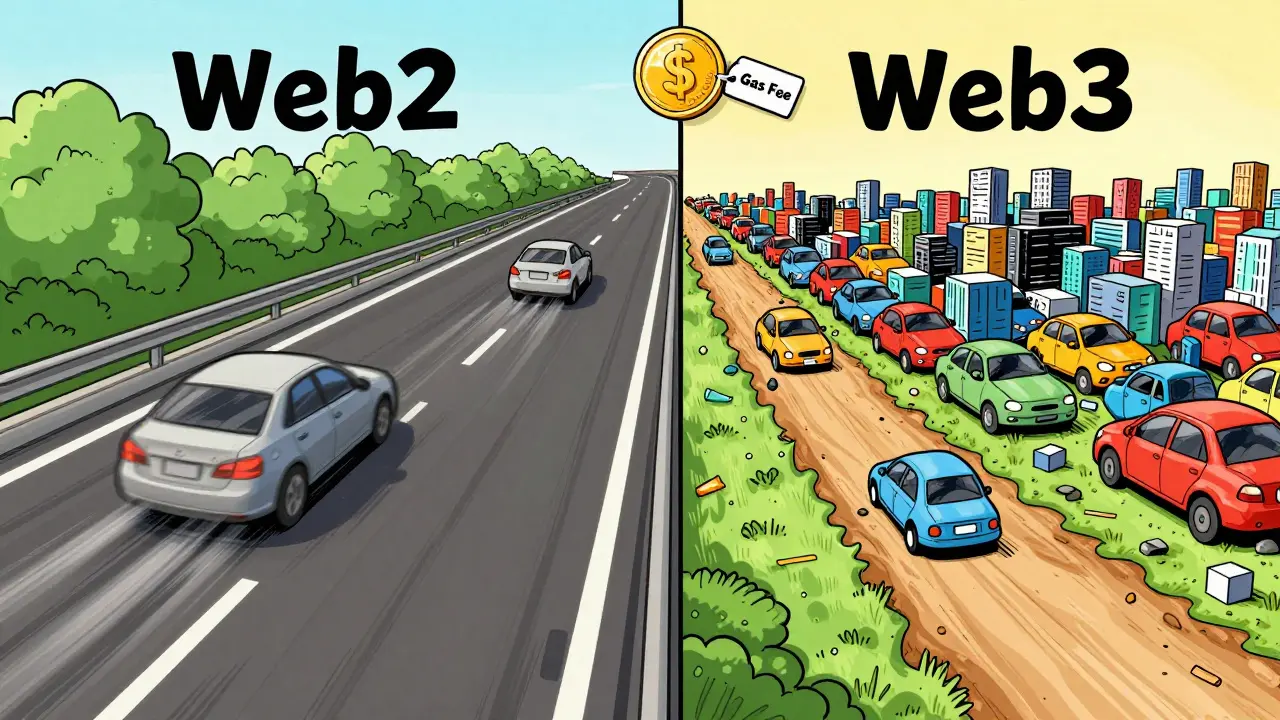
The most immediate wall users hit is performance. We've become spoiled by Web2 apps that respond instantly. In contrast, Blockchain networks often struggle to keep up. For perspective, while Visa can handle 65,000 transactions per second (TPS), Ethereum often hovers between 15 and 30 TPS. That's a staggering difference. If a global payment system ran at 30 TPS, the world economy would essentially freeze.
Then there's the cost of doing business. In the Web2 world, sending a message or updating a profile is free. In Web3, you pay "gas fees." During peak times in 2025, some users saw Ethereum fees spike to $100 for a single transaction. Who is going to buy a $5 digital sticker if the transaction fee is $20? This makes microtransactions, the very thing that could disrupt the creator economy, economically impossible.
| Metric | Web2 (Standard) | Web3 (Ethereum/Bitcoin) | Layer-2 Solutions |
|---|---|---|---|
| Transaction Speed | Near-Instant | 15 sec - 6 min | 2,000 - 4,000 TPS |
| Average Cost | $0.00 | $1.20+ (Fluctuates) | Significantly Lower |
| User Onboarding | Email/Password | Wallet + Seed Phrase | Varies |
The UX Nightmare: Why Users Give Up
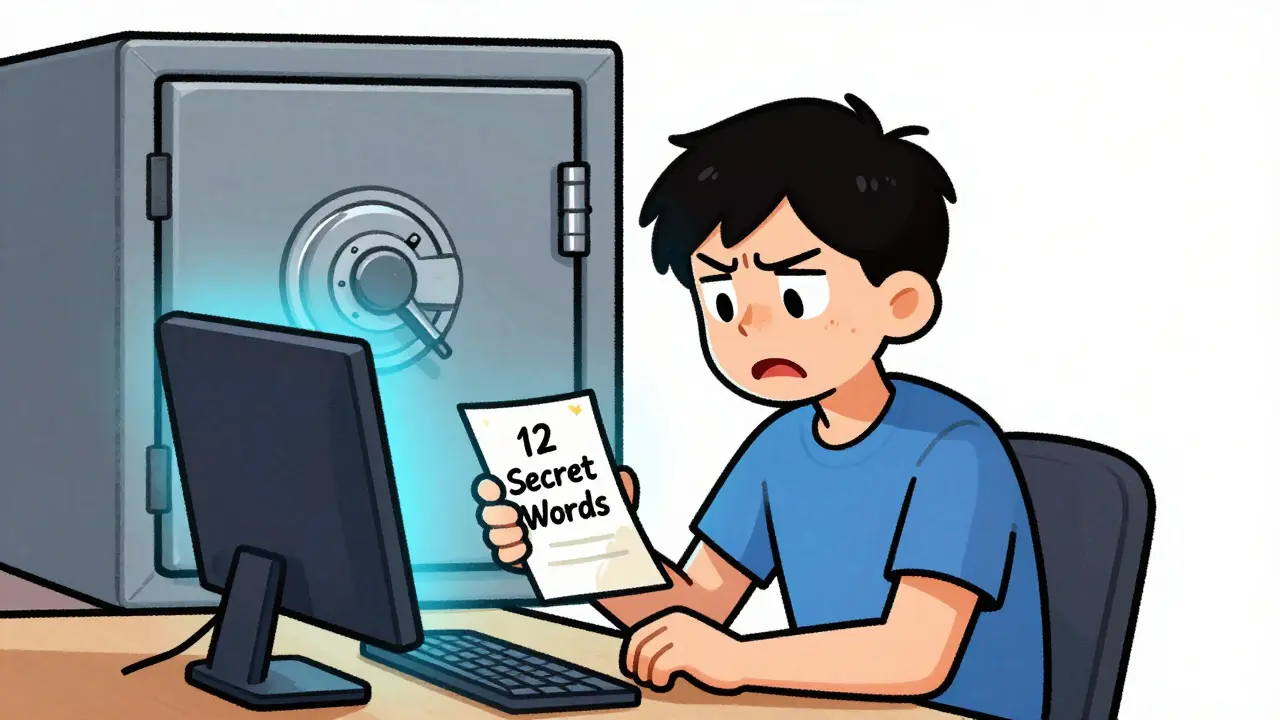
If the technical side is the engine, the user experience (UX) is the steering wheel-and right now, the steering wheel is missing for most people. Onboarding into Web3 requires 3 to 5 more steps than a traditional app. You don't just "sign up"; you create a Digital Wallet, manage a private key, and figure out which network you're on. For a regular person, this is a nightmare.
We see this clearly in the gaming world. Some platforms have reported an 83% drop-off rate during the onboarding process. People want to play a game, not become a part-time cybersecurity expert. When a user on Reddit recently shared how they lost $47 due to a "slippage error" while bridging tokens, it highlighted the core problem: the system is too fragile for people who aren't developers.
Security Risks and the Trust Gap
In Web2, if you lose your password, you click "Forgot Password." In Web3, there is no "Forgot Password" button. This absolute responsibility is terrifying for the average consumer. Moreover, the security of the code itself is a major concern. Smart Contracts-the self-executing pieces of code that power Web3-are frequently exploited. In the third quarter of 2025 alone, about $1.2 billion was stolen through these vulnerabilities.
This creates a vicious cycle. High-profile hacks make the news, which scares off the 94% of the population that hasn't tried Web3, which then leaves the space dominated by high-risk speculators rather than everyday users. Until the security is invisible and the recovery process is human-centric, mass adoption will stall.
The Regulatory Fog
It's not just the users who are hesitant; it's the big companies too. Imagine you're a Fortune 500 CEO. You see the potential for Decentralized Identity to cut fraud, but you have no idea if the laws in your country-or the countries you sell to-will consider your tokens as securities or currencies. This uncertainty is a dealbreaker. Reports show that 78% of major companies have paused their Web3 projects simply because the legal rules are too blurry.
While 87 countries have now established some form of crypto framework, they don't talk to each other. What's legal in Southeast Asia (where penetration is high at nearly 19%) might be a legal grey area in North America. This fragmentation prevents the kind of global scaling that made the original internet so powerful.

The Knowledge Gap and Jargon Barrier
Web3 has a communication problem. The industry loves its jargon. Terms like "liquidity pools," "sharding," "minting," and "gas limits" act as a barrier to entry. When you tell a new user they need to "bridge assets to a Layer-2 rollup to avoid high gwei costs," you've basically told them to go away.
Education is the final hurdle. Learning to develop for Web3 takes about 120-150 hours of study, which is nearly triple the time it takes to learn equivalent Web2 skills. This shortage of skilled developers means we have fewer people capable of building the simple, intuitive interfaces that would actually attract new users.
How We Actually Get Past This
The path forward isn't more blockchain features; it's fewer barriers. We're already seeing progress. Ethereum's Dencun upgrade significantly lowered costs for Layer-2 networks, and some gaming platforms are implementing "one-click" wallets that hide the complexity from the user. The goal should be a "invisible blockchain" where the user doesn't even know they're interacting with a ledger-they just know their transaction was instant and their asset is secure.
Is Web3 ever going to be as fast as Web2?
It's unlikely that a single decentralized chain will match the speed of a centralized server, but Layer-2 scaling solutions and new protocols like Solana's Firedancer are pushing TPS into the thousands. The goal is to reach a point where the user perceives the speed as "instant," even if the backend takes a few seconds to finalize.
Why are gas fees so high and unpredictable?
Gas fees are essentially a bidding war for space on the blockchain. Since a block can only hold so much data, users pay more to get their transaction processed faster. As network capacity increases through upgrades and scaling solutions, these costs typically drop, but they remain volatile during high-demand events like NFT mints.
Can I recover my funds if I lose my seed phrase?
In a purely decentralized wallet, no. The seed phrase is the only key to your funds. However, "Account Abstraction" and institutional custody solutions are emerging that allow for social recovery, where a trusted group of friends or a service can help you regain access without a seed phrase.
Are smart contracts safe to use?
They are as safe as the code they are written with. Because smart contracts are public and immutable, a single bug can be exploited by anyone in the world. To mitigate this, reputable projects use professional auditors to check the code before it goes live, but no contract is 100% risk-free.
Which regions are adopting Web3 the fastest?
Southeast Asia and Africa are currently leading in penetration rates. This is often driven by a higher need for decentralized financial tools in regions with unstable local currencies or limited access to traditional banking systems.
Oh yeah, because writing 12 words on a napkin is exactly how most people like to manage their life savings. Pure genius.
Absolutly ridiclous that we even let these forign tech trends mess with the Amercian market when our own systems are already the gold standard in the world and we dont need some decentralized mess that just lets hackers steal money and then the governement has to step in and fix the mess created by people who think they are smarter then the actual law enforcment agencies of this great nation!!
I totally get where the friction is coming from, but I'm still super bullish on the long term! Once those one-click wallets really hit the mainstream, it's gonna be a game changer for everyone. We just need to keep guiding the newbies through the process until it's seamless.
It's funny how they talk about "regulatory fog" like it's an accident. They just want a way to track every single micro-transaction you make so they can freeze your assets the moment you stop complying with the narrative. The decentralization is the only way to stay off the grid, even if the UX is a disaster right now.
Imagine thinking Layer-2 is the "solution" while the base layer is basically a glorified spreadsheet from 2009. 🙄 The whole thing is just a giant circus for people who like losing money to "slippage" and then calling it an investment strategy. It's honestly adorable that people think this will actually replace traditional banking when it can't even handle a few thousand transactions without breaking a sweat.
Sure, let's just wait for another "revolutionary" upgrade to fix the fees. I'm sure the 100th update will finally make it usable for people who don't have a PhD in cryptography.
Actually, if you look at the progress on Account Abstraction, it's really promising! 🚀 We can finally get rid of seed phrases and make it feel like a normal app. Let's stay positive and help each other learn! ✨
Omg the sheer AUDACITY of the devs to call this a "revolution" when I spent three hours just trying to bridge some tokens and ended up with an error message in a language I dont even recognize!! Like seriously who designed this??? It's a total disaster and a joke of a user interface!!
Just another bubble. Boring.
It is profoundly disappointing that the current generation prioritizes the convenience of a "forgot password" button over the moral imperative of absolute personal sovereignty. One must endure the discipline of managing a seed phrase to truly understand the value of digital ownership. The lack of fortitude in the average consumer is a tragedy of the highest order.
Typical Western struggle. In India, we're actually seeing the utility because we have real problems to solve, not just "my digital sticker is too expensive." The irony of people complaining about UX while the tech is literally saving financial systems in the global south is just peak comedy.
the government is probablly the ones who wrote the bugs into the smart contracts just to steal the money and make it look like a hack... so typical. also the typos in this whole industry are worse than the code lol.
I think the point about the trust gap is really important. People just want to feel safe with their money.
The fragmentation between 87 different countries' laws is the biggest hurdle here. Even if the tech becomes invisible, the legal risk for a company to implement it globally is still a nightmare. We need a unified standard or this stays a niche toy for speculators.
just take it slow and learn one thing at a time. no need to rush into the deep end if you aren't ready. we can all help each other out
i think its cool how different countries are handlng it but yeah the jargon is totaly a mess. i tried readng a whitepaper and it felt like a math test i didnt study for. hope they make it simpler soon
For anyone feeling overwhelmed, I highly recommend starting with a managed wallet first. It's a great way to get used to the flow without the stress of managing keys immediately. Once you're comfortable, you can migrate to a cold wallet. Just take a breath, it's a learning curve for everyone, and there's no shame in asking for a guide. We've all been there, and the community is generally very welcoming if you look in the right places. Don't let the technical jargon scare you off because the actual utility is worth the effort. Just remember to never share your seed phrase with anyone, regardless of how helpful they seem. Security first, then exploration. You'll get the hang of it in no time!