
Ever clicked on a chart and saw a token named after a cartoon whale, only to find it’s down 99% from its peak? That’s exactly what you’re looking at with Wally The Whale, also known as WALLY. It’s a cryptocurrency that doesn’t promise you faster transactions, lower fees, or a revolutionary new way to store value. Instead, it promises something much simpler: a laugh.
Launched on the Solana blockchain, WALLY is a classic example of a memecoin designed purely for entertainment. The project’s creators have been refreshingly honest about their intentions, stating explicitly that the coin exists "to be funny while having no tangible value." In a market crowded with dog-themed tokens like Dogecoin and Shiba Inu, WALLY tried to carve out a niche by bringing a marine mammal into the fold. But if you’re thinking about buying in, you need to understand exactly what you’re dealing with-and why the numbers might look scary.
The Anatomy of a Joke Coin
To understand WALLY, you first have to understand the ecosystem it lives in. Memecoins are a unique subset of cryptocurrencies. Unlike Bitcoin, which aims to be digital gold, or Ethereum, which powers smart contracts, memecoins derive their value almost entirely from community sentiment, internet culture, and hype. There is no underlying technology driving WALLY forward. There is no whitepaper detailing a complex protocol. There is just the image of a whale and the hope that enough people will buy it to push the price up.
This lack of utility is not an oversight; it’s the feature. The team behind WALLY didn’t build a decentralized application (dApp) or a governance system. They built a token on Solana because it’s cheap and fast to transact there, making it easy for retail traders to swap small amounts without worrying about high gas fees. However, this simplicity comes with a massive trade-off: volatility. Without fundamental value to anchor the price, WALLY’s value swings wildly based on social media trends and trader psychology.
The Price Puzzle: Why Numbers Don’t Match
If you’ve looked up the price of WALLY recently, you probably noticed something confusing. Different websites show completely different prices. This isn’t a glitch in your browser; it’s a symptom of extreme illiquidity and fragmented data sources.
| Platform | Reported Price (USD) | 24h Volume | Status Note |
|---|---|---|---|
| CoinGecko | $0.0897 | $9.75 - $41.57 | High variance in volume |
| Coinbase | $0.0000000098 | $1.38 | Near-zero liquidity |
| Crypto.com | $0.0000000253 | N/A | Not tradable yet |
| Bybit | $0.0000000205 | $9.90 | Minimal activity |
| CoinCodex | $0.0726 | N/A | Predicts -25% decline |
Look at those numbers. One site says it’s worth nearly nine cents; another says it’s worth less than a billionth of a dollar. How can this happen? It happens because WALLY has very little trading volume. When a coin has low liquidity, a single small trade can skew the price significantly on one exchange but not on another. Some platforms may be showing stale data, while others are reflecting real-time micro-transactions. For an investor, this means you can never truly know the "real" price until you try to sell, and even then, the slippage could eat up most of your value.
Supply Shock: The Trillion-Token Problem
Another critical factor to consider is the token supply. WALLY has a maximum supply of 1 trillion tokens. In the world of crypto, supply matters immensely. Bitcoin caps at 21 million, creating scarcity. WALLY, with its trillion-token cap, is abundant. While abundance isn’t inherently bad (many successful coins have large supplies), it becomes problematic when combined with low demand.
Data on circulating supply is equally messy. Coinbase reports zero WALLY in circulation, while CoinMarketCap and Coinranking suggest nearly 1 trillion are already out there. This contradiction suggests that the token distribution data is unreliable or that the majority of tokens are held in a few wallets, potentially controlled by the developers or early insiders. If the circulating supply is indeed near 1 trillion, and the price is fractions of a cent, the fully diluted valuation (FDV) remains incredibly low, indicating that the market sees very little long-term potential in the asset.
How to Buy WALLY (And Why You Should Think Twice)
You won’t find WALLY listed on major centralized exchanges like Binance or Coinbase Pro in the traditional sense. To get your hands on some WALLY, you’ll need to use a decentralized exchange (DEX) on the Solana network. Here’s how the process typically works:
- Set Up a Wallet: You’ll need a Solana-compatible wallet like Phantom or Solflare. These allow you to hold SOL and SPL tokens (like WALLY).
- Fund Your Wallet: Buy SOL from a reputable exchange and transfer it to your wallet address.
- Connect to a DEX: Use platforms like Raydium or Jupiter. Connect your wallet to the interface.
- Paste the Contract Address: This is crucial. Because WALLY is a low-cap token, it might not appear in search bars. You must paste the official smart contract address to ensure you’re swapping for the real token and not a scam copycat.
- Swap: Exchange your SOL for WALLY. Be prepared for high slippage settings, as the pool depth is shallow.
Binance users might see guidance through their Web3 Wallet feature, but again, this relies on connecting to external DEX protocols. The friction involved in buying WALLY is a warning sign in itself. Legitimate, high-demand assets are easy to buy. If you have to hunt down contract addresses and navigate complex decentralized interfaces, you’re entering speculative territory.
Risk Assessment: Is WALLY Dead?
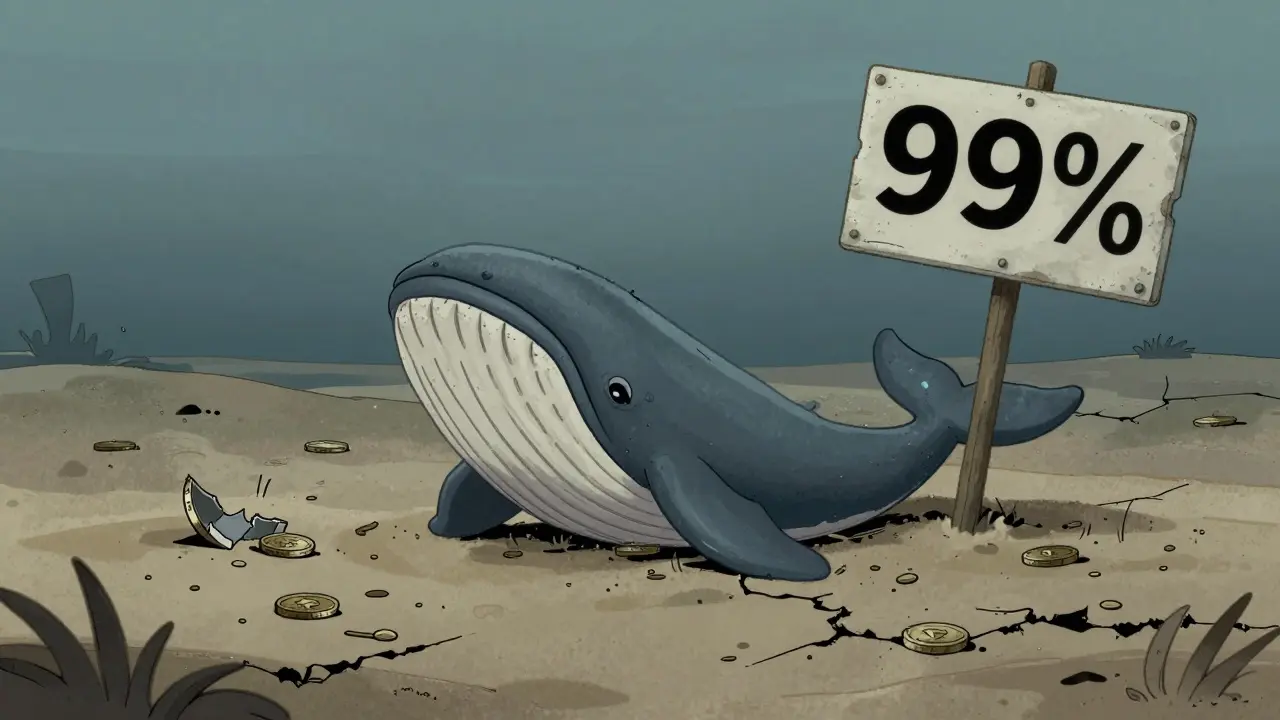
Let’s address the elephant-or rather, the whale-in the room. WALLY has dropped over 99% from its all-time high. Whether you look at the BTC-denominated highs reported by CoinGecko or the USD peaks on Coinbase, the trend is brutally downward. Technical analysis tools like the Fear & Greed Index might show "Greed" at times, but with negligible volume, these indicators are largely meaningless. They’re measuring noise, not signal.
The project lacks the hallmarks of a sustainable crypto venture:
- No Whitepaper: There is no technical documentation outlining future goals.
- No Roadmap: There are no planned updates, partnerships, or development milestones.
- No Team Transparency: The core developers remain anonymous, which is common for memecoins but risky for investors.
- No Utility: As stated, it has no tangible value beyond speculation.
This profile fits the description of an abandoned or failing project. Many memecoins launch with a burst of hype, spike in price as early buyers cash out, and then fade into obscurity. WALLY appears to be in that latter stage. The minimal trading volume-often under $10 per day on some platforms-suggests that interest has evaporated. When liquidity dries up, selling becomes difficult, and the price can collapse instantly.
Conclusion: Entertainment vs. Investment
So, what is Wally The Whale? It’s a digital joke. It’s a testament to the absurdity of the crypto market where anything can become a currency if enough people agree to play along. But playing along costs money. If you’re looking for a fun experiment with spare change you’re willing to lose entirely, WALLY offers that thrill. But if you’re seeking investment growth, portfolio diversification, or exposure to blockchain innovation, WALLY fails every metric. The extreme volatility, data inconsistencies, and lack of fundamental support make it one of the riskiest assets you can touch. Treat it like a lottery ticket, not a savings account.
Is Wally The Whale (WALLY) a good investment?
No, WALLY is not considered a good investment due to its lack of utility, extreme volatility, and 99% drop from its all-time high. It is designed as a humorous memecoin with no intrinsic value, making it highly speculative and risky.
Why do different websites show different prices for WALLY?
The price discrepancies arise from extremely low liquidity and fragmented trading volumes. With minimal daily trades, small transactions can cause significant price swings on individual exchanges, leading to inconsistent data across platforms like CoinGecko, Coinbase, and Bybit.
Can I buy WALLY on Coinbase or Binance?
You cannot buy WALLY directly on centralized exchanges like Coinbase or Binance in the traditional spot market. You must use a decentralized exchange (DEX) on the Solana blockchain, such as Raydium or Jupiter, by connecting a compatible wallet and swapping SOL for WALLY using the correct contract address.
What is the total supply of WALLY tokens?
The maximum supply of WALLY is 1 trillion tokens. However, circulating supply data is inconsistent across trackers, with some reporting nearly 1 trillion in circulation and others reporting zero, indicating unreliable data or potential centralization of holdings.
Does WALLY have any real-world utility?
No. The project explicitly states that WALLY has "no tangible value" and was created solely for entertainment purposes. It does not offer staking rewards, governance rights, or access to any services or products.
Is WALLY The Whale an abandoned project?
While not officially declared dead, WALLY shows strong signs of abandonment. It lacks a development roadmap, transparent team, or active community engagement. The near-zero trading volume and 99% price decline suggest that market interest has largely disappeared.
Listen up, you absolute degenerates. This is exactly why I say crypto is a scam designed to bleed the American working class dry while tech bros in Silicon Valley laugh all the way to the bank. You think buying a cartoon whale token makes you an investor? It makes you a mark. We need regulation that crushes this garbage before it destroys more families. Stop playing casino with your rent money and get a real job.
You are all missing the point entirely because you are too busy looking at charts instead of understanding the fundamental absurdity of assigning value to a jpeg of a marine mammal. The market doesn't care about your feelings or your national pride. It cares about liquidity and attention. And right now, WALLY has neither. So stop whining and look at the data.
I actually find the whole memecoin phenomenon fascinating from a cultural standpoint :) It’s like digital folklore evolving in real-time. People aren’t just buying tokens; they’re buying into a shared joke, a community inside joke that excludes everyone else. Whether it goes to zero or moon, it’s a sociological experiment wrapped in blockchain tech. Pretty wild when you think about it!
The epistemological crisis inherent in these valuation discrepancies is truly staggering for those who understand basic market microstructure theory. When one exchange lists a price near $0.09 and another lists it at fractions of a cent, we are witnessing the complete collapse of price discovery mechanisms due to insufficient order book depth. It is not merely 'volatility'; it is a failure of the asset class to function as a store of value, rendering any discussion of 'investment' semantically void. The arbitrage opportunities should theoretically correct this, but the transaction costs on Solana DEXs relative to the tiny trade sizes make efficient market hypothesis irrelevant here. One must recognize that without underlying cash flows or utility protocols, the token is purely a speculative vehicle subject to pure noise trading.
This article is so boring. Why do people even read this stuff?
Let's remember that every major innovation started as something others called silly. Bitcoin was once seen as a toy for nerds. While WALLY may lack utility now, the community aspect is powerful. Don't let fear dictate your curiosity. Just be mindful of your risk tolerance and stay kind to each other in the comments. Learning together is what matters most.
Oh, the tragedy of it all! A trillion tokens floating in the void, chasing a ghost of value that never existed in the first place. It is a mirror reflecting our collective desperation for meaning in a digital abyss. We build cathedrals of code only to watch them crumble under the weight of our own greed. How poetic, how utterly devastating. The whale swims alone in the dark ocean of illiquidity, singing songs no one hears anymore.
Hey everyone, let's keep things positive here! Sure, WALLY might be down, but look at the technology behind Solana. It's fast, it's cheap, and it's open source. That's something to celebrate. Instead of focusing on the losses, let's focus on the learning experience. Every dip is a chance to educate ourselves and come back stronger. You've got this!
i dont get it why is the price diffrent on every site?? its confusing af. i thought crypto was supposed to be transparent lol. maybe im just dumb but this seems sketchy.
It is interesting to consider how the lack of a whitepaper affects long-term viability. Usually, a roadmap provides clarity for investors. Without it, how do you measure progress? Is it possible that the anonymity of the team is intentional to avoid regulatory scrutiny? These are valid questions for anyone looking to understand the mechanics of such projects beyond the surface level hype.
Well,, frankly speaking... I believe that the fragmentation of data sources is a critical issue here!!! If CoinGecko says one thing and Coinbase says another... then which one do we trust??? It creates a lot of uncertainty for the average user who just wants to know their portfolio value. Perhaps centralized aggregators need to improve their verification processes??
This is pathetic. Another unregulated offshore scheme preying on naive retail investors. The SEC needs to shut these DEXs down immediately. You can't have a functioning financial system when assets are priced by bots and scammers hiding behind pseudonyms. It's an affront to the rule of law and economic stability. Wake up people, this isn't investing, it's legalized theft.
The carcass of WALLY lies bloated in the stagnant pool of low-volume trades, a grotesque monument to human folly. It is a leviathan of lies, swimming through the murky waters of decentralized exchanges, devouring the hopes of the gullible. The contract address is a siren song, luring sailors onto the rocks of slippage and despair. Do not touch the flesh of this beast; it will rot your soul and empty your wallet.