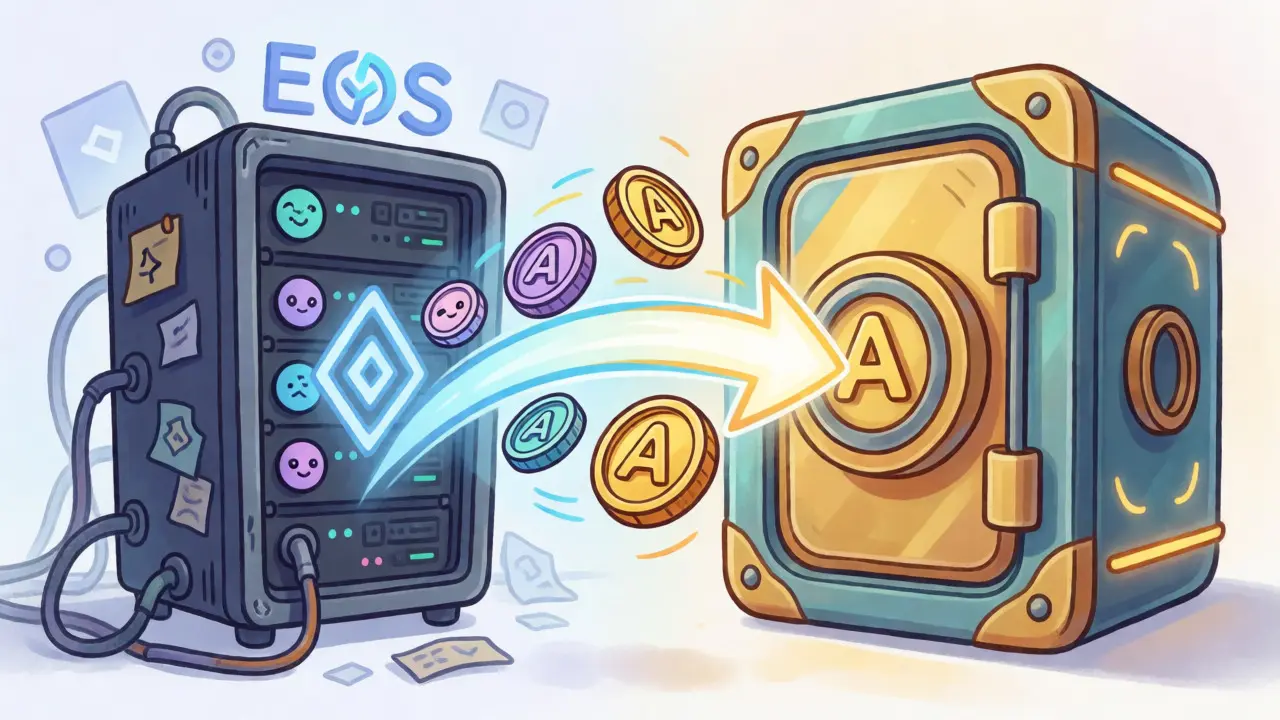
You might have noticed your EOS holdings suddenly looking different in your wallet. Or perhaps you saw a new ticker symbol "A" popping up on exchanges and wondered what the fuss was about. You are not alone. In May 2025, the well-known EOS network officially rebranded to Vaulta, introducing a new native token called A. This wasn't just a cosmetic change or a marketing gimmick; it marked a strategic pivot from a general-purpose smart contract platform to a specialized Web3 banking infrastructure.
If you are trying to figure out if this asset is worth your attention, you need to understand more than just the name change. You need to know how the technology works, why the supply is capped, and whether the shift toward decentralized finance (DeFi) banking services actually holds water. Let's break down exactly what Vaulta is, how it differs from its predecessor, and where it fits in the current crypto landscape as of late 2026.
The Big Shift: From General Purpose to Web3 Banking
For years, EOS struggled to find a unique identity in a crowded field of Layer-1 blockchains. It promised high speed and low fees but often felt like a solution looking for a problem. The rebrand to Vaulta changes the narrative entirely. Instead of trying to be everything to everyone-gaming, NFTs, social media-the team decided to focus exclusively on financial services.
Vaulta is a high-performance blockchain network designed specifically to power next-generation decentralized financial services. Think of it less as a playground for speculative tokens and more as an operating system for digital banks. The goal is to bridge Traditional Finance (TradFi) with Decentralized Finance (DeFi), allowing institutions to tokenize assets, process payments, and offer insurance products on-chain with the reliability required by regulated entities.
This specialization matters because it dictates the technical requirements. A gaming chain needs throughput for millions of small transactions. A banking chain needs certainty. That’s why Vaulta emphasizes deterministic finality-a feature we will discuss later. By narrowing their scope, the developers hope to attract serious financial players who previously avoided public blockchains due to concerns about security and settlement times.
Understanding the Token Swap: EOS to A
The most immediate concern for existing investors was what happens to their old coins. The answer is straightforward: it was a 1:1 swap. On May 14, 2025, the official migration began. If you held one EOS token, you now hold one A token.
- No Loss: The exchange rate was fixed at 1:1. Your portfolio value didn't magically drop or rise just because of the swap.
- Automatic Migration: For most users on major exchanges like Binance or Kraken, the swap happened automatically in the backend. You didn't need to do anything except log in and see the new ticker.
- Self-Custody Users: If you kept your EOS in a personal wallet, you had to use the official Vaulta portal to claim your A tokens under the new contract address "core.vaulta".
This seamless transition helped maintain community trust. Had there been a complex vesting schedule or a haircut on the supply, panic selling likely would have occurred. Instead, the project preserved the existing economic base while changing the utility and branding overhead.
Tokenomics: Deflationary Supply and Halving Cycles
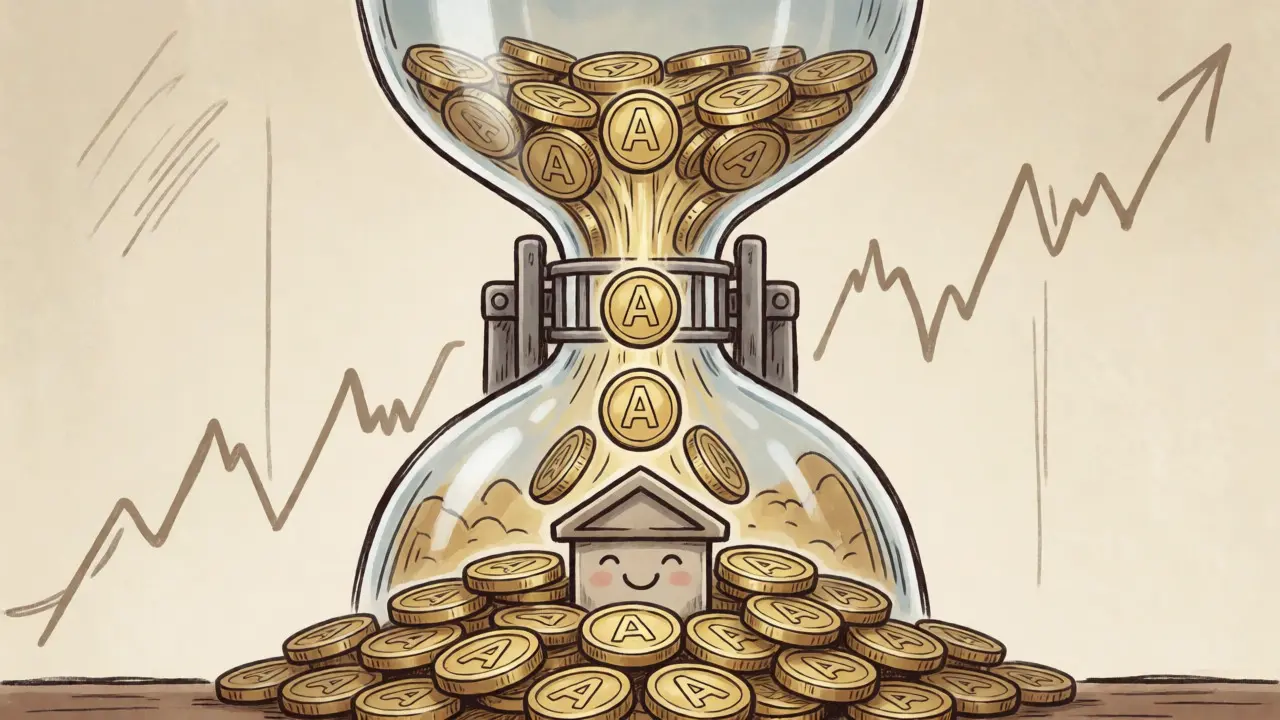
One of the strongest arguments for holding Vaulta (A) lies in its monetary policy. Unlike Ethereum, which burns fees dynamically, or many altcoins with infinite inflation, Vaulta adopts a model reminiscent of Bitcoin. The total maximum supply of A is hard-capped at 2.1 billion tokens.
Even more interesting is the issuance mechanism. Vaulta implements a four-year halving cycle. Every four years, the rate at which new tokens are issued through staking rewards gets cut in half. As of August 2026, approximately 1.66 billion A tokens are in circulation. This means roughly 79% of all tokens that will ever exist are already out in the wild.
| Metric | Value / Status | Implication |
|---|---|---|
| Max Supply | 2,100,000,000 A | Scarcity ensures long-term value potential. |
| Circulating Supply | ~1.66 Billion A (Aug 2026) | High distribution reduces sell pressure from early unlocks. |
| Issuance Model | Four-Year Halving | Deflationary pressure increases over time. |
| Consensus | DPoS + Savanna | Energy-efficient and fast settlement. |
Why does this matter to you? In crypto markets, scarcity often drives price appreciation when demand remains steady or grows. With fewer new tokens entering the market every four years, holders can expect less dilution of their stake compared to chains with aggressive inflation rates.

Technical Backbone: DPoS and One-Second Finality
Vaulta inherits its core architecture from EOS, utilizing Delegated Proof-of-Stake (DPoS). However, it has upgraded the consensus layer with the Savanna algorithm. This isn't just jargon; it solves a critical problem for financial applications: uncertainty.
In many blockchains, a transaction is considered "confirmed" after a few blocks, but there is still a tiny chance it could be reversed during a chain reorganization. For sending money between banks, this risk is unacceptable. Vaulta’s Savanna consensus provides one-second deterministic finality. Once a transaction is confirmed, it is irreversible within roughly one second. There is no waiting for six confirmations like in Bitcoin. This makes Vaulta suitable for real-time payment systems and high-frequency trading applications.
Furthermore, the DPoS model allows for high throughput without sacrificing decentralization entirely. Block producers are voted in by token holders, creating an incentive structure where validators must act honestly to keep their positions and rewards. If they go offline or produce invalid blocks, they get slashed. This economic security model keeps the network robust against attacks.
Utility: What Can You Actually Do with A?
A token isn't just a speculative asset; it is the fuel for the entire Vaulta ecosystem. Here is how you use it:
- Paying Transaction Fees: Like gas on Ethereum, you need A to send tokens or interact with smart contracts. However, fees are generally negligible due to the efficient DPoS design.
- Staking: You can lock up your A tokens to help secure the network. In return, you earn staking rewards paid out from transaction fees and newly minted tokens. This is a passive income strategy for long-term holders.
- Governance: Holding A gives you voting rights. You can vote on protocol upgrades, treasury spending, and changes to the banking modules. It turns holders into stakeholders with actual say in the project's direction.
- Access to Services: To use the integrated DeFi yields, tokenized investments, or on-chain insurance products, you typically need to hold or stake A. It acts as a membership key to the premium features of the Web3 banking stack.
The vision here is comprehensive. Imagine opening a savings account on a blockchain, earning yield from global liquidity pools, and insuring your digital assets-all settled instantly on the same chain. Vaulta aims to make that seamless experience possible.
Market Position and Adoption Challenges
As of late August 2026, Vaulta trades around $0.07 to $0.08 per token, with a market capitalization hovering near $125 million. This places it firmly in the mid-cap category. It has liquidity on major exchanges including Binance, Kraken, and Bybit, ensuring that buyers and sellers can enter and exit positions without significant slippage.
However, adoption faces hurdles. The crypto world is skeptical of rebrands. Many projects have tried to relaunch with new names to escape bad reputations, only to fail again. Vaulta’s success depends on whether traditional financial institutions actually adopt its tools. Are banks really using Vaulta for cross-border settlements? Are fintechs building lending platforms on top of it?
Early indicators show promise. The integration of TradFi bridges suggests institutional interest. But until we see billions of dollars in Total Value Locked (TVL) driven by external users rather than internal speculation, the jury is still out. Investors should watch developer activity and partnership announcements closely, not just price charts.
Frequently Asked Questions
Is Vaulta (A) the same as EOS?
Yes, Vaulta is the rebranded version of the EOS network. The underlying blockchain technology evolved from EOS, and the native token A replaced EOS at a 1:1 ratio in May 2025. While the name and branding changed to focus on Web3 banking, the core lineage remains intact.
How do I buy Vaulta (A) crypto?
You can purchase A tokens on major cryptocurrency exchanges such as Binance, Kraken, and Bybit. If you previously held EOS, you may have received A automatically via the exchange's swap process, or you could have claimed it through the official Vaulta portal if you used a self-custody wallet.
What is the maximum supply of Vaulta (A)?
The maximum supply of Vaulta (A) is fixed at 2.1 billion tokens. This cap is enforced by the protocol's code, similar to Bitcoin's 21 million limit, making it a deflationary asset over time due to the four-year halving cycles.
Why did EOS rebrand to Vaulta?
The rebrand was a strategic move to refocus the project on Web3 banking and institutional-grade financial services. By shedding the general-purpose image of EOS, Vaulta aims to differentiate itself by offering specialized tools for payments, tokenized investments, and DeFi yields with faster finality.
Can I stake Vaulta (A) tokens?
Yes, staking is a core function of the Vaulta network. Holders can delegate their A tokens to block producers to secure the network and earn staking rewards. Staking also grants governance rights, allowing participants to vote on protocol proposals.
Look, I’ve been in this game long enough to remember when EOS was the darling of the ICO boom, promising us all a Netflix on the blockchain and instead delivering a ghost town with high fees disguised as 'free' transactions because nobody actually used it. This rebrand to Vaulta feels like putting lipstick on a pig that’s already been dead for three years, but let’s be fair, the pivot to Web3 banking is at least an honest admission that they never had any business trying to compete with Solana or Ethereum for gaming or NFTs. The deterministic finality thing is cool if you’re a bank, sure, but do you really think JPMorgan is going to wake up tomorrow and decide to run their settlement layer on a chain that spent half a decade arguing about who gets to be a block producer? It’s a nice technical upgrade, Savanna is legit fast, but the market cap of $125 million tells me that most people are still waiting for the other shoe to drop, and honestly, the 1:1 swap was too easy, which usually means the community didn’t fight hard enough for better terms or there’s some hidden liquidity trap we haven’t seen yet.
Great breakdown! It’s so refreshing to see a project actually narrow its scope rather than trying to be everything to everyone.
The focus on institutional-grade financial services makes a lot of sense given the current regulatory landscape. If they can actually land those TradFi partnerships, the deterministic finality feature will be a massive selling point for cross-border payments. Fingers crossed for them!
Deterministic finality is meaningless without economic security depth. You’re confusing latency with trust minimization. A one-second window is irrelevant if the validator set remains oligarchic and captured by incumbent exchanges. Until we see genuine permissionless entry for block producers, this is just a centralized database with a crypto skin. The halving narrative is a distraction from the lack of organic demand.
oh great another rebrand to hide the fact that the tech stack is obsolete
Yeah I agree with Liam above, the pivot to banking is smart. But Matthew has a point about the validators. Its kinda hard to tell if its truly decentralized when u look at the top 21 BPs. Still, the 1:1 swap was super smooth for me on Kraken, didnt have to do anything manually which was a relief cause I hate dealing with claim portals.
You guys are missing the forest for the trees. This isn't about banking. It's about the illusion of scarcity. Bitcoin has scarcity because of energy cost. Vaulta has scarcity because of code. That's not the same thing. If banks want finality, they'll use private chains or Layer 2s on ETH. They won't touch a DPoS chain with a history of governance drama. The 'A' token is just a membership card for a club nobody wants to join.
Also, typo in the title? Or am I blind? Whatever.
I find the philosophical shift here quite interesting. We are moving from a general-purpose utility to a specialized vertical. It raises questions about whether specialization leads to obsolescence faster than generalization does in digital ecosystems. 🤔
But yes, the seamless transition is reassuring for holders.
Specialization is death. General purpose platforms survive because they adapt. By locking themselves into 'banking', they've created a glass ceiling. If fintech regulation changes, they're screwed. And don't get me started on the 'halving' copy-paste job from BTC. It’s lazy tokenomics designed to trick retail investors into holding bags that will never move. Toxic optimism is worse than realism.
Because apparently, changing the name from EOS to Vaulta fixes the fact that nobody uses the network. Groundbreaking strategy. Truly visionary.
Hey team, solid overview. For those looking to stake, keep an eye on the APY fluctuations post-halving. The deflationary pressure should theoretically support price, but only if TVL grows. Don't chase yield blindly; check the validator uptime stats first. Stay safe out there.
Yield chasing is a fool's errand. You're earning inflation while losing principal value. Simple math. Emotional attachment to tokens kills portfolios. Sell the dream, buy the reality.
I appreciate the respectful tone in this discussion. It’s helpful to hear different perspectives on the adoption challenges. From a cultural standpoint, bridging TradFi and DeFi requires a level of trust that technology alone cannot provide. It will take time and consistent reliability to win over traditional institutions.
Agreed. The UX for self-custody users claiming the tokens could have been clearer though. Had to dig through docs to find the contract address. Otherwise, good update.
It strikes me that the essence of money is trust, not just speed. While one-second finality is technically impressive, does it translate to perceived safety for a grandmother sending money to her grandson? The abstraction layers in DeFi often obscure this human element. Perhaps the branding needs to focus less on 'Web3 Banking' and more on 'Reliable Digital Cash'. Just a thought from someone observing the societal integration of these tools.
Oh please, spare me the anthropological musings. 'Reliable Digital Cash'? How quaint. The elite know that true power lies in infrastructure control, not grandma's remittances. Vaulta is positioning itself for the whales and the institutions, not the plebeians. If you don't understand the difference between a settlement layer and a payment rail, you're playing checkers while they play chess. It's pretentious to assume the mass market cares about your 'trust' narratives when they just want low fees and instant access. Get real.
Sure, let's pretend the 'elite' aren't also buying memecoins at 3 AM. Chess vs Checkers is a cute metaphor until you realize the board is rigged by whoever controls the exchange listings. Sarcastic, but accurate.
This is such an exciting development for the ecosystem! I love seeing projects mature and find their niche. It reminds me of how Visa evolved from paper checks to digital networks-it wasn't overnight, but the infrastructure became indispensable. If Vaulta can deliver on those insurance products and tokenized investments, it could really change how we interact with finance. Plus, the community seems engaged, which is always a good sign! Let's keep supporting the builders and watching those partnership announcements closely. The future of finance is being written right now, and it’s happening on-chain! 🚀💸
Stop hyping it up until you see the volume. Talk is cheap. Show me the TVL growth month-over-month before I care about your 'future of finance' narrative. Execute or die.