
Imagine you have a pizza cut into eight slices. If you throw two slices into the trash, the remaining six slices are now more valuable because there is less pizza to go around for the same number of hungry people. That is the basic logic behind token burning in cryptocurrency. It is not just a buzzword used by marketing teams; it is a fundamental economic mechanism that changes how digital assets behave. By permanently removing tokens from circulation, projects attempt to create scarcity. But does throwing away digital money actually make the rest worth more? The answer depends on how the process works, who controls it, and whether anyone is actually buying the remaining supply.
The Core Concept: Permanent Removal of Supply
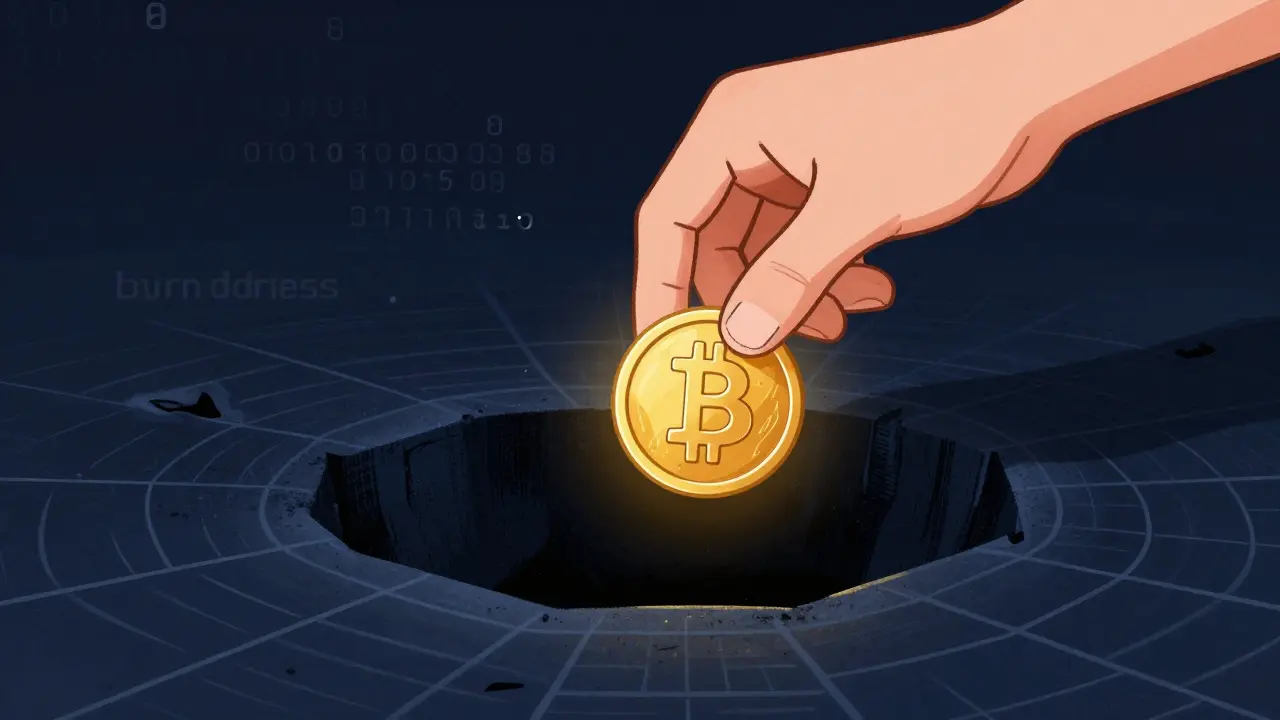
Token burning is the process of sending cryptocurrencies to a wallet address where they can never be accessed again. In traditional finance, destroying physical cash or stock certificates is rare and heavily regulated. In the crypto world, it happens every day, often automatically. When tokens are burned, they are sent to what is known as a burn address. This is a public blockchain address that has no private key associated with it. Think of it like mailing a letter to a house that doesn't exist, or throwing coins into a deep ocean trench. Once they arrive at this address, the math of the blockchain proves they are there, but no human or computer can ever retrieve them.
The goal is simple economics: supply and demand. If the supply of a token drops while the demand stays the same or increases, the price should theoretically rise. This creates a deflationary pressure. Unlike Bitcoin, which has a fixed maximum supply of 21 million coins, many other tokens have inflationary models where new tokens are constantly created to reward validators or developers. Burning acts as a counterweight to this inflation. It keeps the total circulating supply in check, preventing the value of each individual token from being diluted over time.
How the Technical Process Works
You might wonder if "burning" involves some complex cryptographic shredding. It doesn't. Technically, burning is just a standard transaction. You send your tokens to a specific hexadecimal string-the burn address. On Ethereum-based networks, this address often looks like 0x000000000000000000000000000000000000dEaD (with zeros replaced by 'dead' in hex). Because no one holds the private key to sign a transaction out of this address, the tokens are stuck there forever. The blockchain ledger records the transaction, showing exactly when and how many tokens were destroyed. This transparency is crucial. Anyone can verify the burn happened by looking at the block explorer.
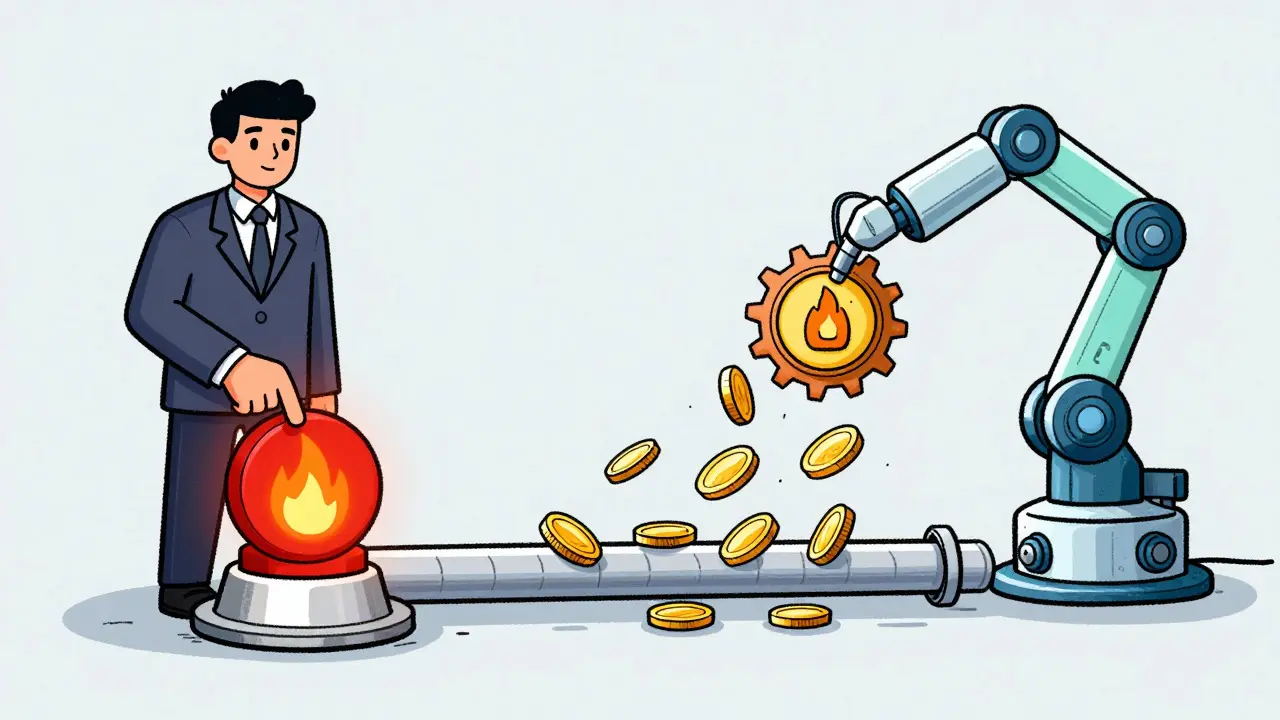
There are two main ways this happens: manual burns and automatic burns. Manual burns are executed by the project team. They decide how many tokens to burn, usually based on a formula tied to the project's revenue or market performance. For example, Binance, one of the largest crypto exchanges, performs quarterly burns of its native token, BNB. Since 2017, Binance has removed over 48.5 million BNB from circulation. These burns are strategic events that generate significant community attention. Automatic burns, on the other hand, are coded directly into the smart contract. They happen without human intervention. A classic example is Ethereum's EIP-1559 upgrade. Every time you pay a transaction fee on Ethereum, a portion of that fee is burned automatically. This means the more activity there is on the network, the more ETH is destroyed. It turns network usage into a deflationary force.
| Feature | Manual Burns | Automatic Burns |
|---|---|---|
| Control | Project Team / Developers | Smart Contract Code |
| Predictability | Variable (depends on decisions) | High (triggered by conditions) |
| Trust Required | High (must trust team) | Low (code is law) |
| Example | BNB Quarterly Burn | Ethereum Base Fee Burn |
| Flexibility | Can adjust timing/amount | Fixed rules only |
Why Projects Use Token Burning
Projects don't burn tokens just for fun. There are specific economic goals driving these mechanisms. First, it combats inflation. Many blockchain projects issue new tokens to pay for network security (staking rewards) or development grants. Without a burn mechanism, the supply would grow indefinitely, causing the price to drop continuously. Burning stabilizes this growth. Second, it aligns incentives. If a platform burns tokens using its revenue (like fees from trading), then the success of the platform directly reduces the supply. This encourages the team to build a useful product because higher usage leads to more burns, which potentially raises the token price. Third, it signals confidence. When a company burns its own shares or tokens, it suggests they believe the asset is undervalued or that they want to return value to holders rather than hoarding capital.
However, not all burns are created equal. A burn of 0.01% of the total supply is statistically insignificant. It won't move the needle on price. Research from MIT indicates that burns need to represent a meaningful percentage of the circulating supply-often above 2%-to have a noticeable impact on market dynamics. Small, frequent burns can still build long-term deflationary trends, but large, one-off burns are often seen as more impactful by traders.
Real-World Examples and Market Impact
Let's look at how this plays out in practice. Shiba Inu (SHIB) provides a dramatic case study. In May 2021, the community collectively burned 410 trillion SHIB tokens, which was about 4% of the total supply at the time. This event generated massive hype and contributed to a 230% price increase over the following month. While correlation doesn't always mean causation, the psychological impact of such a large reduction in supply cannot be ignored. Investors saw scarcity increasing, which drove buying pressure.
On the institutional side, Ethereum's shift to a deflationary model via EIP-1559 changed the entire narrative around the asset. Before this update, ETH was purely inflationary. Afterward, during periods of high network congestion, the amount of ETH burned exceeded the amount newly issued. This phenomenon, sometimes called "ultra-deflation," attracted investors who viewed ETH not just as tech infrastructure, but as a store of value similar to gold. As of late 2023, over 4.2 million ETH had been burned, representing billions of dollars in value. This demonstrates how a technical change in fee structure can fundamentally alter an asset's economic profile.
Conversely, skepticism exists. Critics argue that burning is a marketing gimmick. If no one is buying the tokens, reducing the supply doesn't matter. It's like cutting a pizza into fewer slices but having no customers. The collapse of TerraUSD (UST) in 2022 highlighted this risk. UST relied on algorithmic burning and minting to maintain its $1 peg. When confidence evaporated, the burning mechanism failed to stop the depeg because there was no underlying demand to support the reduced supply. This shows that burns are a tool for managing supply, not a magic bullet for creating value.
Risks and Limitations of Deflationary Models
While token burning sounds attractive, it comes with risks. One major issue is centralization. In manual burn models, the project team decides when and how much to burn. If the team burns tokens only when the price is high to boost their own holdings, or delays burns to manipulate market sentiment, it breaks trust. Transparency is key. Projects must publish transaction hashes so anyone can verify the burn occurred. Another risk is the "death spiral." If a protocol relies too heavily on burning to maintain value, it may neglect building actual utility. Users might buy the token only for speculation on the next burn, not because they use the service. When the speculation ends, the price crashes regardless of the low supply.
Regulatory uncertainty also looms. The U.S. Securities and Exchange Commission (SEC) has hinted that certain token structures could be considered securities. If a burn mechanism is structured primarily to manipulate price rather than serve a functional purpose, regulators might view it skeptically. However, as of 2026, most legitimate burn mechanisms are accepted as part of standard tokenomics, provided they are transparent and not deceptive.
Future Trends: Dynamic and Conditional Burns
The technology is evolving beyond simple static burns. Newer blockchains are experimenting with dynamic burn rates. For instance, Kadena introduced mechanisms where the burn rate adjusts based on market conditions. If the price drops too low, the burn rate might increase to support it, or vice versa. VeChainThor implemented "conditional burns" that only trigger when specific volume thresholds are met. This adds a layer of sophistication, making the tokenomics more responsive to real-world usage rather than arbitrary schedules.
We are also seeing integration with real-world assets. Paxos Gold (PAXG) burns tokens when physical gold is redeemed. This creates a direct link between the digital token and the physical commodity. It ensures that the digital supply never exceeds the physical reserve, maintaining a strict 1:1 parity. This hybrid approach combines the efficiency of blockchain with the stability of tangible assets, offering a robust model for future financial instruments.
Conclusion: Is Token Burning Right for You?
Token burning is a powerful tool in the crypto ecosystem, but it is not a guarantee of profit. It works best when combined with genuine utility and strong network effects. As an investor, you should look beyond the headline numbers of "tokens burned." Ask yourself: Is the burn sustainable? Is it transparent? Does the project have real users who need the token? If the answer is yes, the deflationary pressure from burning can enhance value over time. If the answer is no, it might just be a distraction. Always do your own research, verify the burn transactions on-chain, and understand the broader economic model before making decisions.
What happens to tokens after they are burned?
Tokens are sent to a "burn address," which is a public wallet with no private key. This makes them permanently inaccessible and effectively removes them from circulation. They remain visible on the blockchain ledger as proof of destruction, but no one can ever spend or retrieve them.
Does token burning always increase the price?
Not necessarily. While burning reduces supply, which can theoretically increase price, it only works if demand remains constant or grows. If no one wants to buy the token, reducing the supply will not raise the price. Additionally, small burns relative to the total supply often have negligible market impact.
What is the difference between manual and automatic burning?
Manual burning is controlled by the project team, who decide when and how many tokens to burn. Automatic burning is coded into the smart contract and triggers based on predefined conditions, such as transaction volume or time intervals, without human intervention. Automatic burns are generally considered more transparent and trustworthy.
Can burned tokens be recovered?
In almost all cases, no. Because burn addresses lack private keys, it is mathematically impossible to sign a transaction to move tokens out of them. The only exception would be a catastrophic bug in the blockchain itself or a change in consensus rules by network validators, both of which are extremely rare.
Which cryptocurrencies use token burning?
Many major cryptocurrencies use burning mechanisms. Notable examples include Ethereum (via EIP-1559 base fee burns), Binance Coin (BNB) through quarterly burns, Shiba Inu (SHIB) via community and developer burns, and Solana (SOL) which burns a portion of transaction fees. Over 70% of top cryptocurrencies incorporate some form of supply reduction strategy.