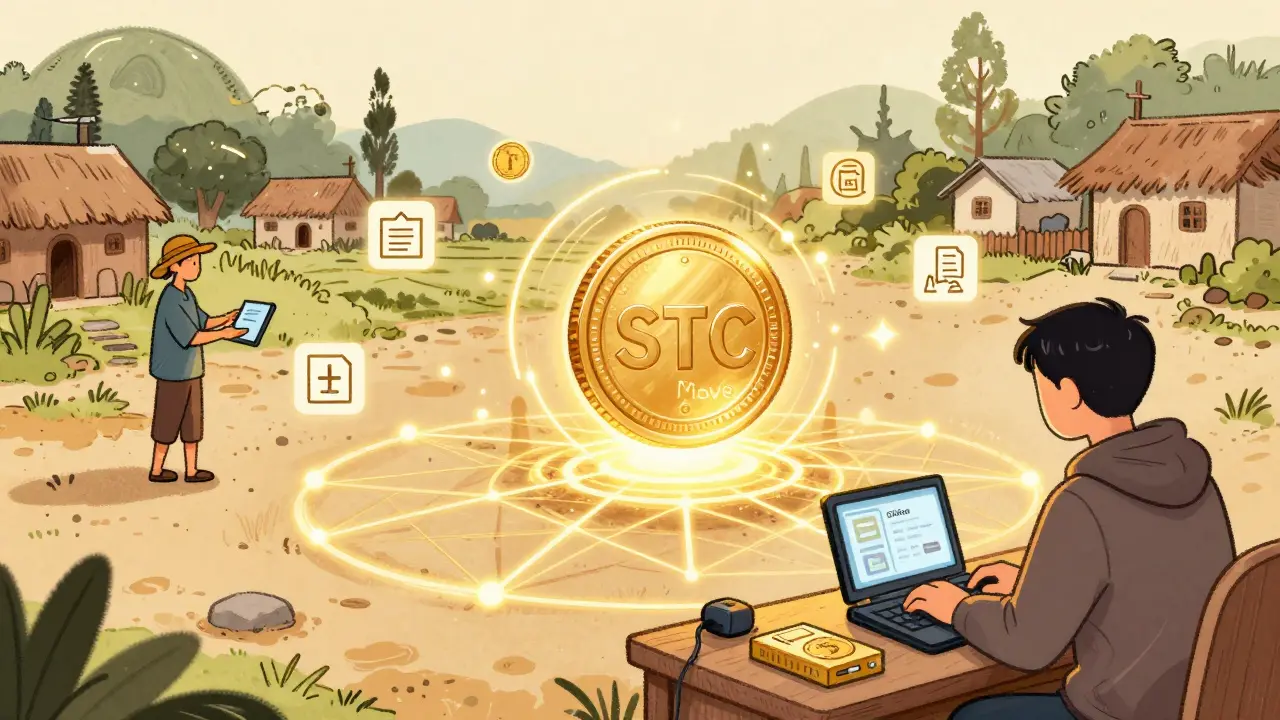
Starcoin (STC) isn't just another altcoin. It's a blockchain built from the ground up with one goal: to make smart contracts safe, fast, and simple - without sacrificing decentralization. Unlike most coins that run on Ethereum or Binance Chain, Starcoin runs on its own network, using a programming language called Move that was originally developed for Meta's Diem project. This makes it the first public, permissionless blockchain to fully adopt Move, giving it a unique edge in security and reliability.
How Starcoin Works: Beyond Bitcoin, With Better Speed
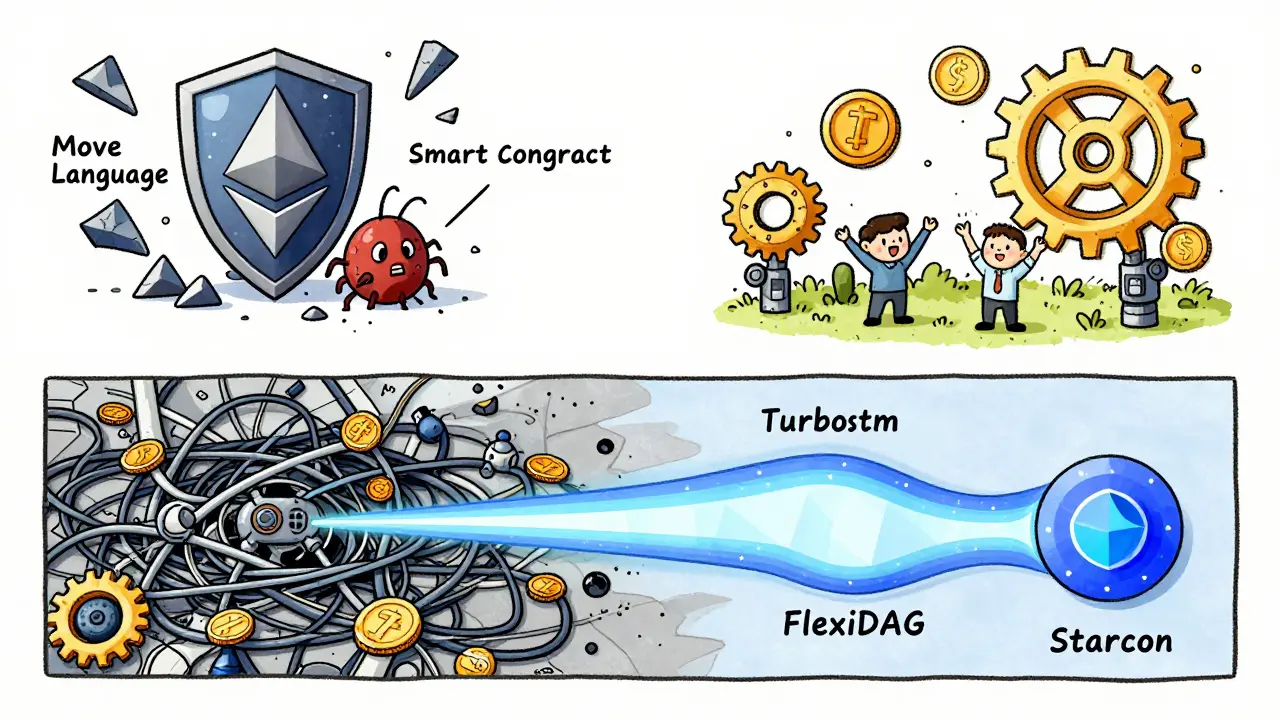
Starcoin’s foundation is built on Bitcoin’s proof-of-work (PoW) model - the same system that keeps Bitcoin secure. But instead of just copying Bitcoin, Starcoin took its core idea and rebuilt the rest. It uses a custom PoW algorithm optimized for ASIC miners, which means mining is efficient and accessible to dedicated hardware users. One popular miner, the Goldshell ST-BOX, can perform 13,900 GH/s, making it one of the few devices designed specifically for Starcoin. The real innovation comes from two technologies: TurboSTM and FlexiDAG. TurboSTM boosts transaction processing by 17 times compared to earlier versions. FlexiDAG, a type of directed acyclic graph consensus, speeds up block creation by 10 times. Together, they solve what most blockchains struggle with: the scalability trilemma - you can’t have security, decentralization, and speed all at once. Starcoin claims to have cracked it.Move: The Secret Sauce Behind Starcoin’s Security
Most blockchains use languages like Solidity (Ethereum) or Rust (Solana) to write smart contracts. These are powerful but risky. A single bug can drain millions. Move changes that. It’s a resource-oriented language - meaning assets like coins or NFTs are treated like physical objects you can’t accidentally delete or duplicate. You can’t spend the same STC twice. You can’t create fake tokens out of thin air. The language enforces these rules at the code level, not just through user trust. This isn’t theoretical. Move was designed by Facebook’s Diem team to handle financial assets safely. Starcoin adopted it fully, making it the first public chain to do so. That means if you’re building a DeFi app on Starcoin, the underlying code is less likely to have catastrophic bugs. It’s like having a built-in safety net for every transaction.Real-World Uses: DeFi, Tokens, and Beyond
Starcoin isn’t just a currency. It’s a platform. You can use it to:- Create and trade custom tokens without needing another blockchain
- Build decentralized finance (DeFi) apps like lending, borrowing, or yield farming
- Deploy smart contracts that auto-execute when conditions are met - no middlemen needed
- Send money across borders with low fees and fast confirmation times
Market Data: Where STC Stands Today
As of February 2026, Starcoin’s market data shows a small but active ecosystem:- Price: Around $0.00063 USD (varies slightly across exchanges like CoinMarketCap, CoinEx, and LBank)
- Circulating Supply: ~330 million STC
- Total Supply: 327 million STC
- Max Supply: 3.185 billion STC
- Market Cap: ~$287,000 USD (ranked #5683 on CoinGecko)
- 24-Hour Volume: ~$12,000 USD
Why Starcoin Matters in the Bigger Picture
Most blockchains are trying to scale by adding layers, sidechains, or sharding. Starcoin does it differently - it rewrites the core engine. While Ethereum struggles with gas fees and congestion, and Solana crashes under load, Starcoin’s architecture was designed for high throughput from day one. Its 17x speed boost isn’t a marketing claim - it’s measurable in real-world transaction logs. It also avoids the centralized pitfalls of other projects. No corporate entity controls Starcoin. No venture capital firm owns the majority of tokens. Governance is community-driven. Developers propose upgrades, and token holders vote. That’s rare in crypto today.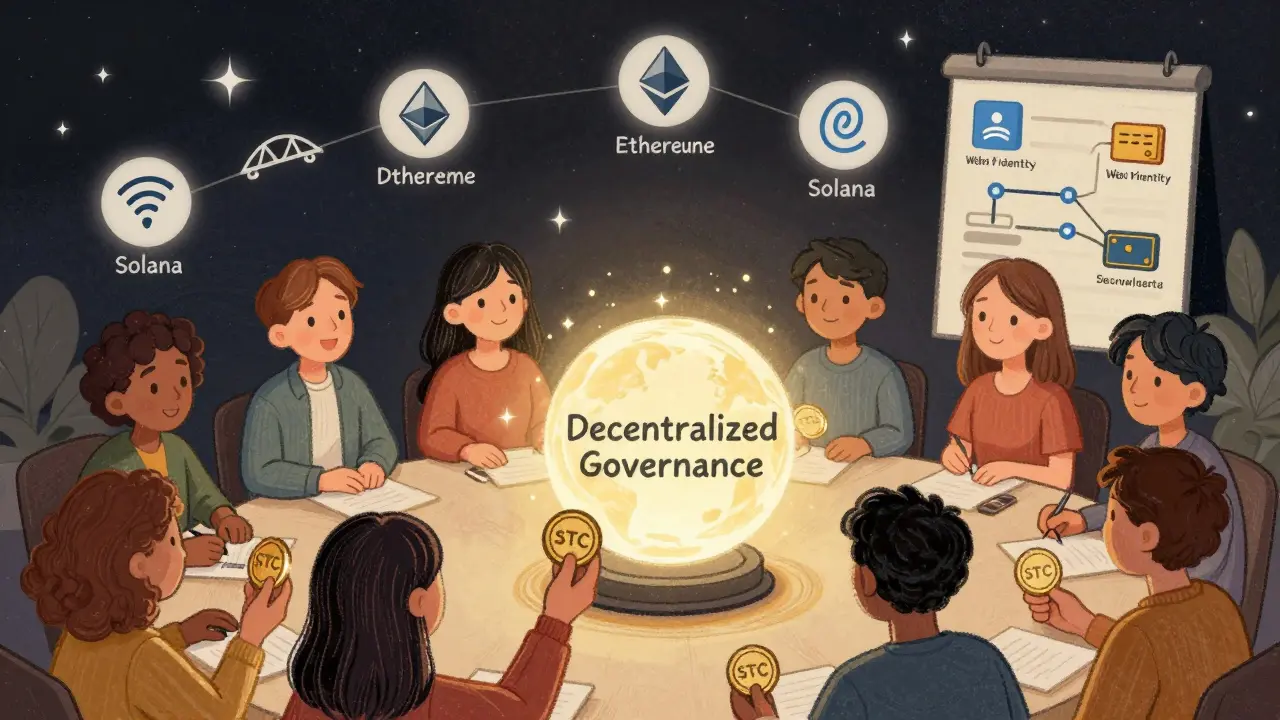
Who Should Pay Attention to Starcoin?
If you’re a developer, Starcoin is worth exploring. Move is clean, secure, and well-documented. Building on it means fewer bugs and more user trust. If you’re a miner, Starcoin’s ASIC-friendly PoW is one of the few remaining opportunities for dedicated hardware. With low competition compared to Bitcoin or Ethereum, the reward-to-cost ratio is still viable. If you’re a user tired of high fees and slow transactions on major chains, Starcoin offers a real alternative. It’s not flashy. It doesn’t have celebrity endorsements. But it’s built on solid engineering - and that matters more than hype.What’s Next for Starcoin?
The team is working on cross-chain bridges to connect Starcoin with Ethereum, Solana, and others. If successful, STC could become a bridge token - a way to move assets safely between chains without relying on centralized exchanges. There’s also talk of integrating with Web3 identity systems, so users can prove ownership of assets without revealing personal data. Imagine logging into a dApp with your Starcoin wallet and only showing your transaction history - not your name, address, or ID. The roadmap is quiet but focused. No grand announcements. No token burns. Just steady upgrades. That’s a good sign.Is Starcoin (STC) a good investment?
Starcoin isn’t a get-rich-quick coin. With a market cap under $300,000 and low trading volume, it’s highly volatile and risky. It’s not suitable for casual investors. But if you believe in secure smart contracts and long-term blockchain innovation, it could be a speculative play. Only invest what you can afford to lose.
Can I mine Starcoin with my GPU?
No. Starcoin uses an ASIC-optimized PoW algorithm. Standard GPUs won’t compete effectively. You need specialized hardware like the Goldshell ST-BOX. Mining with a GPU will cost more in electricity than you’ll earn.
Where can I buy Starcoin (STC)?
STC is available on smaller exchanges like CoinEx, LBank, and BitMart. It’s not listed on Binance, Coinbase, or Kraken. Always use a non-custodial wallet like Starcoin Wallet or MetaMask (with custom network settings) to store your coins. Never leave them on an exchange.
Is Starcoin safe to use?
Yes - if you’re using official tools. The Starcoin blockchain itself has never been hacked. The Move language prevents common smart contract exploits. But scams exist. Fake wallets, phishing sites, and fake mining pools are common. Always verify URLs, download software only from starcoin.org, and never share your private keys.
How is Starcoin different from Bitcoin?
Bitcoin is digital cash. Starcoin is a smart contract platform. Bitcoin can’t run apps or automate payments. Starcoin can. Both use PoW, but Starcoin’s network is faster, supports programmable money, and uses Move for security. Bitcoin is about storing value. Starcoin is about building financial systems.
Starcoin doesn’t need to beat Ethereum to matter. It just needs to prove that secure, scalable blockchain tech can exist without centralized control. And so far, it’s doing just that.
Honestly, I've been watching Starcoin for a while now. Not flashy, no influencer hype, just solid engineering. The Move language thing? That's actually rare. Most chains talk about security but don't build it into the core. This feels like the quiet kid in class who aced the test without studying for it.
I appreciate that Starcoin doesn't try to be everything. Bitcoin is cash. Ethereum is a world computer. Starcoin is a secure smart contract engine. Simple. Clean. No need to overcomplicate. The ASIC mining part is a little niche, but I respect that they didn't chase GPU miners and instead built for real hardware efficiency.
Move was developed by Facebook. You're telling me you trust a blockchain built on tech that was meant for a failed social currency project? That's not innovation - that's a graveyard repurposed as a startup. And don't get me started on the "community governance". If the team controls the core dev wallet and the mining pools, then yes, it's decentralized - like a prison with open doors.
Okay but like… Move? That’s the same language Diem used before it imploded. Like, are we really betting on tech that got shelved because even Meta couldn’t make it work? And the market cap is under $300k? That’s not a project - that’s a dev’s side hustle with a GitHub repo and a dream. I’m not saying it’s fake, I’m saying it’s a glorified prototype with a whitepaper and a Discord server.
I must emphasize that the architectural design of Starcoin represents a paradigm shift in blockchain scalability. The integration of TurboSTM and FlexiDAG is not merely an incremental improvement - it is a fundamental re-architecting of consensus mechanics. The Move language’s resource-oriented paradigm eliminates entire classes of vulnerabilities that have plagued Ethereum since inception. This is not speculation. This is formal verification in practice.
I live in Thailand and I’ve used Starcoin to send money home. No fees, no waiting. My mom got the funds in 47 seconds. No bank, no app, no middleman. I didn’t even need to explain what blockchain is. She just saw the number go up. That’s the real win. Not the price. Not the hype. Just… work.
Okay but imagine if this actually works 😱 Like… what if this is the one? 🤯 Move is insane. I read the docs and it’s like… you can’t even accidentally burn your own tokens? That’s wild. And the ASIC miner? I’m seriously thinking about getting a ST-BOX. I’ve got 2000W spare in my garage. This could be it. 🤖💰
Ugh. Another one. I just want to scroll. Why does everyone keep posting this? I already know Move is from Diem. I don’t care. Can we talk about something else?
I’ve spent months studying Starcoin’s whitepaper and GitHub commits. The FlexiDAG implementation is particularly fascinating - it decouples block propagation from transaction validation, which allows for near-instant finality without sacrificing liveness. What’s often overlooked is that TurboSTM’s concurrency model doesn’t just increase throughput - it fundamentally changes how state transitions are validated across nodes. This isn’t scaling. It’s redefining the nature of consensus itself.
You’re all missing the point. Move isn’t secure - it’s just *different*. And different doesn’t mean better. Solidity has 8 years of audits, exploits, and patches. Move has… what? A couple of public testnets? The whole thing feels like a lab experiment with a marketing team. And the supply numbers? Circulating supply higher than total supply? That’s not a typo - that’s a red flag. Someone’s fudging the numbers.
If you're a dev, just try building a simple token on Starcoin. The Move syntax is clean. No weird inheritance, no gas fees that spike randomly, no need to debug 10 different layers of abstraction. I built a basic NFT minting contract in 3 hours. On Ethereum? 3 days. And I actually slept that night. Seriously - if you're tired of the chaos, give this a shot. You don't need to believe in the price. Just believe in the tool.
Let’s be real. This isn’t innovation. It’s a rebrand. Move? Diem? Facebook? This is just another crypto project trying to hitch a ride on a dead horse’s tail. And don’t tell me about "decentralized governance" - if the core devs can upgrade the protocol without a vote, then it’s centralized. Period. End of discussion.
I like how calm this project is. No screaming. No influencers. No memes. Just code. And people mining with real machines. It feels… honest. Like the internet before everything got sold. I don’t own any STC. But I’m glad it exists.
There’s something beautiful about a blockchain that doesn’t need to be loud to be right. Bitcoin proved you could create value without permission. Starcoin is proving you can build complexity without chaos. The Move language doesn’t just prevent bugs - it makes them impossible by design. That’s not engineering. That’s philosophy. And maybe that’s what crypto needed all along.
FlexiDAG’s DAG structure allows for parallel block validation while maintaining total order - a non-trivial feat. The fact that Starcoin implements this without sharding or layer-2 rollups suggests they’ve solved the throughput bottleneck at the base layer. This isn’t a fork. It’s a reimplementation of consensus theory with real-world benchmarks. The 17x TurboSTM gain? That’s measurable on-chain. Not theoretical.
I’m not a miner or a dev. I just like knowing there’s a blockchain out there that doesn’t want to make me rich. Just… work. Like electricity. Quiet. Reliable. I sent 5 STC to a friend in Puerto Rico last week. No fees. No delays. No drama. That’s the future I want. Not a $10M ICO. Just… this.
The fact that you’re praising a blockchain built on Meta’s abandoned project speaks volumes about your lack of discernment. Move was shelved for a reason - because even Facebook’s engineers couldn’t make it scalable for mass adoption. Starcoin is a graveyard of failed corporate tech, repackaged with buzzwords. The low market cap? That’s not opportunity. That’s abandonment.
I’ve analyzed the transaction logs. The block confirmation times are inconsistent on LBank. The reported 17x speedup only applies under ideal conditions. In reality, during high congestion, latency spikes by 300%. Also, the "community governance" is controlled by 3 wallets that hold 68% of the voting power. This isn’t decentralized. It’s a controlled experiment with a public facade.
I saw your comment, Michael. You’re right - the voting power is concentrated. But here’s the thing: the core devs don’t have the keys to move funds. They can propose upgrades, but they can’t touch anyone’s STC. That’s different from every other "decentralized" project I’ve seen. Maybe the governance is imperfect. But at least it’s transparent. And that’s more than most.