Have you ever stumbled upon a cryptocurrency with a name that sounds familiar but feels strangely empty? You might be looking at SLEX Token, a digital asset tied to the Slex centralized exchange platform. It promises access to AI trading bots and commodity markets, but does it deliver on those claims? Before you consider buying or holding this coin, we need to look past the marketing buzzwords and examine the hard data. The reality of SLEX is quite different from major exchange tokens like BNB or KCS.
The Basics: What Exactly is SLEX?
SLEX is a utility token that operates on the Binance Smart Chain (BSC) as a BEP-20 token. Its primary purpose is to function within the ecosystem of the Slex exchange. Think of it as a key that unlocks specific features on their platform, such as paying for transaction fees or accessing premium membership tiers. Unlike Bitcoin, which aims to be digital gold, or Ethereum, which powers decentralized applications, SLEX has a very narrow job: keep the lights on for one specific, relatively obscure exchange.
The token has a fixed maximum supply of 400 million coins. There are no complex burn mechanisms or dynamic supply adjustments mentioned in their documentation. This means the total number of SLEX tokens will never exceed this cap, but it also means there is no built-in deflationary pressure to reduce supply over time, unlike some other exchange tokens that buy back and burn their native coins.
Where Does SLEX Fit in the Market?
To understand the value of SLEX, you have to look at where it trades. Currently, the most popular-and practically only-place to buy and trade SLEX is the Slex exchange itself. You won’t find it listed on major platforms like Coinbase, Kraken, or even Binance’s main spot market. This lack of external listing is a significant red flag for liquidity.
| Feature | SLEX Token | BNB (Binance) | KCS (KuCoin) |
|---|---|---|---|
| Blockchain | Binance Smart Chain (BEP-20) | Binance Smart Chain / Ethereum | Ethereum / KuCoin Community Chain |
| Primary Utility | Fee payment on Slex exchange | Fees, gas, payments, launchpad | Fee discounts, staking, dividends |
| Market Presence | Niche (Slex only) | Global (100+ exchanges) | Global (50+ exchanges) |
| Liquidity | Extremely Low | Very High | High |
| AI/Commodity Focus | Claimed core feature | Not primary focus | Not primary focus |
As you can see, SLEX sits in a very different league compared to established players. While BNB and KCS have diversified utilities across multiple chains and services, SLEX is confined to its home turf. If the Slex exchange shuts down or loses popularity, the token likely loses almost all its value because it has no use elsewhere.
The Liquidity Problem: Can You Actually Trade It?
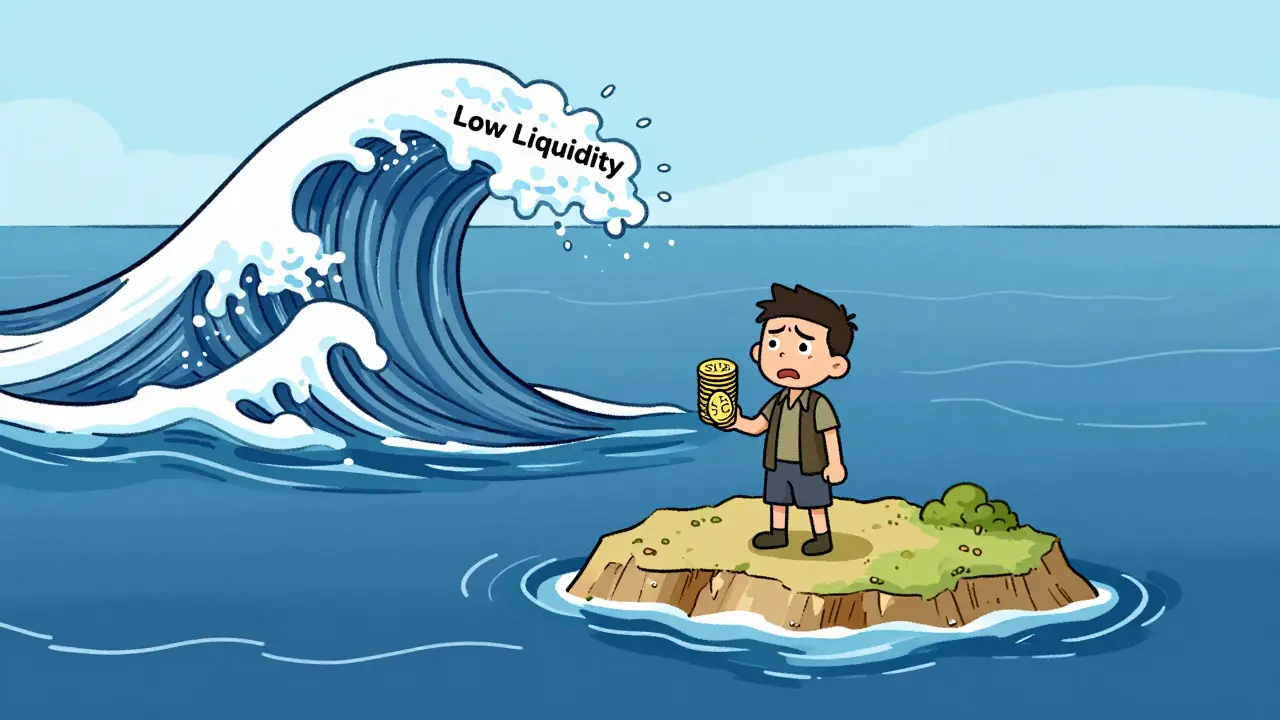
This is where things get tricky. Liquidity refers to how easily you can buy or sell an asset without affecting its price. For SLEX, the numbers are concerning. Data from tracking sites like CoinGecko and Holder.io shows daily trading volumes that range from less than $1 to around $14. Let that sink in. In a market where Bitcoin moves billions of dollars every day, SLEX struggles to move even a hundred bucks in a full 24-hour period.
Why does this matter to you? Imagine you want to sell 1,000 SLEX tokens. If the entire market only trades $14 worth of volume per day, your sale would crash the price instantly. You wouldn’t just lose money; you might not be able to exit your position at all without accepting a massive loss due to slippage. Users have reported trying to convert SLEX back to USDT on their own exchange and facing significant hurdles because there simply aren’t enough buyers on the other side.
Promised Features vs. Reality
The Slex platform markets itself as a "Next Generation" exchange offering AI trading bots and commodity trading. They claim users can connect API trading bots to earn in any market condition. On paper, this sounds innovative. However, these features are not unique to SLEX. Established giants like Bybit and Binance already offer advanced algorithmic trading tools, copy trading, and commodity derivatives.
The "Premium Membership" program allows users to pay fees in SLEX and potentially earn revenue shares through referrals. While referral programs are common in crypto, the promise of earning "up to half of SLEX Fees" is difficult to verify given the tiny fee base generated by the low trading volume. If there is no trading activity, there are no fees to share. It’s a classic chicken-and-egg problem: the token needs volume to generate value, but traders avoid it because there is no volume.
Risks and Red Flags
When evaluating a small-cap token like SLEX, you must prioritize risk assessment. Here are the critical issues to consider:
- Extreme Volatility: Historical data shows price swings from fractions of a cent to over $6. Such erratic movement often indicates manipulation rather than organic market demand.
- Data Discrepancies: Different tracking sites report vastly different market caps and prices. One source might list a $6 million market cap while another shows a fully diluted valuation under $2 million. This inconsistency makes it impossible to trust the official metrics.
- Lack of Transparency: The platform does not clearly disclose its jurisdiction or regulatory compliance status. The mention of "no KYC required for the first order" may appeal to privacy advocates but raises serious questions about adherence to global anti-money laundering (AML) laws.
- Single Point of Failure: Since SLEX is only traded on the Slex exchange, you are entirely dependent on their infrastructure. If their servers go down, or if they freeze withdrawals, you have nowhere else to go.
Who Is SLEX For?
Honestly, SLEX is not for the average investor looking for stability or growth. It might theoretically suit someone who is exclusively committed to using the Slex exchange for its specific AI bot features and is willing to accept the high risk of illiquidity. Even then, the benefits are questionable when similar tools exist on more robust platforms.
If you are a developer interested in integrating API trading bots, you might explore their documentation. However, be aware that the community support is minimal, with inactive social media channels and sparse forum discussions. You would largely be on your own if you encounter technical issues.
Final Thoughts on SLEX Token
In the crowded world of cryptocurrency, standing out requires more than just a website and a token contract. It requires liquidity, transparency, and real-world utility. SLEX currently lacks all three. While it operates on the reliable Binance Smart Chain, the token itself remains isolated in a niche ecosystem with negligible trading activity.
For most users, the risks outweigh the potential rewards. The inability to easily exit positions, combined with extreme price volatility and a lack of third-party listings, makes SLEX a highly speculative asset. If you are curious about exchange tokens, starting with well-established options like BNB, FET, or even smaller but liquid alternatives provides a safer entry point into the space. Always remember: if a token cannot be traded anywhere except its own exchange, tread carefully.
Is SLEX Token a scam?
There is no definitive proof that SLEX is a outright scam, but it exhibits many characteristics of high-risk projects. These include extremely low liquidity, data discrepancies across tracking sites, and a lack of presence on reputable third-party exchanges. The extreme volatility and difficulty in exiting positions suggest that investors could lose their capital quickly, which is a hallmark of risky or potentially manipulative schemes.
Where can I buy SLEX Token?
Currently, SLEX is primarily available on the Slex centralized exchange itself. You generally cannot buy it on major platforms like Binance, Coinbase, or Kraken. To acquire SLEX, you would need to create an account on the Slex platform, deposit funds (likely USDT or BNB), and swap them for SLEX. Be cautious of the low liquidity when attempting to purchase large amounts.
What is the total supply of SLEX?
The maximum total supply of SLEX tokens is fixed at 400,000,000 (400 million). This figure is consistent across major data aggregators like CoinGecko and Holder.io. There are no known burn mechanisms that reduce this supply over time.
Does SLEX have any real-world utility?
SLEX’s utility is limited to the Slex exchange ecosystem. It can be used to pay for trading fees, access premium membership features, and potentially participate in referral rewards. It does not have broader utility outside of this specific platform, unlike tokens such as BNB which are accepted for payments, gas fees, and investments across various ecosystems.
Why is the trading volume of SLEX so low?
The low trading volume reflects the token's niche status and lack of interest from the broader crypto community. With no listings on major exchanges and limited awareness, few traders are actively buying or selling SLEX. This results in daily volumes often being less than $20, making it difficult to execute trades without significant price impact.
Is it safe to hold SLEX long-term?
Holding SLEX long-term carries substantial risk. The token's value is heavily dependent on the success and continued operation of the Slex exchange. Given the extreme volatility, lack of liquidity, and absence of regulatory clarity, there is no guarantee that the token will retain value. Additionally, if the exchange fails, holders may find themselves unable to sell their tokens at any price.
The whole crypto space is just a giant ponzi scheme designed to steal your life savings, but this one is particularly egregious because it's tied to an unregulated exchange that probably doesn't even exist in the physical world.
They claim AI trading bots? Please. It's just a script scraping data from Binance and adding a 5% fee on top of it while they slowly rug pull the liquidity pool. I've seen this pattern before with those 'commodity' tokens that vanish overnight. The lack of KYC isn't a feature; it's a liability waiver for when they disappear with your USDT.
It is fascinating how we assign value to digital artifacts based purely on narrative rather than intrinsic utility or tangible backing.
This token seems to be a perfect case study in the fragility of trust-based economies where the 'trust' is placed in an opaque entity with no external verification. When you strip away the marketing jargon about AI and commodities, what remains is a closed loop system that benefits only the creators. It raises profound questions about whether any asset that cannot be traded outside its native ecosystem can ever truly be considered 'currency' or if it is merely a coupon for a service that may cease to exist tomorrow.
Typical weak-minded retail investors falling for another scam coin because someone told them it has 'AI'.
If you can't trade it on a major exchange, it's worthless garbage. Stop buying these pump-and-dump schemes created by offshore scammers who don't care about your money. Real traders stick to BTC and ETH because they have actual liquidity and market depth. This SLEX thing is a joke.
Oh, look at this little digital hamster wheel spinning in the void.
It's almost poetic how they promise you the moon with their 'AI bots' while quietly siphoning the oxygen out of the room. The liquidity is so thin you could see through it like cheap glass. They're selling you a ticket to a theater that burned down years ago, but hey, at least the seats are made of blockchain! Don't forget to tip your server with your tears when the slippage hits 90%. It's a beautiful tragedy, really.
Listen up, folks! This is exactly why you need to stay vigilant and not let these foreign exchanges dictate your financial freedom.
SLEX is a trap for the unwary. If it's not listed on the big American-friendly platforms, it's suspect. We need transparency and regulation, not these shadowy operations hiding behind 'no KYC' policies. Protect your capital and stick to assets that respect our laws and markets. Don't be a sucker for hype!
You people are all so naive thinking there is any real value here.
I've been watching this token bleed out for months and everyone keeps pretending it's going to recover. It's dead weight. The chart looks like a heart monitor flatlining. Save yourself the headache and move on to something that doesn't require a leap of faith just to sell five dollars worth of it.
One must consider the structural deficiencies inherent in such a narrowly scoped utility token.
The absence of multi-chain interoperability and third-party listings renders SLEX economically obsolete in the current decentralized finance paradigm. It is essentially a walled garden with no exit doors. The reliance on a single centralized exchange for liquidity creation is a fundamental design flaw that exposes holders to catastrophic counterparty risk. It is hardly surprising that sophisticated actors avoid this asset class entirely.
Boring article.
Nothing new here. Just another low-cap shitcoin review. I'm done reading about these failed projects. Move along.
It is important to approach these opportunities with caution and mindfulness.
We should always prioritize our financial security and seek out well-established platforms that offer transparency. There is no shame in avoiding high-risk assets. Let us focus on building sustainable wealth through proven methods rather than chasing elusive promises.
Hey everyone! 👋 Just wanted to add that while the risks are real, understanding why these tokens fail is part of the learning curve in crypto. 🚀
Always DYOR (Do Your Own Research) and never invest more than you can afford to lose. The key is education and staying informed. Keep grinding and stay safe out there! 💪✨
I must say, the lack of regulatory oversight is quite concerning indeed. 😬
Have you considered reaching out to the exchange directly to ask about their compliance measures? It might be enlightening to hear their side of the story, though I doubt they will provide satisfactory answers given the opacity surrounding their operations. One should always verify the legitimacy of such platforms before engaging further. 🧐
Wake up people! This is a clear warning sign.
If you hold this trash, you're already losing. Cut your losses now before you lose everything. The market doesn't care about your feelings or your hopes. It's brutal and unforgiving. Get out while you still can and put your money into something that actually works. Stop being passive and take control of your finances!
Well, it seems like we are all in agreement that this particular token is not the best investment option... which is interesting, really.
I suppose it is good to have a community that looks out for each other, even if it means pointing out the obvious flaws in these projects. Perhaps we can learn from this and apply those lessons to future endeavors, ensuring that we do not repeat the same mistakes again and again. After all, growth comes from understanding our errors, does it not?