You’ve probably seen the endless parade of "Inu" coins. They promise moonshots, rely on cute dog imagery, and vanish just as quickly as they appear. Shinjiru Inu V2 (SHINJI) is one such project. It launched in 2022 on the BNB Smart Chain using the BEP-20 standard, positioning itself not just as a meme coin, but as a deflationary asset with NFT utility. But does it have any real value, or is it another ghost town in the crypto graveyard?
If you are holding SHINJI or thinking about buying some, you need to look past the marketing hype. The numbers tell a stark story of extreme volatility, microscopic liquidity, and high risk. This guide breaks down what SHINJI actually is, how its mechanics work, and why most investors should approach it with extreme caution.
The Core Identity: More Than Just a Meme?
At its heart, Shinjiru Inu V2 is a cryptocurrency token deployed on the BNB Smart Chain (BSC). Unlike Bitcoin or Ethereum, which run their own blockchains, SHINJI relies on Binance’s infrastructure. This means transactions are fast and cheap, typically costing less than $0.50 in gas fees. However, this convenience comes with trade-offs. BSC is known for hosting thousands of low-quality tokens, making it harder to spot legitimate projects.
The project markets itself as "deflationary." In simple terms, this means the supply of tokens is supposed to shrink over time, theoretically increasing the value of remaining tokens. SHINJI claims to achieve this through burning mechanisms and fee structures tied to its ecosystem features, particularly Non-Fungible Tokens (NFTs). While the concept sounds appealing, the execution depends entirely on user activity-and right now, that activity is nearly non-existent.
From V1 to V2: Why the Migration Matters
One red flag for any crypto investor is a contract migration. SHINJI started as Version 1 (V1) but migrated to Shinjiru Inu V2 in 2022. When a project migrates contracts, users usually have to swap their old tokens for new ones. This process often resets price history, changes tokenomics, and can sometimes be used to hide previous failures or reset developer control.
The V2 launch happened sometime in late 2022. By December 3, 2022, the token hit an all-time low (ATL), and by January 27, 2023, it reached its all-time high (ATH). This rapid rise and fall within two months is classic pump-and-dump behavior. Since then, the price has never recovered. Understanding this history is crucial because it shows that the initial excitement was short-lived and driven by speculation rather than sustainable growth.
Tokenomics and Supply: The Math Doesn't Add Up
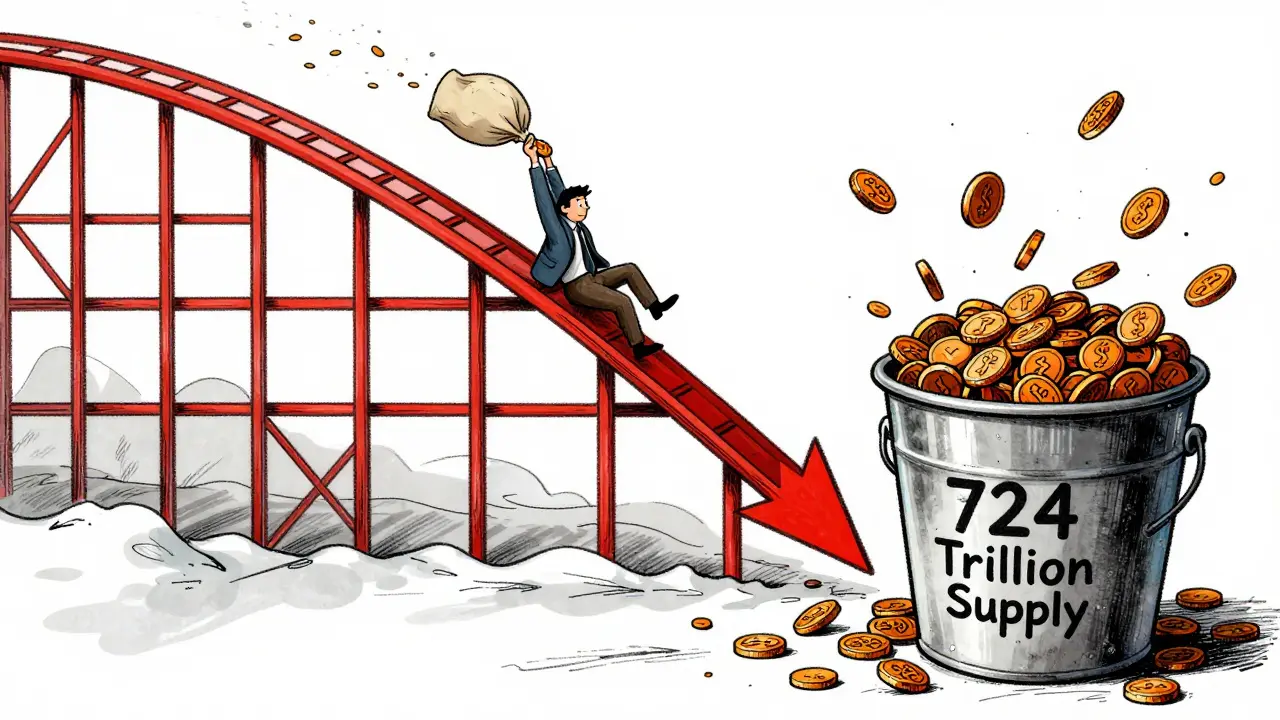
Let’s look at the hard numbers, because they reveal the true scale of this project. SHINJI has a maximum supply of approximately 724.62 trillion tokens. That is a staggering number. To put it in perspective, Bitcoin has a max supply of 21 million. Even inflationary tokens like Tether (USDT) don’t reach trillions in count.
| Metric | Value | Context |
|---|---|---|
| Max Supply | ~724.62 Trillion | Extremely high dilution |
| Circulating Supply | 0 / Unverified | Data discrepancy across trackers |
| All-Time High (ATH) | $0.0000000018 | Jan 27, 2023 |
| Current Price | ~$0.000000000024 | June 2026 estimate |
| Fully Diluted Valuation (FDV) | $17,000 - $29,500 | Micro-cap status |
| 24h Volume | <$100 | Negligible liquidity |
The circulating supply is reported as zero or unverified by major platforms like Coinbase and Yahoo Finance. CoinMarketCap lists it as "1P," which is likely a placeholder or error. This lack of clarity makes it impossible to calculate a true market capitalization. Instead, we look at the Fully Diluted Valuation (FDV), which assumes all tokens are in circulation. At roughly $20,000 total value, SHINJI is a micro-cap asset. For context, you could buy the entire theoretical supply of SHINJI for less than the cost of a used car.
Liquidity Crisis: Can You Actually Sell?
This is the most critical part for any potential buyer. Liquidity refers to how easily you can convert your crypto into cash without crashing the price. SHINJI trades primarily on PancakeSwap v2, a decentralized exchange on BNB Smart Chain.
Recent data shows daily trading volumes under $100. Sometimes, it’s literally zero. What does this mean for you? If you try to sell $500 worth of SHINJI, you might not find a buyer. Or worse, your sale could wipe out the available liquidity pool, causing the price to drop 50% or more instantly. This is called slippage. In illiquid markets, slippage eats your profits-or turns your gains into losses.
Furthermore, SHINJI is not listed on major centralized exchanges like Binance, Coinbase Pro, or Kraken. You cannot simply log in and sell. You must use a Web3 wallet like MetaMask or Trust Wallet, connect to PancakeSwap, and hope there’s enough BNB in the pool to cover your exit. This friction keeps retail investors away and traps those who are already inside.
The NFT and Staking Angle
To justify its existence beyond memes, SHINJI introduced an NFT ecosystem. According to project documentation, users can buy Shinjiru NFTs using SHINJI tokens. Here’s the catch: every purchase incurs a 10% fee. Of that fee, 8% goes to a staking pool, and 2% is allocated elsewhere (likely burned or for operations).
On paper, this creates a cycle: buying NFTs fuels staking rewards, which incentivizes holding. In reality, if no one is buying NFTs, the staking pool gets no funds. Without new money entering the system, staking yields become irrelevant. It’s a circular economy that requires constant inflow of new participants to survive-a hallmark of unsustainable models.
Risk Assessment: Who Is This For?
Let’s be blunt. SHINJI is not an investment; it is a speculative gamble. The anonymous team, lack of audits, and negligible volume make it unsuitable for anyone seeking wealth preservation or steady growth.
- High Risk: The price is down over 98% from its all-time high. Recovering to even half that level would require massive, sustained buying pressure that currently doesn’t exist.
- No Transparency: There are no public founders, no legal entity, and no formal governance structure. If the developers decide to abandon the project, there is no recourse for holders.
- Scam Potential: With so many fake tokens on BSC, ensuring you hold the correct V2 contract address is vital. One wrong click, and your funds are gone forever.
However, if you understand these risks and still want exposure, treat it like buying a lottery ticket. Only spend what you are willing to lose completely. Do not leverage it, do not borrow money to buy it, and do not expect it to replace your savings.
How to Buy SHINJI (If You Insist)
If you’ve read the warnings and still want to proceed, here is the technical path. Remember, this involves interacting directly with smart contracts.
- Set Up a Wallet: Download MetaMask or Trust Wallet. Ensure you are connected to the BNB Smart Chain network, not Ethereum or Bitcoin.
- Get BNB: Buy BNB (Binance Coin) on a reputable exchange like Binance or Coinbase. Withdraw it to your MetaMask wallet address on the BSC network.
- Go to PancakeSwap: Navigate to pancakeswap.finance. Connect your wallet.
- Find the Token: Paste the official SHINJI V2 contract address. Never trust links from social media comments. Verify the address on CoinMarketCap or CoinGecko.
- Swap: Select BNB in the top box and SHINJI in the bottom. Adjust your slippage tolerance-likely to 5% or higher due to low liquidity.
- Confirm: Review the transaction details carefully. Once confirmed, you will hold SHINJI in your wallet.
Final Verdict
Shinjiru Inu V2 is a relic of the 2022 meme coin boom. It survives on-chain, but it lacks the community, liquidity, and innovation needed to thrive. Its deflationary mechanics are theoretical without active usage, and its NFT integration adds complexity without proven demand. For the vast majority of crypto enthusiasts, there are better opportunities with transparent teams, audited code, and deep liquidity. If you choose to engage with SHINJI, do so with eyes wide open and a strict limit on capital allocation.
Is Shinjiru Inu V2 (SHINJI) a scam?
While there is no definitive proof of a malicious scam, SHINJI exhibits many high-risk traits common in fraudulent projects: an anonymous team, unverified circulating supply, and extremely low liquidity. The lack of transparency means you have no guarantee of support or security updates.
What blockchain does SHINJI use?
SHINJI operates on the BNB Smart Chain (BSC) as a BEP-20 token. This means you need a wallet compatible with BSC, such as MetaMask or Trust Wallet, and you will need BNB to pay for transaction gas fees.
Why is the price of SHINJI so low?
The price is low due to massive oversupply (over 700 trillion tokens) and negligible demand. Additionally, the token has dropped over 98% from its all-time high in early 2023, reflecting a loss of investor interest and liquidity.
Can I buy SHINJI on Binance?
No, SHINJI is not listed on Binance or other major centralized exchanges. You must buy it via decentralized exchanges like PancakeSwap by swapping BNB for SHINJI directly from your wallet.
What is the purpose of the Shinjiru NFTs?
The NFTs are designed to drive demand for SHINJI tokens. Purchasing an NFT requires SHINJI and incurs a 10% fee, 8% of which goes to a staking pool. This aims to create a deflationary loop, though current adoption is minimal.
Who created Shinjiru Inu V2?
The creators of SHINJI are anonymous. No individual founders or corporate entities are publicly disclosed, which is typical for many small-cap meme tokens but increases risk for investors.
Look, I don't care about the cute dog pictures or whatever NFT garbage they are selling. The fact that this token migrated from V1 to V2 is a massive red flag for any serious investor. It’s basically a reset button for the devs to hide their tracks. You think you’re buying into a community, but you’re just providing exit liquidity for the people who coded the contract. Stop letting these offshore scams bleed your savings dry.
i saw this coin on twitter last year and it looked kinda sus lol. like why do we need another inu coin? there are already so many. i didnt buy any cause i knew it was gonna crash. glad i waited out
The sheer audacity of deploying a BEP-20 token with such abysmal tokenomics is indicative of a profound lack of understanding regarding market microstructure. The circulating supply discrepancy alone suggests either negligent auditing or outright malfeasance. One must question the intellectual capacity of the developers who believe a deflationary mechanism can overcome zero organic utility. It is not merely a bad investment; it is an insult to the concept of decentralized finance.
Ah, the beautiful decay of SHINJI. It sits there like a rotting carcass in the digital wilderness, picking at its own wounds while hoping someone will mistake its silence for mystery. The migration to V2 wasn’t a upgrade, it was a funeral procession for the original holders’ dignity. We watch as the price bleeds out, drop by microscopic drop, a slow-motion tragedy written in code. There is a certain poetic justice in holding a bag that weighs nothing yet crushes your soul. The NFTs are just tombstones for dreams that never had a pulse.
It is truly tragic how these projects rise and fall in mere months. The human desire for quick riches blinds us to the obvious signs of failure. We see the pump, we ignore the dump, and then we wonder why we are left holding empty bags. This cycle repeats endlessly across the blockchain landscape. Perhaps if we paused to reflect on the value of patience, we might avoid these pitfalls. But no, the siren song of the moonshot is too loud. We dive in headfirst, only to drown in liquidity pools that are barely puddles. It is a lesson written in fire, yet we continue to walk through it.
You all sound so naive thinking this has any chance. Everyone here is just waiting for the other shoe to drop because it already did. The author thinks he is helping by writing this guide but really he is just feeding the hype machine one more time. Nobody cares about the tokenomics when the volume is zero. It is dead. Move on.
I have been watching the crypto space for years; and honestly; most of these meme coins are just noise. The migration aspect is interesting though; because it shows how fluid these contracts can be. However; without real adoption; it is just numbers on a screen. I prefer to stick to established assets; but I understand the allure of high risk. Just be careful; folks.
This is exactly why I say crypto is a scam for the weak-minded. Real investors put their money in stocks, bonds, and tangible assets. Not some dog coin with trillions of tokens that means absolutely nothing. You people are throwing your hard-earned cash into a black hole. Wake up! Support real businesses, not these internet jokes. It is embarrassing to see grown adults chasing these ghost projects.
Boring post. Another dead coin. Who even reads this stuff?
It is important to remember that every loss is a learning opportunity. We should support each other in making better financial decisions. Take a breath and look at the big picture. Community matters more than any single token. Let us stay positive and keep educating ourselves.
Hey everyone! :) I actually checked the contract address on BscScan. It is wild to see how little activity there is. The dev wallets seem empty too. Maybe they moved on to the next project. Always good to DYOR! 🐕💸
We must consider the psychological impact of these volatile assets. Why do we seek validation in price charts? The migration from V1 to V2 represents a break in continuity, much like our own personal journeys. It forces us to ask what value we are truly seeking. Is it profit, or is it belonging? The answer may lie not in the token, but in our own expectations. We project our hopes onto these digital artifacts. Perhaps the real lesson is in recognizing our own vulnerability to hype. Understanding this dynamic can lead to greater financial wisdom.
Great breakdown of the risks involved here. It is crucial to understand the difference between speculation and investment. While SHINJI may have had its moment, the current metrics suggest it is not a viable long-term hold. Always diversify your portfolio and never invest more than you can afford to lose. Stay safe out there and keep learning!