You’ve probably seen the ticker NAC flash across a screen or heard whispers about "Nirvana Chain" in crypto forums. It’s not Bitcoin, and it’s certainly not Ethereum. So, what exactly is it? Simply put, Nirvana Chain is a Web3.0 public blockchain platform designed to make building decentralized applications (dApps) easier and more flexible than traditional blockchains.
The native asset of this network is the NAC token, which serves as the fuel for transactions, governance, and security within the ecosystem. But here’s the catch: while the technology sounds ambitious, the market reality is quite different from its early hype. Understanding NAC requires looking past the buzzwords to see how the chain actually works, why the token exists, and whether it has any real utility left after significant price drops.
The Core Problem: Why Another Blockchain?
By mid-2026, the blockchain space is crowded. We have Ethereum for smart contracts, Solana for speed, and Polygon for scaling. So, why did developers create Nirvana Chain? The answer lies in flexibility. Most major blockchains force developers to use one specific consensus mechanism-either Proof of Work (PoW), Proof of Stake (PoS), or something else. If your app needs high speed but low energy consumption, you’re stuck with whatever the main chain offers.
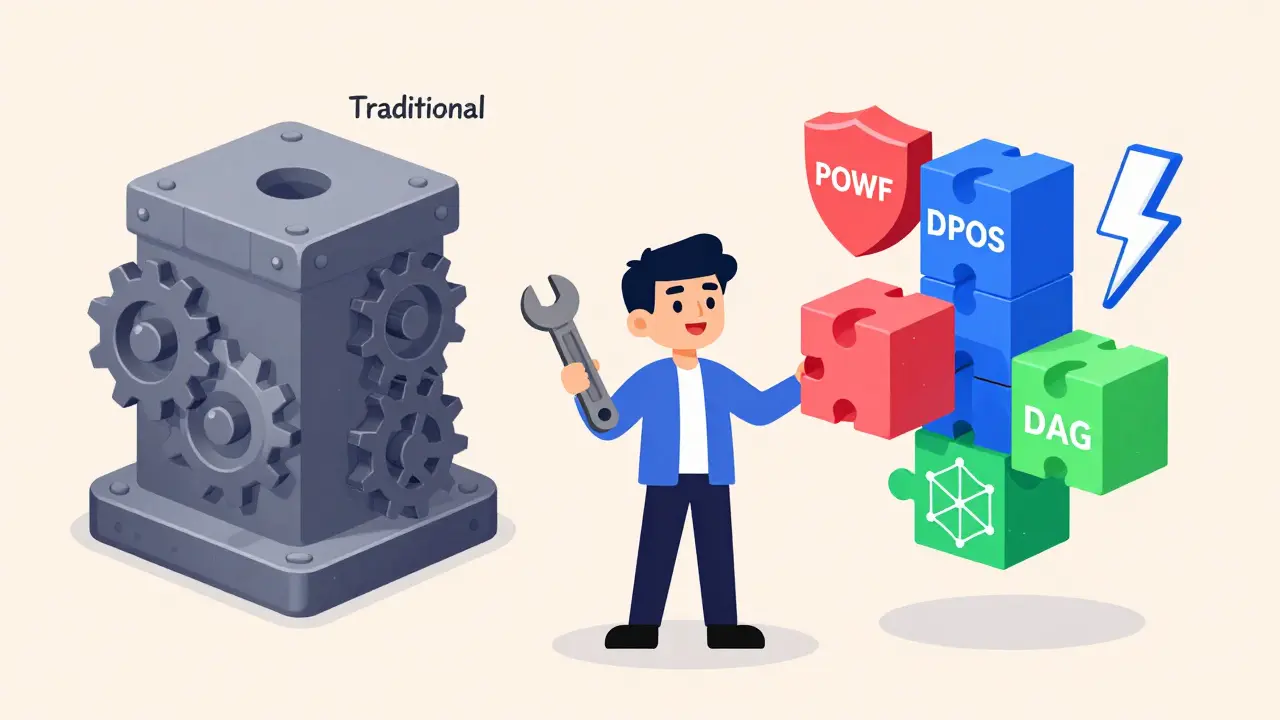
Nirvana Chain attempts to solve this by introducing a heterogeneous composite chain model. This means the platform doesn’t pick just one way to agree on data. Instead, it allows different parts of the network-or even individual applications-to choose the consensus method that fits their needs best. Think of it like a car manufacturer letting you choose between an electric engine, a gas engine, or a hybrid depending on whether you want speed, range, or efficiency. For developers, this promises less compromise when building complex dApps.
How the Technology Works: A Hybrid Approach
To understand the tech behind NAC, we need to break down its three-layer architecture. It’s not a monolithic structure; it’s built to handle different tasks simultaneously.
- The Main Chain (POWF): The backbone of the network uses a mechanism called Proof of Work Fraction (POWF). This provides the base layer of security, similar to how Bitcoin secures its ledger, but optimized for this specific ecosystem.
- The Logic Chain (DPOS): When you build an application instance on Nirvana, the logic part can run on Delegated Proof of Stake (DPOS). This allows for faster transaction validation and lower costs for user interactions.
- The Data Chain (DAG): For storing and ordering data, the system utilizes Directed Acyclic Graph (DAG) technology. DAGs are known for handling high volumes of transactions without the bottlenecks typical of linear blockchains.
This combination aims to give developers the security of PoW, the speed of DPOS, and the scalability of DAG all in one place. Additionally, the platform features a lightweight Turing-complete virtual machine (NVM) that supports microservice architecture. In plain English, this means developers don’t need to rewrite their entire backend code to move to the blockchain. They can plug existing services into the chain more easily, lowering the barrier to entry for traditional software engineers.
NAC Token Utility: What Can You Actually Do With It?
A cryptocurrency is only as valuable as its use cases. If you hold NAC, you aren’t just holding a speculative asset; you’re holding a key to the Nirvana Chain ecosystem. Here are the primary functions of the token:
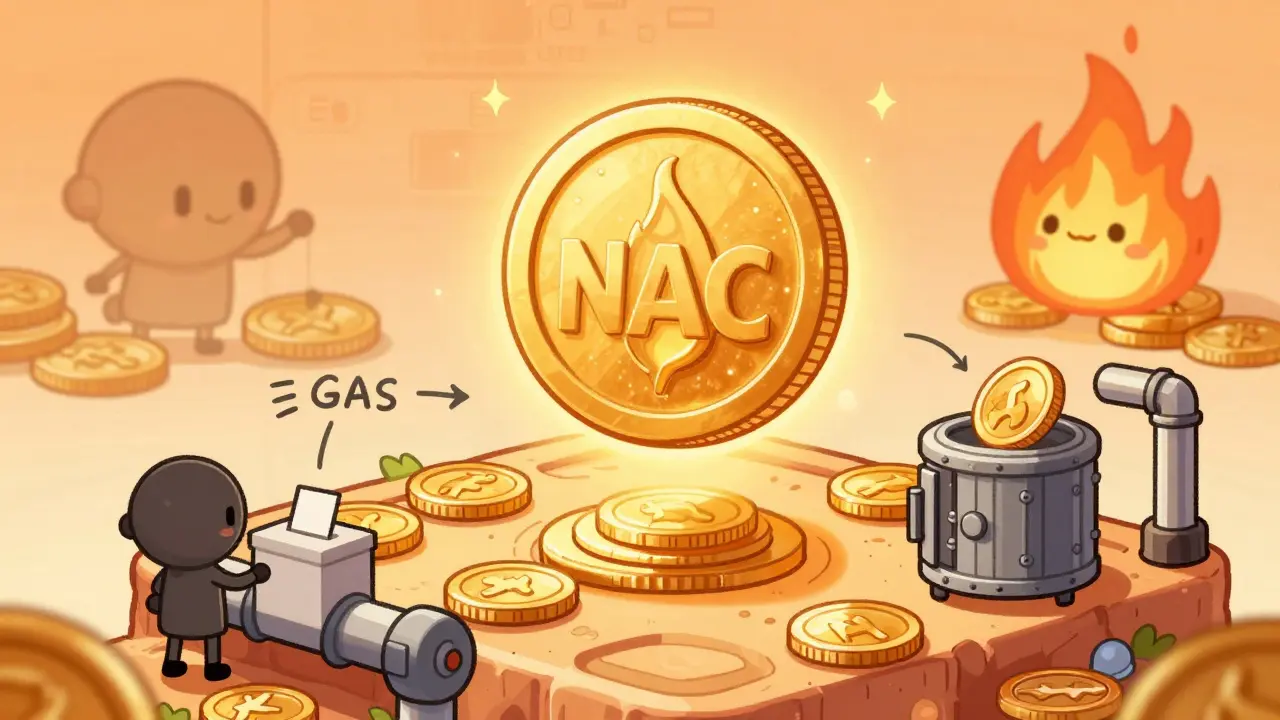
- Transaction Fees (GAS): Every action on the network, from sending tokens to executing a smart contract, requires GAS. This fee is paid in NAC, ensuring the network has economic incentives to process transactions.
- Governance: NAC holders get a voice. You can vote on proposals regarding fund usage, protocol upgrades, and other critical network decisions. Your voting power is generally proportional to your holdings.
- Staking and Security: Validators who secure the network stake NAC tokens. In return, they earn rewards. This aligns the interests of validators with the health of the network-if they act maliciously, they risk losing their staked assets.
- Full Node Vouchers: To operate a full node, participants may need to exchange NAC for vouchers. This creates demand for the token among serious infrastructure providers.
However, the most distinctive feature of NAC is its extreme deflationary model. The project employs a multi-tiered destruction mechanism designed to permanently remove tokens from circulation. This includes daily, quarterly, and annual burns. For example, 100% of NAC used to exchange full node vouchers is destroyed. Another 10% of domain name rental fees and 10% of AppStore release fees are burned. Even transaction fees see a 10% burn rate. The goal is simple: reduce supply over time to potentially increase scarcity and value, assuming demand remains constant or grows.
Market Reality: Price, Supply, and Volatility
Let’s talk numbers, because the technical promise of Nirvana Chain contrasts sharply with its current market performance. As of July 2026, NAC is trading significantly below its historical highs, reflecting the harsh realities of the crypto market cycle.
| Metric | Data Point |
|---|---|
| Current Price Range | $0.06 - $0.10 USD |
| All-Time High (ATH) | $7.26 USD |
| Distance from ATH | ~98.5% decline |
| Max Supply | 75,000,000 NAC |
| Circulating Supply | Approx. 16.5 million NAC |
| 24h Volume | $18 - $22,850 (varies by source) |
| Active Markets | Limited (approx. 4 exchanges) |
The discrepancy in volume reports-from as low as $18 to nearly $23,000 in a single day-highlights a major issue: liquidity. With trading spread across very few active markets, buying or selling large amounts of NAC can cause significant price swings. This makes it risky for institutional investors or anyone looking to enter or exit positions quickly.
The drop from $7.26 to under $0.10 is staggering. While many altcoins suffered during bear markets, a 98% loss suggests either a severe lack of adoption, failed partnerships, or simply being caught in a prolonged downturn without enough community support to recover. For potential buyers, this looks like a "deep discount," but for skeptics, it looks like a warning sign. Always remember: past performance does not guarantee future results, especially in niche crypto projects.
Security Features: Anti-Quantum and Beyond
One area where Nirvana Chain tries to stand out is future-proofing. The platform claims to incorporate anti-quantum computing measures. Quantum computers, once fully realized, could theoretically break the encryption standards (like SHA-256 or ECDSA) that protect most cryptocurrencies today.
While quantum threats are still years away from becoming practical risks for blockchains, Nirvana Chain’s inclusion of these measures shows forward-thinking design. Combined with distributed storage solutions that prevent single points of failure, the network aims to be resilient against both current cyber threats and future technological shifts. However, until quantum computing becomes a tangible threat, this feature is more of a theoretical safety net than an immediate selling point for average users.

Is NAC Worth Your Attention?
So, should you care about Nirvana Chain? It depends on your role in the crypto ecosystem.
If you are a developer, the heterogeneous consensus model might appeal to you. The ability to mix POWF, DPOS, and DAG technologies could simplify the process of building apps that require specific performance characteristics. The lightweight NVM also helps if you want to integrate blockchain features without starting from scratch.
If you are an investor, proceed with extreme caution. The low liquidity, limited number of exchanges, and massive distance from all-time highs indicate high risk. The deflationary burning mechanism is interesting in theory, but it only adds value if people actually *use* the network to pay fees, rent domains, and launch apps. Without active usage, burning tokens just reduces supply without increasing demand.
For the average user, NAC currently lacks the mainstream accessibility of coins like Bitcoin or Ethereum. You won’t find it accepted at coffee shops or integrated into major payment processors. Its value proposition is strictly tied to the success of the dApps built on top of it. Until those apps gain traction, NAC remains a speculative asset rather than a functional currency.
Final Thoughts
Nirvana Chain represents an ambitious attempt to fix the rigidity of traditional blockchains. By allowing developers to choose their consensus mechanisms, it offers a level of customization that giants like Ethereum cannot easily replicate. The NAC token plays a crucial role in securing and governing this network, with a unique deflationary model aimed at preserving long-term value.
However, technology alone doesn’t drive crypto prices. Adoption does. Currently, NAC struggles with low liquidity and limited market presence. The gap between its technical potential and its market reality is wide. Whether it bridges that gap will depend on whether developers find the platform’s flexibility compelling enough to build valuable applications on it. For now, it remains a niche player in a crowded field, offering intriguing tech but carrying significant investment risk.
What is the maximum supply of NAC tokens?
The maximum supply of NAC tokens is capped at 75 million. However, due to the aggressive deflationary burning mechanisms (including transaction fees and voucher exchanges), the actual circulating supply is significantly lower, currently estimated around 16.5 million tokens.
How does Nirvana Chain differ from Ethereum?
Ethereum primarily relies on a single consensus mechanism (Proof of Stake) for its mainnet. Nirvana Chain uses a heterogeneous composite model, allowing different parts of the network to use different consensus methods like POWF, DPOS, and DAG. This gives developers more flexibility to optimize for speed, security, or cost depending on their specific app needs.
Is NAC a good investment in 2026?
Investing in NAC carries high risk. While the price is far below its all-time high, the token suffers from low liquidity and limited trading venues. Its value depends entirely on the adoption of dApps built on the Nirvana Chain. Without strong developer activity and user growth, the price may remain stagnant or decline further. Always do your own research before investing.
What is the purpose of the token burning mechanism?
The burning mechanism is designed to create deflationary pressure on the NAC supply. By permanently destroying tokens used for transaction fees, domain rentals, and node vouchers, the project aims to reduce the total circulating supply over time. Theoretically, if demand stays steady while supply decreases, the price per token should increase.
Where can I buy NAC tokens?
NAC is traded on a limited number of cryptocurrency exchanges. Due to low liquidity, availability may vary by region. Users should check major aggregators like CoinMarketCap or CoinGecko for the most up-to-date list of supported exchanges and verify that the platform is reputable before connecting their wallet.
I have been following the development of heterogeneous consensus models for quite some time, and it is fascinating to see how Nirvana Chain attempts to address the rigidity of traditional blockchains. The concept of allowing developers to choose between POWF, DPOS, and DAG based on their specific application needs is truly innovative. It seems like a thoughtful approach to solving the scalability trilemma without compromising on security or decentralization.
Typical marketing fluff from another layer-1 project that fails to understand basic market dynamics. You cannot simply "choose" your consensus mechanism without introducing severe fragmentation in liquidity and validator sets. This is not innovation; it is a solution looking for a problem that does not exist because Ethereum L2s already handle this flexibility far more efficiently.
honestly i think ppl are being too harsh on the tech itself but the price action is scary af. like 98% down from ath? thats not just bear market stuff, thats dead project energy. im not buying the hype about quantum resistance either bc its still years away lol
I really hope this project finds its footing! It is so important to support projects that try to innovate rather than just copy-paste existing codebases. The deflationary model sounds very promising if they can actually get users to engage with the network regularly. Let us give them a chance to prove their worth!
It is interesting to note the distinction between the main chain using POWF and the logic chain using DPOS. From a technical standpoint, this separation of concerns could indeed reduce congestion during high-load periods. However, the complexity of managing three different consensus mechanisms simultaneously poses significant challenges for node operators and developers alike.
The tokenomics are fundamentally flawed due to the lack of organic demand drivers. Burning tokens via transaction fees is a common tactic, but without actual utility requiring those transactions, the burn rate is negligible compared to inflationary emissions. The liquidity crisis mentioned in the article is a direct result of failed value accrual mechanisms.
i guess it depends on what you are trying to build. if you need speed and low cost, maybe dpos makes sense. but mixing poowf seems overkill for most apps. seems like a lot of overhead for something that might not even be used much
Oh wow, look at all these fancy acronyms! 🤡 POWF? DPOS? DAG? It sounds like a secret handshake club for people who want to sound smart while losing money. The anti-quantum feature is just a gimmick to scare grandmas into investing their pension funds. Stay woke, stay poor! 😂💸
You are all missing the bigger picture. This is clearly part of a larger narrative designed to distract from the centralization of major exchanges. The 'heterogeneous' model is just a cover for backdoor access by early insiders. Do your own research and realize that the quantum threat is a manufactured fear to sell unnecessary upgrades. Wake up sheeple! 👁️👄👁️
As someone who has traveled extensively through various technological landscapes across different cultures, I find the attempt to create a universal blockchain infrastructure quite admirable. It reminds me of the diverse architectural styles found in global cities, where different structures serve different purposes yet coexist within the same urban fabric. Perhaps we should approach this with an open mind and appreciate the cultural exchange of ideas inherent in such collaborative projects.
its just another coin trying to do everything at once. usually when a project tries to be too many things, it ends up being nothing special. ethereum is enough for most devs
I must ask: why would any serious developer choose a platform with such limited liquidity and exchange presence? The risk-reward ratio appears severely skewed against adoption. Furthermore, the claim of anti-quantum security seems premature given the current state of cryptographic research. We need concrete data, not speculative promises.
bro this is wild. 98% drop? thats insane. i feel bad for anyone who bought near the top. total disaster. dont touch this trash
In the grand scheme of digital existence, perhaps the volatility is merely a reflection of our collective uncertainty. 🧘♂️ The burning mechanism is akin to letting go of attachments, yet one wonders if the supply reduction holds meaning without genuine desire. A philosophical paradox wrapped in a token contract. 🙃
The sheer audacity to launch another L1 in 2026 is breathtaking. It is a testament to human stubbornness, or perhaps foolishness. The technology might be neat, but the market has spoken loud and clear. This is a graveyard of dreams, painted in neon colors. 💀✨
i tried to read the whitepaper but it was so confusing. there are typos everywhere and the grammar is off. makes me worry about the team's attention to detail. hope they fix it soon
One must acknowledge that the integration of Directed Acyclic Graph technology for data ordering is a sophisticated endeavor. However, the execution appears lackluster when compared to established protocols. The pretension of claiming superiority over Ethereum is unwarranted without substantial empirical evidence of superior throughput or lower latency.
The fundamental flaw here is the assumption that developers care about choosing consensus mechanisms. They care about user base and liquidity. Nirvana Chain has neither. The deflationary model is a band-aid on a bullet wound. Without network effects, this token will continue to bleed value until it reaches zero. Stop pretending it is viable.