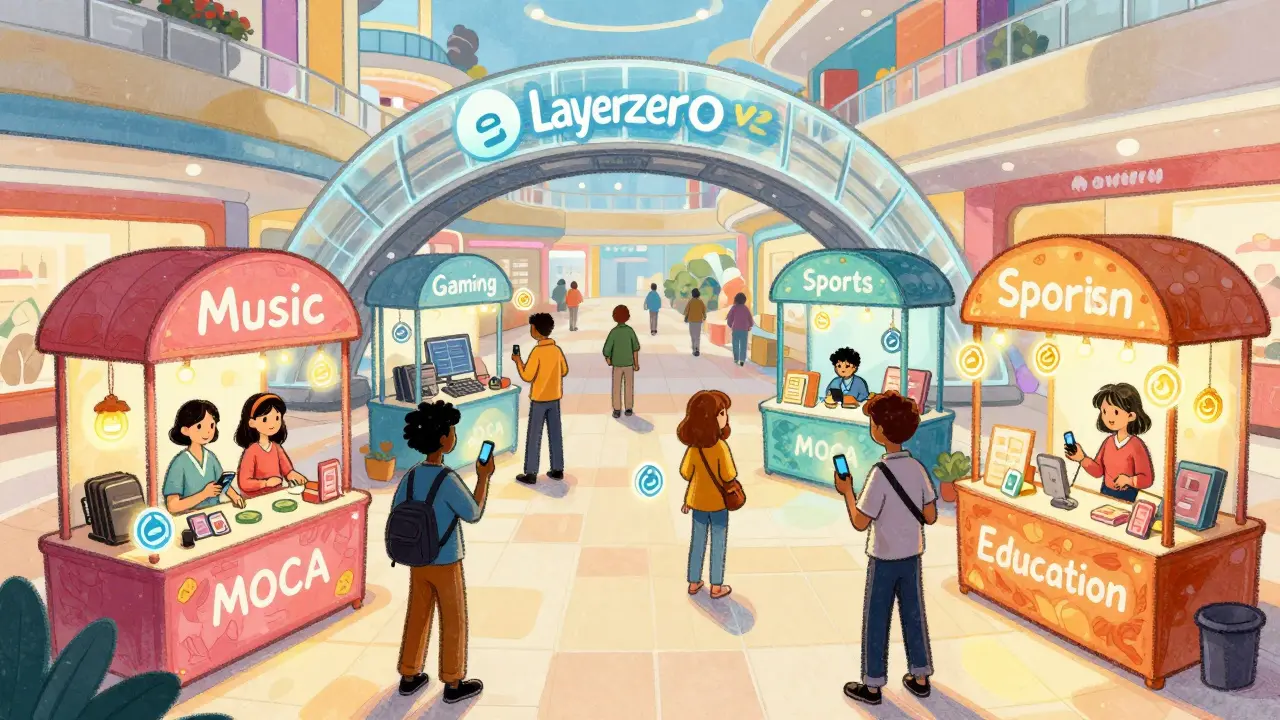
Moca Network (MOCA) isn't another cryptocurrency built just to trade. It’s designed to be the connective tissue between your favorite digital experiences-music, gaming, sports, education, and more. Unlike most tokens that live on one blockchain and serve one purpose, MOCA works across chains, brands, and platforms. It’s not about speculation. It’s about participation. If you’ve ever bought a digital jersey, streamed a song with exclusive perks, or unlocked a game item using crypto, MOCA is quietly behind that experience.
What Exactly Is MOCA?
MOCA is a fungible token with a fixed supply of 8,888,888,888 tokens. It runs on the LayerZero v2 protocol, which means it doesn’t get stuck on one blockchain like Ethereum or Solana. Instead, it moves freely across chains, making it one of the first tokens built to be truly chain-agnostic. This isn’t just a technical detail-it’s the whole point. MOCA doesn’t care if you’re on Polygon, Arbitrum, or a private subnet run by a music label. It works everywhere.
Think of MOCA like digital cash that’s accepted at every store in a massive shopping mall, instead of being tied to just one shop. You don’t need to buy different coins for different brands. One MOCA token lets you pay, earn, and unlock features no matter where you are in the network.
Who’s Behind Moca Network?
Moca Network is backed by Animoca Brands, one of the biggest names in blockchain gaming and Web3 culture. They’re the company behind popular projects like The Sandbox and F1 Delta Time. Their involvement isn’t just about funding-it’s about real-world integration. Animoca has direct access to hundreds of consumer brands, game studios, and media companies. That’s why Moca Network already has over 450 partner companies integrated into its ecosystem as of mid-2023.
These partners aren’t just using MOCA as a payment method. They’re building their own subnets-small, focused blockchain networks tied to their brand-and connecting them to Moca Network. A sports team might create a subnet for fan rewards. A music label might build one for exclusive album access. All of them use MOCA as the common currency.
How Does MOCA Actually Work?
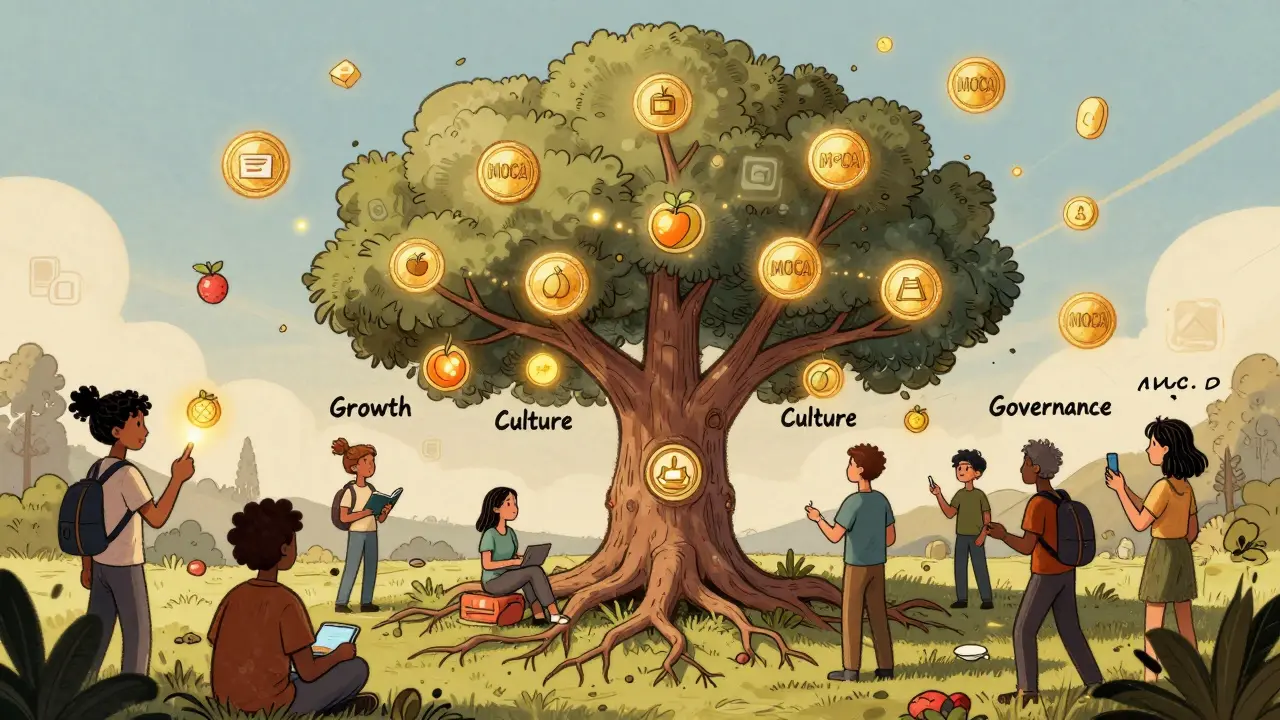
MOCA has three core roles: Growth, Culture, and Governance. These aren’t marketing buzzwords-they’re the engine of the network.
- Growth: Partners contribute MOCA to help build shared infrastructure. The more they use it, the more the whole network grows. It’s like a cooperative where every business invests in the shared plumbing so everyone benefits.
- Culture: MOCA rewards real behavior. If you listen to a song on a partner platform, attend a virtual concert, or complete a learning module, you earn MOCA. Your loyalty and reputation (based on consistent activity) determine how much you get. This turns passive users into active contributors.
- Governance: MOCA holders can vote on network upgrades, partner approvals, and treasury use. The more tokens you hold and stake, the more influence you have. It’s democracy, but powered by blockchain.
MOCA also functions as the network’s “gas.” Just like Ethereum uses ETH to pay for transactions, Moca Network uses MOCA to pay for accessing services, adopting tools, or triggering actions across subnets. You don’t need to hold different tokens for each partner-just MOCA.
Technology: zkProofs and Decentralized Identity
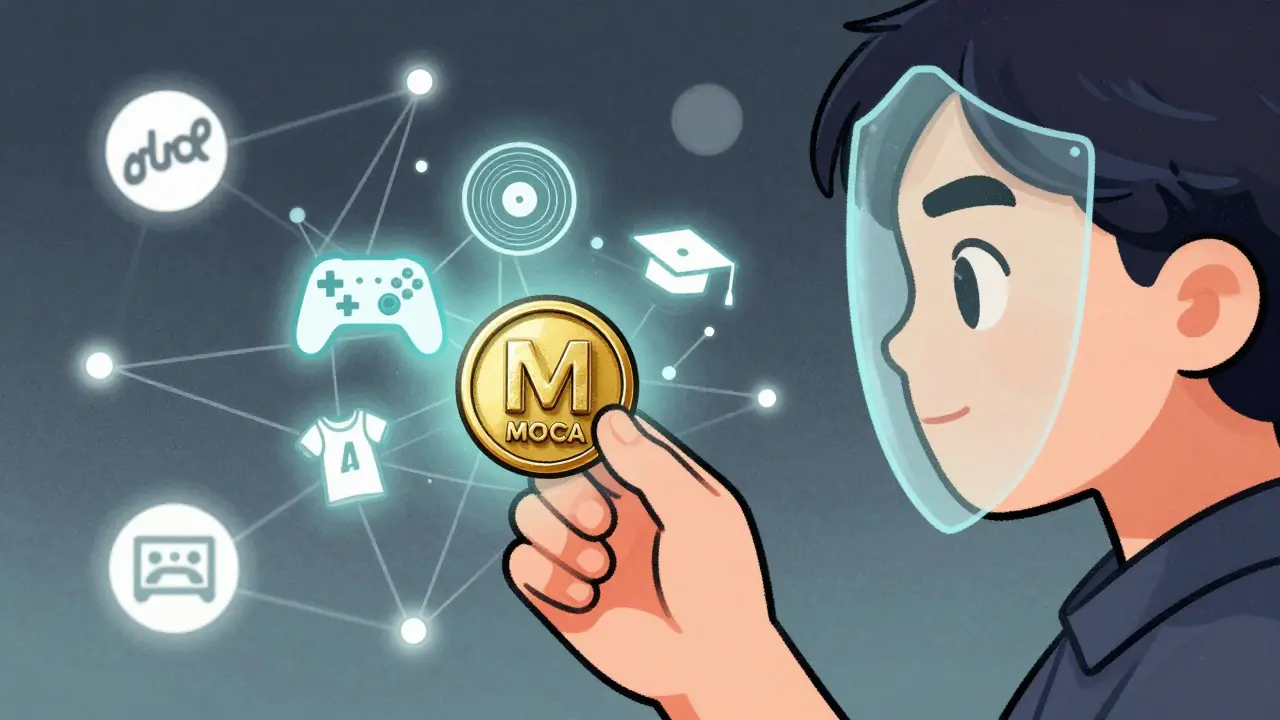
One of MOCA’s most underrated features is its identity system. Instead of linking your crypto wallet to your real name, Moca Network uses zkProofs (zero-knowledge proofs) to verify who you are without revealing your personal data. You can prove you’re a loyal fan of a band without giving away your email, location, or purchase history.
This isn’t just privacy-it’s scalability. Traditional blockchains struggle with user data. Moca Network avoids the problem entirely. Your identity is stored in a decentralized way, encrypted, and only shared when you choose to. This makes it easier for mainstream users to join without fear of being tracked or exposed.
The network also uses a non-mining consensus mechanism. No energy-hungry proof-of-work here. Transactions are validated through a lightweight, eco-friendly method that aligns with sustainability goals.
Real-World Use Cases
MOCA isn’t theoretical. It’s already being used in real products:
- Gaming: Earn MOCA by completing challenges in partner games. Use it to buy skins, NFTs, or early access to new levels.
- Music: Artists release exclusive tracks or concert tickets redeemable with MOCA. Fans earn tokens for streaming, sharing, or attending live events.
- Education: Learning platforms reward students with MOCA for finishing courses or helping peers. These tokens can be used for discounts on future lessons or tools.
- Sports: Fan clubs use MOCA to vote on team decisions, unlock merchandise drops, or access behind-the-scenes content.
- Intellectual Property: Creators can license their work through Moca Network and receive MOCA as payment, with built-in royalty tracking.
The Moca Ecosystem app (home.moca.app) includes a non-custodial wallet, a private messenger, and business payment tools-all designed to make crypto feel as simple as using a banking app.
Why MOCA Is Different
Most crypto projects try to replace banks or become decentralized exchanges. Moca Network doesn’t want to replace anything. It wants to connect things.
Compare it to Chainlink or Polkadot. Chainlink connects blockchains to real-world data. Polkadot links different blockchains together. MOCA connects people to culture. It’s not about finance-it’s about identity, loyalty, and shared experience.
Its fixed supply of nearly 8.9 billion tokens is also unusual. Most tokens have inflation or burning mechanisms. MOCA’s supply is locked. That means value, if it grows, comes from adoption-not from artificial scarcity.
Staking and Rewards
MOCA holders can stake their tokens to earn rewards. The exact APY (annual percentage yield) changes based on how many people are staking and how much activity is happening in the network. There’s no fixed rate, but the system is designed so that the more you participate, the more you earn.
Staking isn’t just about passive income. It’s how you get voting power. If you stake 10,000 MOCA, you get more influence than someone staking 1,000. This creates a feedback loop: the more you care about the network, the more you invest in it.
Is MOCA a Good Investment?
That’s the question everyone asks. But MOCA isn’t built like a typical crypto asset. There’s no whitepaper promising moonshots or doubling your money. The Moca Foundation doesn’t sell you a product. It invites you into a culture.
If you’re looking for a token to flip in six months, MOCA might not be for you. But if you’re a gamer, music fan, student, or creator who uses digital platforms regularly, MOCA could become part of your daily digital life-like a loyalty card, but better.
Its biggest strength? It’s not trying to be Bitcoin or Ethereum. It’s trying to be the invisible layer that makes your favorite apps, games, and services work better together-with you in control.
What’s Next for Moca Network?
The roadmap is simple: grow the network. Add more partners. Improve the wallet. Expand into new industries. The goal? One MOCA to unite all cultures. It’s ambitious, but with Animoca’s backing and over 450 partners already on board, it’s not just a dream-it’s a building.
There’s no public data on active wallets or daily users yet. But the focus on usability-non-custodial wallets, simple payments, private messaging-suggests they’re prioritizing adoption over hype.
Is MOCA a coin or a token?
MOCA is a token-not a coin. Coins (like Bitcoin or Ethereum) have their own blockchain. Tokens (like MOCA) run on existing blockchains. MOCA is built on LayerZero v2 and works across multiple chains, making it a utility token, not a standalone cryptocurrency.
Can I mine MOCA?
No, you cannot mine MOCA. The network doesn’t use proof-of-work. Instead, it uses an energy-efficient consensus mechanism. You can earn MOCA by participating in partner platforms-streaming, playing games, completing tasks-or by staking existing tokens to earn rewards.
Where can I buy MOCA?
MOCA is available on major crypto exchanges like Gate.io, Bybit, and KuCoin. You can trade it for Bitcoin, Ethereum, or stablecoins like USDT. Always check the official Moca Network website for the most up-to-date exchange listings and avoid third-party sellers.
Does MOCA have a wallet?
Yes. The Moca Ecosystem app includes a non-custodial wallet that supports MOCA and other tokens. It also has a private messenger, business payment tools, and integration with partner apps. You don’t need a separate wallet-everything is built into one interface designed for everyday users.
Is MOCA regulated?
MOCA is not directly regulated, but its focus on real-world utility-like payments, access, and loyalty-helps it avoid being classified as a security in many jurisdictions. It’s designed to function like a digital membership card rather than an investment contract. However, regulations vary by country, so users should check local laws before buying or using MOCA.
How does MOCA compare to Chainlink or Polkadot?
Chainlink connects blockchains to real-world data. Polkadot links different blockchains together. MOCA connects people to digital culture. It doesn’t compete with them-it uses their infrastructure. MOCA runs on LayerZero v2 (which Polkadot-style networks also use) and leverages interoperability to deliver real utility to consumers-not just developers.
Can I earn MOCA without buying it?
Yes. You can earn MOCA by participating in partner platforms: listening to music, playing games, completing educational modules, or attending virtual events. Your loyalty and reputation determine how much you earn. It’s designed to reward behavior, not just ownership.
What happens if a partner leaves the network?
If a partner leaves, their subnet may stop accepting MOCA, but your tokens don’t disappear. MOCA remains usable across all other active partners. The network is designed so that no single partner controls the value of the token. Its worth comes from the entire ecosystem, not one company.
Is MOCA decentralized?
Yes. While Animoca Brands helped launch it, governance is controlled by MOCA token holders through voting. No single entity controls upgrades, treasury spending, or partner approvals. The network is designed to become fully decentralized over time as more users stake and participate.
Why does MOCA have such a large supply? (8.88 billion)
The large supply is intentional. It’s designed to be used by millions of everyday users-not just investors. A smaller supply would make small transactions impractical. With 8.88 billion tokens, even tiny rewards (like 0.01 MOCA for listening to a song) are possible without needing fractions of a cent. It’s built for mass adoption, not scarcity.
MOCA isn’t here to make you rich overnight. It’s here to make your digital life simpler, fairer, and more rewarding. If you’re already spending time and money on games, music, or learning platforms, MOCA might be the token that finally turns your activity into something that lasts.
Honestly, I’ve been waiting for something like this for years. Most crypto projects feel like they’re trying to sell you a dream, but MOCA just feels like a tool. I’ve used it to unlock a bonus track on a music app, and it was seamless. No wallet drama, no gas fees panic. Just open, listen, earn. It’s not flashy, but it works. That’s rare.
Okay but let’s be real - Animoca’s behind this. That means it’s either genius or a trap. They made The Sandbox, which turned into a ghost town after the hype died. Are we just getting another branded loyalty card with a blockchain sticker on it? I’m not buying the ‘culture’ pitch. It’s still capitalism with better UX.
ZERO KNOWLEDGE PROOFS? That’s what they call it? Sounds like a fancy way to hide data from regulators. And don’t tell me this isn’t a pump-and-dump waiting to happen. 8.8 billion tokens? That’s not for mass adoption - that’s for dilution. Someone’s got a dump pile of MOCA they’re trying to offload before the SEC catches on. Mark my words - this is a security in disguise. They said ‘not an investment,’ but everyone knows crypto = investment. They’re lying to you.
And don’t get me started on ‘ecosystem.’ That’s corporate speak for ‘we’re gonna take your data and sell it to advertisers under the guise of loyalty.’
Ugh. I read the whole thing. I’m tired now. Can we just… not?
MOCA’s architecture is fundamentally flawed if you’re not considering the LayerZero v2 dependency. The whole chain-agnostic model collapses if LayerZero’s relayer network gets centralized. That’s not a feature - it’s a single point of failure disguised as innovation. And the zkProofs? They’re only as secure as the proving circuits - and no one’s audited those. The whole thing smells like a whitepaper written by a marketing team that Googled ‘blockchain’ and ‘zero-knowledge’ five minutes ago.
Also, ‘non-custodial wallet’ is meaningless if the UI is designed to nudge users into staking 90% of their holdings. Behavioral design is the new rug pull.
It’s not about value. It’s about participation. If you’re waiting for a return, you’re missing the point. This isn’t money. It’s a shared language for digital belonging.
Been using MOCA for gaming rewards. Got a skin I actually like. No stress. No drama. Just cool. Keep it simple.
For anyone new to this - if you’re already using Spotify, Steam, or Duolingo, you’re already in the Moca ecosystem. You just don’t know it yet. MOCA is the invisible layer that turns passive consumption into active contribution. You don’t need to understand zkProofs to earn a token for finishing a course. You just need to show up. That’s the magic. Start small. Play a game. Listen to a song. See what happens. The tech is there. The culture is growing. You just have to be part of it.
Is this not just a ponzi scheme with a new name? Animoca has a history of overpromising. And 8.8 billion supply? That's absurd. No scarcity means no value. I'm skeptical. Very skeptical. Also, why is the website so slow? Technical issues like that suggest poor execution.
You call this ‘democracy’? The governance model is a charade. The top 1% of holders will control 90% of the votes. And let’s not pretend this isn’t a venture capital play dressed up as a cultural movement. The real beneficiaries? The VCs who dumped early. The rest of us? We’re the guinea pigs. I’ve seen this movie before - and it ends with a rug pull and a LinkedIn post from the founder about ‘building the future.’
So you’re telling me I can earn tokens for listening to music… and then use them to buy more music? Wow. What a revolution. I’m so moved. Next you’ll tell me water is wet.