
You might have seen KUB Coin (KUB) pop up on a trading chart or heard whispers about it in Asian crypto circles. But what exactly is it? Is it just another speculative asset, or does it serve a real purpose?
KUB is not just a random ticker symbol. It is the native utility token of Bitkub Chain, a Layer 1 blockchain network developed in Thailand by Bitkub Blockchain Technology Co., Ltd.. If you are looking to understand where this coin fits in the broader crypto landscape, especially with its roots in one of Southeast Asia's most regulated markets, you need to look beyond the price charts and into its actual function.
The Core Purpose: Why Does KUB Exist?
To understand KUB, you first have to understand the ecosystem it lives in. Bitkub Chain was launched in April 2021 with a specific goal: to become a leading global public blockchain infrastructure that prioritizes financial inclusivity and transparency. It is Thailand’s first licensed blockchain infrastructure, which gives it a layer of legitimacy that many unregulated projects lack.
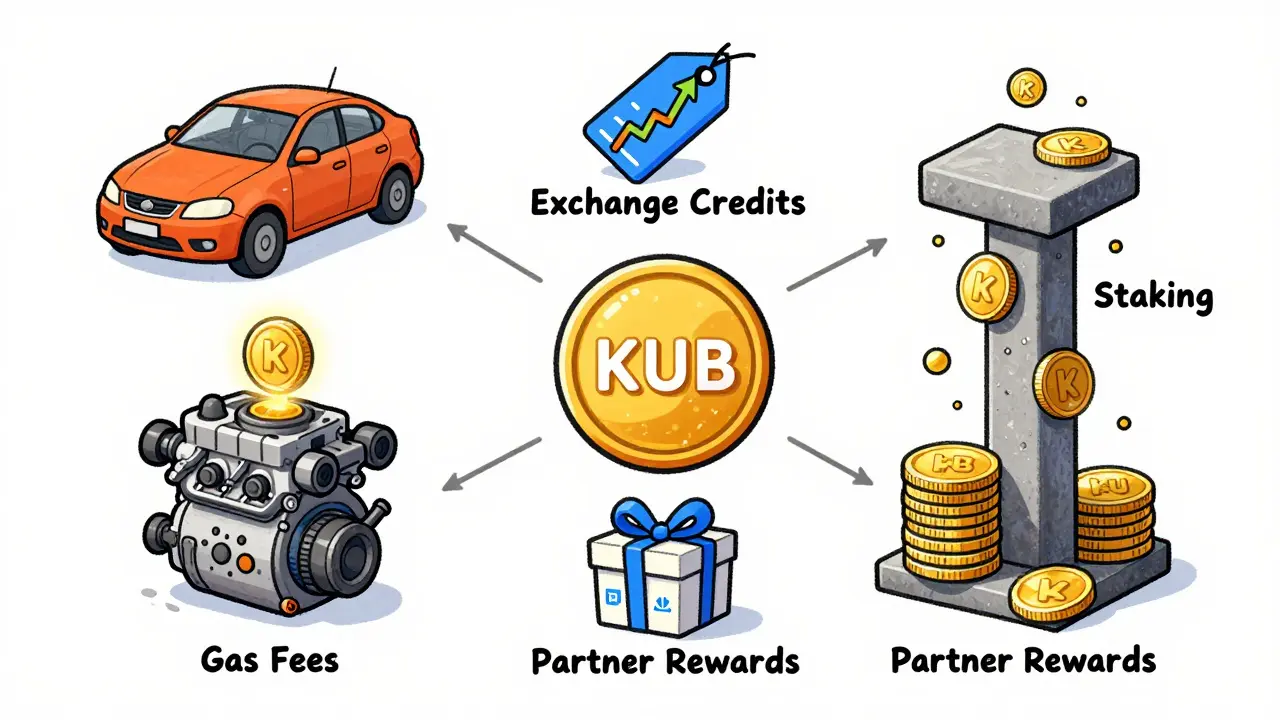
KUB acts as the economic backbone of this system. You can think of it like fuel for a car engine. Without it, the network doesn't move. Specifically, KUB serves four primary functions:
- Gas Fees: Every time you send a transaction, deploy a smart contract, or store data on Bitkub Chain, you pay fees in KUB. This covers the computational work done by validators.
- Staking: Holders can lock up their KUB tokens to participate in the network's consensus mechanism, either as Validators who secure the network or Delegators who support those validators.
- Exchange Credits: You can exchange KUB for fee credits on digital asset exchanges operated by the Bitkub Organization. This is a unique perk that lowers trading costs for users within their ecosystem.
- Partner Rewards: Occasionally, holders can redeem special goods or services from Bitkub Business Technology partners. However, keep in mind that these are strictly for marketing campaigns. KUB is not intended to be used as general currency for buying coffee or groceries.
Who Built It and How Does It Work?
The credibility of any blockchain often comes down to who is behind it. Bitkub Chain was founded by Passakorn Pannok, a software engineer holding a Master's degree from Chulalongkorn University with over 13 years of experience in blockchain technology. This isn't an anonymous team hiding behind pseudonyms; it is a structured corporate effort under Bitkub Capital Group Holdings Co., Ltd.
Technically, Bitkub Chain uses a Proof-of-Authority (PoA) consensus mechanism. Unlike Bitcoin's energy-intensive Proof-of-Work or Ethereum's pure Proof-of-Stake, PoA relies on a limited set of trusted validators to approve transactions. This approach allows for high throughput and faster finality, making it attractive for enterprise applications and high-volume retail use cases. The network supports the KAP-20 token standard, enabling assets like KKUB, KUSDT (a stablecoin), and KBTC (wrapped Bitcoin) to move smoothly without intermediaries.
Tokenomics: Supply and Distribution Breakdown
If you are considering investing, you need to know how many coins exist and who holds them. Scarcity drives value, but distribution determines control. Here is the breakdown of KUB’s supply structure as of May 2026:
| Fund / Category | Percentage | Amount (KUB) | Unlock Status |
|---|---|---|---|
| Liquidity Provision Fund | 46% | 50,605,103 | Distribution Completed |
| Ecosystem Fund | 13.64% | 15,000,000 | Unlocked at V1.0 Launch |
| Community Development Fund | 13.64% | 643,543.05 | Quarterly unlocks (2 years from Sept 2021) |
| Initial Airdrop Fund | 9.09% | 10,000,000 | Distribution Completed |
| BCGH Reserve Fund | 9.09% | 10,000,000 | 3-year lock, then yearly unlocks (from Sept 2024) |
| Strategic Partners Fund | 8.54% | 3,164,857.71 | Unlocked at V1.0 Launch |
| Total Maximum Supply | 100% | 110,000,000 | - |
As of May 11, 2026, approximately 78,000,000 KUB tokens are in circulation, representing about 63% of the total supply. The fact that nearly half the supply was allocated to liquidity provision suggests the team wanted to ensure deep market depth from the start. However, the ongoing unlocks from the BCGH Reserve Fund mean there is still inflationary pressure to monitor as new tokens enter the market each year.
Price Performance and Market Sentiment in 2026
Let’s talk numbers. If you bought KUB during its peak hype cycle, you are likely feeling some pain. As of May 11, 2026, the price of KUB hovers around $0.90 USD. This represents a staggering 93.8% decline from its 52-week high of roughly Rp246,126 (Indonesian Rupiah equivalent) recorded back in December 2021.
Here is how the market looks right now:
- Current Price: ~$0.90 - $1.55 USD (varies slightly by exchange)
- Market Cap: Approximately $61.7 Million
- Fully Diluted Valuation (FDV): ~$98.4 Million
- 24-Hour Volume: Between $234,000 and $415,000 USD
The low trading volume relative to the market cap indicates limited daily liquidity. You won’t see massive swings happening in seconds unless a large whale decides to move the market. Analyst sentiment is also heavily skewed bearish. Out of 27 analysts tracking the token, 18 are bearish, only 6 are bullish, and 3 remain neutral. This suggests that while the project has survived, the market expects continued difficulty or stagnation rather than explosive growth.
However, the year-to-date return shows a +18% gain. This tells us that after hitting rock bottom, the token has stabilized somewhat. Whether this is a sign of recovery or just a dead-cat bounce remains a question for traders to answer based on their risk tolerance.

Where Can You Trade KUB?
Availability is key for any crypto asset. KUB is primarily listed on Bitkub Exchange, the leading digital asset platform in Thailand. Because Bitkub Chain is a Thai-licensed infrastructure, its native token naturally finds its deepest liquidity here.
Internationally, availability is more selective. While you might find listings on smaller international platforms, major global giants like Crypto.com do not currently list KUB for trading. This limits your ability to easily swap KUB for USDT or BTC if you don't already have access to Thai-centric exchanges or those specific international partners that support it. Always check the current listing status before attempting to trade, as exchange policies change frequently.
Is KUB a Good Investment?
This is the million-dollar question. There is no simple yes or no. KUB is a regional play. It benefits from being tied to a licensed, professional entity in a country that is actively embracing blockchain regulation. This reduces the risk of the project vanishing overnight due to legal crackdowns, a common fate for many altcoins.
On the flip side, the Proof-of-Authority model, while efficient, is less decentralized than networks like Ethereum or Solana. This can make it less appealing to purists who value censorship resistance above all else. Furthermore, the massive price drop from its peak indicates that early investor enthusiasm has cooled significantly. For KUB to recover, Bitkub Chain needs to demonstrate significant adoption of its dApps, increased transaction volume, and perhaps broader international partnerships that bring fresh capital into the ecosystem.
If you are interested in KUB, you should view it as a bet on the growth of institutional-grade blockchain infrastructure in Southeast Asia, rather than a quick moonshot. Monitor the unlock schedules of the reserve funds and watch for any announcements regarding new major dApp launches or cross-chain bridges that could increase utility.
What is the main use case for KUB Coin?
The primary use case for KUB is paying gas fees for transactions on the Bitkub Chain network. It is also used for staking to secure the network via Proof-of-Authority consensus and can be exchanged for trading fee credits on Bitkub Exchange.
Is KUB Coin available on Binance or Coinbase?
As of May 2026, KUB is not widely listed on major global exchanges like Binance or Coinbase. It is primarily traded on Bitkub Exchange in Thailand and select other international platforms. Always verify current listings directly on the exchange websites.
How does Bitkub Chain differ from Ethereum?
Bitkub Chain uses a Proof-of-Authority (PoA) consensus mechanism, which relies on trusted validators for speed and efficiency. Ethereum uses Proof-of-Stake (PoS), which is more decentralized but generally slower and more complex. Bitkub Chain is also designed specifically with Thai regulatory compliance in mind.