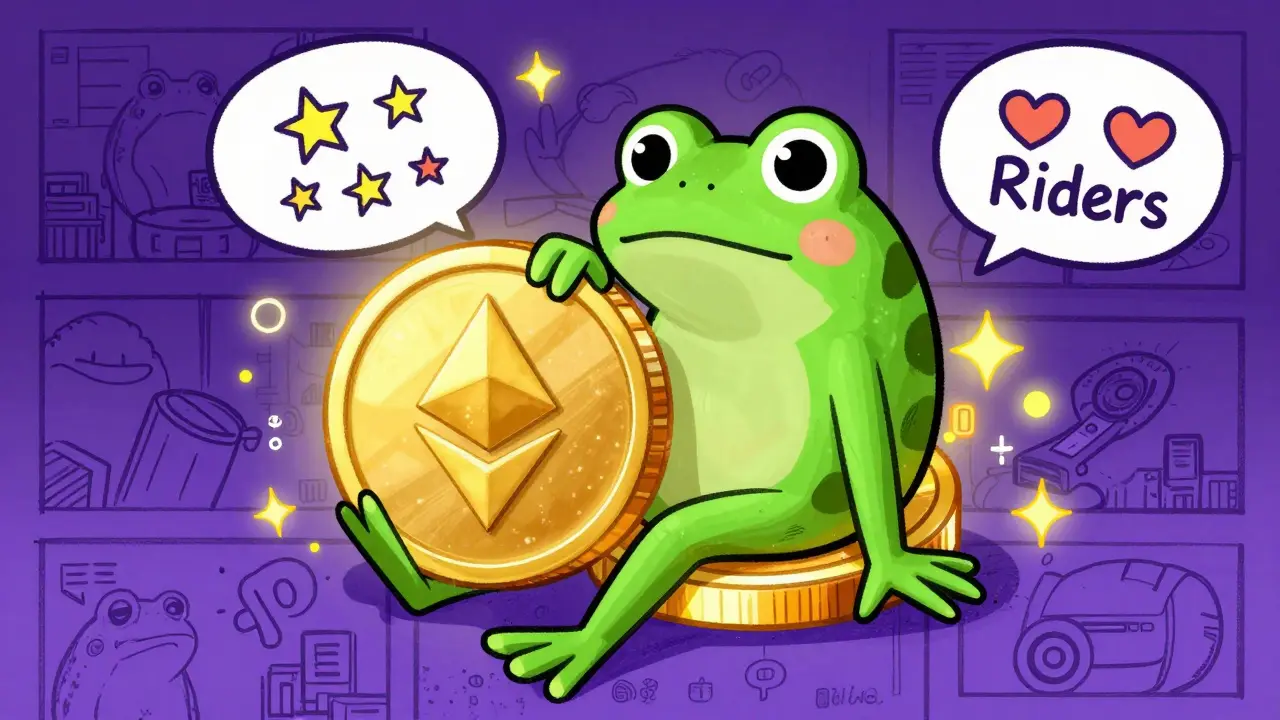
You’ve probably seen a frog meme or two online. But have you heard of Hoppy (HOPPY)? It’s not just another random coin popping up on your feed. It’s a specific tribute to an internet icon. If you are wondering what this token actually does, who created it, and whether it has any real value, you are asking the right questions before spending a single dollar.
Here is the short version: Hoppy is a meme cryptocurrency built on the Ethereum blockchain that celebrates the character Hoppy from Matt Furie's comic "The Night Riders". It doesn’t offer staking rewards, governance rights, or complex technology. It is, by design, a pure speculative asset driven by community hype and internet culture. As of mid-2026, it trades as an ERC-20 token with a fixed supply, making it a high-risk, high-volatility play in the crowded world of memecoins.
The Origin Story: From Comic Book to Blockchain
To understand HOPPY, you have to look at its roots. This isn’t a generic frog face slapped onto a token contract. The branding comes directly from Matt Furie, the artist behind the popular webcomic The Night Riders, which first launched in 2012. In the comic, Hoppy is an anthropomorphic frog character known for his laid-back attitude and distinct visual style.
When the memecoin boom hit Ethereum, creators looked for characters with existing cultural weight. They didn’t just pick any frog; they picked Hoppy. This connects the token to the broader "Furieverse," which includes other famous characters like Pepe. However, unlike some projects that claim official endorsement without proof, Hoppy positions itself as a fan-driven tribute. It leans heavily into the humor and nostalgia associated with Furie’s art.
There is a bit of confusion about when exactly it started. Some trackers point to a launch date of July 15, 2023, while others cite March 9, 2024, as the debut of the current active contract. This discrepancy likely stems from earlier experimental deployments versus the main token that gained traction. The version most people trade today is the one launched in early 2024, often referred to as the "hoppy.vip" deployment.
Tokenomics: Simple, Fixed, and Tax-Free
If you are tired of tokens that take a 5% fee every time you buy or sell, Hoppy might catch your eye. The project explicitly markets itself as having no transaction taxes. There are no buy fees, no sell fees, and no hidden charges embedded in the smart contract.
Let’s look at the numbers:
- Total Supply: 420.69 billion tokens. Yes, that number is intentional. It follows the meme-culture numerology common in crypto (420 and 69).
- Circulating Supply: Approximately 420.69 billion. The supply is fixed, meaning there is no inflation. No new tokens will be minted.
- Utility: None. The developers are upfront about this. Hoppy does not generate revenue, does not offer staking yields, and does not provide access to a platform.
This minimalist approach is part of its appeal to certain traders. It strips away the complexity of DeFi protocols and leaves only the raw market dynamics of supply and demand. You hold the token because you believe the community will keep buying it, not because it earns interest.
| Attribute | Details |
|---|---|
| Blockchain | Ethereum (ERC-20) |
| Ticker Symbol | HOPPY |
| Total Supply | 420,690,000,000 (Fixed) |
| Transaction Tax | 0% |
| Primary Use Case | Speculative Trading / Meme Culture |
| Contract Address | 0x6e79b51959cf968d87826592f46f819f92466615 |
Market Performance and Volatility
Memecoins are notorious for their wild price swings, and Hoppy is no exception. As of July 2026, the token has experienced significant fluctuations. At various points, its market capitalization has ranged from under $1 million to peaks exceeding $80 million during hype cycles in late 2024.
Currently, HOPPY ranks around #2,300 on major aggregators like CoinGecko. Its price hovers in the fractions of a cent-typically between $0.000003 and $0.00004 USD depending on the exchange and liquidity pool. This means you need a lot of tokens to see meaningful gains, but it also allows for massive percentage increases if the community rallies.
Trading volume varies wildly. On quiet days, daily volume might dip below $200,000. During spikes of interest, it can surge past $7 million in 24 hours. This volatility is a double-edged sword. It offers opportunity for quick profits but carries the risk of rapid losses if sentiment shifts.
Where Can You Buy Hoppy?
Since Hoppy is an ERC-20 token, you cannot buy it directly with fiat currency (like USD or EUR) on most platforms. You typically need to go through a decentralized exchange (DEX) or use a centralized exchange that supports Ethereum pairs.
- Decentralized Exchanges (DEXs): The primary liquidity hub for Hoppy is Uniswap V2. Here, you swap Ether (ETH) for HOPPY using the HOPPY/WETH trading pair. Other DEXs like SushiSwap may also list it, but Uniswap usually has the deepest liquidity.
- Centralized Exchanges (CEXs): Major platforms like Kraken and Coinbase have listed Hoppy for tracking and sometimes spot trading. If you already hold ETH on these platforms, you might find a direct trading pair, though availability can change quickly.
Before buying, always double-check the contract address. Scammers often create fake tokens with the same name. The verified contract for the active Hoppy token is 0x6e79b51959cf968d87826592f46f819f92466615.

Risks You Need to Know
Investing in Hoppy is not investing in a company with earnings or products. It is betting on attention. Here are the main risks:
- No Fundamental Value: Because there is no utility, the price relies entirely on social momentum. If the meme dies, the price could drop to near zero.
- Liquidity Risk: While liquidity is decent compared to micro-cap coins, it can dry up fast. Selling large amounts might slip the price significantly.
- Smart Contract Risks: Although audits suggest the contract is standard and renounced, all Ethereum contracts carry inherent technical risks.
- Regulatory Uncertainty: Governments worldwide are still figuring out how to regulate memecoins. Future laws could impact trading venues or tax obligations.
Hoppy vs. Other Frog Memecoins
You might wonder why you should choose Hoppy over PEPE or FROG. Each has a different vibe. PEPE is the giant in the room, with billions in market cap and deep institutional recognition. Hoppy is smaller, more niche, and tied specifically to Matt Furie’s lesser-known but beloved character.
Some traders prefer Hoppy because it feels less "overdone" than PEPE. Others avoid it because it lacks the massive brand recognition. It’s a matter of personal preference and risk tolerance. If you want safer, slower growth, stick to larger caps. If you’re hunting for higher multiples in a volatile market, Hoppy fits that profile.
Is Hoppy (HOPPY) a good investment?
Hoppy is a high-risk speculative asset. It has no underlying utility or revenue model. Only invest money you can afford to lose entirely. Past performance does not guarantee future results, and memecoins can crash rapidly.
Who created the Hoppy token?
The token is inspired by the character Hoppy from Matt Furie's comic "The Night Riders." While the exact anonymous developers are not publicly named, the project is community-driven and pays homage to Furie's artwork.
Does Hoppy have a maximum supply?
Yes, the total supply is fixed at 420.69 billion tokens. There is no inflation, and no new tokens can be created.
Can I stake Hoppy to earn rewards?
No. Hoppy is a pure memecoin with no staking mechanisms, yield farming options, or governance features. Its value is derived solely from market demand.
How do I store Hoppy safely?
Since it is an ERC-20 token, you can store it in any Ethereum-compatible wallet such as MetaMask, Trust Wallet, or Ledger. Never share your private keys or seed phrase with anyone.