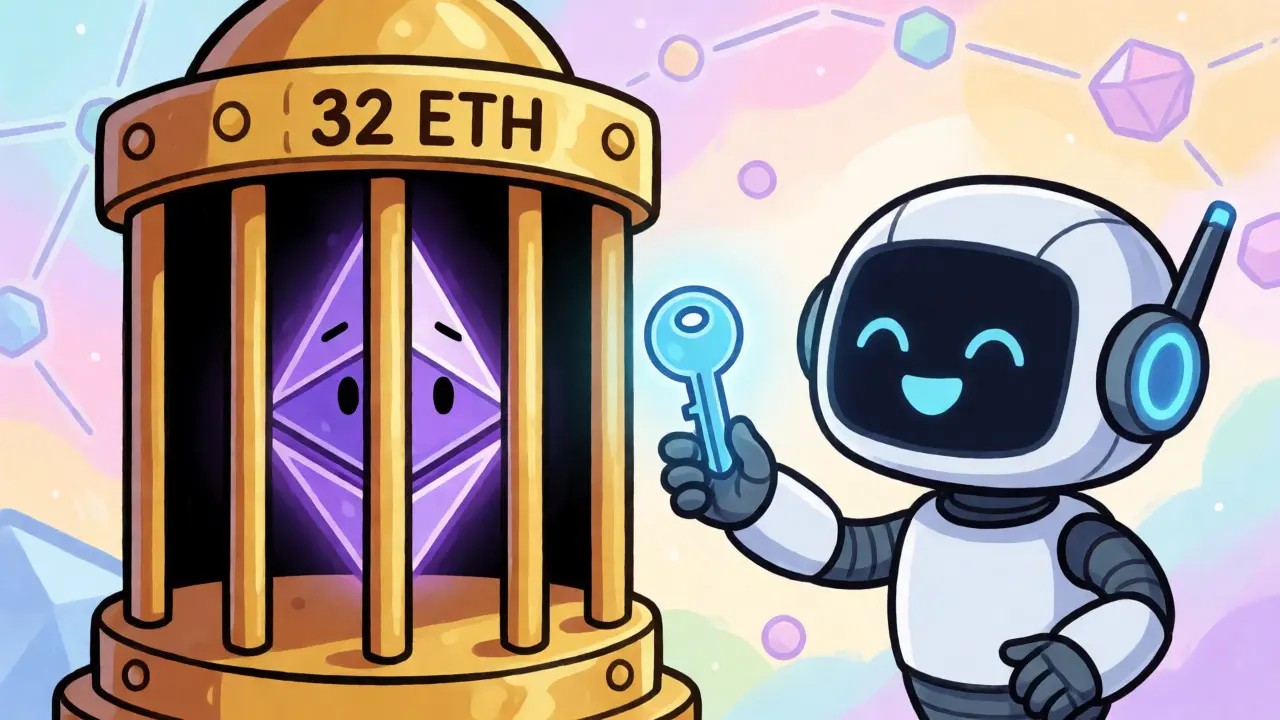
Imagine you want to earn interest on your Ethereum holdings, but you don't want to lock up your capital for months or run a validator node yourself. That’s the exact problem Frax Finance solves with its innovative liquid staking solution, Frax Ether. Launched in late 2022, this protocol transforms how we interact with ETH by combining stablecoin mechanics with high-yield staking opportunities.
If you’ve ever looked at the complex landscape of Decentralized Finance (DeFi), you know that simplicity is rare. Most protocols are either too simple to be useful or too complex to understand. Frax Finance sits in a sweet spot: it offers sophisticated yield strategies wrapped in an interface that feels surprisingly intuitive. But what exactly is going on under the hood? How does FRXETH differ from other liquid staking tokens like stETH? And more importantly, should you put your ETH into this system?
The Core Concept: Why Liquid Staking Matters
To understand FRXETH, you first need to grasp why traditional Ethereum staking is painful. Since the Merge, securing the Ethereum network requires validators to stake 32 ETH each. If you have less than 32 ETH, you can’t validate directly. You could use a centralized exchange, but then you lose custody of your keys. Or you could use a liquid staking derivative (LSD), which gives you a token representing your staked ETH.
Liquid Staking Derivatives allow you to keep your assets liquid while earning staking rewards. However, many early LSDs had issues with centralization or poor composability within the broader DeFi ecosystem. Frax Finance entered this space with a different philosophy. They didn’t just create another wrapper; they built a system that leverages their existing reputation as a major stablecoin issuer to provide a robust, audited, and highly integrated staking solution.
The promise here is straightforward: deposit ETH, get a token back that represents your share of the staked pool, and use that token across DeFi protocols to earn extra yield. It sounds simple, but the execution involves some clever engineering that sets Frax apart.
Breaking Down the Three Pillars of Frax Ether
Frax Ether isn’t just one token. It’s actually a three-part system working in harmony. Understanding these components is crucial because holding the wrong one means you might miss out on yield.
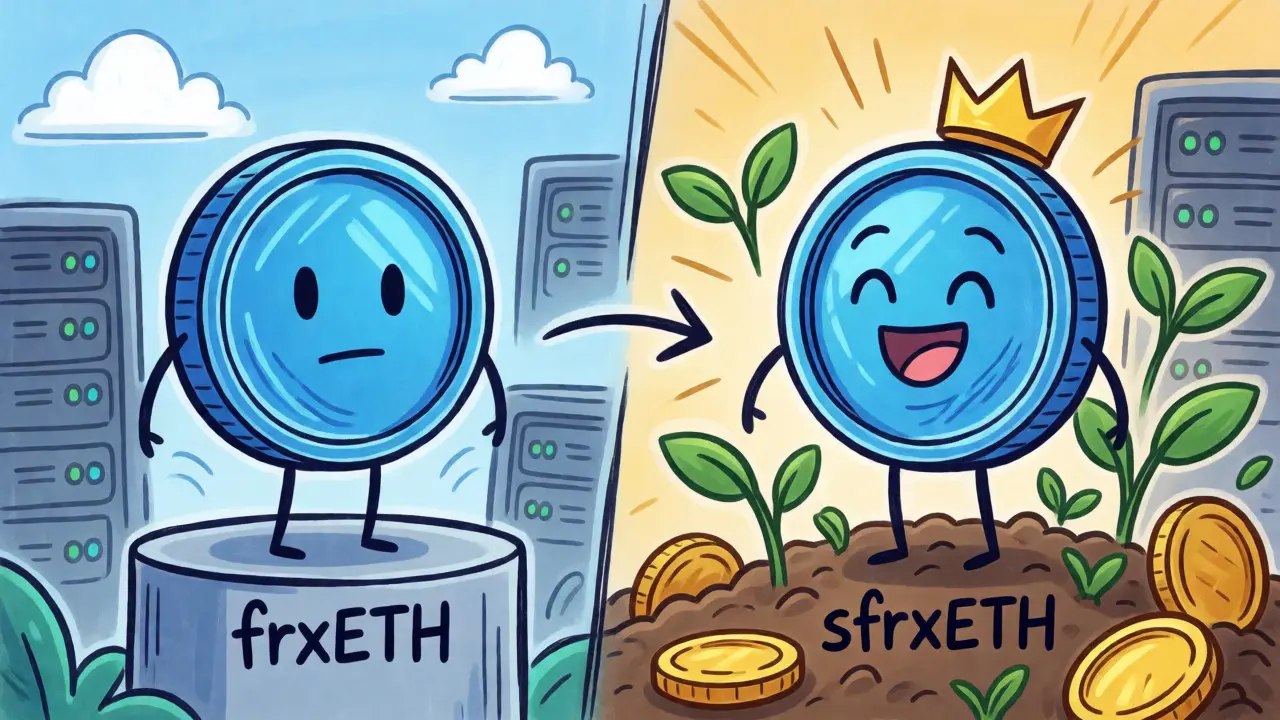
- frxETH: This is the base token. It’s pegged 1:1 to ETH. Think of it as digital cash backed by real ETH. Holding frxETH alone doesn’t generate staking rewards-it’s like holding regular ETH.
- sfrxETH: This is the yield-bearing version. When you convert frxETH to sfrxETH, you’re entering a vault that automatically compounds staking rewards. The value of sfrxETH rises relative to frxETH over time.
- Frax ETH Minter: This smart contract handles the conversion between ETH and frxETH. It also manages the validator nodes, spinning up new ones when enough ETH is deposited.
Here’s the key insight most beginners miss: **frxETH does not earn staking yield by default.** If you buy FRXETH on an exchange and hold it in your wallet, you’re essentially holding WETH (Wrapped ETH). To earn the ~4-5% annual percentage yield (APY) typical of ETH staking, you must actively convert your frxETH into sfrxETH. This two-step process gives users flexibility. Do you want pure liquidity without yield? Hold frxETH. Do you want maximum return? Stake into sfrxETH.
How the Peg Works (And Why It’s Safe)
A common fear with any algorithmic or semi-algorithmic system is the "depeg." Will my 1 frxETH still be worth 1 ETH if the market panics? Frax addresses this with a hard peg mechanism. The protocol defends the price of frxETH within a tight band: 0.99 to 1.01 ETH per frxETH.
This isn’t maintained by magic. It’s enforced by arbitrage incentives. If frxETH trades below 0.99 ETH, arbitrageurs will buy frxETH cheaply and redeem it for full ETH, driving the price back up. If it trades above 1.01 ETH, they’ll mint new frxETH using ETH and sell it, pushing the price down. This mechanical stability is backed by real collateral-actual ETH held in the staking contracts-not just trust in an algorithm.
| Feature | Traditional Solo Staking | Lido (stETH) | Frax Ether (frxETH/sfrxETH) |
|---|---|---|---|
| Minimum Deposit | 32 ETH | Any amount | Any amount |
| Liquidity | Low (locked until exit) | High (liquid token) | High (liquid token) |
| Yield Source | Direct Validator Rewards | Validator Rewards + MEV | Validator Rewards + MEV + DeFi Strategies |
| Fee Structure | N/A | 10% of rewards | 10% total (8% protocol, 2% insurance) |
| Ecosystem Integration | None | High | Very High (Native Frax Stablecoins) |
The Economics: Fees, Yields, and Insurance
Let’s talk numbers. As of September 2026, Frax Ether has grown significantly, with a market capitalization hovering around $494 million. This scale matters because it ensures deep liquidity on exchanges like Curve and Uniswap. You won’t face massive slippage when trying to exit your position.
The fee structure is transparent. Frax takes 10% of all staking rewards generated by the validators. Here’s where it gets interesting: 8% goes to the protocol treasury to fund development and operations, while the remaining 2% is directed into a dedicated insurance fund. This insurance fund acts as a buffer against potential slashing events or technical failures. It’s a proactive risk management tool that shows the team understands the importance of user protection.
Your net yield depends on the current state of the Ethereum network. Typically, base staking rewards fluctuate between 3% and 5% APY. Because sfrxETH auto-compounds, the effective yield is slightly higher due to compounding effects. Additionally, since frxETH is deeply integrated into the Frax ecosystem, you can often find boosted yields by providing liquidity in pools paired with other Frax stablecoins like USDC or DAI.
Security and Audits: Can You Trust It?
In crypto, code is law, but bugs are inevitable. Frax Finance has taken security seriously by commissioning comprehensive audits from reputable firms like Certik and Trail of Bits. These aren’t just box-ticking exercises; the reports detail specific vulnerabilities found and fixed during development.
The underlying architecture of frxETH is largely forked from the proven FRAX and FPI stablecoin contracts. This is a strategic advantage. Instead of writing entirely new code from scratch, Frax leveraged battle-tested smart contracts that have already survived years of production usage and billions in transaction volume. For a skeptic, this reduces the surface area for novel bugs.
However, no system is risk-free. Smart contract risk remains, as does the risk of Ethereum itself undergoing changes. But compared to smaller, unaudited yield farms, Frax Ether offers a level of institutional-grade security that appeals to both retail and professional investors.
How to Get Started: A Practical Guide
Ready to try it out? Here’s the step-by-step process to maximize your returns:
- Acquire ETH: Ensure you have ETH in your wallet (MetaMask, Rabby, etc.).
- Mint frxETH: Go to the Frax Finance app. Connect your wallet and select "Mint frxETH." Approve the transaction. You now hold frxETH, which is 1:1 with ETH but earns no yield yet.
- Convert to sfrxETH: On the same dashboard, find the option to "Stake" or "Deposit into sfrxETH." Confirm the transaction. Your balance will now show sfrxETH.
- Monitor Your Yield: Watch the exchange rate between sfrxETH and frxETH. It should slowly increase over time. When you’re ready to exit, you’ll receive more frxETH than you originally deposited.
Pro Tip: Don’t stop at holding sfrxETH in your wallet. Because it’s an ERC-4626 compliant vault token, it’s compatible with many DeFi protocols. You can use sfrxETH as collateral to borrow stablecoins, or provide liquidity in pools that offer additional trading fee rewards. This "yield stacking" is where Frax really shines, leveraging its deep integration with the Curve finance ecosystem.
Common Pitfalls to Avoid
Even experienced DeFi users make mistakes with liquid staking derivatives. Here are three traps to watch out for:
- Confusing frxETH with sfrxETH: Remember, only sfrxETH accrues staking yield. If you leave funds in frxETH form, you’re missing out on free money.
- Ignoring Slippage: While liquidity is good, during extreme market volatility, the peg might temporarily drift outside the 0.99-1.01 range. Always check the current exchange rate before making large swaps.
- Overlooking Gas Costs: Minting and staking involve multiple transactions. During periods of high network congestion, gas fees can eat into your short-term gains. Wait for low-gas windows if you’re moving small amounts.
Another nuance is the difference between "staking rewards" and "MEV rewards." Frax passes through Maximum Extractable Value (MEV) to users, which can boost yields during busy network periods. Keep an eye on the Frax dashboard for real-time APY updates, as these figures change dynamically based on network activity.
The Bigger Picture: Frax’s Role in DeFi
Frax Ether isn’t just a standalone product; it’s a gateway to the entire Frax ecosystem. By holding FRXETH, you gain access to governance rights via the FRAX token, participation in various incentive programs, and seamless interoperability with other Frax products. This network effect creates a moat around the protocol. Users who enter for the staking yield often stay for the breadth of financial tools available.
As Ethereum continues to evolve, the demand for efficient, decentralized staking solutions will only grow. Frax Finance has positioned itself well by prioritizing transparency, security, and user experience. Whether you’re a whale looking for safe yield or a newcomer wanting exposure to ETH staking without the technical hassle, Frax Ether offers a compelling proposition.
Does frxETH earn staking rewards automatically?
No, frxETH itself does not earn staking rewards. It functions similarly to Wrapped ETH (WETH). To earn yield, you must convert your frxETH into sfrxETH, which is the yield-bearing token that accumulates staking rewards over time.
What is the difference between frxETH and sfrxETH?
frxETH is a stablecoin-like token pegged 1:1 to ETH. sfrxETH is an ERC-4626 vault token that holds frxETH and automatically compounds staking rewards. The value of sfrxETH increases relative to frxETH as validators produce yield.
Is Frax Ether safe to use?
Frax Ether has undergone rigorous audits by reputable firms like Certik and Trail of Bits. The system includes a 2% insurance fund to mitigate risks. However, as with any DeFi protocol, there are inherent smart contract and market risks.
How much does Frax charge in fees?
The protocol retains 10% of all staking rewards. Of this, 8% goes to the protocol treasury and 2% is allocated to an insurance fund. There are no separate withdrawal fees charged by the protocol itself, though standard Ethereum gas fees apply.
Can I use sfrxETH in other DeFi protocols?
Yes, sfrxETH is widely supported in the DeFi ecosystem, particularly on Curve Finance. You can use it to provide liquidity, borrow against it, or participate in yield farming strategies to stack additional returns on top of the base staking yield.