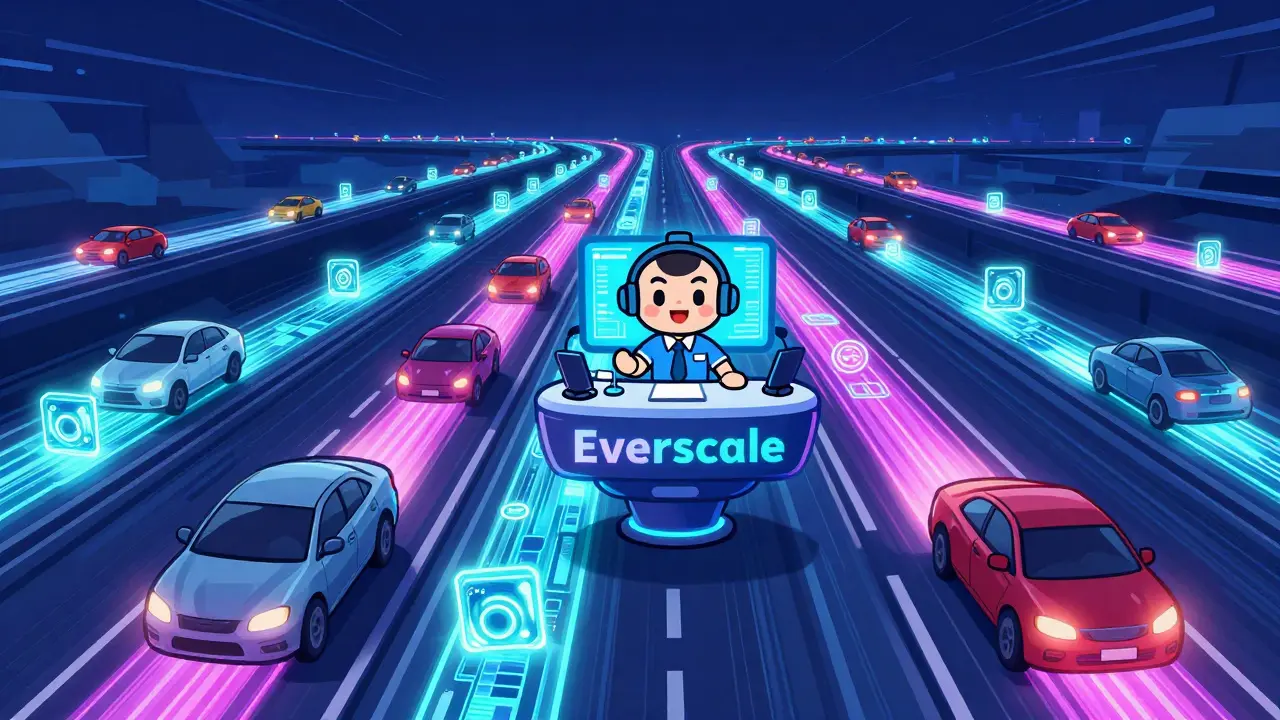
Most of us are used to the "waiting game" with crypto. You send some funds or mint an NFT on Ethereum, and then you sit there for minutes, hoping the transaction clears. It feels like using a dial-up modem in a fiber-optic world. Everscale (EVER) is a Layer-1 blockchain network designed to kill that wait time by processing millions of transactions per second with sub-second finality. Essentially, it's a network built for the scale of a global credit card company rather than just a niche digital asset store.
If you've ever wondered why some blockchains struggle to scale while others promise the moon, you have to look at the architecture. Everscale (EVER) doesn't just try to make one big road faster; it builds a massive highway system of 260 shardchains. This means the network can handle institutional-scale traffic without breaking a sweat, making it a serious contender for anyone who thinks Bitcoin or Ethereum are too slow for real-world business use.
The Core Engine: How Shardchains Work
To understand why EVER is different, we need to talk about Shardchain technology. In a traditional blockchain, every single node has to agree on every single transaction. That's a recipe for a bottleneck. Everscale flips this by using a workchain and 260 shardchains. Think of the workchain as the air traffic controller and the shardchains as the actual runways.
These shardchains handle subsets of accounts, meaning the workload is split up. This architecture allows for a block time of just 1.71 seconds. While Bitcoin users are waiting 10 minutes for a confirmation, Everscale users get nearly instant settlement. For a developer building a high-frequency trading app or a fast-paced Web3 game, this isn't just a luxury-it's a requirement.
What Exactly is the EVER Token?
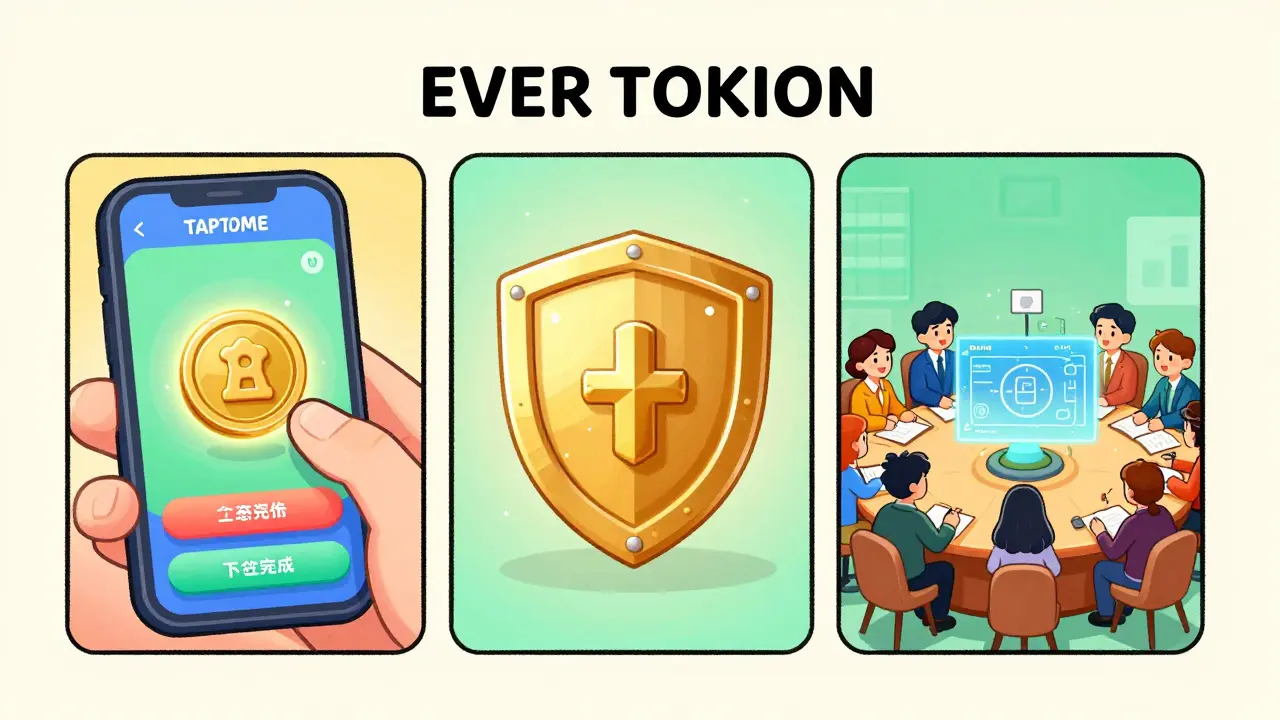
The EVER token is the fuel that keeps this entire machine running. It isn't just a coin you hold in a wallet hoping the price goes up; it has several concrete jobs to do within the ecosystem:
- Network Fees: Every time you swap a token or move funds, you pay a tiny fee in EVER. Because the network is so efficient, these fees often sit below $0.001, making micropayments actually viable.
- Staking and Security: You can stake your EVER to help secure the network and earn rewards in return.
- Governance: Holding EVER gives you a seat at the table. You can participate in community DAOs to vote on how the network evolves and how the treasury is spent.
- Smart Contract Power: Running a contract or storing data on-chain requires EVER.
One interesting detail is the token's precision. EVER uses 9 decimal places, meaning you can send as little as 0.000000001 EVER. This is perfect for the "tap games" and micro-tipping apps that are starting to pop up on the platform.
Tokenomics and the Treasury Strategy
A lot of projects fail because they dump all their tokens on the market at once. Everscale takes a different approach with a fixed total supply of 2,119,349,045 tokens. But the real story is in the distribution.
| Allocation Segment | Percentage | Primary Purpose |
|---|---|---|
| Free Float | 39.2% | Active circulation and trading |
| Locked Tokens | 11.1% | Strategic reserves |
| Treasury | 49.8% | Ecosystem growth and sustainability |
The Treasury is the most critical part. It's not just a pile of money; it's split into specific buckets. 85% goes toward partnerships to bring in new users, 10% rewards the developers who build the apps, and 5% helps bootstrap new validators to keep the network decentralized. This shows a long-term play toward adoption rather than a quick pump-and-dump scheme.
Breaking the Walls: Wrapped EVER (WEVER)
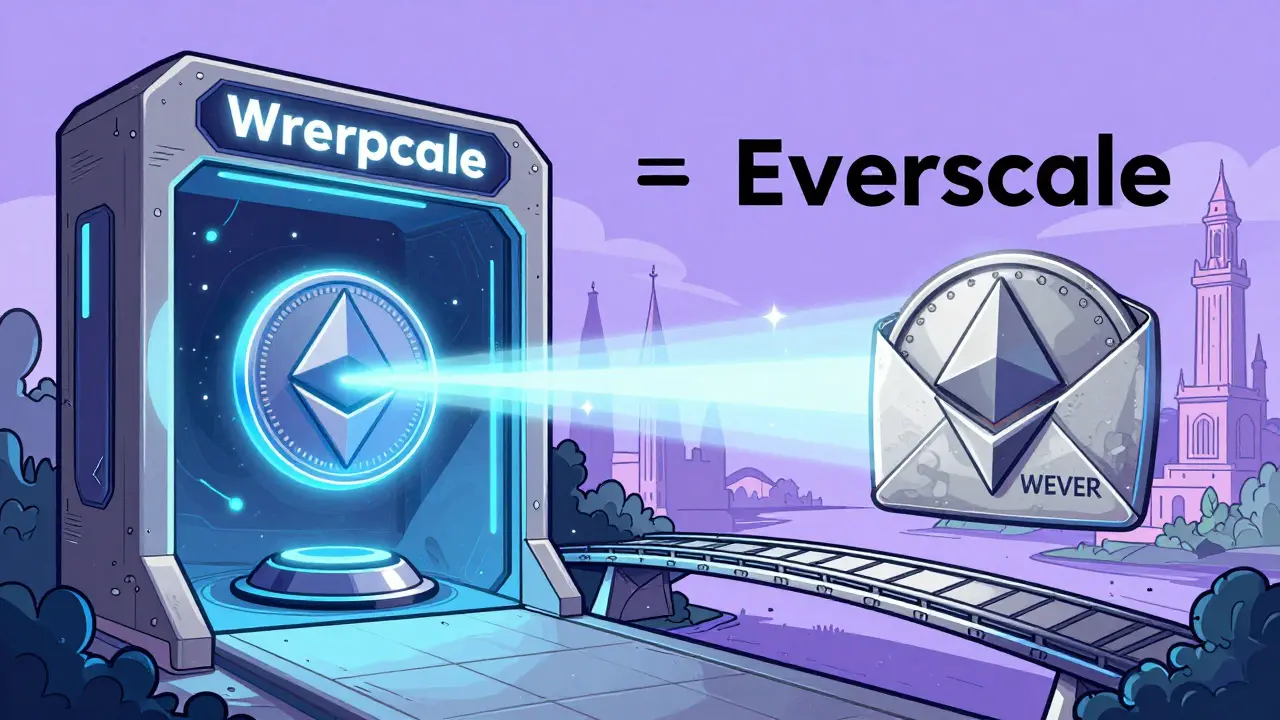
One of the biggest problems in crypto is "silos." If your money is on Everscale, you can't easily use it in an Ethereum DeFi pool. To fix this, the ecosystem created WEVER (Wrapped Everscale).
WEVER is an ERC-20 token that lives on Ethereum. It's basically a digital voucher. You lock your EVER tokens in a smart contract on the Everscale chain, and an equal amount of WEVER is minted on Ethereum. The ratio is always 1:1. When you're done, you simply "unwrap" it-burn the WEVER and get your original EVER back. This bridge allows Everscale to tap into the massive liquidity of the Ethereum ecosystem without sacrificing its own speed.
Development and Compatibility
For the devs, Everscale is surprisingly friendly. It supports both Solidity and C++. If you've already written contracts for Ethereum, you can move your logic over without learning a whole new language from scratch.
Furthermore, the network uses the TIP-3 token standard, which allows for the creation of up to 2^32 different tokens. This is a staggering number, meaning the platform can support everything from complex industrial tokens to millions of unique NFT collections without slowing down the main chain.
Real-World Performance vs. The Giants
How does this actually stack up against the big names? Let's be honest: Bitcoin and Ethereum have the fame and the market cap, but they struggle with the "trilemma" of security, decentralization, and speed. Everscale chooses to prioritize throughput.
While Ethereum has moved toward Layer-2 solutions to handle congestion, Everscale handles it at the Layer-1 level. With over 1 million active accounts and 356 million transactions already processed across nearly 57 million blocks, the network has proven it can handle a heavy load. If you're running a business that needs to process thousands of payments per second, a 15-second block time (like Ethereum's) is an eternity. A sub-second finality is the only way to compete with traditional payment processors like Visa.
Is EVER the same as Ethereum?
No. While both are Layer-1 blockchains that support smart contracts, they have different architectures. Ethereum uses a single-chain approach (supplemented by Layer-2s), whereas Everscale uses a shardchain architecture to achieve significantly higher transaction speeds and lower fees.
What is the purpose of WEVER?
WEVER is the wrapped version of EVER. It allows users to move the value of their Everscale tokens over to Ethereum and other ERC-20 compatible chains, enabling them to use their assets in external DeFi protocols and exchanges.
How are EVER tokens created?
EVER tokens are minted according to strict protocol rules by hundreds of independent validators. This ensures the network remains decentralized and prevents any single entity from controlling the token supply.
Are transaction fees on Everscale expensive?
Actually, they are among the lowest in the industry. Most transactions cost less than $0.001, and in some cases, the average fee is reported as near $0, thanks to the efficiency of the shardchain design.
Can I build apps on Everscale?
Yes. Developers can use Solidity or C++ to create smart contracts. The network is designed to support everything from simple gaming apps to complex industrial-scale decentralized applications (dApps).
Next Steps for Users and Developers
If you're a trader, the first step is checking the 43 different markets where EVER is traded to find the best liquidity. Keep an eye on the volatility, as EVER can swing significantly in short windows.
If you're a developer, start by exploring the TIP-3 standard. Since you can use Solidity, you can port existing Ethereum projects over to see how they perform with sub-second finality. It's a great way to test the limits of your application's speed.
For long-term holders, look into the governance DAOs. The treasury holds nearly 50% of the supply; having a say in how those funds are allocated for partnerships and developer rewards is where the real influence lies.
The throughput on this is wild. Getting sub-second finality via shardchains is exactly what we need for institutional-grade liquidity. Definitely a massive upgrade over the standard EVM bottlenecks we see everywhere else.
Oh, please. Another "revolutionary" Layer-1 promising the world while the actual adoption remains an absolute ghost town. It's simply tragic how we keep falling for the same marketing scripts.
This is just more foreign tech trying to sneak into our systems while the US gov shud be focusin on American made blockchains that dont have hidden agendas from oversea dev teams who dont share our values!! Absolute madness that we even consider these things without proper vetting of where the treasury funds actually flow to in the real world
Funny how they mention "independent validators" but don't list who actually controls the workchain. It's probably just a centralized honey pot designed to track every single micro-transaction for some globalist database. I've seen this pattern before and it always ends with a "network upgrade" that magically wipes the wallets of anyone asking too many questions.
This looks like a great start for anyone getting into Web3! The low fees make it so much more accessible for new users who are scared of losing a ton of money on gas fees. Keep exploring, guys!
sharding is just a way to hide the fact that the network is fragile. one glitch in a shard and the whole thing crashes. probably just a scam anyway lol
The sheer audacity of claiming to compete with Visa is simply breathtaking. One must wonder if the architects truly comprehend the magnitude of the infrastructure required for such a feat, or if this is merely a fever dream of misplaced ambition.
Let's get this energy up! The TIP-3 standard is a total game-changer for creative projects. Imagine the explosion of vibrant, colorful NFT ecosystems when we aren't paying a kidney in gas fees!
Glad to see a focus on developer rewards. That's how real ecosystems grow.
If you're moving funds through WEVER, just make sure you double-check the smart contract addresses on the Ethereum side. Bridging can be tricky for beginners, and while the 1:1 ratio is solid, security always comes first when you're locking assets on a different chain.
Too many tokens. Just a pump.
I want to know more about the actual hardware requirements for these validators. If it's too high, the decentralization claim is a lie.
Solid tech. Very promising.
It is profoundly disappointing that the masses chase speed over spiritual and moral alignment in their financial instruments. One must possess the discipline to look beyond the mere utility of a shardchain and question the ethical implications of such a rapid, unchecked expansion of digital capital.
Shardchains are just another way for the elites to obfuscate the ledger. They'll tell you it's for "speed" but it's really about fragmentation so the retail sheep can't see the whale wallets moving the supply. Typical centralization masquerading as a L1. Proper British finance knows you can't trust a black box like this.
My soul is absolutely weeping at the thought of my funds being trapped in a bridge if WEVER fails. The psychological torture of waiting for a confirmation is one thing, but the existential dread of a smart contract exploit is a void I cannot fathom!
This is a huge leap for the digital economy! 🚀 Shifting from the "waiting game" to instant settlement is like moving from a horse to a rocket ship. I love how it bridges the gap between high-finance and micro-tipping. Let's see where this journey takes us! 😊
I think it's really wonderful that developers can use Solidity here. It's like welcoming a new neighbor into the neighborhood and telling them they don't even have to change their furniture to fit in. By making it easy for people to switch over from Ethereum, they're creating a much more inclusive environment where everyone has a chance to build something cool without feeling overwhelmed by a steep learning curve, and that's just how a community should grow in the first place.
For those wondering about the scalability, the use of 260 shardchains is a brilliant way to solve the trilemma without compromising too much on security. If you look at the way the workchain coordinates the state, it's clear that this is designed for massive volume. I've spent a lot of time analyzing various L1 architectures and the way EVER handles asynchronous processing is genuinely impressive. You're essentially getting the benefits of a distributed system while maintaining the integrity of a single blockchain. It's a sophisticated approach that really puts the focus on utility over hype. If the treasury continues to be used for actual developer growth and not just marketing, this could easily become the backbone for a new generation of high-frequency dApps. I'd highly recommend anyone interested in high-throughput systems to dive into the technical docs and see how the TIP-3 standard handles token proliferation without bloating the state. It's a masterclass in efficiency.