Imagine holding a digital dollar that doesn't rely on a bank's promise or a corporate treasury to stay at $1. That is the core promise of DOLA, a cryptocurrency designed to solve one of the biggest trust issues in finance: who actually holds the money backing your tokens?
In the world of decentralized finance (DeFi), stability is everything. You need a reliable medium of exchange to trade volatile assets like Bitcoin or Ethereum without losing value overnight. Most people turn to centralized stablecoins like USDT or USDC. But these require you to trust a company to hold fiat reserves. Enter Inverse Financea decentralized protocol that created DOLA as a fully collateralized, algorithmic stablecoin. DOLA aims to offer the stability of the US dollar with the transparency and censorship resistance of blockchain technology.
How Does DOLA Maintain Its Value?
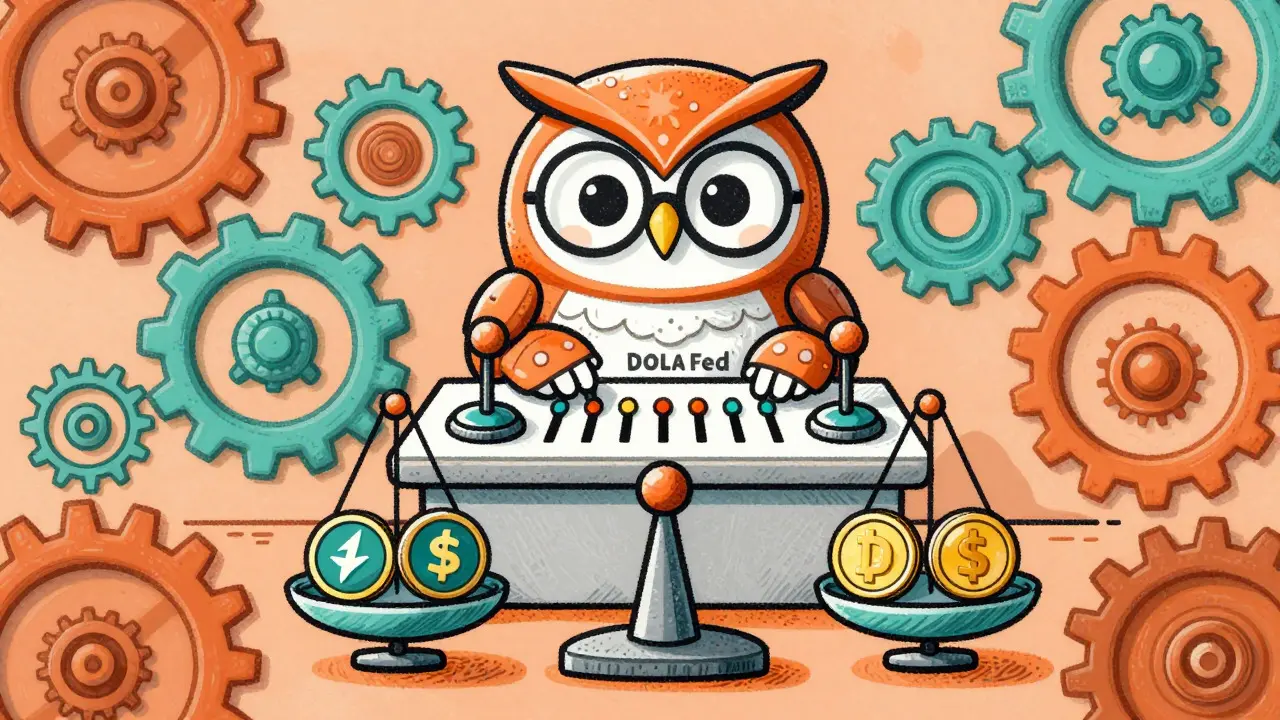
The secret sauce behind DOLA isn't magic; it's a sophisticated system called the DOLA Fedan automated interest rate mechanism that manages the supply of DOLA to maintain its peg to the US dollar.. Think of it like a central bank for a single token. If the price of DOLA drops below $1, the Fed incentivizes users to buy more by raising interest rates, increasing demand. If the price goes above $1, it lowers rates to encourage minting, increasing supply.
Unlike purely algorithmic stablecoins that failed in the past (remember UST?), DOLA is fully collateralized. This means every single DOLA token in existence is backed by real crypto assets deposited by users. When you want DOLA, you don't just click "mint." You deposit collateral-like ETH or other supported assets-into the Fixed-rate Module (FiRM)a lending platform within Inverse Finance where users lock up assets to mint DOLA.. The system calculates how much DOLA you can borrow based on the value of your collateral. If you repay the loan, your DOLA is burned, and you get your collateral back.
This hybrid model combines the best parts of overcollateralized systems (like MakerDAO’s DAI) with algorithmic efficiency. It avoids the risk of under-collateralization while using smart contracts to automate the boring stuff like interest rate adjustments.
DOLA vs. Other Stablecoins: What’s the Difference?
You might be wondering why you’d choose DOLA over the giants like Tether (USDT) or Circle’s USDC. The answer lies in control and transparency.
| Feature | DOLA | USDC / USDT | DAI |
|---|---|---|---|
| Backing | Crypto Assets (On-chain) | Fiat Reserves (Off-chain) | Crypto Assets (On-chain) |
| Governance | Decentralized DAO | Centralized Company | Decentralized DAO |
| Transparency | Real-time via Transparency Portal | Quarterly Attestations | Real-time On-chain |
| Censorship Resistance | High | Low (Can freeze addresses) | High |
| Market Cap (Approx.) | $110M - $200M | $80B+ Combined | $5B+ |
USDT and USDC are convenient, but they are centralized. The companies behind them can freeze your funds if they feel like it, or if regulators demand it. DOLA lives on the blockchain. No one can stop you from transacting. However, this comes with a trade-off: liquidity. DOLA has a significantly smaller market cap than its competitors. As of late 2023, DOLA hovered around $113 million to $200 million depending on the data source, whereas USDT alone is worth nearly $100 billion. This means DOLA is less liquid, which can lead to slight price deviations during high volatility.
Who Should Use DOLA?
DOLA isn't trying to replace the dollar for buying coffee. It’s built for specific DeFi power users. Here is who benefits most:
- Yield Farmers: Because DOLA is integrated into the Frontier Protocola leveraged yield farming platform compatible with DOLA., users can use DOLA as collateral to leverage their positions. This allows you to amplify returns on stablecoin yields without taking on directional risk from volatile assets.
- Censorship-Resistant Traders: If you are worried about blacklists or frozen accounts, DOLA offers peace of mind. Your assets are controlled by your private key, not a corporate server.
- Capital Efficiency Seekers: The FiRM module allows for fixed-rate borrowing, which can be cheaper and more predictable than variable-rate loans in other protocols.
If you are a beginner just looking to store value, DOLA might be overly complex. The learning curve involves understanding collateral ratios, liquidation risks, and gas fees. For casual users, USDC remains the simpler choice.
Risks and Challenges
No financial instrument is risk-free, and DOLA has its own set of challenges. First, there is the issue of peg deviation. While the DOLA Fed works hard to keep the price at $1, it’s not perfect. During extreme market crashes, DOLA has dipped to $0.95 or lower. This creates arbitrage opportunities for traders but potential losses for holders who sell during panic.
Second, there is liquidity risk. With a market cap under $200 million, large trades can impact the price more significantly than they would on USDT. If you try to move millions of dollars worth of DOLA quickly, you might face slippage.
Third, consider smart contract risk. Like all DeFi projects, DOLA relies on code. If there is a bug in the Inverse Finance contracts or the FiRM module, funds could be at risk. Audits are regular, but zero-day exploits remain a threat in the space.
How to Buy and Store DOLA
Getting started with DOLA requires a few technical steps. Since it is an ERC-20 token on Ethereum (and available on Layer-2s like Base), you need a non-custodial wallet like MetaMask.
- Set Up Your Wallet: Install MetaMask and connect to the Ethereum network. To see DOLA, you may need to add the token manually using the contract address:
0x865377367054516e17014ccded1eaba875674ee0. - Acquire Collateral: You typically don’t buy DOLA directly on a centralized exchange like Coinbase. Instead, you buy ETH or another supported asset.
- Mint DOLA: Go to the Inverse Finance interface. Deposit your collateral into the FiRM module. The system will tell you how much DOLA you can mint based on the current collateral ratio.
- Manage Your Position: Monitor your health factor. If the value of your collateral drops too low, you must add more assets or repay some DOLA to avoid liquidation.
Note that gas fees on Ethereum mainnet can be high. Many users now prefer using DOLA on Layer-2 networks like Base, where transaction costs are significantly lower, making smaller minting operations economically viable.
The Future of DOLA
Inverse Finance is actively working to expand DOLA’s utility. Recent updates include integration with the Base chain, which drastically reduced transaction costs. Looking ahead, the roadmap includes expanding backing sources to include Real World Assets (RWAs), such as tokenized US Treasury bonds. This could make DOLA even more robust by diversifying its collateral base beyond just crypto.
While DOLA remains a niche player compared to the stablecoin giants, its commitment to decentralization and transparency appeals to a growing segment of the crypto community that values sovereignty over convenience. Whether it becomes a mainstream alternative depends on adoption, regulatory clarity, and the continued reliability of its algorithmic mechanisms.
Is DOLA a good investment?
DOLA is a stablecoin, so it is not designed to appreciate in value like Bitcoin or Ethereum. Its goal is to stay pegged to $1. Therefore, it is not an "investment" in the traditional sense of capital appreciation. However, it can be used as a tool to earn yield through DeFi protocols like Frontier, making it useful for generating passive income.
What backs the DOLA coin?
DOLA is fully backed by crypto assets deposited by users into the Inverse Finance protocol. These assets are held in smart contracts and can be viewed in real-time on the Inverse Finance Transparency Portal. This makes it different from centralized stablecoins that are backed by fiat currency in bank accounts.
Can DOLA lose its peg?
Yes, like any algorithmic or crypto-backed stablecoin, DOLA can deviate from its $1 peg, especially during periods of high market volatility. The DOLA Fed mechanism works to correct these deviations by adjusting interest rates, but temporary dips below $1 have occurred in the past.
Where can I buy DOLA?
DOLA is primarily traded on decentralized exchanges (DEXs) like Uniswap and Curve. It is also available on some centralized exchanges, though liquidity varies. The most common way to acquire DOLA is by minting it directly through the Inverse Finance website by depositing collateral assets.
Is DOLA safer than USDT?
"Safer" depends on what you fear. If you fear government censorship or corporate freezing of assets, DOLA is safer because it is decentralized and permissionless. If you fear smart contract bugs or liquidity crunches, USDT might be perceived as safer due to its massive size and established infrastructure, despite being centralized.
They say its decentralized but who really controls the code? It feels like another trap for the unsuspecting masses to lose their savings. The elites are always watching and waiting for you to trust the wrong algorithm. We must remain vigilant against these digital illusions that promise freedom but deliver only surveillance.
look i know people hate on algo stablecoins after uST but this is different because its fully collateralized which means there is actual value behind it not just vibes
Oh wow, another stablecoin? 🙄 How original. I bet it will crash harder than my last relationship 💔 You guys are so naive thinking code can replace human greed. DOLA is just a fancy word for 'soon to be worthless' 😂📉
One must consider the implications of relying on such volatile mechanisms! Is it truly wise to entrust one's financial stability to an automated interest rate system that has yet to prove its long-term resilience? The lack of regulatory oversight is deeply concerning!
DOLA is backed by crypto assets in smart contracts. Check the transparency portal yourself if you don't trust the article. It's not magic, it's math.
the whole concept of money is a social construct anyway so why not let the blockchain decide what holds value instead of some guy in a suit in new york deciding your worth based on arbitrary metrics that change with the wind
I love the idea of censorship resistance! 🌟 It gives me so much hope for the future of finance. No more banks freezing accounts for no reason! Let's gooo! 🚀💸
When we think about the nature of value itself, we realize that trust is the most important currency of all. And when that trust is placed in a machine rather than a person, we must ask ourselves if the machine understands the weight of responsibility. It is a long road to true decentralization and many will stumble along the way as they try to find their footing in this new world.
The liquidity risk mentioned in the article is something that often gets overlooked by casual investors who are too focused on the potential yields without considering the ease of exit strategies during market downturns which can be catastrophic for those who need immediate access to their funds.
It is wonderful to see so many perspectives being shared here! Everyone has valid points and it is important to listen to both sides of the argument before making any decisions. Keep the conversation going! 🙂
The structural integrity of the DOLA Fed mechanism is fundamentally flawed because it relies on the assumption that market participants will act rationally during periods of extreme stress which is a historical fallacy that has been disproven time and time again in traditional markets.