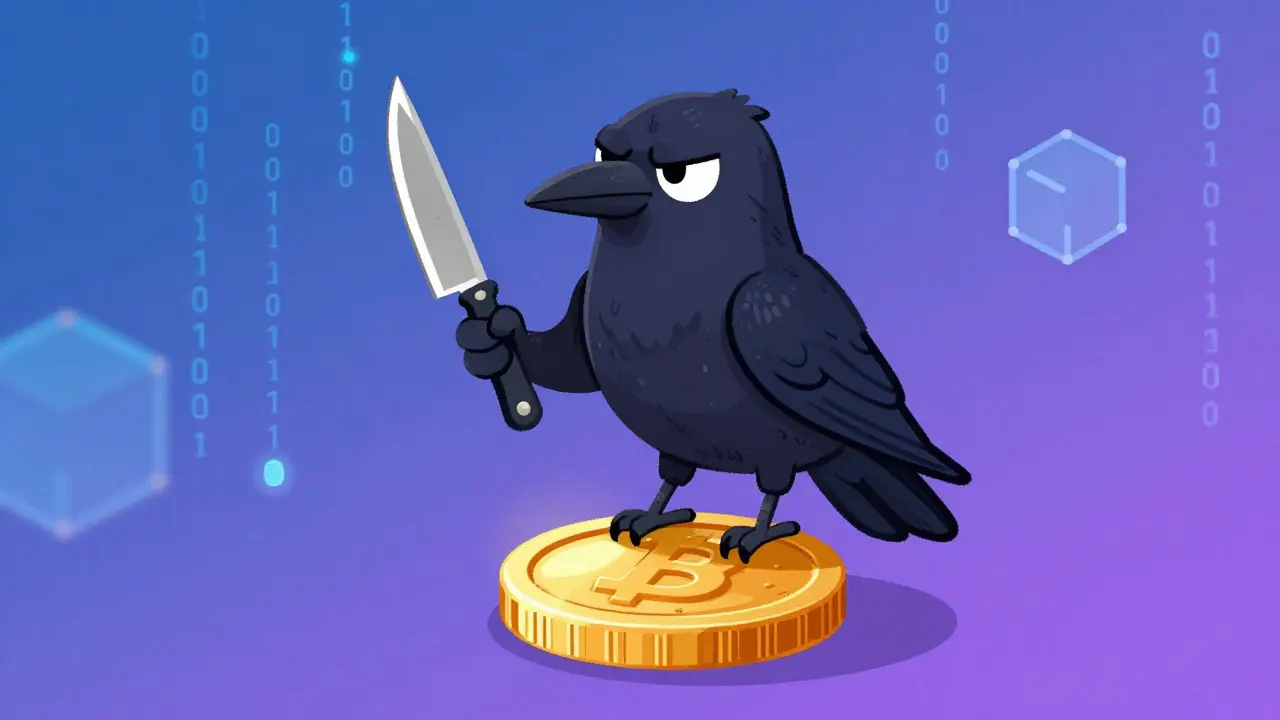
Imagine buying a digital coin that looks like a cartoon crow holding a knife. You might think you are investing in something clever or funny. In reality, you are likely stepping into one of the most volatile corners of the cryptocurrency market. Crow with Knife (CAW) is exactly that-a meme coin launched in 2024 that has captured the attention of speculative traders while largely ignoring traditional financial metrics.
If you have stumbled upon CAW on your feed or heard about it in a Telegram group, you probably want to know if it is worth your money. The short answer is complicated. It is not an investment in the traditional sense. It is a high-risk gamble wrapped in internet humor. Let us break down what this token actually is, how it works across different blockchains, and why experts generally advise extreme caution.
Understanding the Crow with Knife (CAW) Ecosystem
To understand CAW, you first need to understand the genre it belongs to. It is a meme coin. Unlike Bitcoin, which aims to be digital gold, or Ethereum, which powers smart contracts, meme coins derive their value primarily from community hype, social media trends, and cultural relevance. CAW fits squarely into the "animal meme" subgenre, sitting alongside giants like Dogecoin and Shiba Inu but with significantly less traction.
Launched in 2024, CAW operates as a multi-chain token. This means it does not live on just one blockchain. Instead, developers created versions of the token for five major ecosystems: Cronos, Solana, Polygon, Arbitrum, and BNB Chain. This strategy was likely designed to maximize visibility and allow traders on different platforms to access the asset without needing to bridge assets manually every time.
| Attribute | Value / Detail |
|---|---|
| Total Supply | 778 Trillion Tokens |
| Circulating Supply | ~770 Trillion Tokens |
| Supported Chains | Cronos, Solana, Polygon, Arbitrum, BNB Chain |
| Token Standard | ERC-20 compatible (18 decimals) on EVM chains |
| Primary Use Case | Speculative Trading / Community Meme |
The sheer number of tokens-nearly 778 trillion-is intentional. In the world of meme coins, massive supplies create a psychological illusion of affordability. When you can buy trillions of tokens for $50, it feels like you own a lot. However, this also means the price per individual token will always be microscopic. As of late 2025, the price hovered around $0.000000014 USD. Do not let the zeros fool you; the math remains strict.
Price Volatility and Market Reality
Let us talk numbers, because they tell a stark story. While top-tier cryptocurrencies like Bitcoin or Ethereum have stable markets backed by billions in daily volume, CAW exists in the shadows. Its market capitalization sits at approximately $19.32 million. To put that in perspective, that is less than 0.001% of the total cryptocurrency market cap. It ranks outside the top 2,800 projects globally.
Low market cap equals high volatility. On any given day, CAW can swing wildly. Data from November 2025 showed price swings ranging from -13% to -23% in a single 24-hour period. For context, if you invested $100, you could lose $23 overnight without any change in the broader crypto market. This happens because liquidity is thin. There simply are not enough buyers and sellers to stabilize the price.
Furthermore, data discrepancies plague smaller coins. Some tracking platforms incorrectly listed CAW at $0.07 due to decimal errors, failing to account for the 18 decimal places standard in ERC-20 tokens. Always verify prices on multiple reputable sources like CoinMarketCap or Coinbase before making any decisions. Relying on a single app can lead to costly mistakes.
How to Trade CAW: The Technical Hurdles
Buying CAW is not as simple as clicking "Buy" on a major exchange like Coinbase or Binance. Because it is a low-cap token, it is rarely listed directly against fiat currencies like the US Dollar or Euro. You typically have to go through a decentralized exchange (DEX) or a specialized platform like Gate.io.
Here is the typical process a trader faces:
- Acquire Base Currency: Buy ETH, BTC, or USDT on a centralized exchange.
- Transfer to Wallet: Send these funds to a self-custody wallet like MetaMask (for EVM chains) or Phantom (for Solana).
- Select the Correct Network: This is the most critical step. If you try to send CAW via the wrong network address, your funds may be lost forever. Each chain has a unique contract address.
- Swap on DEX: Connect your wallet to a decentralized exchange like Uniswap or Raydium and swap your base currency for CAW.
This process introduces significant friction. More importantly, it introduces slippage. Slippage is the difference between the expected price of a trade and the executed price. Due to fragmented liquidity, average slippage on small orders for CAW has been reported at over 24%. That means if you try to sell $100 worth of CAW, you might only receive $76 after fees and price impact. This is a major red flag for anyone looking to enter and exit positions quickly.
Risks and Regulatory Headwinds
You cannot discuss meme coins without discussing risk. CAW carries several layers of danger that go beyond normal market fluctuations.
First, there is no identifiable founding team. Most information about the creators is missing from official documentation. In the crypto world, anonymity is common, but when combined with zero utility, it raises concerns about accountability. If the project fails or if issues arise with the smart contracts, there is no one to call.
Second, regulatory scrutiny is tightening. In May 2025, the SEC issued guidance classifying tokens with "no utility and solely speculative value" as securities. CAW fits this description perfectly. It has no real-world application, no governance rights, and no underlying asset. This classification could restrict its availability on US-based exchanges, further reducing liquidity and accessibility for American investors.
Third, consider the survival rate. According to Messari’s Q3 2025 report, 68% of new cryptocurrency listings fall below the $50 million market cap threshold. Of those, the average survival time before delisting is just 117 days. VanEck’s Micro-Cap Crypto Report projected that 92% of tokens under $20 million would become worthless within 18 months. CAW, sitting at ~$19 million, is right in the danger zone.
Community Sentiment and Future Outlook
So, who is buying CAW? The user base consists almost entirely of retail speculators. Social media sentiment on platforms like Reddit and Telegram reflects a "get rich quick" mentality rather than long-term investment strategy. Users often cite the humorous artwork-the crow with the knife-as the primary reason for engagement.
However, engagement is declining. Data from DappRadar in late 2025 showed a nearly 70% drop in unique active wallets over a 90-day period. Transaction volumes followed suit, dropping by over 71%. The GitHub repository associated with the project has seen no commits since March 2024, suggesting development has stalled completely.
Predictions for CAW are sharply divided. Retail analysts on forums often predict massive gains, driven by hope and FOMO (Fear Of Missing Out). Meanwhile, data-driven analysts point to the declining metrics and predict delisting by mid-2026. Without a roadmap, new features, or institutional interest, the latter scenario appears more plausible based on historical patterns of similar tokens.
Conclusion: Is CAW Worth It?
Crow with Knife (CAW) is a classic example of a high-risk, low-reward speculative asset. It offers entertainment value and the thrill of gambling, but it lacks the fundamentals required for sustainable growth. If you decide to interact with CAW, treat it as disposable income-money you are fully prepared to lose. Never invest funds meant for rent, savings, or emergency expenses.
For serious crypto investors, established assets with clear utility, strong teams, and robust liquidity remain the safer choice. CAW serves as a reminder that in the crypto world, not everything that shines is gold. Sometimes, it is just a meme with a knife.
What is the current price of Crow with Knife (CAW)?
As of late 2025, the price of CAW fluctuates around $0.000000014 USD. However, prices vary significantly across different exchanges and blockchain networks due to low liquidity. Always check real-time data on reputable trackers like CoinMarketCap or Coinbase before trading.
Is Crow with Knife (CAW) a scam?
While there is no definitive proof of a malicious "rug pull," CAW exhibits many characteristics of high-risk speculative assets. It has an anonymous team, no utility, and declining activity. These factors make it extremely risky, bordering on speculative gambling rather than legitimate investment.
Which blockchains support CAW?
CAW is a multi-chain token available on Cronos, Solana, Polygon, Arbitrum, and BNB Chain. Each network has a specific contract address, so users must ensure they are interacting with the correct version of the token to avoid losing funds.
Why is the supply of CAW so large?
The total supply of 778 trillion tokens is a common tactic in meme coins. It creates a psychological appeal for retail traders who prefer owning "trillions" of units rather than fractions of a dollar. However, this massive supply keeps the individual token price extremely low and contributes to volatility.
Can I buy CAW with USD directly?
No, CAW is not typically listed on major centralized exchanges for direct fiat purchase. You usually need to buy a base cryptocurrency like ETH or USDT first, transfer it to a compatible wallet, and then swap it for CAW on a decentralized exchange.
What are the risks of investing in CAW?
Risks include extreme price volatility, high slippage fees during trades, potential regulatory bans (as it may be classified as a security), and the likelihood of the token becoming worthless due to lack of development or community interest. Historical data suggests most micro-cap meme coins fail within 18 months.
Does CAW have any real-world utility?
No. CAW is purely a speculative meme token. It does not offer governance rights, staking rewards, or integration with real-world services. Its value is derived entirely from community sentiment and trading activity.
Who created Crow with Knife (CAW)?
The founding team behind CAW is anonymous. No identifiable individuals or organizations are listed in official documentation, which is typical for many meme coins but adds to the investment risk.
Another article telling you to be careful about losing your money on garbage. Groundbreaking journalism right there.
This entire crypto ecosystem is a scam designed to bleed the working class dry while the elites laugh all the way to the bank. It's pathetic that people still fall for this digital snake oil. We need strict regulations now, not some vague warnings from bloggers who probably own bags of these trash tokens themselves. The system is rigged against you.
The SEC isn't trying to protect you; they're trying to control the narrative and crush decentralized freedom. This token is just another symptom of a deeper rot in our financial infrastructure where anonymous actors manipulate markets with impunity. You have to look at the contract addresses because the centralized exchanges are already compromised by government backdoors. Trust no one but your own hardware wallet.
You gotta keep your head up out there! Just because one coin fails doesn't mean the whole game is over. Stay focused on your goals and don't let the haters bring down your vibe. Keep grinding!
I feel so much pain reading this. It breaks my heart to see people get hurt like this. But remember, every loss is a lesson wrapped in a tough package. I believe in your ability to bounce back stronger than ever before. Let's spread some love instead of hate.
Wait wait wait hold on a second. Are we really talking about a crow with a knife? Like literally a bird holding a weapon? That is the most absurd thing I have ever heard. I cannot believe this exists in 2025. My mind is blown. Absolutely ridiculous.
The slippage metrics mentioned here are indicative of severe liquidity fragmentation across the EVM chains. When you see 24% slippage on a swap, it means the order book depth is non-existent. You are essentially eating the spread entirely. It's a classic pump and dump structure disguised as community engagement. Look at the GitHub commits. Zero activity since March. That's a dead project waiting for the final rug pull. Don't touch it with a ten-foot pole.
I am curious about the multi-chain strategy though. Why did they choose Cronos and Arbitrum specifically? Is there any technical advantage or was it just random selection to appear more legitimate? I try to understand the logic behind these decisions even if the outcome seems poor.
It is important to approach this topic with an open mind. While the risks are evident, dismissing all meme coins ignores the cultural phenomenon they represent. Perhaps there is value in the community aspect itself, regardless of the financial utility. We should seek understanding rather than immediate condemnation.
honestly i just want ppl to stop losing their savings lol