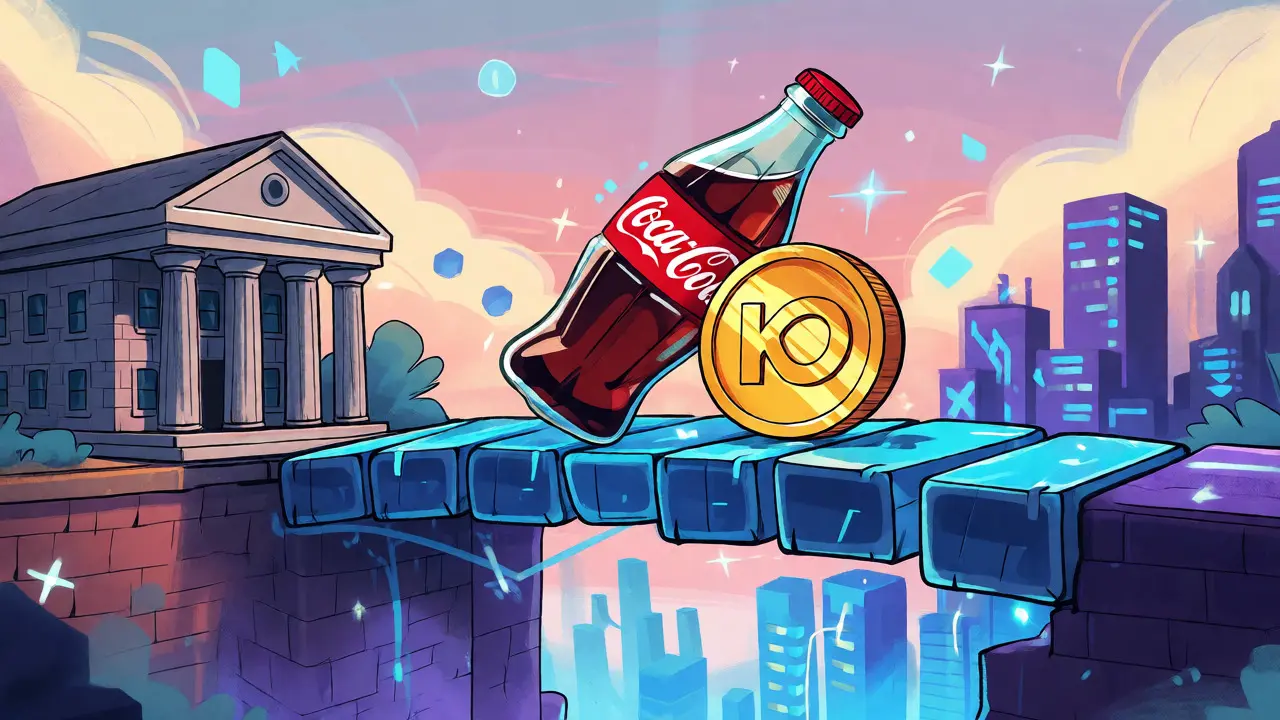
Imagine buying shares of Coca-Cola without opening a brokerage account, dealing with time zones, or worrying about cross-border fees. That’s the promise behind KOon, a tokenized representation of Coca-Cola Company stock issued by Ondo Finance. If you’ve seen this ticker popping up on crypto exchanges and wondered if it’s just another meme coin or something more substantial, you’re in the right place. This isn’t a speculative asset driven by hype; it’s a digital wrapper around one of the world’s most recognizable blue-chip stocks.
The core idea here is simple: bridge the gap between traditional finance (TradFi) and blockchain technology. For years, international investors faced hurdles accessing U.S. equities. Geographic restrictions, complex compliance checks, and limited trading hours kept many out. Ondo Finance aimed to fix that by putting Coca-Cola shares on the blockchain. But how does it actually work? Is it safe? And should you care? Let’s break down what KOon really is, how it trades, and where it fits in the evolving landscape of real-world assets (RWA).
Understanding the Mechanics of KOon
Ondo Finance created a system where each KOon token represents economic exposure to Coca-Cola stock (KO). Think of it as a digital IOU backed by real shares held in custody. When you buy KOon, you aren’t just holding a random code; you’re holding a claim on the performance of Coca-Cola. The token operates on an Ethereum-compatible network, utilizing the ERC-20 standard, which means it behaves like most other tokens you might already have in your wallet.
Here’s the critical distinction: KOon is not Coca-Cola itself. It’s a synthetic derivative designed to track the price of KO. The underlying shares are held by Ondo Finance or its custodians. This structure allows for features traditional stocks don’t offer, like 24/5 trading availability. While the New York Stock Exchange closes at 4 PM ET, KOon can be traded continuously during those hours, giving global investors flexibility. However, because it tracks a real stock, its value moves in lockstep with Coca-Cola’s market price, minus any minor tracking errors or premiums/discounts based on liquidity.
One major selling point is automatic dividend reinvestment. In traditional investing, dividends hit your cash balance, and you have to manually decide whether to reinvest them. With KOon, the protocol handles this automatically. When Coca-Cola pays a dividend, the value is reflected in the token’s net asset value (NAV), effectively compounding your position without you lifting a finger. This appeals heavily to passive investors who want growth without active management.
Market Performance and Liquidity Metrics
As of late 2026, KOon sits in a niche but active corner of the crypto market. Data from platforms like CoinMarketCap and CoinGecko shows a price hovering around $79.50-$80.00 USD, closely mirroring the actual share price of Coca-Cola. The market capitalization remains modest, sitting near $3.5 million, which places it well outside the top 1,000 cryptocurrencies by size. Don’t let the small cap fool you, though. The volume-to-market-cap ratio is surprisingly high-around 79%-indicating that a significant portion of the total token supply changes hands daily.
| Metric | Value / Status | Context |
|---|---|---|
| Current Price | ~$79.50 - $80.00 | Tracks KO stock price closely |
| Market Cap | ~$3.5 Million | Niche product, early adoption phase |
| Circulating Supply | ~44,900 Tokens | Dynamic supply based on minting/redemption |
| Holder Count | ~550 Addresses | Concentrated user base |
| All-Time High | $83.67 (March 2026) | Recent peak before slight correction |
| Security Rating | 3.6/5 (CertiK) | Audited but requires due diligence |
The low number of holders-roughly 550 addresses-suggests that while trading activity is healthy relative to its size, ownership is concentrated among sophisticated users or bots engaging in arbitrage. There is no maximum supply cap. Instead, the supply expands when new users mint tokens (buying into the pool) and contracts when they redeem them. This elastic supply model ensures the token stays pegged to the underlying asset’s value, provided the redemption mechanism works smoothly.

Who Should Consider Buying KOon?
If you live in the United States, you might ask why you’d bother with KOon when you can just buy KO through Fidelity or Schwab. For U.S. residents, regulatory clarity often makes direct ownership simpler and cheaper. However, the story changes dramatically for non-U.S. investors. Many countries restrict access to U.S. equity markets or impose heavy taxes and paperwork barriers. For someone in Southeast Asia, Latin America, or parts of Europe, KOon offers a frictionless entry point.
You don’t need to open a foreign brokerage account. You just need a crypto wallet and some stablecoins or fiat currency accepted on supported exchanges. Platforms like Bybit, Binance, and Crypto.com list KOon, allowing users to trade it alongside Bitcoin or Ethereum. The process is identical to buying any other altcoin: deposit funds, search for the ticker, and execute a market or limit order.
- Global Accessibility: Ideal for users in regions with limited access to U.S. brokers.
- 24/5 Trading: Trade during Asian or European business hours without waiting for the NYSE to open.
- Dividend Automation: Hands-off compounding of Coca-Cola dividends.
- Portfolio Diversification: Add blue-chip stability to a volatile crypto portfolio.
Risks and Limitations to Watch
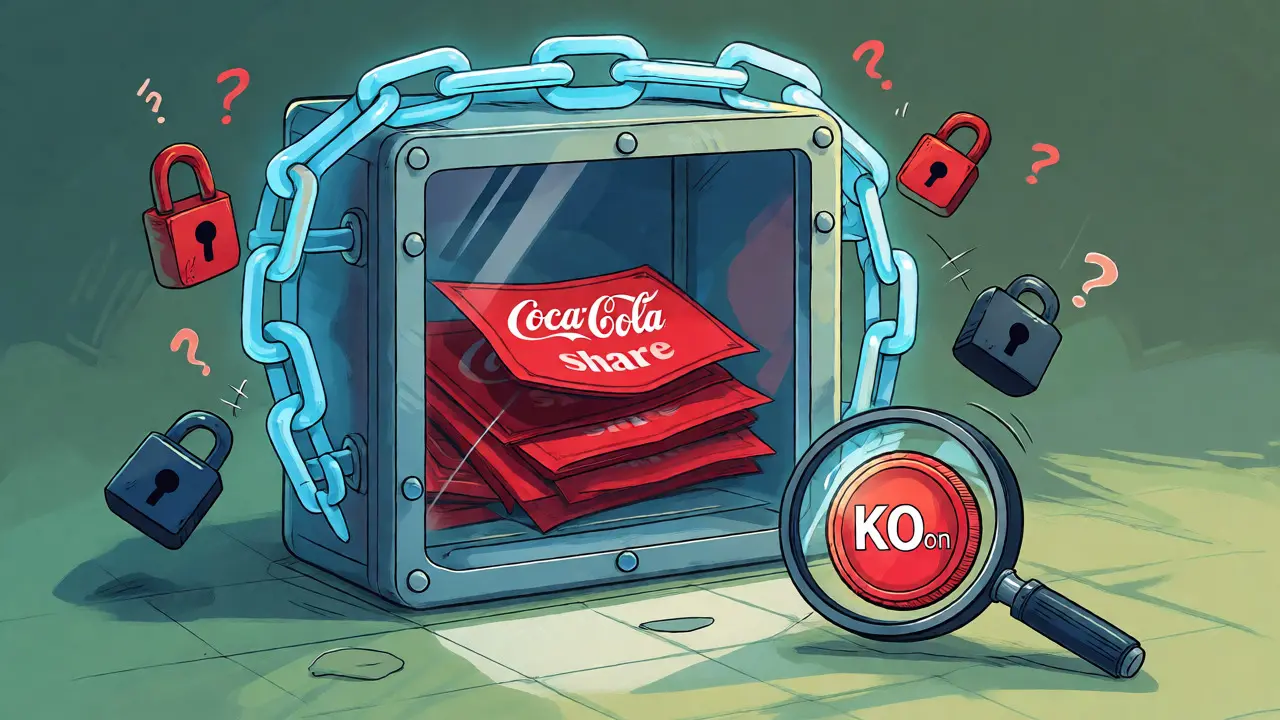
No financial instrument is risk-free, and tokenized stocks carry unique dangers. First, there’s counterparty risk. Unlike holding physical shares where you own a piece of the company directly via a registered broker, KOon relies on Ondo Finance’s ability to maintain proper custody of the underlying shares. If Ondo faces legal trouble, insolvency, or operational failure, your claim to the stock could be jeopardized. This is why checking security audits, like the CertiK rating mentioned earlier, matters.
Second, regulatory uncertainty looms large. The SEC and other global bodies are still defining how tokenized securities fit into existing laws. A sudden regulatory shift could restrict who can buy KOon or how it’s taxed. Additionally, while the price tracks KO closely, slippage can occur during periods of low liquidity. Since the holder count is low, large sell-offs might temporarily decouple the token price from the underlying stock until arbitrageurs step in.
Finally, consider the fee structure. While advertised as low-cost, frequent traders must compare exchange fees against traditional broker commissions. For long-term holders, the convenience might outweigh the costs, but for day traders, the spread and gas fees on the blockchain layer could eat into profits.
How to Buy and Sell KOon
Getting started is straightforward if you’re already comfortable with crypto exchanges. Here’s a typical workflow using a major platform like Bybit or Binance:
- Create and Verify Account: Sign up and complete Level 1 KYC (Know Your Customer) verification. This usually involves uploading an ID and a selfie.
- Deposit Funds: Transfer USDT, USDC, or fiat currency into your exchange wallet.
- Locate KOon: Use the search bar to find "KOon" or "KOON." Ensure you’re selecting the correct contract address if multiple listings exist.
- Execute Order: Choose between a market order (instant execution at current price) or a limit order (set your desired price). Given the tight tracking to KO, limit orders help avoid paying unnecessary premiums.
- Manage Holdings: Tokens appear in your spot wallet. To exit, reverse the process: sell for stablecoins and withdraw to your bank or convert back to other cryptos.
Remember, you cannot typically transfer KOon directly to a traditional brokerage account. Redemption usually happens within the Ondo ecosystem or specific partner exchanges, converting the token back to fiat or stablecoins. Always check the specific withdrawal procedures of your chosen exchange before buying.
The Future of Tokenized Equities
KOon is part of a broader trend known as Real World Assets (RWA) tokenization. Major institutions like BlackRock and Franklin Templeton are exploring similar models, signaling that this isn’t just a crypto-native experiment. As blockchain infrastructure matures and regulations clarify, we’ll likely see more blue-chip stocks-from Apple to Microsoft-available as tokens.
For now, KOon serves as a proof-of-concept that successful legacy companies can integrate with DeFi rails. It offers a bridge for the unbanked or underbanked globally, providing access to wealth-building assets previously reserved for those with international brokerage accounts. Whether it becomes a mainstream staple depends on Ondo Finance’s ability to scale liquidity and navigate the regulatory maze. If you’re looking for a way to hold Coca-Cola exposure without leaving the crypto ecosystem, KOon is a viable, albeit niche, option.
Is KOon the same as owning Coca-Cola stock?
No, it is not the same. KOon is a tokenized derivative that provides economic exposure to Coca-Cola stock. You do not receive voting rights, and you rely on Ondo Finance’s custody arrangements rather than holding shares directly in a brokerage account.
Can I vote on Coca-Cola shareholder issues with KOon?
Generally, no. Tokenized stocks like KOon typically do not grant voting rights to token holders. These rights remain with the entity holding the underlying physical shares, which is Ondo Finance or its designated custodian.
Where can I buy KOon crypto?
KOon is available on several major cryptocurrency exchanges, including Bybit, Binance, Crypto.com, and others listed on aggregators like CoinMarketCap. Availability may vary by region due to local regulations.
Does KOon pay dividends directly to my wallet?
Not exactly. Dividends are automatically reinvested into the token's value, increasing the Net Asset Value (NAV) per token. You realize this gain when you sell the token, rather than receiving separate cash payments.
Is KOon safe to hold?
Safety depends on two factors: the smart contract security (audited by firms like CertiK) and the solvency/compliance of Ondo Finance. While the underlying asset (Coca-Cola) is stable, the tokenized structure introduces counterparty risk that traditional stocks do not have.
Let's cut through the noise here because most people are missing the forest for the trees.
You call this a bridge to TradFi but it is nothing more than a synthetic derivative wrapped in blockchain jargon to justify high fees and low liquidity. You do not own the stock you hold an IOU that can be revoked if Ondo gets sued or if the SEC decides to have a bad day which is a massive counterparty risk that traditional brokerage accounts simply do not carry with the same intensity. The market cap is three million dollars which is absolutely laughable when compared to Coca-Cola's trillion-dollar valuation meaning you are trading in a vacuum where slippage will destroy your returns on any meaningful trade size. Why would anyone in the US bother with this when they can buy actual shares with voting rights and no custody risk from their existing broker for zero commission. This is a solution looking for a problem and it only makes sense for users in regions with strict capital controls who are desperate for exposure and willing to accept inferior terms just to get access. The dividend reinvestment feature is nice but you are paying for convenience with security and regulatory uncertainty which is a poor trade-off for serious investors. Do not let the marketing fool you into thinking this is equal to owning equity it is a shadow of the real thing and shadows disappear when the light source moves.
bro you clearly dont understand the rwa thesis
its about composability and 24/5 liquidity not just ownership structure
the custodial risk is priced in via the tracking error and its minimal atm
plus the frictionless entry for non-us users is huge for adoption metrics
youre stuck in legacy mindset thinking vps vs aws
smart contract audits by certik mitigate the code risk significantly
regulatory clarity is coming anyway so front running the curve is smart
Honestly though isn't it kind of weird that we're tokenizing stocks now? I mean I get the tech stuff but like do we really need another layer between me and my Coke money? It feels a bit unnecessary if you ask me especially since I already have a Robinhood account lol.
I think it’s actually pretty cool! 🥤 It’s like having the stability of blue chips mixed with the speed of crypto. Plus no waiting for NYSE hours is a game changer for us night owls 😴✨ Definitely worth a small allocation if you’re curious!
oh great another way to pay fees for something i could buy directly
but hey at least the dividends auto compound right? saves me the hassle of clicking buttons every quarter i suppose
still seems like a lot of middlemen for one soda company
dont listen to the haters guys this is legit!
i bought some last week and its been smooth sailing so far
fees were low and the app was super easy to use
definitely gonna add more next month keep it up oendo team!
This is exactly what happens when you prioritize convenience over integrity. By removing direct ownership and voting rights, you are creating a class of second-tier shareholders who don't actually participate in the governance of the companies they fund. It is morally bankrupt to sell a product that strips away fundamental shareholder rights under the guise of technological innovation. We should be demanding better access to real equity not accepting diluted versions of it just because it fits on a blockchain. If you cannot vote you do not truly own it and that distinction matters more than you realize.
While the sentiment is understandable the technical reality is far more nuanced. One must consider that ERC-20 standards provide interoperability across DeFi protocols which is a utility that traditional equities lack entirely. Furthermore the atomic settlement nature of blockchain transactions eliminates T+2 settlement risk which is a significant hidden cost in traditional markets. To dismiss this as mere convenience is to ignore the structural inefficiencies of legacy financial rails. The counterparty risk is indeed present but it is managed through transparent on-chain proof of reserves which is arguably more auditable than opaque bank statements. :)
yeah cause buying stock directly is so hard right
just use your bank duh
complicated for complicated people
It is fascinating to observe how this technology attempts to democratize access while simultaneously introducing new layers of complexity. From a philosophical standpoint, we must question whether the abstraction of ownership through tokens dilutes our connection to the underlying economic activity. However, for those excluded from traditional systems, this abstraction might serve as a vital lifeline rather than a barrier. It is a delicate balance between accessibility and authenticity that requires careful consideration from both regulators and consumers alike.
I appreciate the thoughtful analysis regarding the risks involved. It raises an interesting point about the nature of value itself. Is value derived from legal title or from economic exposure? Perhaps we are witnessing a shift where functional equivalence becomes more important than formal ownership structures. It is a quiet revolution happening in the background that few fully grasp yet.