Imagine buying a coin that pays you just for holding it. No staking buttons to click, no complex setups-just automatic rewards flowing into your wallet every time someone else trades. That’s the promise of Bonfire, a deflationary cryptocurrency token built on the Binance Smart Chain that uses the Reflect Finance model to distribute transaction fees directly to holders. But behind this simple premise lies a high-risk, speculative asset with a dramatic history. If you’re wondering what Bonfire actually is, how it works, and whether it’s worth your attention in 2026, you’ve come to the right place.
The Core Concept: Passive Income Through Reflections
At its heart, Bonfire is not a traditional utility token. It doesn’t grant access to a specific app or service right out of the gate. Instead, it operates as a yield-generating contract based on the Reflect Finance protocol, which pioneered the concept of "reflection" tokens. In simple terms, whenever any transaction occurs involving Bonfire-whether someone buys, sells, or transfers tokens-a fee is automatically deducted. A portion of that fee is instantly redistributed to all existing holders proportional to their balance.
This means if you hold 1% of the total supply, you receive 1% of the reflected fees. There’s no need to stake your tokens or lock them up. The smart contract handles everything in real-time. For investors tired of active management, this frictionless yield model was revolutionary when it launched in 2021. However, it also creates inherent inflationary pressure on individual token value, since new tokens are continuously printed and distributed rather than generated from external revenue streams.
How the 10% Transaction Fee Works
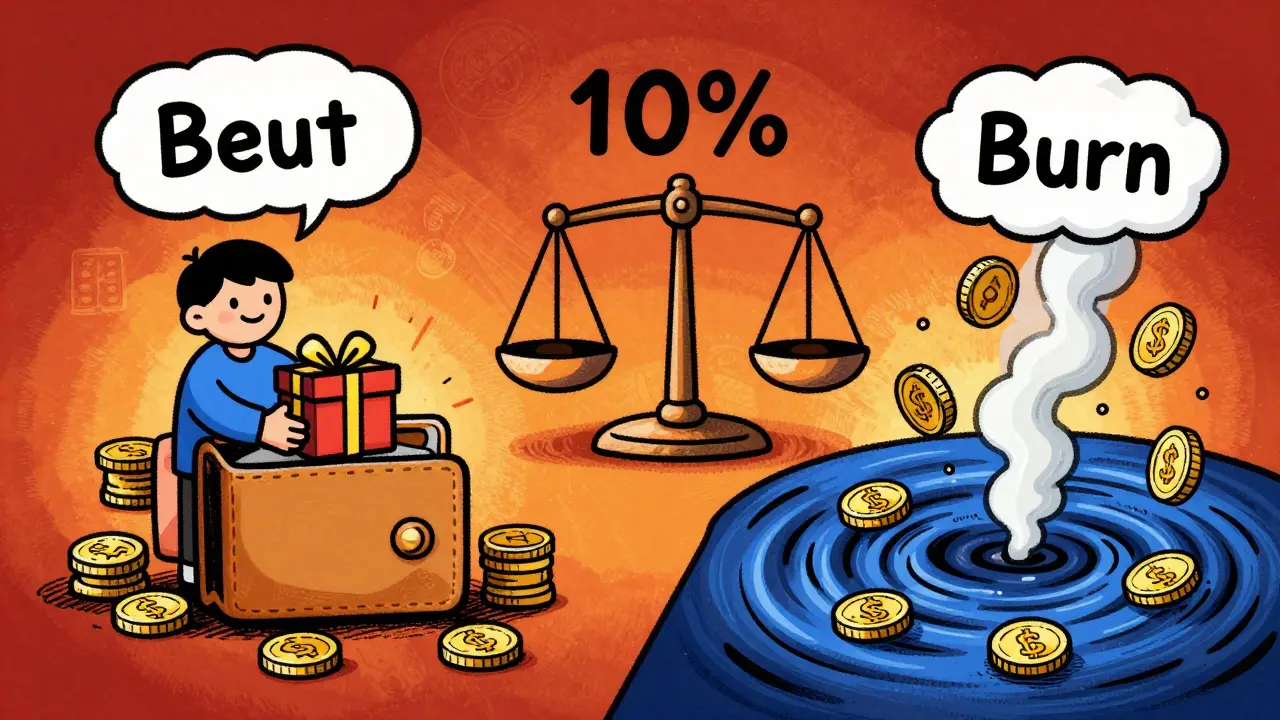
To understand Bonfire’s economics, you need to look at its dual-fee structure. Every transaction incurs a total 10% tax, split evenly between two mechanisms:
- 5% Holder Redistribution: This half goes directly to all token holders via the reflection mechanism described above. It rewards long-term holding behavior.
- 5% Liquidity Pool Injection: The other half is automatically sent to an auto-compounding liquidity pool on decentralized exchanges like PancakeSwap. This helps stabilize trading pairs and reduces volatility over time.
Additionally, part of these fees triggers a deflationary burn mechanism. Tokens are permanently removed from circulation by sending them to a dead address-a wallet with no private keys. According to data from J2TX, approximately 42% of the total supply had been burned as of recent records. With a fixed initial supply of one quadrillion (1,000,000,000,000,000) tokens, this burning process theoretically increases scarcity over time.
| Fee Component | Percentage | Purpose |
|---|---|---|
| Holder Reflection | 5% | Redistributed proportionally to all holders |
| Liquidity Pool | 5% | Auto-injected into DEX pools for stability |
| Total Tax | 10% | Applied to every buy, sell, or transfer |
Market Performance and Price History
Let’s talk numbers because they tell a stark story. Bonfire reached its all-time high price of $0.00000094 on May 10, 2021, during the peak of the altcoin bull run. As of early 2026, the price hovers around $0.0000000099 according to Coinbase and CoinGecko data. That represents a decline of roughly 99% from its peak.
While short-term fluctuations show minor gains-such as a 4% increase over 24 hours or a 9% rise over a week-the broader trend remains deeply bearish. The fully diluted valuation (FDV) sits at approximately BTC 48.3052, meaning even if all tokens were circulating, the market cap would remain negligible compared to major cryptocurrencies.
This extreme depreciation reflects broader patterns seen across many meme-inspired and community-driven tokens launched during the 2021 crypto boom. Early adopters saw massive returns, but late entrants faced steep losses as hype faded and liquidity dried up. The extremely low per-token price combined with a quadrillion-unit supply makes each purchase highly speculative.
Security Features: Renounced Contracts and Decentralization
One critical advantage Bonfire offers is transparency through renunciation. After launch, the developers formally renounced ownership of the smart contract. What does this mean? No one-not even the original team-can alter the code, change fee structures, mint new tokens beyond the set rules, or withdraw liquidity reserves.
This measure protects against common DeFi risks like rug pulls, where creators abandon projects after draining funds. By locking down control, Bonfire operates autonomously. You can verify this status yourself on blockchain explorers like BscScan. Still, remember that renunciation only prevents malicious changes-it doesn’t guarantee profitability or project success.
Ecosystem Ambitions vs. Reality
Bonfire wasn’t designed to be just another reflection token. Its roadmap outlines a broader vision: building a decentralized social media platform integrated with NFT marketplaces, cryptocurrency exchange tools, and metaverse-compatible utilities. These initiatives aim to create a niche digital haven resistant to inflation and centralized censorship.
However, years later, much of this infrastructure remains aspirational. While the core token functions smoothly on Binance Smart Chain, offering faster transactions and lower fees than Ethereum mainnet alternatives, the promised ecosystem expansions have yet to materialize at scale. Community engagement through giveaways, competitions, and charity drives has kept interest alive, but without tangible products, adoption struggles to grow organically.
The focus on integrating with Web3 solutions sounds promising, yet execution timelines remain vague. Prospective users should distinguish between stated goals and operational reality before allocating capital.
Risks Every Investor Should Understand
If you’re considering buying Bonfire, here’s what you must weigh carefully:
- Extreme Volatility: A 99% drop from ATH shows how fragile speculative assets can be.
- High Trading Costs: The 10% fee applies to both buys and sells, making frequent trading costly.
- Inflationary Pressure: Continuous token printing via reflections dilutes individual holdings unless demand grows faster.
- Lack of Utility: Without functional apps or services driving usage, value depends entirely on speculation and community sentiment.
- Dependence on New Buyers: Like many Ponzi-like models, sustainability relies on constant inflow of fresh capital to sustain prices and provide exit liquidity.
These factors make Bonfire unsuitable for conservative portfolios. It appeals primarily to traders comfortable with high risk and those interested in experimenting with novel tokenomic designs.
Is Bonfire Worth Your Attention in 2026?
That depends on your goals. If you seek passive income without effort, Bonfire delivers exactly that-small, regular distributions triggered by network activity. If you believe in the potential of decentralized social platforms and want early exposure to an evolving ecosystem, there may be upside if development accelerates.
But if you expect steady growth, reliable dividends, or institutional-grade security, Bonfire falls short. Its strength lies in simplicity and decentralization; its weakness is lack of differentiation beyond basic mechanics. Success hinges almost entirely on sustained community momentum and eventual delivery of planned utilities.
For now, treat it as experimental finance-not investment advice. Always do your own research, start small, and never invest more than you can afford to lose.
What is Bonfire (BONFIRE) crypto coin?
Bonfire is a deflationary cryptocurrency token launched in 2021 on the Binance Smart Chain. It uses the Reflect Finance model to automatically redistribute 5% of every transaction fee to all token holders, while another 5% supports liquidity pools and burns remaining tokens to reduce supply.
How does Bonfire generate passive income?
Passive income comes from the 5% transaction fee redistributed to holders proportionally based on their balance. Rewards accrue automatically without staking or manual claims, thanks to the smart contract’s reflection mechanism.
Why did Bonfire’s price drop 99% from its all-time high?
The sharp decline reflects typical post-hype corrections seen in speculative altcoins. After peaking in May 2021, reduced buyer interest, limited utility, and continuous token issuance led to sustained downward pressure despite ongoing community efforts.
Is Bonfire safe to invest in?
Bonfire includes safety features like a renounced contract, preventing developer tampering. However, it carries significant financial risk due to extreme volatility, high transaction fees, and reliance on speculative demand rather than proven utility.
What is the total supply of Bonfire tokens?
The total supply is fixed at one quadrillion (1,000,000,000,000,000) tokens. Approximately 42% have been burned so far, reducing circulating supply and increasing scarcity over time.
Can I trade Bonfire on major exchanges?
Bonfire trades primarily on decentralized exchanges like PancakeSwap within the Binance Smart Chain ecosystem. Centralized listings are limited, affecting accessibility and liquidity for average investors.
Does Bonfire have any real-world use cases?
Currently, Bonfire lacks widely adopted real-world applications. Its roadmap includes plans for a decentralized social platform, NFT marketplace, and metaverse integrations, but these remain largely undeveloped as of 2026.
How do I check my Bonfire reflections?
You can view accumulated reflections using block explorers like BscScan or dedicated tracking dashboards provided by third-party analytics platforms. Simply enter your wallet address to see current balances and historical distributions.
Look, I've been in crypto since the Bitcoin halving of 2012 and let me tell you something about these reflection tokens. They are absolute garbage for anyone who actually understands how market dynamics work. The whole premise of Bonfire is that it pays you just for holding, which sounds like a dream until you realize that the 'payment' is just diluted value from other people selling. It's not real yield, it's just wealth transfer from sellers to holders, and since everyone wants to sell, the price crashes. You're getting paid in pennies while your principal evaporates. I've seen this exact pattern with SafeMoon and dozens of other BSC clones. The 10% tax is a killer for liquidity because it creates a massive spread on every trade. If you buy at $0.00000001, you instantly lose 5% of your position just by entering the trade. Then if you want to exit, you lose another 5%. That means the price has to go up 11% just for you to break even. Most retail investors don't do the math. They see 'passive income' and think they found the holy grail. Spoiler alert: there is no holy grail, only smart contracts designed to extract fees from the uninformed. The renounced contract part is nice, sure, it stops the devs from rug pulling directly, but it doesn't stop the market from going to zero. And that's exactly what happened here. A 99% drop from ATH isn't a correction, it's a death spiral. Don't waste your time chasing ghosts.
another day another scam token explainer lol. why are people still falling for this 'reflection' bs? its literally just printing money to pay off the early whales while the rest of us get crumbs. the math doesnt add up unless you believe in magic beans growing in blockchain soil. also the grammar in that article was sus, probably written by an ai or some dev trying to pump their bags before dumping on you all. typical shill post disguised as education. yawn.
you guys are missing the point entirely and its making me angry because you refuse to see the philosophical beauty in decentralization even when it fails. bonfire isnt about profit, its about the experiment of trustless redistribution. yes the price dropped 99%, but look at the community spirit! look at the charity drives! we are building a society where value flows automatically without central banks stealing our gains through inflation. i know the numbers look bad on paper but have you considered that fiat currency is also losing value every second? at least bonfire burns tokens! scarcity is key! i might be yelling but its because i care so much about this vision. dont let the haters win. keep holding. the ecosystem will come. i promise. i feel it in my bones. we are pioneers. we are the ones who build the future even if the present is painful. embrace the chaos. love the burn. trust the process. or whatever. just dont sell into the dip because thats weak energy.
This entire narrative is morally bankrupt and intellectually lazy. You are promoting a financial instrument that functions essentially as a pyramid scheme wrapped in blockchain jargon to make it sound sophisticated. The fact that the developers renounced the contract does not absolve them of creating a mechanism that relies on constant new capital inflow to sustain itself. This is predatory design targeting vulnerable individuals who lack financial literacy. The 'reflections' are not dividends; they are illusory gains that mask the erosion of actual asset value. By participating in this, you are complicit in a system that extracts wealth from late entrants to reward early speculators. It is unethical. It is dangerous. And it is a waste of computational resources on a network already plagued by spam and scams. Stop enabling this behavior. Read a book on basic economics instead of listening to influencers push low-cap meme coins with quadrillion supplies. Your ignorance is not bliss; it is liability.
I must say that the concept of automatic redistribution is quite intriguing from a theoretical standpoint. Although I am not an expert in cryptocurrency, I find the idea of passive income appealing. However, I noticed several typos in the original post which makes me wonder about the credibility of the source. Perhaps more rigorous editing would help convey the message better. Nevertheless, I appreciate the effort to explain complex mechanisms in simple terms. It is important to educate oneself before investing any funds. I hope that the project developers will continue to work towards their roadmap goals. Transparency is key in this industry. I wish everyone good luck in their endeavors.
why should i care about some random coin launched by scammers overseas? american innovation is being stifled by these unregulated foreign assets. the sec should ban this stuff immediately. it reminds me of penny stocks from the 90s except worse because nobody knows who owns the code. stick to gold or maybe treasuries if you want safety. this crypto nonsense is destroying the middle class. i lost money on ethereum and never looked back. stay away from bonfire. its trash.
You claim it is deflationary yet the supply is quadrillions of tokens. Do you comprehend the scale of that number? It is absurd. The burning mechanism is a joke when compared to the initial issuance. Furthermore, stating that the contract is renounced implies security, but it merely signifies that the creators have abandoned ship and left you to fend for yourselves against market forces. There is no team to hold accountable. There is no recourse. It is a lawless wasteland. And you lot cheer for it. Truly pathetic. The price action confirms everything I said. Down 99%. Not a correction. A collapse. Wake up.
I can hear the frustration in your voices and I want you to know that I see you. I really do. Investing in high-risk assets like Bonfire takes courage, even if the results aren't what you hoped for. Please remember that every loss is a lesson. The volatility you experienced is part of the journey. Don't let the negativity of others dim your light. You believed in the vision of decentralized social platforms and that belief is valuable. Keep learning. Keep growing. I am here for you. ❤️
when we consider the broader implications of tokenomics we must understand that value is subjective and determined by consensus rather than intrinsic utility alone. the fact that bonfire has maintained a community despite significant price depreciation suggests a certain resilience in the holder base. perhaps the reflections serve as a psychological anchor keeping users engaged with the protocol. it is not merely about financial return but about participation in a novel economic experiment. the long term viability may depend on whether the promised ecosystem developments materialize. until then we observe and learn. patience is a virtue in this space. the market cycles are long and often punishing for those who lack perspective. i encourage you to reflect on your own motivations for holding. is it greed or curiosity? both are valid drivers of human behavior. let us move forward with mindfulness.
Oh wow, another boring thread about dead coins 🙄 I'm so tired of reading about these failed projects. Why do people keep pretending this is investment advice? It's gambling with extra steps. My portfolio is down too but at least I'm not defending a coin that went to zero. Cry me a river 💔📉 #BonFireIsDead
The mainstream media will never admit that these 'failed' tokens are actually surveillance tools designed to track wallet addresses and correlate them with identity data. The renounced contract is a smokescreen to hide the fact that the liquidity pools are monitored by shadowy entities who manipulate prices to flush out weak hands. I have seen the patterns. The 10% fee is not just for redistribution; it is a tithe collected by algorithms that predict market movements based on holder behavior. You think you are holding a coin? You are holding a tracking beacon. The metaverse integration is not for socializing; it is for mapping your digital footprint in a controlled environment where dissent is algorithmically suppressed. Wake up sheeple. The quadrillion supply is irrelevant because the real value is in the data harvested from your transactions. They are watching you right now.
Hey everyone! 👋 Just wanted to chime in with some helpful info. If you are looking at Bonfire, make sure you check the current liquidity depth on PancakeSwap before buying. The slippage can be huge due to that 10% tax. Also, use a block explorer like BscScan to verify the contract address matches the official one. Scammers create fake tokens with similar names. Stay safe out there! 🛡️💰 Let me know if you need help calculating your potential returns based on current volume. Happy to assist!
I agree with the points raised about the risks involved. It is important to approach such investments with caution. The lack of tangible utility is a significant concern. However, I appreciate the detailed breakdown of the fee structure. It helps clarify how the mechanics work. Thank you for sharing this information.