
Have you ever wondered how much value your attention actually holds? We scroll through videos, watch ads, and engage with content every day, but that engagement rarely pays us directly. Bitcast (SN93) is a cryptocurrency token built on the Bittensor network designed to incentivize content creators by turning measurable audience engagement into economic rewards. It operates as the native token of Bittensor Subnet 93, a specialized layer within the broader Bittensor ecosystem.
If you’ve heard whispers about SN93 in crypto circles, you might be asking: Is this just another meme coin, or does it have real utility? The short answer is that Bitcast attempts to solve a specific problem in the digital advertising world-the disconnect between brand spending and creator compensation. By leveraging blockchain technology, it aims to create a transparent, performance-based payment system for influencers and brands alike. However, like many early-stage projects in the Web3 space, it comes with significant volatility and risks that you need to understand before diving in.
How Bitcast Works: The Decentralized Creator Economy
To understand SN93, you first need to grasp the concept of the "creator economy" in the context of blockchain. Traditionally, when a brand wants to run an ad campaign on YouTube, they pay an agency or use a centralized platform. That platform takes a cut, and the creator gets paid based on vague metrics or flat fees. Bitcast flips this model.
According to its public documentation, Bitcast functions as a decentralized platform where brands issue specific campaign briefs. Content creators, primarily those with YouTube channels, produce videos that meet these briefs. Instead of guessing if the video was good, the system relies on hard data: engagement metrics like views, likes, and interactions.
Here is where the blockchain part kicks in. The Bittensor network is a decentralized machine learning network that uses subnets to coordinate specialized services. Within this network, Subnet 93 is dedicated to Bitcast. It employs two key roles:
- Validators: These nodes verify the quality and authenticity of the engagement metrics. They ensure that the views aren’t bots and that the content matches the brand’s brief.
- Miners: In the Bittensor context, miners often refer to the service providers-in this case, the creators or the infrastructure supporting them-who are rewarded for providing valuable output.
When a video performs well, the Bittensor protocol automatically distributes SN93 tokens to the participants who contributed to that success. This removes the middleman and ensures that payment is directly tied to performance. It’s essentially a smart contract for influencer marketing.
Tokenomics: Supply, Circulation, and Dilution Risks
One of the most critical aspects of any cryptocurrency is its tokenomics-the rules governing its supply and distribution. For Bitcast (SN93), the numbers tell a story of extreme scarcity in circulation versus massive potential supply.
| Metric | Value | Implication |
|---|---|---|
| Circulating Supply | ~324,310 SN93 | Extremely low float; only ~1.5% of max supply is available. |
| Maximum Supply | 21,000,000 SN93 | Hard cap limits total inflation, but creates dilution risk. |
| Fully Diluted Valuation (FDV) | ~$56.71 Million | Theoretical market cap if all tokens were circulating. |
| Market Capitalization | ~$875,860 | Current real-world value of circulating tokens. |
Look closely at the gap between the circulating supply and the maximum supply. Currently, only about 324,000 tokens are out there, while nearly 21 million can exist. This means that over 98% of the tokens are yet to enter circulation. Why does this matter?
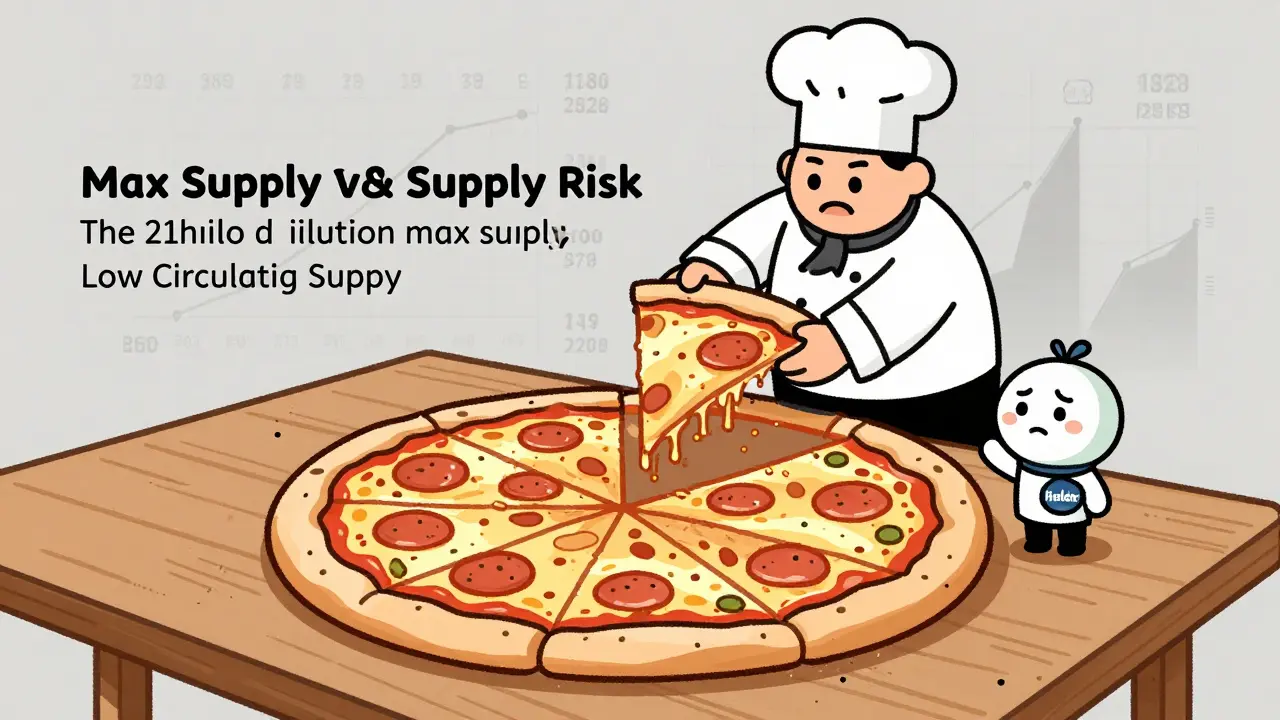
If the price remains stable, the introduction of millions more tokens could significantly dilute the value of existing holdings. Imagine a pizza cut into 10 slices; if you hold one slice, you own 10%. If the chef suddenly adds 100 more slices, your share drops to less than 1%. In crypto terms, this is known as "unlock pressure." Investors need to ask: When will these remaining 20+ million tokens be released? Who gets them? Without clear vesting schedules or allocation details publicly available, this uncertainty poses a major risk.
Price History and Volatility: What the Data Shows
Bitcast is not a stable asset. Its price history reflects the chaotic nature of micro-cap cryptocurrencies. Tracking data from platforms like CoinMarketCap and CoinGecko shows that SN93 has been actively traded since June 2025, but the price points vary wildly depending on which exchange or aggregator you look at.
For instance, CoinGecko recorded an all-time high (ATH) of approximately $2.86 in July 2025, while CoinMarketCap reported a significantly higher peak of $11.50 in August 2025. This discrepancy highlights a common issue in small-cap trading: liquidity fragmentation. Different exchanges may have different volumes, leading to divergent prices. One platform might show a price of $2.60, while another shows $4.40 for the same token at the same time.
This volatility is a double-edged sword. On one hand, it offers opportunities for rapid gains. On the other, it makes entry and exit strategies difficult. A drop of 70% from an ATH is not uncommon for assets in this category. If you are considering buying SN93, you must be prepared for swings that could wipe out a significant portion of your investment overnight.
Where Can You Trade SN93?
Finding a place to buy Bitcast isn't as simple as logging into Binance or Coinbase. As of mid-2026, SN93 is not listed on major centralized exchanges like Crypto.com or Binance for direct trading. Crypto.com explicitly notes that "SN93 is not tradable yet" on their platform, meaning they only track the price for informational purposes.
This suggests that liquidity is currently found on smaller centralized exchanges or decentralized exchanges (DEXs). While this allows for early access, it also increases counterparty risk. Smaller exchanges may have lower security standards, less liquidity, and fewer regulatory safeguards. Always verify the legitimacy of any exchange listing SN93 before connecting your wallet.

Risks and Considerations Before Investing
Before you allocate any funds to Bitcast, consider these critical factors:
- Lack of Transparency: The project team behind Bitcast remains largely anonymous, operating under the handle @Bitcast_network. There is no legal entity publicly named, and no third-party audits of their smart contracts have been widely published. In crypto, anonymity can mean privacy, but it can also mean accountability issues if things go wrong.
- Dependence on YouTube: Bitcast’s current model is tightly integrated with YouTube. If YouTube changes its API policies or cracks down on automated engagement tracking, Bitcast’s core functionality could be disrupted. It lacks diversification across other social platforms at this stage.
- Regulatory Uncertainty: As governments worldwide tighten regulations around crypto assets, tokens classified as securities or those lacking clear utility face scrutiny. Bitcast’s performance-based reward structure might attract regulatory attention depending on how it’s interpreted.
- High Dilution Risk: As mentioned earlier, the massive gap between circulating and maximum supply means future unlocks could crash the price unless demand grows exponentially.
Is Bitcast Worth Your Attention?
Bitcast represents an interesting experiment in merging the creator economy with decentralized AI networks. If you believe that decentralized advertising and performance-based creator payments are the future, SN93 offers a way to bet on that thesis. The integration with Bittensor provides a robust technical foundation, leveraging established validator-miner dynamics to ensure fairness.
However, it is crucial to approach SN93 with caution. It is a high-risk, speculative asset. The lack of detailed tokenomics, anonymous team, and extreme volatility make it unsuitable for conservative investors. Do your own research, start with amounts you can afford to lose, and stay updated on any official announcements regarding token unlocks or exchange listings.
What is the ticker symbol for Bitcast?
The ticker symbol for Bitcast is SN93. This designation identifies it as the token associated with Subnet 93 on the Bittensor network.
Is Bitcast (SN93) safe to invest in?
Like all cryptocurrencies, Bitcast carries significant risk. It is a micro-cap token with high volatility, limited liquidity, and an anonymous development team. Additionally, the large difference between circulating supply and maximum supply poses a dilution risk. It should only be considered by investors comfortable with high-risk speculative assets.
How do creators earn SN93 tokens?
Creators earn SN93 by producing content, primarily YouTube videos, that meet specific briefs issued by brands. Their earnings are determined by engagement metrics such as views and interactions, which are verified by validators on the Bittensor network.
Can I buy SN93 on Binance or Coinbase?
As of mid-2026, SN93 is not listed for direct trading on major centralized exchanges like Binance or Coinbase. Liquidity is primarily found on smaller exchanges or decentralized platforms. Always verify the current listing status on reliable aggregators like CoinMarketCap or CoinGecko.
What is the role of Bittensor in Bitcast?
Bittensor provides the underlying infrastructure for Bitcast. Specifically, Bitcast operates on Bittensor Subnet 93, using Bittensor’s decentralized network of validators and miners to verify content performance and distribute SN93 rewards securely and transparently.
Why is there a big difference between SN93's market cap and FDV?
The Fully Diluted Valuation (FDV) assumes all 21 million tokens are in circulation, while the market cap only accounts for the ~324,000 tokens currently available. This large gap indicates that most tokens are locked or unissued, creating potential sell pressure (dilution) if they are released without proportional growth in demand.