You see a new coin called Azerop (AZR) popping up in your feed. It promises passive income, eco-friendly tech, and a shiny Web3 ecosystem. But before you connect your wallet, pause. The reality of Azerop is far murkier than the marketing slides suggest. This isn't just another Bitcoin or Ethereum clone; it's a small-cap project with significant gaps in public verification. If you're wondering what this token actually does, who runs it, and whether your money is safe, here is the unvarnished truth.
The Core Promise vs. The Evidence
Azerop Network describes itself as a decentralized finance (DeFi), sustainability, and gaming ecosystem. On paper, it sounds ambitious. The official website claims to offer low transaction fees, cross-chain connectivity, and "Flash" and "Fixed" staking models for passive income. However, there is a massive disconnect between these claims and verifiable on-chain data. Unlike established protocols like Aave or Uniswap, where you can instantly check total value locked (TVL) and active users, Azerop lacks transparent metrics. There are no published audit reports from reputable firms like CertiK or Hacken. No GitHub repositories show active developer commits. When a project talks big but shows little code, you should be skeptical.
The project highlights its "eco-friendly" nature, implying a consensus mechanism that consumes less energy than Proof-of-Work chains. Yet, the whitepaper-or lack thereof-doesn't specify if it uses Proof-of-Stake, Delegated Proof-of-Stake, or something else entirely. Without knowing the underlying technology, you can't assess security or decentralization. Is it truly decentralized, or does a central entity control the ledger? The current evidence points to the latter, making the "decentralized" label more of a marketing slogan than a technical reality.
Tokenomics: Supply and Scarcity
Let's look at the numbers. Most aggregators list the total supply of AZR at 1 billion tokens. Some sources claim the circulating supply is also 1 billion, which implies all tokens are already in circulation. This is unusual for a new project. Typically, teams retain a portion of the supply for vesting over several years to align incentives. If 100% of the supply is circulating, who holds it? Are they whales dumping on retail investors? Or is the distribution so wide that no single entity has power?
Crucially, there is no detailed allocation table available. You won't find clear percentages for the team, advisors, marketing, or treasury. In crypto, transparency here is non-negotiable. Without it, you don't know if insiders can dump their holdings tomorrow, crashing the price. Furthermore, the absence of a verified smart contract address makes it hard to track holder concentration. If one wallet holds 50% of the supply, the market is effectively controlled by one person. Until we see an explorer link (like BscScan or Etherscan) with verified source code, treat these supply figures as self-reported rumors rather than blockchain facts.
The Price Paradox: $0.94 or $0?
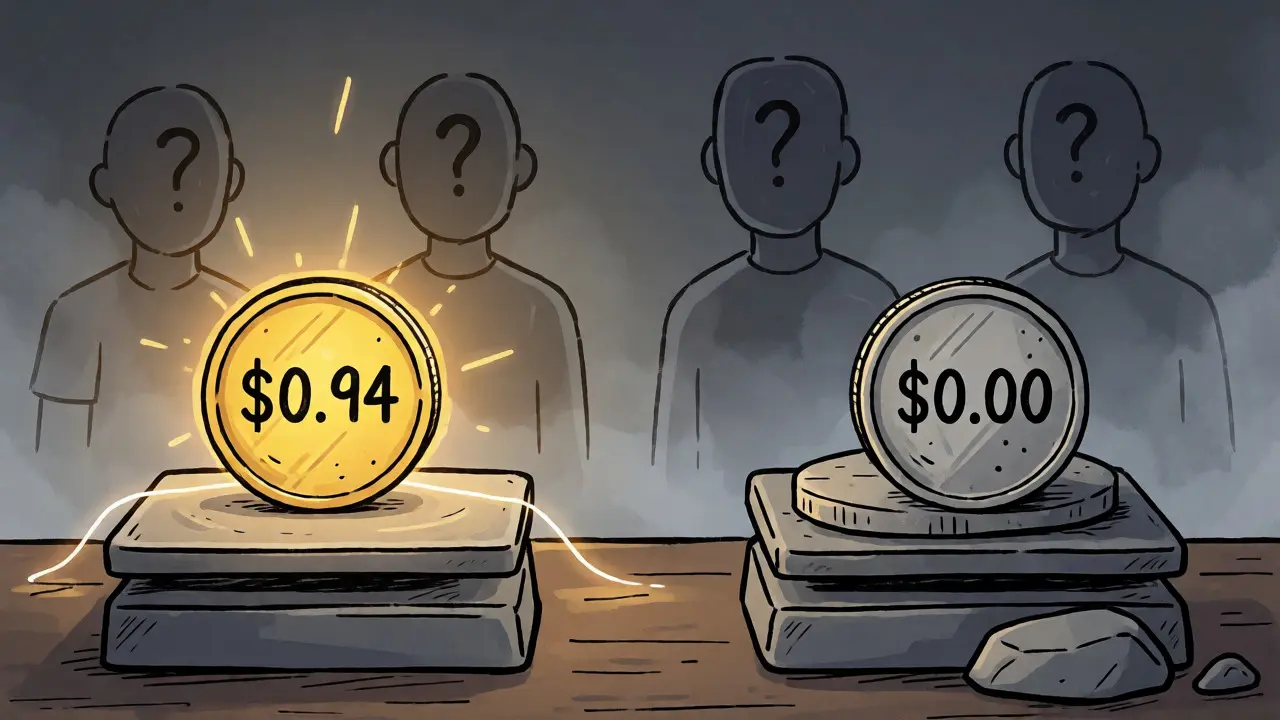
Here is where things get weird. Depending on which aggregator you check, the price of AZR varies wildly. One platform might list it at roughly $0.94, while another shows it at $0.00 with zero trading volume. How can both be true? Usually, this indicates illiquidity. The token might have been listed on a minor exchange with very few buyers and sellers. A single trade can spike the price artificially, while other platforms, lacking real-time data feeds, default to zero or stale prices.
| Metric | Crypto.com Report | Bitget Prediction Page | Implication |
|---|---|---|---|
| Current Price | ~$0.9429 | $0.00 | High volatility or stale data |
| 24h Volume | N/A | Not specified | Lack of liquidity |
| Supply Status | 1B Total/Circulating | 1B Max/Total | Potential inflationary pressure |
This discrepancy isn't just a technical glitch; it's a red flag. A healthy asset has consistent pricing across major exchanges like Binance, Coinbase, or Kraken. If AZR only trades on obscure platforms with thin order books, you might buy in at $0.94 and struggle to sell because there are no buyers at that price. Always check the actual trading pair and volume before trusting a headline price.

Staking Models: Flash and Fixed
Azerop promotes two main earning methods: "Flash" and "Fixed" staking. The pitch is simple: lock up your AZR, earn rewards. But dig deeper. What backs these rewards? In sustainable DeFi protocols, yields come from trading fees, lending interest, or real-world asset cash flows. In many micro-cap coins, yields are paid out in newly minted tokens. This is inflationary. If the token price drops faster than you earn yield, you lose money in dollar terms, even if your token count goes up.
The official site doesn't disclose the Annual Percentage Yield (APY) formulas clearly, nor does it explain the risk controls. What happens if the network stalls? Are your funds locked for 30 days, 6 months, or indefinitely? Without smart contract audits, you don't know if the staking contract has bugs that could let hackers drain the pool. Treat these "passive income" opportunities as high-risk speculative bets, not savings accounts.
Team and Transparency Gaps
Who built Azerop? This is a critical question with a vague answer. Aggregators mention headquarters in India and Dubai, but no named founders or core developers appear in prominent press releases. There is no LinkedIn page linking key engineers to the project. In crypto, anonymity isn't always bad-Bitcoin was created by Satoshi Nakamoto-but anonymity combined with a lack of technical documentation is dangerous. It suggests the team may not have the engineering pedigree to deliver complex features like cross-chain bridges or dApp development tools.
Milestones listed on the website include dates like December 2025 and February 2026. Did these events happen? Was the mainnet launched? Were partnerships signed? Publicly available news outlets haven't covered these milestones significantly. If a project hits a major milestone, you usually see tweets, blog posts, and community excitement. Silence often means the milestones were internal goals that weren't publicly validated or achieved.
Community and Adoption
Search for "Azerop reviews" on Reddit or Twitter. You'll find surprisingly little organic discussion. Compare this to a project like Solana or Cardano, where thousands of users discuss upgrades daily. Azerop's community seems small, possibly limited to early investors and promoters. There are no substantial user testimonials about using the crowdfunding platform or playing the blockchain games. Are people actually using the product, or just holding the token hoping for a pump?
Adoption is the ultimate test for any crypto project. Does Azerop solve a real problem better than existing solutions? Its competitors include giants like Aave for lending, Uniswap for swapping, and various gaming blockchains. Unless Azerop offers a unique technological breakthrough-which hasn't been demonstrated-it faces an uphill battle to attract users away from established platforms with higher liquidity and security guarantees.
Risk Assessment and Verdict
So, should you invest in Azerop? Here is the breakdown. The primary risks are information asymmetry and liquidity. You cannot verify the smart contract, meaning you trust the team blindly. You cannot verify the team's identity, meaning accountability is low. You cannot rely on price data due to inconsistent reporting. These factors place AZR firmly in the "high-risk/speculative" category.
If you decide to participate, do it with money you can afford to lose completely. Do not stake large amounts until you see independent audits. Do not assume the $0.94 price is real without checking the order book depth. For most investors, waiting for more concrete evidence-such as a verified contract, a named team, and measurable TVL-is the smarter move. Azerop is currently a promise, not a proven protocol.
Is Azerop (AZR) a scam?
It is not necessarily a confirmed scam, but it is highly risky. The lack of public audits, anonymous team details, and inconsistent price data are common traits of rug-pull candidates or failed micro-cap projects. Proceed with extreme caution.
Where can I buy AZR tokens?
AZR appears on smaller aggregators like Crypto.com and Bitget, but it is not listed on major tier-1 exchanges like Binance or Coinbase. Ensure you are buying the correct contract address, as multiple tokens may share the same symbol.
Does Azerop have a working product?
There is limited public evidence of a fully functional, widely adopted product. While the website lists features like staking and gaming, independent verification of active users or transaction volume is missing.
What is the total supply of AZR?
Most sources report a total supply of 1 billion AZR tokens. Some claim this entire amount is already circulating, though detailed allocation breakdowns are not publicly available.
Why is the AZR price different on different sites?
This is likely due to low liquidity and stale data feeds. Minor exchanges may show inflated prices based on few trades, while others show $0 due to lack of recent activity or indexing errors.
typical shitcoin garbage. no github, no audit, just vibes and lies.