
Imagine a world where your favorite crypto token isn't trapped on one single network. Most coins you know are like residents of a single city; if they want to move, they need a complex visa process called a bridge. Any Inu is a decentralized memecoin designed as an omnichain token, meaning it lives and breathes across more than 20 different blockchain networks at once. Using the ticker symbol $AI, this project attempts to merge the viral nature of "dogcoins" with some actual cross-chain heavy lifting.
The Tech Behind the Dog: How Omnichain Works
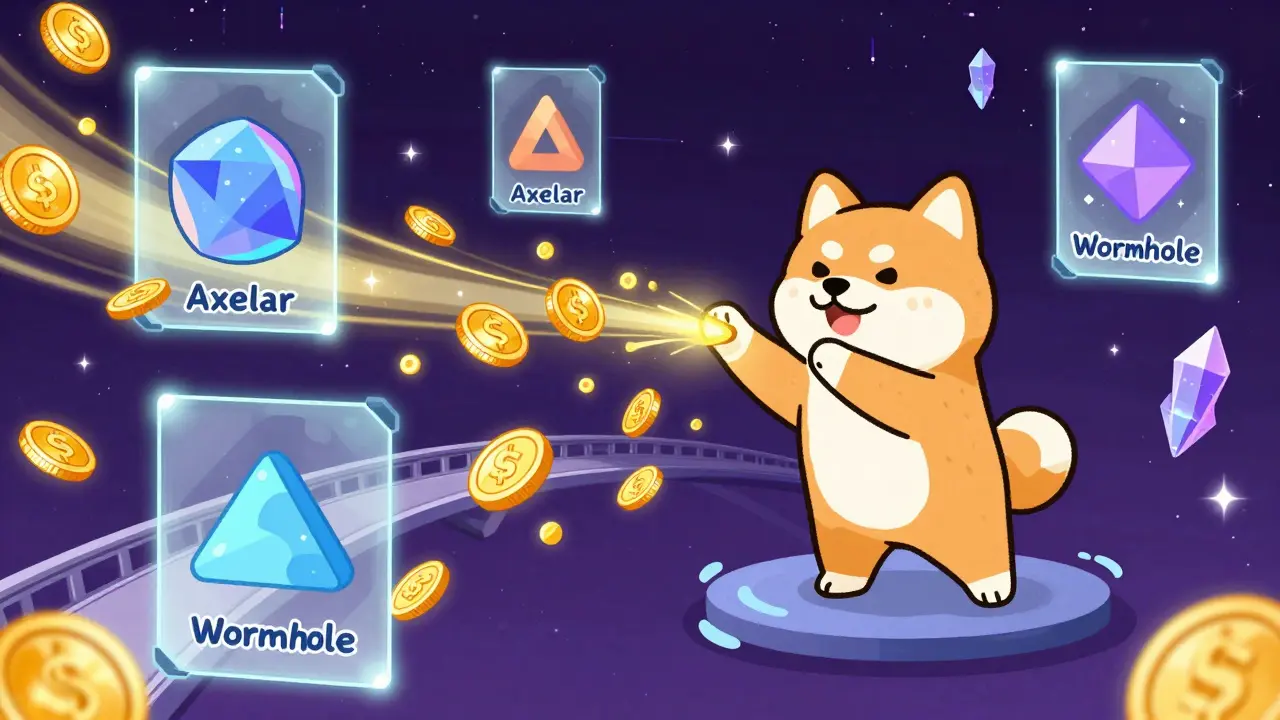
Most memecoins launch on one chain-like Solana or Ethereum-and stay there. Any Inu does things differently. It doesn't just bridge; it operates as a native asset across multiple environments. To pull this off, the project relies on two major pieces of infrastructure. First, it uses Axelar is a cross-chain communication protocol that enables the Interchain Token Service (ITS) . This allows $AI to move smoothly between EVM-compatible networks like Ethereum, Binance Smart Chain, and Polygon.
But the EVM world isn't everything. To reach the massive audience on Solana is a high-performance blockchain known for its speed and low transaction costs , Any Inu integrates Wormhole is a general message-passing protocol that connects different blockchains . By combining these two, Any Inu avoids the "silo effect" where a token is only valuable if you use a specific wallet or network.
Supply, Distribution, and the Math of $AI
When you look at the numbers, Any Inu has a massive supply. The maximum cap sits at 420,690,000,000 coins. If you check sources like Coinbase, you'll see that almost the entire supply-roughly 420.3 billion tokens-is already circulating. This means there's no "mystery" minting happening behind the scenes; what exists is what's available.
The interesting part isn't the total number, but where those coins live. Because it's an omnichain project, the supply is spread across its 20+ supported networks. While the project doesn't give a strict percentage breakdown for each chain, the goal is accessibility. If you're a Base user, you can hold $AI there. If you prefer Avalanche, you can hold it there. It's a strategy designed to cast the widest possible net for new holders.
| Attribute | Value / Detail |
|---|---|
| Ticker Symbol | $AI |
| Total Supply | ~420.69 Billion |
| Core Infrastructure | Axelar ITS & Wormhole |
| Network Reach | 20+ Blockchains |
| All-Time High | $0.000122 (March 2024) |
Market Reality: Prices and Volatility
Here is where things get a bit messy. If you look at different trackers, you'll see wildly different prices for Any Inu. Coinbase might show it at $0.00000720, while other sites list it closer to $0.000002. This usually happens with low-cap tokens because liquidity is spread thin across many different exchanges and chains. When a token is on 20 chains, the price doesn't always sync up instantly.
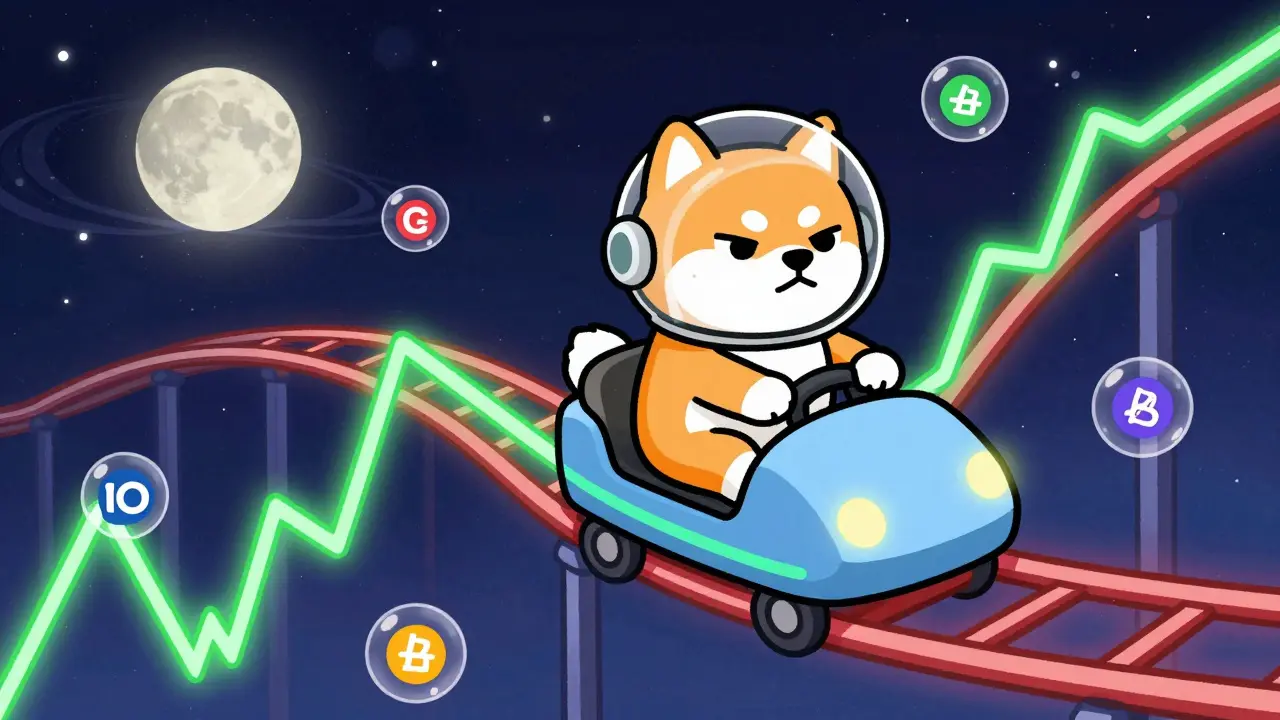
Looking at the history, the ride has been a rollercoaster. After hitting a peak in early 2024, the coin crashed about 94%. That's a tough pill to swallow for early investors. However, as of April 2026, we've seen some weird spikes-like a 63% jump in 24 hours. This is classic memecoin behavior: long periods of boredom followed by a sudden surge of hype.
With a market cap hovering around $409K to $2.99M (depending on who you ask), Any Inu is a "small fish" in a big pond. For comparison, it ranks around #2300- #2400 on major trackers. It hasn't reached the moon-status of Dogecoin, but it has a niche following of traders who love the technical gimmick of being "omnichain."
Is Omnichain Actually Useful for a Memecoin?
You have to ask yourself: do I really need a dog-themed coin on 20 different chains? For most people, the answer is probably no. Most memecoins are about community sentiment-essentially a giant group of people agreeing that a picture of a dog has value. The technology doesn't usually matter.
However, the Any Inu approach solves a real friction point. If a new blockchain becomes the "hot place to be," Any Inu is already there. It doesn't have to wait for a bridge to be built or a new token version to be launched. It's a hedge against network obsolescence. If Ethereum becomes too expensive and everyone moves to a Layer 2, Any Inu is already packed and moved in.
The Speculator's Corner: Predictions and Risks
Some platforms, like Changelly, have put out long-term forecasts. They're eyeing potential price targets as high as $0.000334 by 2032. Now, let's be real: in the crypto world, predictions are more like guesses. A jump from the current price to those levels would require a massive amount of new money and community growth.
If you're thinking about stepping in, keep these red flags in mind:
- Liquidity Risk: With a daily trading volume around $56K, selling a large amount of $AI could cause the price to tank instantly (this is called slippage).
- Utility Gap: Beyond being easy to move between chains, the token doesn't currently "do" much. It's a speculative asset.
- Volatility: A 94% drop from the peak shows that the initial hype bubble burst. There's no guarantee a second one will form.
Connecting the Dots: The Broader Meme Ecosystem
Any Inu belongs to the broader Memecoin is a type of cryptocurrency that is created as a joke or based on an internet meme, often lacking fundamental utility category. It's a direct descendant of the "Dogcoin" trend, which started with Dogecoin and expanded into Shiba Inu. While those older coins focused on building ecosystems (like ShibaSwap), Any Inu focuses on distribution.
By tapping into the "multi-chain revolution," it's trying to move the memecoin meta from "how many people hold this?" to "how many networks can this reach?" It's a gamble on the future of blockchain interoperability. If the future is a web of connected chains rather than one dominant one, Any Inu is positioned correctly.
What makes Any Inu different from other dogcoins?
Unlike most memecoins that live on a single blockchain, Any Inu is an omnichain token. It uses Axelar and Wormhole technology to exist across 20+ different networks simultaneously, making it much easier to swap and move than traditional single-chain tokens.
Is Any Inu a safe investment?
No investment in memecoins is "safe." Any Inu is highly volatile, as seen by its 94% drop from its all-time high. It has relatively low liquidity and is driven primarily by speculation rather than functional utility.
Where can I buy Any Inu tokens?
Because it is multichain, you can find $AI on various decentralized exchanges (DEXs) across the networks it supports, including Ethereum, BNB Chain, Solana, and Base. Always check a reliable aggregator like CoinGecko to find the correct contract address.
What is the maximum supply of $AI?
The total maximum supply is 420,690,000,000 coins. Most of this supply is already in circulation and distributed across the supported blockchain networks.
What is the purpose of the Axelar and Wormhole bridges here?
Axelar enables the token to move between EVM-compatible chains (like Ethereum and Polygon) using the Interchain Token Service. Wormhole specifically helps the token bridge the gap between Ethereum and the non-EVM Solana network.
Next Steps for Potential Holders
If you're determined to try your luck with $AI, don't just buy in blindly. First, decide which network you're most comfortable with (e.g., Base for low fees or Ethereum for security) and use a compatible wallet. Second, check the current liquidity on the DEX you're using; if the volume is too low, you might lose a significant chunk of your investment to slippage during the trade.
For those who already hold the token and are seeing price discrepancies, remember that the "true" price of an omnichain token is often an average of its value across all supported chains. Don't panic if one tracker shows a lower price than another-it's usually just a lag in data aggregation across 20 different networks.
Still think the distribution strategy is a win! 🚀 Getting on 20+ chains from day one is a huge move for visibility. Let's keep the energy high for the next leg up! 💪
lol why do people even care about "omnichain"? its just a bunch of bridges. its not like the coin actualy does anything differnt just cuz its on 20 chains. waste of time
I can see both sides here, honestly. The tech is a neat gimmick and it's cool to see how they're using Wormhole to hit Solana. It's a chill way to gamble on interoperability without betting on one single ecosystem. Pretty interesting experiment in the wild!
OMG a 94% drop??? 😱 i literally cant even with these coins. like why do we do this to ourselfs lol. the drama is too much!!!
If we look at this from a long-term perspective, the ability to navigate through multiple blockchain environments without the traditional friction of bridging could actually provide a very supportive foundation for new investors who are just starting to learn about the ecosystem, and while the volatility is certainly frightening, we should remember that the early stages of any project are always the most turbulent, so we should encourage everyone to do their own research and stay patient while the community grows organically over the coming years.
The conceptual framework of an omnichain existence is quite fascinating when you consider it as a metaphor for the breaking down of digital borders, as it suggests a future where assets are no longer tethered to a specific sovereign chain but instead flow like water across a vast network of interconnected protocols, which ultimately invites us to question whether the very idea of a "home chain" is an obsolete relic of the first generation of decentralized finance that we are now collectively evolving beyond in our quest for true universality.
The integration of Axelar's Interchain Token Service is definitely the key driver for the EVM liquidity flow here. By leveraging these cross-chain primitives, the project essentially abstracts the complexity of the bridge for the end user, which is a great way to onboard retail users who aren't familiar with manual bridging protocols. It's a smart move for scaling the user base across various L2s.
I'm staying hopeful!
One must exercise extreme caution regarding the liquidity risks mentioned in the text. Given the daily volume of approximately fifty-six thousand dollars, a significant sell order would undoubtedly result in substantial slippage, thereby detrimentalizing the execution price for the trader. I would strongly advise all prospective participants to verify the liquidity pools on their respective decentralized exchanges before committing capital.
The price discrepancies are just basic arbitrage opportunities that haven't been filled yet. If you actually knew how DEX aggregators worked you'd see that the "true price" is just a weighted average. its basic economics really, tho most people here dont get it.
I appreciate the detailed breakdown of the supply. It's good to know that the majority of tokens are already circulating to avoid any surprise dilutions.
Imagine thinking a dog coin is a "hedge against network obsolescence." That's the funniest thing I've read all day. Good luck with your magic dog money while the rest of us use actual tech.
It's like a little digital puppy that can travel the world! Even if the price goes up and down like a bouncy ball, the idea of it being everywhere at once is just a fun way to look at crypto. Just be careful with your coins and don't put in more than you can afford to lose, okay?