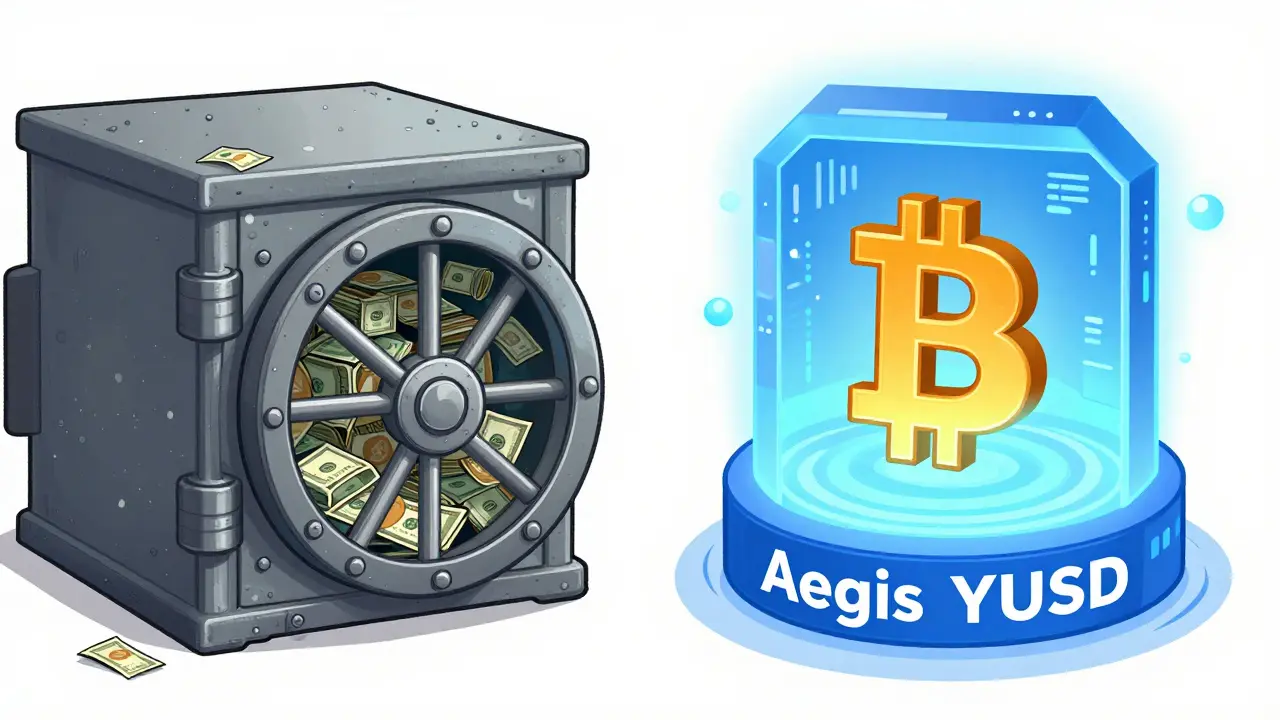
Most people think of stablecoins as digital versions of bank deposits-safe, boring, and usually tied to a company holding actual dollars in a vault. But what if you could have the stability of the US dollar without actually trusting a traditional bank? That is exactly what Aegis YUSD is a decentralized, Bitcoin-backed stablecoin designed to maintain a 1:1 peg to the US dollar while automatically generating yield for its holders. It isn't just another copy of USDT; it is a tool built to protect wealth from fiat hyperinflation and bank failures by using the most secure asset in the world-Bitcoin-as its foundation.
How YUSD Stays Stable Without a Bank
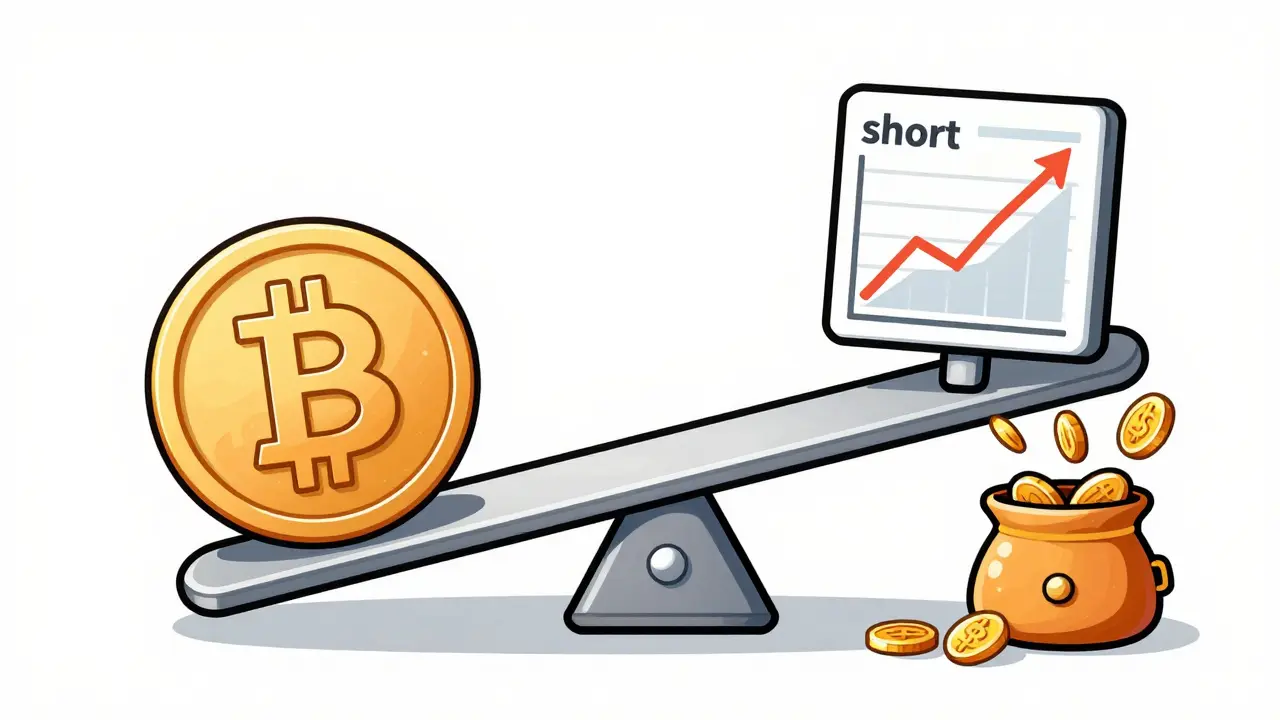
If a coin is backed by Bitcoin, you might wonder why its price doesn't swing wildly like the BTC market. The secret is a delta-neutral hedging strategy . Essentially, Aegis doesn't just hold Bitcoin; they balance it. For every bit of Bitcoin they hold as collateral, they open a "short" position using Bitcoin-margined perpetual contracts .
Think of it like a seesaw. If the price of Bitcoin goes up, the value of the collateral increases, but the short position loses money. If Bitcoin crashes, the collateral drops, but the short position gains value. Because these two forces cancel each other out, the overall value of the reserve stays flat, allowing Aegis YUSD to maintain its $1 peg regardless of whether the market is mooning or crashing.
Passive Income: Yield Without the Staking Hassle
One of the biggest headaches in crypto is "staking"-locking up your funds in a contract and hoping you don't get slashed or locked out. YUSD does things differently. It generates yield through "funding rates." In the world of perpetual contracts, traders pay a fee (the funding rate) to keep their positions open. Aegis captures these fees and distributes them to YUSD holders three times a day.
This means you don't have to click a "stake" button or lock your tokens in a vault. You simply hold the coin in your wallet, and the yield accumulates. It is a passive carry trade integrated directly into the token's architecture, making it a genuine alternative to traditional savings accounts that barely pay any interest.
The Minting Process and Security
You can't just "mine" YUSD. New tokens are created through the Aegis Mint smart contract . When a user deposits stablecoins like USDT, USDC, or DAI, the protocol immediately converts that collateral into Bitcoin via OTC desks. This ensures that every single YUSD in circulation is fully backed by BTC reserves.
Security is a major sticking point for any stablecoin. To avoid the risks associated with centralized exchanges, Aegis uses institutional-grade custodial vaults. They partner with established firms like Fireblocks , Copper , and CEFFU . By keeping assets in these vaults rather than on an exchange, they eliminate the risk of a "platform collapse" taking the reserves with them.
| Feature | Aegis YUSD | Traditional Stablecoins (e.g., USDC) |
|---|---|---|
| Backing Asset | Bitcoin (BTC) | US Dollars / Treasury Bills |
| Yield Generation | Automatic (Funding Rates) | None (unless staked/lent) |
| Banking Risk | Independent of fiat banks | High dependence on banking system |
| Stability Method | Delta-Neutral Hedging | 1:1 Cash Reserves |

Market Performance and Current Stats
As of April 2026, YUSD has shown impressive stability. While most stablecoins drift slightly, YUSD stays very close to its target. Recent data from CoinGecko and CoinMarketCap shows the price hovering between $0.9932 and $0.9988. With a circulating supply of 28 million tokens, it has a market cap of approximately BTC 237.7067.
It's worth noting that YUSD isn't the only tool in the Aegis shed. They also have jUSD , which works on the same delta-neutral principle but is backed by JLP (the liquidity provider token of Jupiter Perpetuals). This shows a broader trend of moving away from dollar-deposits toward asset-backed stability.
Is YUSD Right For You?
Whether this coin fits your portfolio depends on what you're afraid of. If you're worried about a systemic banking crisis or the sudden freezing of a centralized stablecoin by a government, YUSD offers a a massive safety net. Because it operates entirely on Bitcoin-margined contracts, it bypasses the traditional financial plumbing that often fails during a crisis.
However, the complexity of delta-neutral hedging is higher than just holding cash. While the protocol manages the hedge, the stability relies on the continued existence of perpetual contract markets. For the average user, it's a way to get "Bitcoin-level security" with "Dollar-level stability" and a bit of extra cash in the form of daily yield.
What happens if the price of Bitcoin crashes?
Nothing happens to the price of YUSD. Because Aegis uses a delta-neutral strategy, they hold a short position that gains value as Bitcoin falls. This gain offsets the loss in the Bitcoin collateral, keeping the YUSD peg at $1.
Do I need to stake my YUSD to earn rewards?
No. Unlike many other yield-bearing tokens, YUSD distributes funding rate profits directly to holders. There is no staking requirement, meaning the yield is completely passive.
Where is the Bitcoin collateral stored?
The collateral is kept in institutional-grade custodial vaults managed by Fireblocks, Copper, and CEFFU. They are never stored on centralized exchanges to minimize the risk of loss.
How can I trade YUSD?
YUSD is available via decentralized exchanges (DEXs). You can swap Ethereum-based assets like USDT, USDC, or DAI for YUSD using liquidity pools.
What is the difference between YUSD and jUSD?
Both are delta-neutral stablecoins by Aegis. The primary difference is the backing asset: YUSD is backed by Bitcoin, while jUSD is backed by JLP (Jupiter Perpetuals liquidity provider tokens).
The delta-neutral approach is actually a pretty clever way to handle the volatility of BTC while keeping the peg stable.
It effectively removes the market risk and lets you harvest the funding rate, which is a great way to earn passive income without the typical risks of staking.
Oh sure, because "institutional-grade custodial vaults" have never failed anyone before. Pure magic.
This sounds like a goldmine!! 🚀💰 I love how it just works in the wallet without clicking any buttons 🤯 Let's goooo!
This is such a helpful breakdown!!! I really appreciate how clear the comparison table is!!! Keep it up!!!
Why do people care about this. It is just another way to gamble with money you do not have.
I am new to this stuff. So the short position just acts like a mirror to the long one to keep it steady? That seems cool.
Exactly. If the BTC price drops, the profit from the short position covers the loss in the collateral value, so the total value remains the same.
the reliance on perpetual contract markets is a systemic flaw that most users ignore in their haste to earn yield it is simply irresponsible to promote this as a safety net when the infrastructure is still experimental
It is funny how people think they are "protecting wealth" while using a complex financial instrument that could liquidate in a black swan event. This whole "decentralized" narrative is just a way to shift the blame when the money vanishes. I've seen a dozen projects claim they have a "secret sauce" for stability only for the peg to break the moment actual volatility hits. The ethics of selling this as a "safe alternative" to banks is honestly disgusting given the lack of regulation. You're not bypassing the plumbing, you're just swimming in a different, more dangerous sewer. The funding rates are just a lure to get liquidity into a system that lacks transparency. Most people here are just chasing a few percent yield without realizing they are the exit liquidity. It's a classic cycle of greed and ignorance. We are just repeating the 2008 crisis but with digital tokens instead of mortgages. The arrogance of thinking you can hedge away all risk is the real joke here. This isn't innovation, it's just fancy accounting for a risky bet.
Imagine being so worried about banks that you trust a "delta-neutral" smart contract instead. Peak comedy right there.
Typical Western obsession with stablecoins. In India, we understand real value. This is just over-engineering.
This looks like a fantastic opportunity for everyone!!! I am so excited to see where this goes!!! 🌟🌟🌟