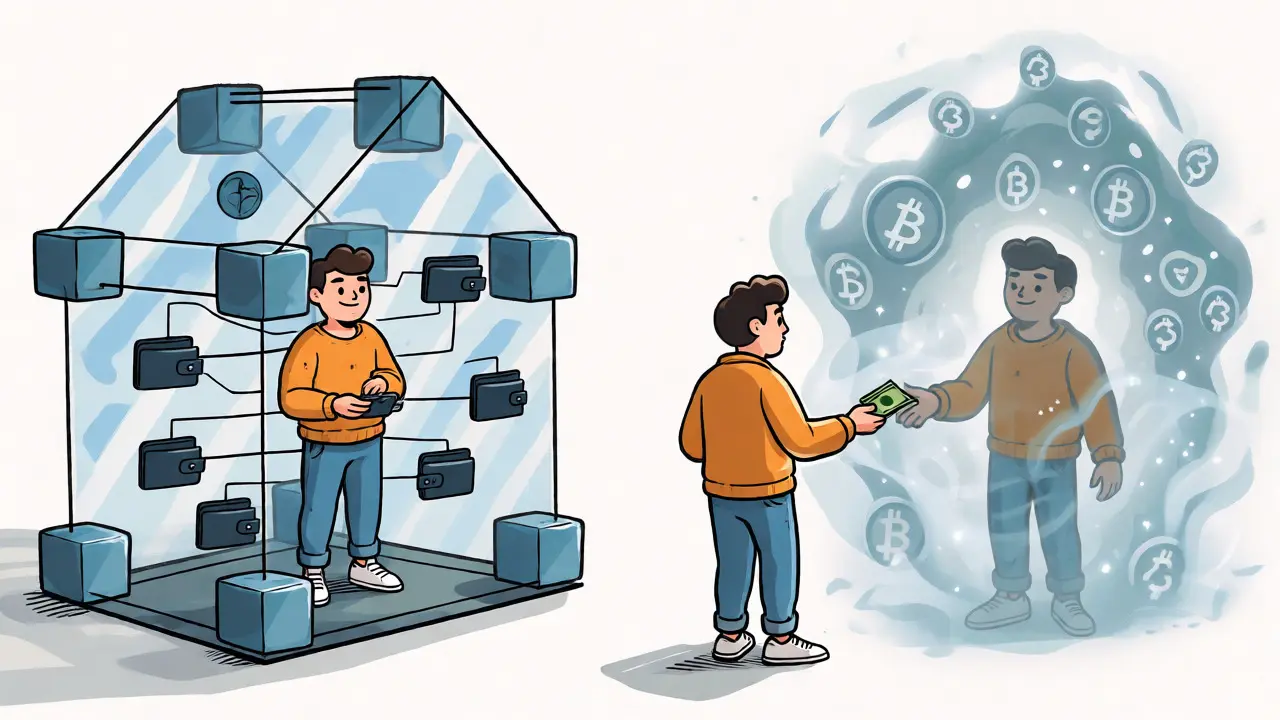
You send $500 to a friend for dinner. On Bitcoin, that transaction is etched into stone forever. Anyone with the right tools can trace your money’s history back to when you mined it or bought it at an exchange. They know where your cash came from and where it went. This transparency builds trust, sure, but it also turns your financial life into an open book. Privacy protocols are the digital antidote to this glass house. They use advanced cryptography to hide who sent money, who received it, and how much was moved, mimicking the anonymity of handing someone a physical banknote.
If you have ever felt uneasy about your spending habits being public data, you are not alone. The core promise of these protocols is simple: give users control over their own financial data without breaking the blockchain’s security. But here is the catch-privacy is hard. It requires complex math, specific software choices, and a willingness to navigate regulatory gray areas. This guide breaks down exactly how these systems work, which coins lead the pack, and why regulators hate them so much.
The Core Problem: Pseudonymity Is Not Privacy
Most people think Bitcoin is anonymous. It isn’t. It is pseudonymous. You use a string of letters and numbers (an address) instead of your name. But if you link that address to your identity once-say, by buying coffee with a KYC-verified card-that entire history becomes yours. Chain analysis firms like Chainalysis have become incredibly good at clustering addresses. If you receive funds from a known darknet market, your "clean" wallet might get flagged, even if you did nothing wrong.
Privacy protocols solve this by breaking the link between sender and receiver. They don’t just hide your name; they obscure the entire transaction graph. Imagine a room full of 1,000 people all holding identical envelopes. Someone hands one envelope to another person. In a transparent blockchain, everyone sees exactly which two people exchanged the envelope. In a privacy protocol, observers only see that *an* envelope moved, but they cannot tell which pair of people did it. This confusion is the heart of cryptographic privacy.
How the Magic Works: Key Technologies
To achieve this level of obscurity, developers rely on three main cryptographic techniques. Understanding these helps you judge which coin actually offers real privacy versus marketing fluff.
Stealth Addresses are one-time use addresses generated for every single transaction. When someone sends you Monero, they create a new, unique address for that payment. Your actual wallet address never appears on the blockchain. This prevents anyone from scanning the ledger and seeing your total balance or transaction count.
Ring Signatures mix your transaction signature with those of other recent users. Think of it as signing a document while wearing gloves that look exactly like everyone else’s gloves. The network verifies that *someone* in the group signed it, but it cannot prove *which* person in the group did it. This hides the sender’s identity.
Zero-Knowledge Proofs (zk-SNARKs) are the heavy hitters. These allow one party to prove to another that a statement is true without revealing any information beyond the validity of the statement itself. For example, I can prove I have enough money to pay you $10 without showing you my bank balance or telling you where that money came from. This technology is computationally expensive but provides the strongest mathematical guarantees of privacy.

The Big Three: Monero, Zcash, and Dash
Not all privacy coins are created equal. Some offer privacy by default, meaning every transaction is private automatically. Others make it optional, which creates a massive loophole. Here is how the major players stack up.
| Coin | Primary Tech | Privacy Model | Regulatory Status |
|---|---|---|---|
| Monero (XMR) | Ring Signatures, Stealth Addresses, RingCT | Mandatory (Default) | Frequently delisted/banned |
| Zcash (ZEC) | zk-SNARKs | Optional (Shielded vs. Transparent) | Generally accepted |
| Dash (DASH) | PrivateSend (CoinJoin) | Optional Mixing | Widely accepted |
Monero is widely considered the gold standard because privacy is mandatory. You cannot turn it off. Every transaction uses ring signatures and stealth addresses. This makes it harder to track than any other major coin, but it also means larger file sizes and slower sync times for wallets. Because it is so effective, exchanges often delist it due to compliance fears.
Zcash takes a different approach. It allows users to choose between "transparent" transactions (like Bitcoin) and "shielded" transactions (private). The problem? Most users stick to transparent transactions because they are faster and easier to integrate with exchanges. If only 10% of the network uses shielded transfers, the anonymity set shrinks dramatically, making it easier to de-anonymize the few people who do care about privacy.
Dash uses a mixing service called PrivateSend. It pools coins from multiple users and redistributes them to break the trail. While effective for casual privacy, it relies on masternodes and is optional. Regulators often view mixing services with suspicion because they can be used to layer illicit funds, though Dash argues its implementation is decentralized and secure.
Why Regulators Hate Them (And Why That Matters)
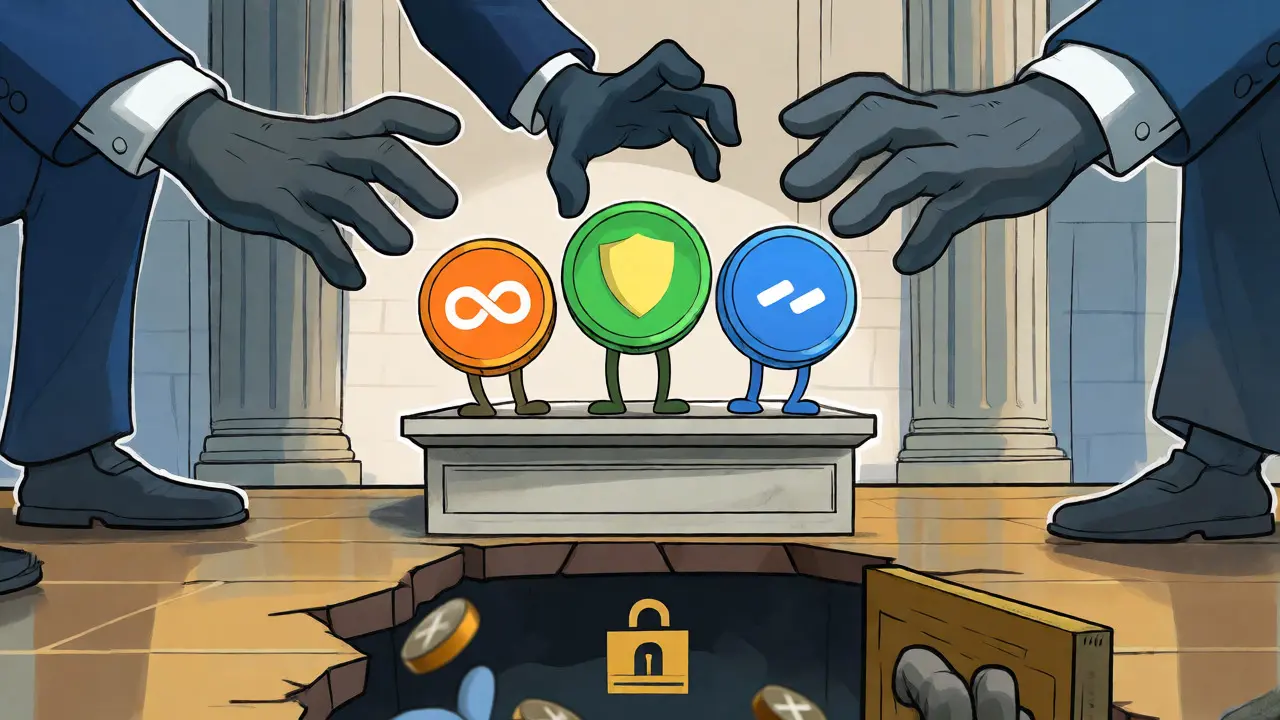
Here is the uncomfortable truth: privacy protocols are often labeled as tools for criminals. Governments worry that if they cannot trace money, they cannot tax it or stop money laundering. This has led to aggressive crackdowns. The European Union’s Markets in Crypto-Assets (MiCA) regulation and various US Treasury guidelines have pressured exchanges to drop privacy coins.
For example, Kraken recently delisted Monero in several jurisdictions. Binance removed Zcash in some regions. If you hold these coins, you need to check if your preferred exchange still supports them. You might need to move your assets to self-custody wallets sooner rather than later. The trend is clear: centralized platforms prefer compliant, traceable assets. Decentralized finance (DeFi) remains a more resilient home for privacy tokens, though even there, compliance wrappers are emerging.
Practical Steps to Use Privacy Coins Safely
Buying a privacy coin is step one. Using it correctly is step two. Many users accidentally leak their privacy by using poor operational security (OpSec).
- Use Official Wallets: Always download wallet software directly from the project’s official website. Third-party apps may log your IP address or fail to implement privacy features correctly.
- Sync Fully: Privacy wallets need to scan the entire blockchain to find your unspent outputs. Do not interrupt this process. A partial sync can leave your balance inaccurate or your privacy compromised.
- Avoid Public Wi-Fi Without Tor: Your IP address can be linked to your transaction broadcast. Using the Tor browser or a trusted VPN masks your location, preventing chain analysis firms from correlating your IP with your wallet activity.
- Be Careful with Exchanges: When you buy Monero with Bitcoin on a KYC exchange, the link between your identity and your XMR is established at the point of purchase. To maximize privacy, try to acquire coins via non-KYC methods or P2P markets if possible.
The Future: Privacy in a Surveillance Economy
We are moving toward a world of Central Bank Digital Currencies (CBDCs), where every cent spent can be tracked by the state. In this context, privacy protocols shift from niche tech experiments to essential tools for financial freedom. They aren’t just about hiding crimes; they are about protecting business negotiations, personal donations, and salary details from prying eyes.
Technology continues to improve. Newer projects are integrating zero-knowledge proofs into Layer-2 solutions, aiming to provide privacy without the speed penalties of older chains. Ethereum, for instance, is increasingly adopting zk-rollups, bringing selective privacy to smart contracts. The future likely holds a hybrid model: transparent blockchains for auditability, with privacy layers on top for user confidentiality.
Are privacy coins completely anonymous?
No system is perfectly anonymous. While protocols like Monero make it extremely difficult to trace transactions, metadata leaks (like IP addresses or timing correlations) can still reveal information. Additionally, if you interact with a regulated exchange, your identity is linked to your entry point into the ecosystem.
Why do exchanges delist privacy coins?
Exchanges delist privacy coins primarily due to regulatory pressure. Anti-Money Laundering (AML) laws require institutions to track the source and destination of funds. Since privacy coins obscure this trail, exchanges fear fines or license revocations if they continue to support them.
Is Monero better than Zcash for privacy?
Monero generally offers stronger privacy because it is mandatory. All transactions are shielded by default. Zcash offers optional privacy, meaning many transactions remain transparent. This smaller anonymity set in Zcash makes it easier to de-anonymize users compared to Monero's uniform privacy.
Can I mine privacy coins easily?
It depends on the coin. Monero uses RandomX, which is CPU-friendly and resistant to ASIC mining, making it accessible for home miners. Zcash uses Equihash, which is dominated by ASICs, making it less profitable for average users to mine competitively.
Do privacy coins affect transaction speed?
Yes, typically. Privacy features add computational overhead. Transactions involving zero-knowledge proofs or ring signatures take longer to verify and create larger block sizes. As a result, confirmation times can be slightly slower than transparent cryptocurrencies like Bitcoin or Litecoin.