
Imagine buying a coin only to watch its price crash 40% in a single day because the founding team decided to sell their entire allocation. This scenario, often called an "unlock event," is one of the biggest risks for retail investors in the cryptocurrency market. To prevent this chaos, projects use vesting schedules that control when specific groups can sell their tokens. Understanding these mechanics is not just for advanced traders; it is essential for anyone holding assets in decentralized finance or new protocol launches.
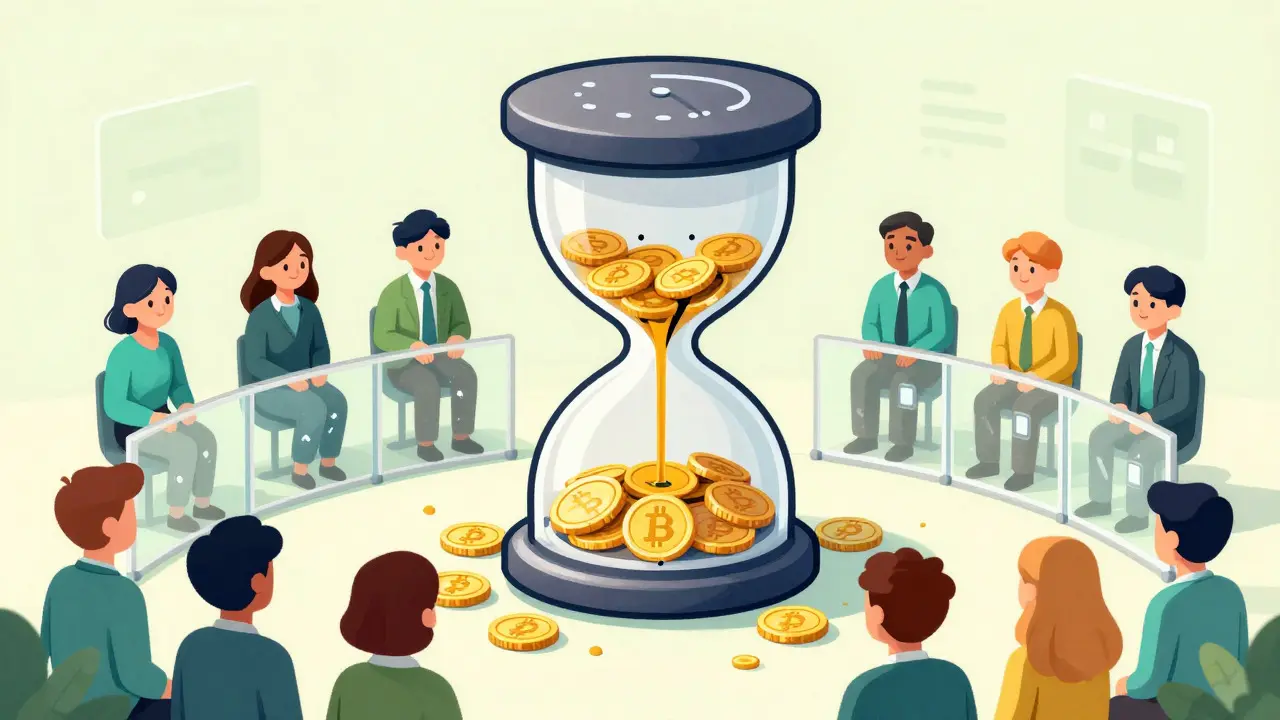
A vesting schedule acts like a timer on your wallet. It locks up tokens allocated to founders, employees, and early investors until specific dates or milestones are met. Once those conditions are satisfied, the tokens "unlock" and become available for sale. This process protects the project from immediate dumping while ensuring long-term commitment from the people building it.
The Core Mechanics of Vesting
At its heart, a vesting schedule is a set of rules executed by a smart contract. These automated programs remove human error and bias from the release process. When you see a token listed as "locked" on a blockchain explorer, it means the smart contract is enforcing the terms defined at launch. The three main components of any standard schedule are duration, cliff period, and frequency.
- Duration: The total time it takes for all tokens to become fully tradable. In the industry, this typically ranges from one to four years. Longer durations signal higher confidence in the project's longevity but reduce short-term liquidity.
- Cliff Period: An initial waiting period where no tokens vest at all. For example, a one-year cliff means the first holder gets nothing for twelve months. After the cliff ends, a significant chunk (often 25% or more) may unlock immediately.
- Frequency: How often tokens are released after the cliff. Common patterns include monthly, quarterly, or annual releases. Linear vesting, where a fixed percentage unlocks every month, is the most popular structure due to its predictability.
For instance, a typical founder vesting schedule might look like this: a one-year cliff, followed by linear monthly vesting over the next three years. This ensures that if a founder leaves within the first year, they keep very little, aligning their incentives with the project's survival.
Why Projects Use Vesting Instead of Instant Distribution
In the early days of crypto, many Initial Coin Offerings (ICOs) allowed immediate trading of all tokens. This led to massive volatility as insiders sold off large portions of supply shortly after listing. Vesting solves this by creating a controlled supply curve. By releasing tokens gradually, projects stabilize prices and encourage stakeholders to focus on building rather than cashing out.
There are three primary benefits to this approach:
- Price Stability: Gradual release prevents sudden spikes in sell pressure that could crash the market cap.
- Commitment Signal: When founders agree to lock up their tokens, it shows they believe in the product’s future value.
- Investor Protection: Retail buyers are less likely to get rugged by teams who exit immediately after fundraising.
However, vesting is not without downsides. For employees, it can feel restrictive if they need liquidity for personal expenses. For investors, it creates uncertainty about future supply shocks. A well-designed schedule balances these needs by offering reasonable timelines that match the project’s development phases.
Types of Vesting Structures
Not all vesting schedules are created equal. Projects choose different structures based on their goals and stakeholder types. Here are the most common models used in the blockchain ecosystem:
| Structure Type | Description | Best For | Risk Level |
|---|---|---|---|
| Linear Vesting | Tokens release in equal amounts at regular intervals (e.g., monthly). | Founders, Employees, Advisors | Low (Predictable) |
| Cliff Vesting | No release during an initial period, then a large portion unlocks, followed by gradual releases. | Early Investors, Core Team | Medium (High initial shock) |
| Milestone-Based | Tokens unlock upon achieving specific project goals (e.g., mainnet launch). | Grants, Partnerships | Variable (Depends on execution) |
| Reverse Vesting | All tokens are issued upfront but locked; ownership transfers back to the company if the holder leaves. | Corporate Equity-Style Grants | Low (Flexible) |
Linear vesting remains the gold standard for employee compensation because it is easy to understand and track. Milestone-based vesting is gaining traction in DAOs where community governance plays a larger role. Reverse vesting is particularly useful for companies migrating from traditional equity models to token-based compensation, as it mirrors stock option behavior.
Navigating Token Unlocks as an Investor
If you hold a cryptocurrency, tracking upcoming unlocks is critical. Major unlock events can act as temporary price suppressors. Before an unlock date, some traders sell their positions to avoid potential downside, causing pre-event dips. Conversely, if the project has strong fundamentals, the unlock might be absorbed quickly, leading to a post-event rally.
To manage this risk, consider the following strategies:
- Check the Allocation: Look at what percentage of the total supply is unlocking. A 1% unlock is negligible; a 10% unlock is significant.
- Identify the Recipient: Unlocks for public treasury funds are often less risky than unlocks for individual founders, who may have higher intent to sell.
- Monitor Liquidity Pools: On decentralized exchanges, increased volume around unlock dates can indicate how the market is reacting.
Tools like token dashboards provide real-time data on vesting progress. Always verify the source, as unofficial trackers can contain errors. Cross-referencing with the project’s official documentation ensures accuracy.
Smart Contracts and Technical Implementation
The reliability of a vesting schedule depends entirely on the underlying smart contract code. Since these contracts are immutable once deployed, any bugs can lead to permanent issues, such as tokens being locked forever or released too early. This is why reputable projects undergo multiple audits before launch.
Modern vesting platforms, such as Streamflow Finance and Magna, offer standardized templates that have been battle-tested across hundreds of projects. Using established infrastructure reduces technical risk compared to custom-built contracts. Additionally, newer implementations support multi-chain vesting, allowing tokens to move between networks like Ethereum, Solana, and Arbitrum without breaking the vesting logic.
One emerging trend is the integration of governance into vesting parameters. Some DAOs now allow token holders to vote on adjusting unlock speeds if certain economic conditions are met. This flexibility adds a layer of community trust but also introduces complexity in decision-making processes.

Common Pitfalls to Avoid
Even experienced participants make mistakes when dealing with vesting schedules. Here are the most frequent errors:
- Ignoring Tax Implications: In many jurisdictions, vested tokens are considered taxable income at the moment they unlock, regardless of whether you sell them. Failing to account for this can lead to unexpected tax bills.
- Assuming All Unlocks Are Equal: Not all unlocked tokens will be sold. Some recipients may hold long-term. Analyzing historical behavior of similar projects helps gauge actual sell pressure.
- Overlooking Gas Fees: Claiming vested tokens requires transaction fees. During high network congestion, these costs can eat into small allocations.
Always read the fine print in the whitepaper. Specific clauses regarding forfeiture, clawbacks, and dispute resolution can significantly impact your final holdings.
Frequently Asked Questions
What happens to tokens if I leave my job before they vest?
It depends on the contract type. With standard forward vesting, unvested tokens usually revert to the company pool. With reverse vesting, you may retain full ownership unless specified otherwise. Always check the employment agreement and smart contract terms.
Do token unlocks always cause price drops?
Not necessarily. While unlocks increase potential supply, actual selling depends on recipient behavior. If the project has strong demand and positive news, the market may absorb the new supply without significant price impact.
How do I find the vesting schedule for a specific token?
Start with the project’s official website or whitepaper. Most credible projects publish detailed tokenomics tables. You can also use third-party analytics platforms that aggregate on-chain data to display real-time vesting progress.
Is there a difference between vesting and locking?
Yes. Locking simply prevents transfer for a set time, after which all tokens become free. Vesting involves a gradual release process where ownership increases over time. You cannot sell unvested tokens, even if they are technically in your wallet address.
Can a project change its vesting schedule after launch?
Generally, no, unless the smart contract includes a governance mechanism or upgrade path. Changes require either a hard fork or a community vote if governed by a DAO. This immutability is a key feature that builds trust in the system.
Really appreciate the breakdown on cliff periods. It’s a detail most retail investors overlook until it hits them in the face. The distinction between linear and milestone-based vesting is particularly useful for those looking at newer DAO structures.
Oh, how delightful that we are all supposed to trust these 'smart contracts' like they are immutable laws of nature 🧐
Let's not forget that code can be buggy, auditors can be lazy, and governance votes can be gamed by whales with more tokens than sense. It’s a fascinating dance of technical determinism meeting human chaos. I suppose if you believe in the machine, you must also believe in the coder who wrote it without coffee ☕️
The point about tax implications is often missed. In many places, the moment the token vests, it is income, whether you sell it or not. People get caught off guard by the bill arriving before they even think about liquidity. It’s a quiet trap for anyone holding long-term allocations.
Concise and accurate. The immutability of smart contracts is a double-edged sword. It builds trust but removes flexibility. If a bug exists, there is no customer support line to call. Just read the contract or lose your funds.
Sure, let's just assume every founder has the moral compass of a saint and won't dump their bags the second the lock expires. Because history shows us otherwise. Vesting is just a polite way of saying 'we need you to wait so we can run away.' Nice try, whitepaper authors.
Look, nobody here really understands what a cliff period actually does because they’re too busy staring at candlesticks like hypnotized rabbits. You’ve got this whole intricate mechanism designed to prevent supply shock, which is basically the financial equivalent of putting a lid on a boiling pot, yet everyone acts surprised when the steam escapes and burns their hands. It’s a classic case of ignoring the engineering behind the curtain while complaining about the heat in the theater. The real tragedy isn’t the price drop; it’s the collective amnesia regarding basic tokenomics that plagues this entire sector, turning sophisticated DeFi instruments into mere gambling chips for the uninitiated masses who never bother to read past the first page of any documentation.
It is interesting how the article mentions reverse vesting. For those coming from traditional corporate equity models, this structure feels much more familiar and less risky than standard forward vesting. It aligns well with how stock options work in Silicon Valley, making the transition to crypto compensation slightly less jarring for experienced professionals.
You need to look at the TVL metrics alongside the unlock schedule. If the protocol is generating real yield, the sell pressure gets absorbed by new inflows. But if it's just a memecoin with no utility, the unlock is a death sentence. Check the DEX volume spikes pre-event. That's your leading indicator.
vesting is just a fancy word for "we want to keep you waiting" lol. i dont see why people make such a big deal out of it. its just time passing. also the whole smart contract thing is overrated, code breaks all the time. maybe we should just go back to paper ledgers? oh wait, we tried that and it was worse. anyway, nice post i guess 👍
One must understand that true sophistication lies not in the duration of the lock, but in the *psychological* grip it holds on the lesser minds. Most retail investors are merely puppets dancing to the rhythm of FUD and FOMO, utterly blind to the elegant architecture of supply control. To master this domain, one must shed the naivety of the crowd and embrace the cold, hard logic of game theory. The elite do not chase prices; they anticipate the structural shifts that others perceive as chaos. It is a lonely summit, indeed, but the view is worth the climb.
Please, spare us the lecture on 'investor protection.' We are adults, not children needing hand-holding through a complex market. If you don't know how to read a tokenomics table, perhaps stick to index funds. The market punishes ignorance, not malice. Get educated or get liquidated.
I love how the article emphasizes checking the allocation percentage! It’s such a simple step that makes such a huge difference in risk management. I always try to cross-reference the official docs with third-party trackers because, honestly, errors happen so often in unofficial dashboards. It’s empowering to feel like you’re actually in control of your position rather than just hoping for the best during those scary unlock dates. Keep up the great work sharing these insights!
They say it's automated, but have you seen who controls the multisig wallets? Always insiders. The 'community vote' is a sham orchestrated by whales who bought up enough supply to dictate terms. Trust nothing. Verify everything. The code is open, but the intent is hidden. 🚨👀
Great points on the gas fees. In Nigeria, when network congestion is high, claiming small vested amounts can sometimes cost more than the value of the tokens themselves. It is a significant barrier for smaller holders that is rarely discussed in Western-centric analyses. We need more solutions for low-value claims.