Remember when Bitcoin was just a way to send money without a bank? Those days are long gone. Today, the real battleground isn't about sending coins; it's about blockchain privacy. By mid-2026, the landscape has shifted dramatically. We aren't just talking about anonymous crypto anymore. We are talking about enterprise-grade data protection, secure voting systems, and healthcare records that stay yours, not your provider's.
The technology that once lived on the fringe of the internet is now sitting at the heart of Fortune 500 strategies. But here is the catch: the old methods of hiding transactions are dying. Regulations are tightening, quantum computers are looming, and users demand simplicity. If you think privacy means "hiding everything," you are already behind. The future is about proving who you are without revealing what you have.
From Anonymity to Verifiable Privacy
We need to clear up a common misconception right away. Privacy does not mean secrecy. In the early days, projects like Monero or Zcash focused on making transactions untraceable. That worked for individuals wanting financial freedom, but it terrified regulators and banks. You can't build a global banking system on something that looks like a dark web marketplace.
The shift in 2025 and into 2026 moved toward Zero-Knowledge Proofs (ZKPs). Think of this as a magical bouncer at a club. Instead of showing your ID (which reveals your name, address, and birthdate), you prove you are over 21 without handing over any other info. The bouncer says "yes" or "no," but learns nothing else about you.
This technology allows for verifiable transactions where the network confirms the math is correct-no double-spending, no fraud-but the actual data remains encrypted. This is why 78% of large corporations adopted these solutions by late 2025. They needed to share data with partners without exposing trade secrets or customer PII (Personally Identifiable Information).
The Tech Stack: ZK-STARKs vs. ZK-SNARKs
If you are looking to implement privacy features, you will hear two acronyms constantly: ZK-SNARKs and ZK-STARKs. Both do the same job, but they have very different personalities.
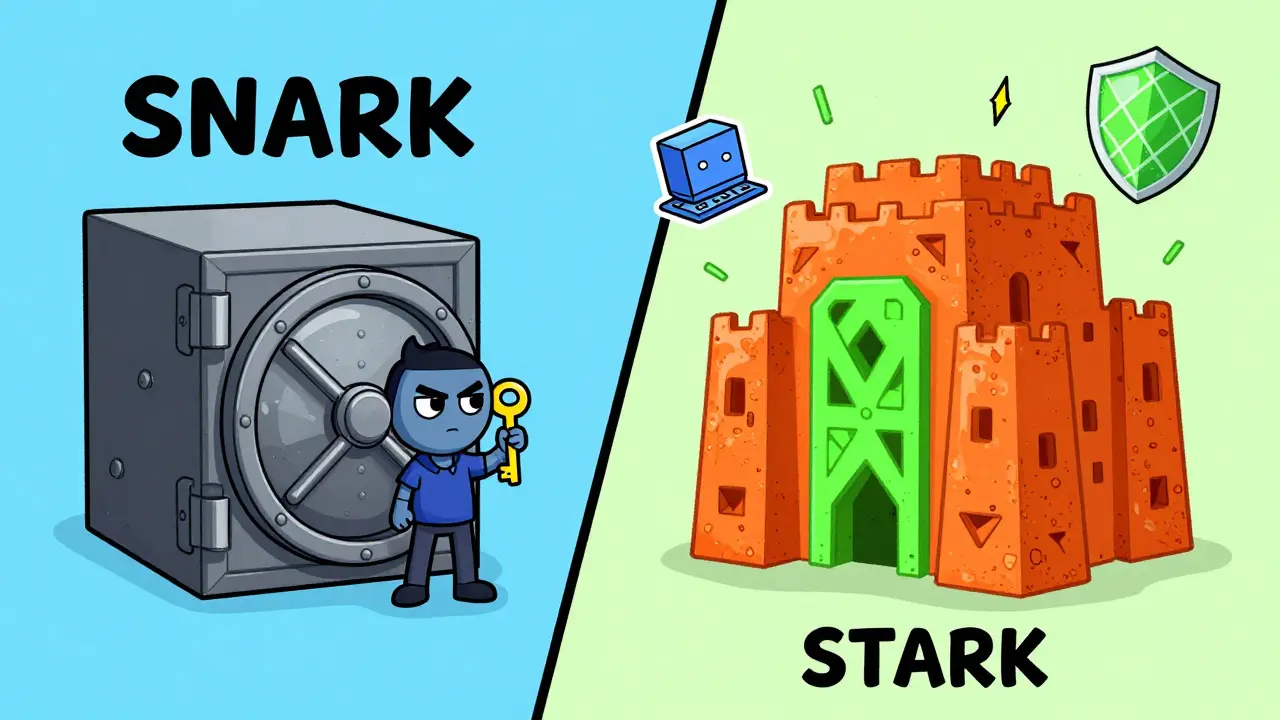
ZK-SNARKs (Succinct Non-Interactive Arguments of Knowledge) have been around longer. They are smaller and faster to verify, which makes them great for existing networks like Ethereum. However, they rely on a "trusted setup"-a one-time ceremony where if anyone kept a secret backdoor, the whole system could be compromised. It’s like trusting a single person to hold the master key to a vault.
ZK-STARKs (Scalable Transparent Arguments of Knowledge) solve that trust issue. They don’t need a trusted setup because they use hash functions instead of elliptic curves. They are slightly larger in size but scale better as computations get more complex. By July 2025, StarkWare Labs reported their STARK-based systems processing 2,800 transactions per second with near-perfect validity confidence. For new projects building from scratch, STARKs are becoming the gold standard for security.
| Feature | ZK-SNARKs | ZK-STARKs |
|---|---|---|
| Trusted Setup Required? | Yes | No |
| Quantum Resistance | Low (Elliptic Curves) | High (Hash Functions) |
| Proof Size | Small (~288 bytes) | Larger (~1-2 KB) |
| Verification Speed | Fast | Moderate |
| Best Use Case | Legacy chains, low-bandwidth devices | New builds, high-complexity logic |
The Quantum Threat and Lattice-Based Encryption
Here is the elephant in the room: quantum computers. Most current blockchain signatures, including those used by Bitcoin and Ethereum, rely on elliptic curve cryptography. A sufficiently powerful quantum computer could break these locks, stealing funds and breaking privacy guarantees.
The industry realized this wasn't a distant threat. By 2025, 63% of major protocols began implementing lattice-based encryption. This is part of the NIST Post-Quantum Cryptography Standardization Project. Lattice-based schemes are mathematically harder for quantum algorithms to crack. If your blockchain project isn't planning a migration path to post-quantum standards, it is essentially building a house of cards.
The window is tight. MIT’s Quantum Computing Impact Assessment suggests non-upgraded networks face vulnerability windows of 12-18 months once fault-tolerant quantum processors arrive. For enterprise adoption, this isn't optional; it's an insurance policy against total obsolescence.
Regulatory Reality: Compliance Meets Privacy
You cannot talk about the future of privacy without addressing regulation. The era of "code is law" ignoring real-world laws is over. The EU’s MiCA framework and the U.S. Treasury’s guidance have created a split world.
In Europe, the focus is on Self-Sovereign Identity (SSI). The idea is that you own your digital identity, stored in a wallet on your phone. When you need to prove you are over 18 or a resident of Germany, you generate a ZK-proof from your wallet. The verifier gets a yes/no answer, but no data leaves your device. This complies with GDPR because no personal data is actually transferred or stored by the third party.
In contrast, the U.S. approach has been more hostile to pure anonymity. Projects like Tornado Cash were sanctioned because they obscured transaction details entirely. The winning model in 2026 is "selective disclosure." You can hide your balance from the public, but you must be able to reveal it to auditors or tax authorities via a private key held by a trusted entity or through a regulated gateway. This is why privacy coins like Monero are seeing reduced exchange listings, while enterprise solutions like Hyperledger Fabric’s Private Data Collections are booming in banking.
AI Integration: Friend or Foe?
Artificial Intelligence is playing a dual role in blockchain privacy. On one hand, AI is helping build better privacy tools. Google’s SecAI module, launched in mid-2025, uses machine learning to detect prompt injection attacks targeting private data on-chain. IBM’s Watson Privacy Guard reduces breach risks in clinical trials by analyzing patterns of data access.
On the other hand, AI is getting smarter at breaking privacy. Deanonymization attacks-where researchers analyze public transaction graphs to link addresses to real identities-are becoming more effective. MIT’s Digital Currency Initiative warned that AI-enhanced attacks can breach 31% of first-generation ZK systems. This means simple mixing services or basic coinjoins are no longer safe. You need robust cryptographic proofs, not just obfuscation techniques.
Implementation Challenges for Developers
If you are a developer, good luck. Writing ZK-programs is not like writing Python scripts. The average time for a developer to master ZK-proof programming is 83 hours, according to a Binariks survey. Rust has become the dominant language for this work, used in 74% of privacy-focused projects.
The biggest pain point? Key management. Users lose keys. Period. This is why Account Abstraction is critical. Ethereum’s recent upgrades allow for smart contract wallets that can recover lost keys using social recovery or biometrics, without compromising the underlying privacy of the transactions. Without user-friendly key management, even the best privacy tech will fail because people simply won't use it.
Another hurdle is cross-chain interoperability. Only 17% of bridges support encrypted asset transfers. Moving private data from a Polygon zkEVM chain to a Solana-based system often requires decrypting the data at the bridge, creating a massive security hole. True end-to-end privacy across chains remains the holy grail of the industry.
Market Leaders and Use Cases
Who is winning this space? It’s not just crypto startups. Big Tech is heavily invested.
- Microsoft Entra Verified ID: Leading in enterprise identity with 19 million verified identities. It integrates seamlessly with Azure’s Confidential Ledger, appealing to healthcare and finance sectors needing HIPAA and GDPR compliance.
- Polygon ID: With 28 million users, Polygon is pushing decentralized identity in consumer apps. Their zkEVM processes over 1.2 million private transactions daily at a fraction of a cent per transaction.
- Circle’s SEED Network: Focused on stablecoin privacy, allowing businesses to move USDC without exposing transaction amounts to competitors.
Real-world impact is visible beyond finance. Estonia uses ZK-proofs for its national voting system, handling 62% of elections with zero verifiable fraud. Ukraine distributed $1.2 billion in military aid via a privacy-preserving blockchain, ensuring funds reached soldiers without leaking strategic data. These examples prove that privacy tech works at scale, not just in theory.
Looking Ahead: 2026 and Beyond
As we move through 2026, three paths are emerging. First, the "regulated privacy" model led by Visa and Mastercard, integrating ZK-payments into traditional rails. Second, "sovereign networks" like Monero’s Kovri 2.0, doubling down on censorship resistance despite regulatory pressure. Third, hybrid enterprise systems that offer configurable privacy levels based on jurisdiction.
The survival rate for privacy solutions will depend on adaptability. McKinsey predicts 70% of compliant solutions will thrive by 2030, while rigid, non-adaptable privacy coins may become obsolete. The key takeaway? Privacy is no longer a niche feature. It is a fundamental requirement for digital trust. Whether you are a developer, a business leader, or a user, understanding how to protect your data while remaining compliant is the most valuable skill in the modern web.
Is blockchain privacy legal in 2026?
Yes, but with conditions. Pure anonymity tools like mixers are heavily restricted or banned in many jurisdictions, including the U.S. and parts of the EU. However, privacy technologies that allow for selective disclosure and audit trails, such as Zero-Knowledge Proofs, are fully legal and encouraged for enterprise use. Compliance depends on whether the solution allows authorized entities to verify transactions when required by law.
What is the difference between ZK-SNARKs and ZK-STARKs?
Both are types of Zero-Knowledge Proofs. ZK-SNARKs require a "trusted setup" ceremony and use elliptic curve cryptography, making them vulnerable to quantum attacks. ZK-STARKs do not require a trusted setup and use hash functions, making them quantum-resistant and scalable, though the proof sizes are larger. STARKs are generally preferred for new, security-critical applications.
How does quantum computing affect blockchain privacy?
Quantum computers threaten traditional cryptographic signatures (like ECDSA) used in most blockchains. Once fault-tolerant quantum processors exist, they could derive private keys from public addresses, breaking privacy and security. To mitigate this, the industry is migrating to lattice-based encryption and other post-quantum cryptographic standards.
Can I use privacy coins like Monero for everyday payments?
It is becoming increasingly difficult. Due to regulatory pressure, many centralized exchanges have delisted privacy coins like Monero and Zcash. While they remain technically functional and popular for censorship-resistant transfers, using them for salary payments or mainstream commerce is challenging due to limited liquidity and lack of merchant integration compared to regulated privacy solutions.
What is Self-Sovereign Identity (SSI)?
SSI is a model where individuals control their own digital identities without relying on central authorities. Using blockchain and Zero-Knowledge Proofs, users store credentials in a personal wallet. They can prove attributes (like age or residency) to third parties without revealing the underlying data, enhancing both privacy and security while complying with regulations like GDPR.
It is frankly exhausting to read this level of oversimplification from someone who clearly hasn't sat in a room with actual cryptographers. The distinction between SNARKs and STARKs is not merely about 'personality' as you so charmingly put it; it is about fundamental computational complexity classes and the specific algebraic structures required for verification circuits. You mention Rust being dominant, yet you fail to acknowledge the significant overhead introduced by the current lack of optimized WASM runtimes for certain STARK implementations on legacy hardware. It’s cute that you think 83 hours is enough to master ZK-programming. That number is laughably low for anyone intending to write production-grade circuits without introducing subtle side-channel vulnerabilities. Most developers don’t understand the difference between a trusted setup ceremony and a transparent one until they’ve already burned their bridge. This article reads like a marketing brochure for a VC-backed startup rather than a technical analysis. We need rigor, not buzzwords.
You people are missing the point entirely because you’re too busy arguing over acronyms while ignoring the moral decay of the entire industry. Privacy should be a human right, not a feature sold to Fortune 500 companies to hide their tax evasion strategies. When you talk about 'selective disclosure' to regulators, you are essentially handing over the keys to your digital soul to bureaucrats who have no interest in protecting your data. They want access. Always. The idea that we can trust these 'trusted entities' or regulated gateways is naive at best and dangerous at worst. We saw what happened with Tornado Cash, and now we see banks using Hyperledger to launder money more efficiently under the guise of compliance. It’s disgusting. If your privacy solution requires permission from a government agency, it isn’t privacy; it’s surveillance with extra steps. Stop pretending that enterprise adoption is a victory when it’s actually just the corporatization of freedom.
I guess the real question is whether any of this matters if the underlying infrastructure collapses under its own weight. I’ve been watching this space since the early days, and honestly, it feels like we’re building castles on sand again. The shift from anonymity to verifiable privacy makes sense on paper, but does it feel right? Probably not. But maybe that’s the price of maturity. I just wonder if we’re solving the right problems. Are we making things safer, or just more complex? Time will tell, I suppose. Let’s see how the quantum threat plays out before we declare winners.
Wow! This is huge!! I love the part about the bouncer analogy!! It really clicks for me!! :D Who knew math could be so cool?? I’m gonna go tell my friends about ZK-STARKs!! They won’t get it but I do!! Yay!!
i dont get why everyone is so worried bout quantum computers. they still dont even work properly. seems like fear mongling to me. also rust is hard lol. i tried once and gave up after an hour. why cant we just use python like normal ppl?
While I appreciate the comprehensive overview provided in the original post, I must gently suggest that the comparison between European and American regulatory frameworks might benefit from a slightly more nuanced perspective, considering that the EU’s MiCA framework is not monolithic and varies significantly in implementation across member states, which often leads to a fragmented landscape that complicates the very self-sovereign identity models you describe, thereby creating additional friction for users who are trying to navigate these new digital identities without falling afoul of local interpretations of GDPR, which themselves are subject to ongoing legal challenges and reinterpretations by various national courts, thus requiring a dynamic approach to compliance that goes beyond the static 'yes/no' verification model proposed here, especially when one considers the intricate web of cross-border data transfer mechanisms that remain largely unresolved despite the best efforts of policymakers, which suggests that the future may hold more ambiguity than the confident projections outlined in this article imply, and perhaps we should temper our expectations regarding the seamless integration of these technologies into everyday life, given the historical precedent of technological adoption curves being far slower and more irregular than predicted by industry analysts, who often overlook the human element of resistance to change, particularly among older demographics who may find the concept of digital wallets and zero-knowledge proofs to be overly abstract and intimidating, thereby necessitating a more inclusive design philosophy that prioritizes user experience and accessibility above all else, lest we create a two-tiered society where only the technologically adept can exercise their right to privacy, which would be a profound failure of the democratic ideals that underpin much of the discourse surrounding blockchain technology in the first place, and therefore, I believe it is crucial that we engage in a broader conversation about the social implications of these developments, ensuring that the benefits of enhanced privacy are distributed equitably across all segments of society, rather than becoming the exclusive domain of those with the resources and expertise to navigate the complexities of the new digital frontier, which is a concern that cannot be addressed solely through technological innovation but requires concerted efforts from educators, policymakers, and community leaders alike to foster a culture of digital literacy and empowerment that enables everyone to participate fully in the emerging decentralized economy, regardless of their background or level of technical proficiency, and this holistic approach is essential if we are to realize the true potential of blockchain privacy as a tool for enhancing individual autonomy and security in an increasingly interconnected world, where the stakes are higher than ever before and the consequences of getting it wrong could be severe and long-lasting, affecting not just individuals but entire communities and economies, and thus demanding our utmost attention and care as we move forward into this uncertain future, together.
Typical Silicon Valley nonsense. You want to give control to some 'Self-Sovereign Identity' wallet while the US Treasury tells you exactly what to do. It’s a joke. Our regulations are there to keep the bad guys out, not to protect your little secret transactions. If you have nothing to hide, you have nothing to fear. These ZK-proofs are just a fancy way to say 'I’m hiding something from the IRS.' And don’t get me started on the EU setting the rules. We’ll follow our own laws here. Any tech that doesn’t align with American interests is garbage. Stick to the dollar and stop playing with crypto toys.
The irony is palpable, thick like molasses in January, as we dance around the corpse of true anonymity. You speak of 'verifiable privacy' as if it is a gift, when in reality it is a shackle forged in the fires of bureaucratic convenience. The 'magical bouncer' does not let you in; he simply decides if you are worthy of existing in his ledger. It is a theater of consent, a pantomime of choice where the script was written by men in suits who view your data as raw material for their algorithms. We are not building a fortress; we are building a panopticon with better lighting. The quantum threat is merely the guillotine waiting to drop, and we are polishing the blade with lattice-based encryption, thinking it makes us safe. It does not. It only delays the inevitable realization that we have sold our shadows for the privilege of being watched politely.
It’s interesting to consider the philosophical implications of key management. If we lose our keys, we lose our identity. Is that not a form of digital death? The reliance on social recovery or biometrics introduces a layer of vulnerability that contradicts the very notion of sovereignty. Perhaps the challenge isn’t just technical, but existential. How do we define ownership in a system where the object of ownership is intangible and easily lost? It makes one wonder if the pursuit of perfect privacy is ultimately a pursuit of perfection itself, which may be unattainable.
Oh, please. Another cheerleader for the status quo. You think Microsoft Entra Verified ID is leading anything other than a march toward total corporate surveillance? Nineteen million verified identities? Sounds like nineteen million leashes. And you call Polygon ID 'decentralized'? Give me a break. It’s centralized power wrapped in blockchain jargon to make it palatable to the masses. The whole 'selective disclosure' model is a trap. Once you give them the ability to peek, they will always peek. Don’t buy into this hype. It’s all smoke and mirrors designed to keep you compliant while they strip-mine your behavioral data. Pathetic.
Hey folks! :D Just wanted to share that in Japan, we’re seeing similar trends with Fintech startups adopting ZK-proofs for KYC processes. It’s fascinating how different cultures approach privacy. Here, there’s a strong emphasis on group harmony, so the idea of 'self-sovereign' identity is met with some skepticism. People prefer trusted intermediaries. It’s a cultural nuance that Western articles often miss. Maybe the global standard won’t be one-size-fits-all after all. Interesting times! :)
How utterly tedious. The author attempts to present a sophisticated analysis but fails to grasp the epistemological crisis inherent in Zero-Knowledge systems. To claim that STARKs are the 'gold standard' ignores the profound computational inefficiencies that render them impractical for high-frequency trading environments, a sector that drives the majority of blockchain liquidity. Furthermore, the conflation of 'privacy' with 'compliance' reveals a fundamental misunderstanding of both concepts. One is a right; the other is a concession. The mention of Estonia’s voting system is particularly egregious, given the well-documented vulnerabilities in their e-governance infrastructure. This is not progress; it is the digitization of control. Disappointing.
I’m just tired of reading all this tech jargon. It’s boring. Why can’t they just make it simple? I don’t care about SNARKs or STARKs. I just want my money to be safe. But apparently, that’s too much to ask. Now we need AI and quantum stuff? Ugh. It’s all so complicated. I’m going to go watch TV instead. At least that doesn’t require a degree in computer science.
Great insights! Remember, learning takes time. Be patient with yourself. You can do this. Keep exploring!
The tragedy of it all is not the technology, but the loss of mystery. We are stripping away the veil of anonymity, replacing it with the cold, hard light of verification. In doing so, we may save ourselves from fraud, but do we lose something deeper? The freedom to be unknown? To exist without a label? It is a dramatic shift, indeed. We stand on the precipice of a new era, one where every action is accounted for, every transaction traced. Is this safety? Or is it a gilded cage? The answer lies not in the code, but in the hearts of those who wield it.
I think we can all agree that this is a complex issue!!! There are many sides to consider!!! On one hand, privacy is important!!! On the other hand, security is crucial!!! We need to find a balance!!! It’s not black and white!!! Let’s try to understand each other!!! Peace and love!!! :)
Listen up! The US is leading the way in regulation because we care about our citizens. Europe is weak. Asia is copying us. If you want real privacy, you need to support American innovation. Don’t listen to these foreign influences trying to dictate how we handle our financial data. Stand tall. Support our laws. Anything less is unpatriotic. Get with the program or get left behind. Simple as that.