
Imagine waking up to a knock on your door. Not for a missed bill or a parking ticket, but because federal agents believe you helped a sanctioned entity move half a billion dollars through blockchain transactions. For years, many in the crypto space treated sanctions like a mild inconvenience-a box to tick during KYC checks. That era is over. Today, sanctions evasion using digital assets isn't just a regulatory headache; it's a serious criminal offense that can land you behind bars for up to 30 years.
This shift isn't hypothetical. It’s happening right now, driven by aggressive enforcement from agencies like the US Department of Justice (DOJ) and the UK’s Office for Financial Sanctions Implementation (OFSI). If you operate an exchange, run a payment processor, or even manage significant personal holdings, understanding the new legal landscape is no longer optional-it’s survival.
The New Reality: From Fines to Felonies
For a long time, the worst-case scenario for breaking sanctions rules was a hefty fine. Companies paid up, admitted mistakes, and moved on. But the penalty structure has fundamentally changed. Authorities now view crypto-facilitated sanctions evasion as part of broader criminal enterprises, akin to money laundering or fraud.
In July 2025, OFSI published a threat assessment making it clear: "Sanctions regulations treat crypto-assets like any other assets-circumvention using crypto-assets is a serious criminal offence." This statement dismantled the old excuse that crypto was too complex or borderless to police effectively. Passive compliance-just having a policy document on a shelf-is dead. Regulators demand active, real-time monitoring. If you fail to detect a breach, you might not just pay a fine; you could face criminal charges.
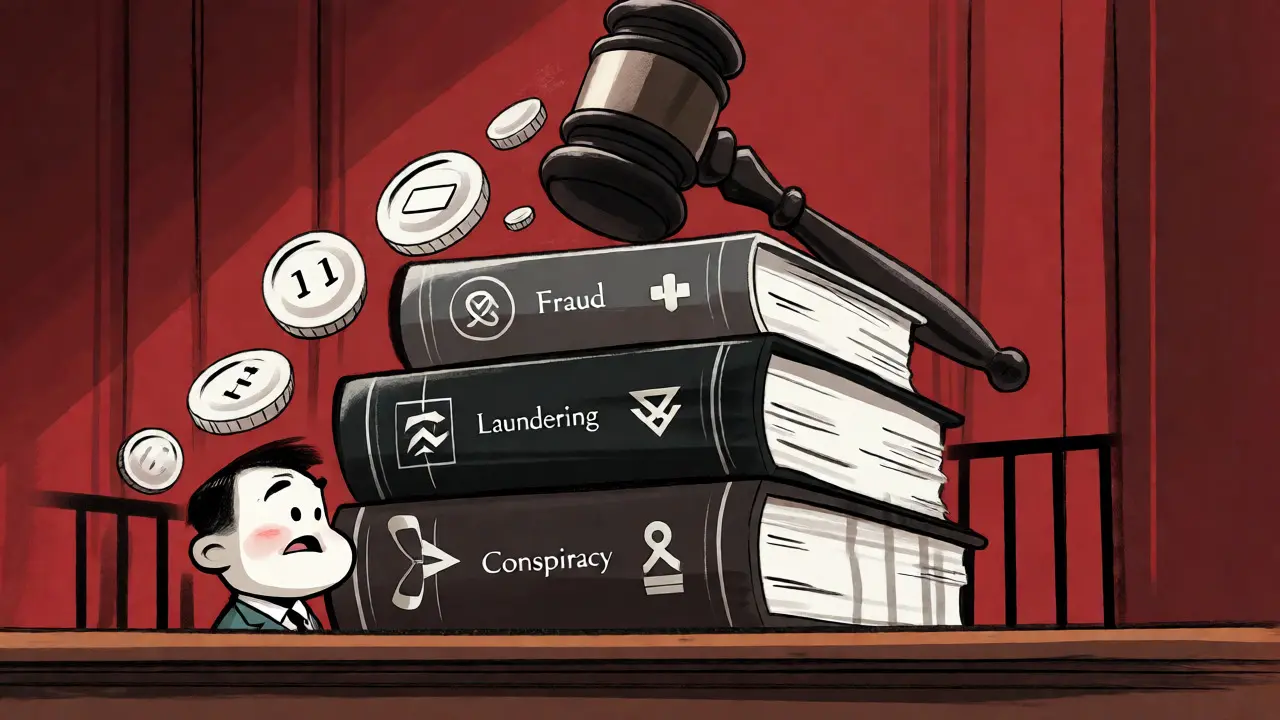
The numbers back this up. In 2024 alone, global penalties for crypto non-compliance exceeded $5.1 billion, a 39% jump from the previous year. The US led this charge with $2.4 billion in fines. But money is only part of the story. The real fear for executives and operators is prison time. When prosecutors stack multiple charges-conspiracy, wire fraud, bank fraud, and specific sanctions violations-the cumulative sentence can easily hit three decades.
How Prosecutors Build a 30-Year Case
You might wonder how a single act of moving coins results in such a massive sentence. It’s rarely about one count. Prosecutors use a "stacking" strategy, charging individuals with multiple distinct crimes arising from the same scheme. Let’s break down the math that leads to 30 years or more.
| Charge Type | Max Sentence (Per Count) | Why It Applies |
|---|---|---|
| Bank Fraud | 30 years | If funds touched US banks via crypto off-ramps. |
| Money Laundering | 20 years | Moving illicit funds to disguise their source. |
| Wire Fraud | 20 years | Using electronic communications to further the scheme. |
| Conspiracy | 5-20 years | Agreeing with others to commit the violation. |
| Unlicensed Money Transmission | 5 years | Operating without proper state/federal licenses. |
Consider the case of Iurii Gugnin, founder of Evita, indicted in June 2025. He didn’t just break one rule. He allegedly funneled over $500 million through US banks while hiding transactions involving sanctioned Russian entities. The DOJ charged him with wire fraud, bank fraud, sanctions evasion, and failure to file Suspicious Activity Reports. Each charge carries its own maximum penalty. When sentences are served consecutively rather than concurrently, the total exposure skyrockets. This is why "30 years" isn't an exaggeration; it’s a realistic outcome for large-scale evasion schemes.
Case Studies: Who Got Caught?
Real-world examples show exactly where the lines are drawn. These aren't obscure cases; they involve major players and high-profile arrests.
OKX Exchange provides a stark warning for exchanges. In February 2025, the DOJ fined OKX over $500 million for severe Anti-Money Laundering (AML) violations. Despite officially banning US users, staff instructed American customers to falsify IDs to bypass restrictions. This wasn't just negligence; it was active facilitation of sanctions evasion. The result? A guilty plea, $84 million in civil fines, and forfeiture of $420 million in illegal proceeds. While the founders avoided prison, the operational impact was devastating.
Another critical area is North Korea. On June 5, 2025, the DOJ filed a civil forfeiture complaint seeking $7.74 million in cryptocurrency laundered on behalf of North Korea. IT workers from North Korea used remote work abroad to earn crypto, bypassing identity checks, and sent funds home to the regime. This highlights that even individual actors, not just corporate giants, are under scrutiny. If you’re facilitating payments for workers from sanctioned jurisdictions, you’re walking a tightrope.
The Office of Foreign Assets Control (OFAC) also stepped up its game in 2024, issuing 13 designations that included 86 cryptocurrency addresses. They targeted networks like the Trickbot ransomware group and exchanges like NetEx24 and Bitpapa. The market reacted instantly: inflows to these sanctioned exchanges dropped by an average of 82% in the three months following designation. Liquidity dried up, proving that regulatory action has immediate economic consequences.
The Compliance Trap: Why Passive Checks Fail
Traditional banks have a luxury crypto firms often lack: the ability to reject incoming transactions. If a wire transfer looks suspicious, a bank can freeze it. In crypto, transactions push into your wallet automatically. You can't say "no" to an incoming token transfer. This technical reality creates unique liability.
OFSI explicitly noted that crypto-asset firms cannot simply reject incoming transactions linked to suspected evasion. Instead, they must proactively upgrade systems to detect, prevent, and report breaches. Blockchain analytics tools are no longer nice-to-have add-ons; they are essential infrastructure. If you don’t monitor the provenance of every coin entering your platform, you risk unknowingly processing funds from sanctioned entities.
Furthermore, the UK’s implementation of the "Failure to Prevent Fraud" offense holds large firms liable if employees or agents commit fraud due to inadequate procedures. This means senior executives can be held personally responsible. It’s not enough to hire a compliance officer; leadership must ensure those officers have the resources and authority to stop bad transactions.
Global Enforcement Trends in 2026
Enforcement isn't just a US problem. The Asia-Pacific region saw a 55% year-on-year rise in enforcement actions in 2024, driven by stricter frameworks in Singapore and Japan. Europe followed suit, with crypto transaction non-compliance fines rising by 28% to €1.2 billion.
International coordination is tighter than ever. The UK’s National Crime Agency launched "Operation Destabilise," targeting money laundering networks involving individuals like Elena Chirkinyan. These operations often lead to cross-border referrals. If you evade sanctions in London, you might face charges in New York or Tokyo. Asset freezes, transaction prohibitions, and travel bans are common collateral damage.
The trend is clear: regulators are sharing data faster. A wallet flagged in the EU is increasingly likely to be scrutinized by US authorities. The idea that you can hide in a jurisdiction with laxer rules is fading as global standards converge around strict AML/KYC protocols.

Protecting Yourself: A Practical Checklist
So, what do you do? Whether you’re running a startup or managing a portfolio, here’s how to reduce your risk:
- Implement Real-Time Screening: Don’t wait for monthly audits. Use automated tools that check wallet addresses against OFAC SDN lists and other sanction databases before confirming transactions.
- Document Everything: Keep detailed logs of why certain transactions were approved or rejected. If a regulator asks, you need to prove you had "reasonable procedures" in place.
- Train Your Team: Ensure staff understand that sanctions apply to crypto just like cash. No more "it’s just code" excuses.
- Monitor Provenance: Use blockchain analytics to trace the history of funds. If a coin came from a known mixer or a sanctioned exchange, flag it.
- Review Contracts: If you’re a business accepting crypto, include clauses that allow you to freeze or return funds if sanctions issues arise post-transfer.
Remember, ignorance is no defense. If you should have known, you will be held accountable.
Frequently Asked Questions
Can I really go to jail for holding crypto from a sanctioned country?
Yes, if you actively facilitate transactions or help conceal the origin of funds. Merely holding might trigger asset freezes, but moving those funds or helping others move them can lead to criminal charges for sanctions evasion or money laundering, especially if done knowingly or with reckless disregard.
What is the difference between civil and criminal sanctions violations?
Civil violations typically result in fines and remedial orders. Criminal violations involve intent or gross negligence and can result in imprisonment. Recent cases show prosecutors treating large-scale crypto evasion as criminal, stacking charges like fraud and conspiracy to maximize prison sentences.
Do small businesses need expensive blockchain analytics tools?
Not necessarily expensive, but necessary. Many providers offer tiered pricing for smaller firms. The cost of a tool is negligible compared to the potential millions in fines or decades in prison. Basic screening capabilities are essential for any business accepting crypto from international clients.
Are DeFi platforms immune to sanctions enforcement?
No. While decentralized, front-end interfaces and developers can be targeted. OFAC has designated addresses interacting with DeFi protocols. If a protocol facilitates transactions for sanctioned entities, the developers or operators may face liability depending on their level of control and involvement.
How does the 30-year sentence calculation work?
It comes from stacking multiple counts. For example, one count of bank fraud (30 years max) plus one count of money laundering (20 years max) served consecutively equals 50 years. Even if judges sometimes merge sentences, the statutory maximums allow for very long prison terms when multiple crimes are charged.