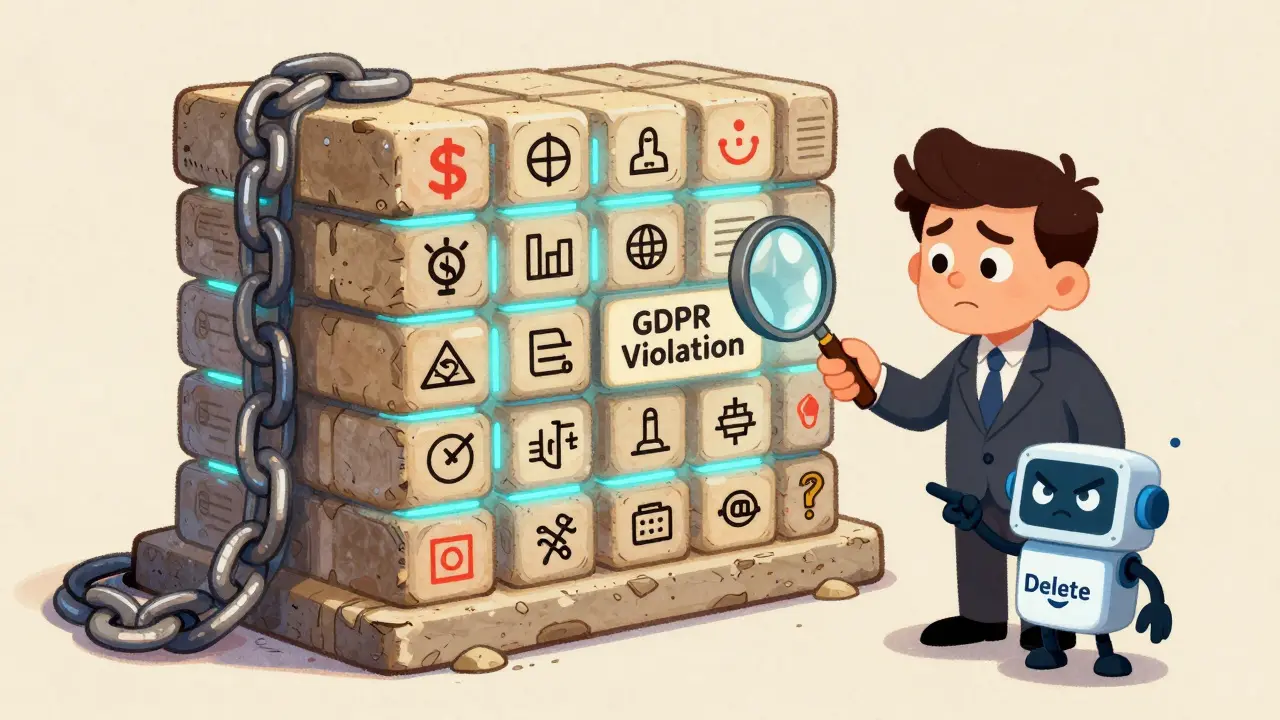
When you think of blockchain, you probably think of cryptocurrency transactions, smart contracts, or decentralized apps. But behind every public ledger is something far less glamorous - and just as critical - record keeping. Unlike traditional databases where records can be edited or deleted, blockchain records are permanent. That permanence makes record keeping on blockchain not just a technical choice, but a legal and compliance imperative.
Why Blockchain Record Keeping Is Different
Traditional record systems allow corrections. You can delete an invoice, update a payroll entry, or edit a client file. Blockchain doesn’t work that way. Once data is written to a block and confirmed by the network, it’s immutable. That’s great for trust and security - but terrible if you make a mistake or need to comply with laws that require data deletion. For example, the European Union’s GDPR gives individuals the right to be forgotten. If a user asks to erase their personal data from a system, a traditional database can do it. A public blockchain? Not so much. That’s why private or permissioned blockchains are becoming the standard for regulated industries. They give organizations control over who can write data, while still preserving the audit trail benefits of blockchain.What Records Must Be Kept? (And For How Long)
Record keeping requirements on blockchain aren’t defined by blockchain itself - they’re dictated by the industries using it. Here’s what different sectors need to preserve:- Financial services: Under GIPS standards, firms must keep all policies, procedures, and performance data supporting compliance claims - including versions from the past. On blockchain, this means storing every update to a trade algorithm or investment strategy as a new block, not replacing the old one.
- Healthcare: In states like Connecticut, licensed professionals must retain patient records for seven years after the last treatment. If a blockchain is used to store medical data, each patient visit, diagnosis, and prescription must be timestamped and linked to a verified identity. Access controls are mandatory.
- Tax and accounting: The IRS requires businesses to keep records that support income and deductions for at least three to seven years, depending on the situation. Blockchain can automate this by logging every transaction with a digital signature. But you still need to store supporting documents - receipts, contracts, bank statements - off-chain, and link them to the blockchain hash.
- Employment records: The EEOC and Department of Labor require payroll records to be kept for three years. If you’re using blockchain for time tracking or wage distribution, every punch-in, shift change, and payment must be recorded with metadata: who approved it, when, and from which device.
- Export controls: The Bureau of Industry and Security (BIS) mandates that export-related records - including licenses, end-user certifications, and shipment details - be stored in a way that prevents alteration. Blockchain is ideal here. Each export transaction becomes a block, with cryptographic proof of origin, destination, and authorization.
Retention periods vary, but the rule is simple: keep records as long as the law requires - and longer if you’re unsure. Blockchain doesn’t reduce your legal obligation. It just changes how you meet it.
Audit Trails: The Real Power of Blockchain Record Keeping
The biggest advantage of blockchain isn’t that records can’t be changed - it’s that you can prove exactly when, how, and by whom they were created. Every block contains:- A timestamp
- A digital signature of the user or system that added the data
- A cryptographic hash of the previous block
- Metadata (like IP address, device ID, or approval code)
This creates an unbreakable chain of custody. If the IRS audits your company, you don’t need to explain why a transaction looks odd. You can show the exact sequence of events: who entered it, when it was approved, and whether it matched the original invoice.
Companies using blockchain for supply chain tracking can prove a product’s origin, handling conditions, and customs clearance - all in one immutable log. Regulators can verify compliance without asking for spreadsheets or requesting access to internal servers.
But here’s the catch: blockchain doesn’t automatically make your records compliant. You still need:
- Clear policies on what data gets recorded
- Access controls to prevent unauthorized entries
- Backup systems for off-chain documents
- Procedures for handling data deletion requests (even if you can’t delete from the chain)

Common Mistakes in Blockchain Record Keeping
Many organizations think switching to blockchain solves their compliance problems. It doesn’t. Here are the top three mistakes:- Storing personal data directly on public blockchains - This violates GDPR and other privacy laws. Use off-chain storage with blockchain hashes as pointers.
- Assuming immutability means no need for backups - If a node goes down or a key is lost, you could lose access to your records. Always maintain encrypted, offline copies.
- Not documenting procedures - Regulators don’t care how fancy your blockchain is. They care if you have written policies on who can add data, how disputes are resolved, and how audits are handled.
One healthcare provider in California used blockchain to store patient records - but didn’t restrict access. A contractor accidentally uploaded a patient’s Social Security number to the chain. Because it couldn’t be deleted, the organization faced a $2.3 million fine under HIPAA. The blockchain didn’t break the law - the lack of controls did.
Best Practices for Blockchain Record Keeping
If you’re implementing blockchain for compliance, follow these steps:- Map your regulatory obligations - List every law that applies to your business: tax, employment, healthcare, export, etc. Don’t assume blockchain changes the rules - it just changes the tool.
- Choose the right blockchain type - Public blockchains (like Ethereum) are great for transparency. Private or consortium blockchains (like Hyperledger Fabric) are better for regulated industries because you control access.
- Separate on-chain and off-chain data - Store sensitive or large files (PDFs, videos, scans) in encrypted cloud storage. Use the blockchain only to store hashes and metadata proving the file hasn’t been altered.
- Implement role-based access - Only authorized users can add or verify records. Audit logs should track every action, even viewing.
- Document everything - Write down how your system works. Who maintains it? How are keys stored? What happens if a user leaves the company? Regulators will ask.
- Test your audit readiness - Run a mock audit. Can you pull a complete record of a transaction from 2023? Can you prove it hasn’t been tampered with? If not, fix it before the real audit.

What Happens When Laws Change?
Blockchain records don’t expire. But laws do. In 2022, the Bureau of Industry and Security updated its export recordkeeping rules. In 2025, OSHA changed its injury reporting thresholds. If your blockchain system was built for last year’s rules, you’re at risk.That’s why your blockchain record keeping system must be flexible. You can’t change past blocks - but you can add new ones that reflect updated policies. For example:
- When a new tax rule takes effect, create a new block labeled “Policy Update: IRS Section 12-2025”
- Link it to the previous version so auditors can see the evolution
- Require dual approval for any policy change to prevent accidental updates
This way, your blockchain doesn’t just store data - it stores your organization’s compliance history.
Final Thought: Blockchain Doesn’t Replace Compliance - It Reinforces It
Blockchain isn’t a magic fix. It won’t turn a sloppy record keeper into a compliant one. But it does make it harder to hide mistakes, easier to prove honesty, and nearly impossible to alter history.If you’re in finance, healthcare, logistics, or government contracting, your record keeping isn’t optional. And if you’re using blockchain, you’re not just adopting new tech - you’re taking on a higher standard of accountability. The ledger doesn’t lie. Neither should you.
Can blockchain records be deleted under GDPR?
No, blockchain records cannot be deleted once confirmed on the chain. However, you can comply with GDPR by storing personal data off-chain and only keeping a cryptographic hash of the data on the blockchain. This way, you can delete the original data while still proving its integrity through the hash. The hash itself is not considered personal data under GDPR if it cannot be reversed to identify an individual.
Do I need to keep paper copies if I use blockchain?
Not necessarily. Most regulatory agencies accept digital records as long as they’re accurate, accessible, and tamper-proof. Blockchain provides both. However, you may still need to keep supporting documents like signed contracts or scanned receipts off-chain. The blockchain should link to these files via hash, not replace them entirely.
What’s the difference between a blockchain audit trail and a traditional log file?
Traditional log files can be edited, overwritten, or deleted by administrators. A blockchain audit trail is cryptographically linked - changing one block breaks the chain and is immediately detectable. Each entry is signed by the user and timestamped by the network, making it far more reliable for legal and regulatory purposes.
Can small businesses use blockchain for record keeping?
Yes, but only if it solves a real problem. Most small businesses don’t need blockchain for tax or payroll records - simple cloud-based accounting software with backups and access controls is enough. Blockchain is overkill unless you’re dealing with multi-party transactions, regulatory audits, or supply chain verification. Don’t use it because it’s trendy - use it because it’s necessary.
What happens if the blockchain network goes down?
If you’re using a public blockchain like Ethereum, the network rarely goes down - it’s decentralized and maintained by thousands of nodes. If you’re using a private blockchain, your organization is responsible for keeping nodes online. Always maintain encrypted backups of your blockchain data. If the network fails, you should still be able to restore records from your backup and validate them against the latest blockchain state once it’s back up.
Is blockchain record keeping more expensive than traditional methods?
Initially, yes. Setting up a secure, compliant blockchain system requires technical expertise, legal review, and integration work. But over time, it often saves money by reducing audit fees, minimizing compliance violations, and cutting down on manual record reconciliation. For regulated industries, the cost of non-compliance - fines, lawsuits, reputational damage - is far higher than the cost of implementation.
Organizations that treat blockchain record keeping as a compliance tool - not just a tech upgrade - are the ones that thrive under scrutiny. The ledger doesn’t care about your excuses. It only records what you put in it.
This is fire 🔥 I've been telling my team for months that blockchain isn't magic dust - it's a ledger with attitude. If you think it fixes bad processes, you're gonna get fined and look stupid. But if you use it right? Game changer.
Exactly. The biggest mistake I see is companies trying to store PDFs and videos directly on-chain. No. Just no. Hash the file, store it in S3 with encryption, and put the hash on the chain. That's how you stay compliant and don't blow up your gas fees. Also, always test your audit flow before going live. I once had a client panic because they couldn't pull a 2021 transaction - turned out their node was down and they had no backup. Rookie move.
Let's be real - most of these companies don't even know what GDPR is, let alone how to handle a right-to-be-forgotten request. They slap a blockchain on their system, call it 'innovative', and then wonder why the EU fined them $2M. The problem isn't the tech. It's the people. They think compliance is a checkbox. It's not. It's a culture. And if your culture says 'move fast and break things', you're going to break the law. And then cry when the regulator shows up.
Wow. Another tech bro pretending blockchain is the answer to everything. You know what's cheaper? A locked file cabinet and a notary. You know what's more reliable? Paper. Blockchain is just a fancy way to spend $500k so your CTO can say he's 'future-proof'. Meanwhile, the accountant is still manually matching receipts because your 'immutable ledger' can't read scanned invoices.
They don't want you to know this but the government is using blockchain to track EVERYTHING. Your medical records? Already hashed. Your tax returns? Logged. Your grocery list? Probably next. This is step one. They're building the surveillance ledger. And you're helping them by signing up for it. Wake up. This isn't compliance. It's control.
Nah bro. Public chains are the future. Why waste time with permissioned stuff? Just store the hash. Let the world see it. Transparency is power. Also 🚀💎 #Web3 #BlockchainIsTheTruth
I work in healthcare. We tried this. A contractor uploaded a patient’s SSN to our 'secure' blockchain. Couldn't delete it. Couldn't fix it. Had to shut down the whole system for 3 weeks. Now we use off-chain storage with blockchain hashes. But guess what? The auditors still asked for paper copies. Because 'digital doesn't feel real' to them. So now we print everything. Blockchain? Nice. Paper? Necessary.
Oh sweetie. You really think a hash is enough? The GDPR says 'personal data' - and if your hash can be linked to a person through metadata, IP logs, or time stamps? Congrats, you just violated Article 17. Also, who approved this? Your dev team? They can't even spell 'compliance'. This is why startups fail. You don't get a gold star for being 'blockchain-enabled'. You get a lawsuit.
I love how people treat blockchain like it's some holy grail. You know what's more powerful? A good lawyer and a well-documented SOP. I've seen companies spend $1.2M on a blockchain system only to have their auditor say 'where's the training manual?' The blockchain doesn't care if your employees don't know how to use it. The regulator does. And they don't care about your cool smart contracts. They care if you can prove you trained your staff. Do you have a sign-off sheet? No? Then you're not compliant. You're just tech-bro-ing your way into trouble.
It's not about the tech. It's about the responsibility. The ledger doesn't lie. But people do. They lie by omission. They lie by choosing the wrong blockchain. They lie by not documenting. The real question isn't 'can we store it on blockchain?' It's 'do we have the maturity to handle what we're storing?' Most organizations don't. And that's not a tech problem. That's a human one.
I just want to say... this is the most important thing I've read this year... I mean... like... wow... I'm literally shaking... I didn't realize blockchain could be this deep... I'm going to print this out and frame it... my wife says I'm obsessed... but I'm not... I'm just... passionate... about compliance... and immutability... and hashes... and also... what if the blockchain goes to the moon? 🚀🔥
Bro I just saw this and I had to comment. You know what's worse than a bad blockchain system? A bad blockchain system with a CEO who thinks it's 'disruptive'. I work with a logistics firm that used blockchain for shipment tracking. They didn't train the drivers. So the drivers just tapped 'confirm delivery' without checking the package. The blockchain recorded it. The customer got a damaged item. The blockchain said 'delivery confirmed'. The company got sued. The blockchain didn't lie. The people did. And now they're paying $3M. Moral of the story? Tech doesn't replace training. It amplifies it.
The real answer? You don't need blockchain for 95% of record keeping. You need a good database, access controls, and a backup. Blockchain is for when you have multiple untrusted parties who need to agree on one version of truth. Like supply chains between competitors. Or interbank settlements. If you're just tracking payroll? Use QuickBooks. Save your gas fees. And your sanity.