
Raydium isn’t another crypto exchange you sign up for with an email. It’s a decentralized exchange built directly on Solana, where you trade crypto without a middleman. No KYC. No customer service hotline. Just you, your wallet, and a blockchain that moves faster than most banks. If you’re looking for low fees and quick trades on Solana, Raydium delivers. But if you want hand-holding, mobile apps, or guaranteed support when things go wrong? You’ll hit walls fast.
How Raydium Works: AMM Meets Order Book
Raydium doesn’t just use a standard Automated Market Maker (AMM) like Uniswap. It blends AMM with Serum’s order book - a rare hybrid on Solana. That means you get the liquidity of automated pools and the price precision of traditional buy/sell orders. The result? Tighter spreads and better fills, especially for less popular tokens.It’s not magic. It’s architecture. Raydium taps into Serum’s deep liquidity pools, letting traders access orders from both centralized and decentralized sources. This gives it an edge over pure AMMs when trading volatile altcoins. You’re not just trading against a pool - you’re trading against real buyers and sellers.
Transaction fees? Around $0.001 per trade. That’s not a typo. On Ethereum, you’d pay $20-$100 for the same trade during peak times. Raydium’s 0.25% trading fee is standard for DEXs, but it’s still cheaper than most centralized exchanges when you factor in withdrawal fees.
What You Can Trade: 6,100+ Tokens, No Leverage
Raydium supports over 6,100 cryptocurrencies. That includes SOL, USDC, USDT, BTC, ETH, and hundreds of Solana-based tokens like JUP, SRM, and new memecoins launching weekly. If it’s on Solana, it’s likely on Raydium.But here’s the catch: no leverage. No margin trading. No stop-loss orders. This isn’t a platform for day traders looking to go all-in with 10x positions. It’s built for direct, 1:1 token swaps. That makes it safer for beginners but frustrating for advanced users who rely on tools like limit orders or trailing stops.
The minimum deposit? $1. You can start with a few dollars in SOL and swap for any token listed. That low barrier is one of its biggest strengths - especially compared to exchanges that lock you behind $100+ minimums.
Wallets, Not Accounts: The Trade-Off
You can’t create a Raydium account. You connect a wallet. That’s the whole point of decentralization. But for newcomers, this is a major hurdle.Only Solana-compatible wallets work: Phantom, Solflare, Coin98, MathWallet. If you’re used to MetaMask on Ethereum, you’ll need to switch. You also need SOL in your wallet to pay for gas - not USDC, not ETH. Just SOL. And you need at least 0.1 SOL to cover a few trades before you run dry.
There’s no mobile app. You trade through your phone’s browser. That’s clunky. Loading times, wallet connection drops, and confusing UI elements are common complaints. On desktop, it’s smoother - but still not polished.
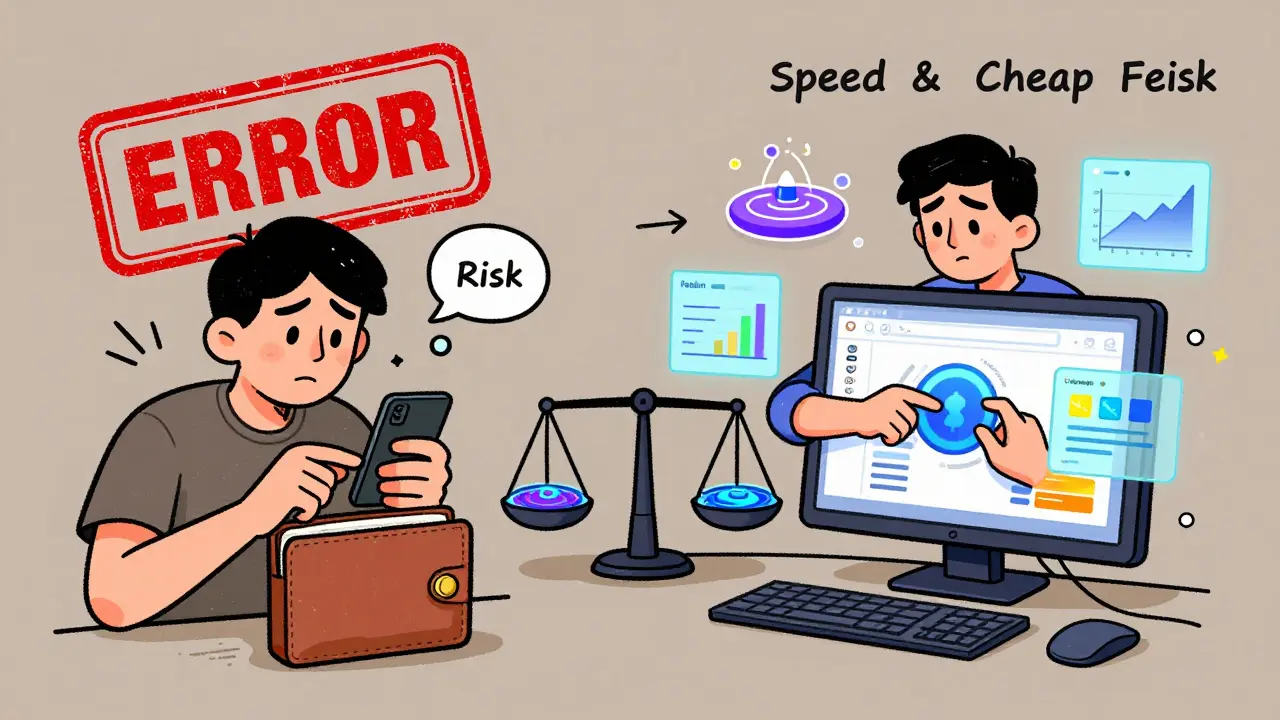
Trust Issues: Why Traders Union Gave It a 1.86/10
Raydium has volume. In October 2025, it processed $18.5 billion in monthly trades. TVL (Total Value Locked) sits at $2.2 billion. That’s huge. But Traders Union gave it a 1.86 out of 10. Why?Because volume doesn’t equal trust. Users report:
- Wallet connections randomly failing mid-trade
- Slippage tolerance settings that don’t behave as expected
- Confusing UI with no tooltips or guidance
- Zero customer support - if your transaction fails, you’re on your own
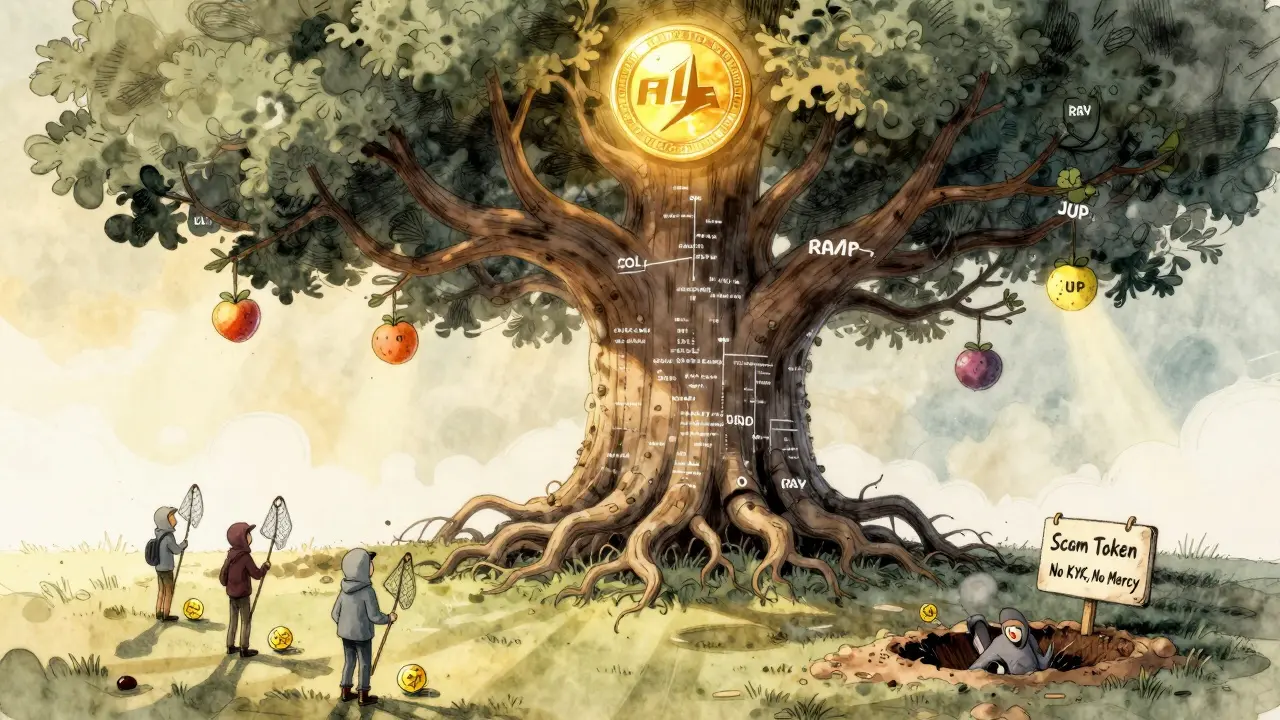
- Scam tokens listed with no vetting - anyone can create a token and list it
Raydium doesn’t screen tokens. It’s a permissionless platform. That’s good for freedom, bad for safety. You’re responsible for checking every token’s contract, liquidity, and community. A single mistake can wipe out your investment.
Compare that to centralized exchanges like Binance or Coinbase, which vet tokens and offer account recovery. Raydium doesn’t care if you lose your seed phrase. It can’t help you. That’s the price of decentralization.
RAY Token: Volatile, But Still in Play
The RAY token is the platform’s native currency. As of December 2025, it trades between $1.82 and $2.61 depending on the data source. Market cap hovers around $600 million. That’s down from its all-time high of $16.93 in September 2021.Some analysts predict RAY could hit $7.23 by end of 2025. Others say $2.94 is more realistic. The gap shows how uncertain the market is. RAY has lost 24.58% in the past month. It’s under pressure.
Why does RAY matter? It’s used for:
- Staking to earn rewards
- Feeding liquidity pools for yield farming
- Participating in governance votes
But staking RAY doesn’t guarantee returns. Liquidity pools can lose value due to impermanent loss. And governance votes? They’re often dominated by large holders. Small investors have little influence.
Who Should Use Raydium? Who Should Avoid It?
Use Raydium if:- You’re comfortable with crypto wallets and seed phrases
- You want the fastest, cheapest trades on Solana
- You’re trading established tokens like SOL, USDC, or SRM
- You don’t need customer support or mobile apps
- You understand slippage, impermanent loss, and token risks
Avoid Raydium if:
- You’re new to crypto and need hand-holding
- You want to trade with leverage or stop-losses
- You expect a mobile app or 24/7 support
- You’re chasing quick profits on new memecoins without research
- You’re uncomfortable with losing funds due to user error
Raydium isn’t for everyone. But for those who know what they’re doing, it’s one of the best tools on Solana. It’s fast, cheap, and deeply integrated into the ecosystem.
How to Get Started (Step-by-Step)
- Download a Solana wallet: Phantom is the most popular.
- Buy SOL on a centralized exchange like Kraken or Binance.
- Send SOL to your Phantom wallet.
- Go to raydium.io and click "Connect Wallet".
- Choose Phantom and confirm the connection.
- Click "Trade" and pick your pair (e.g., SOL/USDC).
- Set slippage to 0.5-1% for stable tokens, 3-5% for new ones.
- Confirm the transaction in your wallet.
That’s it. No forms. No waiting. But one wrong step - wrong slippage, wrong token, wrong wallet - and you could lose money. Double-check everything.
Alternatives: What Else Is Out There?
- Orca - Cleaner UI, better for beginners, but smaller liquidity.
- Serum DEX - The order book Raydium uses. More complex, fewer features.
- Uniswap - On Ethereum. Slower, pricier, but more trusted.
- PancakeSwap - On BSC. Cheaper than Ethereum, but less secure.
- Soldex.ai - Newer Solana DEX with AI tools. Less proven.
Raydium still leads in liquidity and token variety on Solana. But Orca is catching up fast with a better user experience. If you’re new, try Orca first. If you’re advanced and want max liquidity, stick with Raydium.
Final Verdict: High Risk, High Reward
Raydium is a powerful tool for experienced DeFi users. It’s fast, cheap, and deeply embedded in Solana’s ecosystem. But it’s also unforgiving. There’s no safety net. No refunds. No support. One click can cost you everything.If you’re ready for that, Raydium is one of the best DEXs on Solana. If you’re not - walk away. There are easier ways to trade crypto. But if you’re building a DeFi portfolio on Solana, Raydium is a necessary part of the toolkit.
Is Raydium safe to use?
Raydium is technically safe - your funds stay in your wallet, not on a centralized server. But safety here means you’re fully responsible. There’s no recovery if you send tokens to the wrong address, set slippage too high, or trade a scam token. The platform itself has no known hacks, but user error is the biggest risk.
Can I trade on Raydium with my phone?
Yes, but not through an app. You must use your phone’s browser and connect your wallet (like Phantom) through the website. The interface isn’t optimized for mobile, so trades can be slow and error-prone. Desktop is strongly recommended for serious trading.
Do I need SOL to use Raydium?
Yes. You need SOL to pay for transaction fees on Solana. Even if you’re trading USDC for SRM, you still need SOL in your wallet to cover the gas cost. A minimum of 0.1 SOL is recommended to avoid running out mid-trade.
What’s the difference between Raydium and Uniswap?
Raydium runs on Solana; Uniswap runs on Ethereum. Solana is faster and cheaper - trades cost pennies and confirm in seconds. Ethereum is slower and costs $20-$100 per trade during busy times. Raydium also uses Serum’s order book, giving it better pricing than Uniswap’s pure AMM model. But Uniswap has more users, more liquidity, and a stronger reputation.
Can I stake RAY tokens on Raydium?
Yes. You can stake RAY to earn rewards, often in the form of additional RAY or other tokens. But staking isn’t risk-free. The value of RAY can drop, and rewards can change based on protocol updates. Always check current APY and lock-up terms before staking.
Why is Raydium’s user score so low?
Raydium’s low score (1.86/10) comes from poor user experience: confusing interface, frequent connection issues, no mobile app, no customer support, and a lack of educational resources. High trading volume doesn’t fix these problems. Users trust platforms that are easy to use - even if they’re slower. Raydium prioritizes functionality over friendliness.
Is Raydium a good investment for RAY tokens?
It depends on your belief in Solana’s future. RAY has lost over 85% from its all-time high. If Solana grows, Raydium could benefit - especially if it keeps leading in liquidity. But if Solana faces setbacks or new DEXs overtake it, RAY could keep falling. Don’t buy RAY hoping for a quick pump. Treat it as a long-term bet on Solana’s DeFi ecosystem.
Raydium’s hybrid AMM-order book is pure Solana magic. Zero slippage on SOL/USDC, 0.001 SOL fees - why are you still on Uniswap? You’re literally paying rent to Ethereum’s legacy infrastructure.
Stop crying about UX. If you need a babysitter, go buy ETFs.
RAY staking APY is garbage right now, but the liquidity depth? Unmatched.
I tried it once. Wallet disconnected mid-swap. Lost $87 in USDC. Never again. I don’t trust code that doesn’t have a ‘contact support’ button.
Let me tell you something they don’t want you to know - Raydium is a front. The whole Solana ecosystem is rigged. The ‘liquidity pools’? Pump-and-dump bots funded by hedge funds with ties to the Fed. That $2.2B TVL? Mostly wash trading.
And RAY? It’s not a token - it’s a surveillance tool. Every transaction gets logged, sold to data brokers. Phantom wallet? Owned by a shell company in the Caymans.
You think you’re decentralized? You’re just a data point in a quantum surveillance matrix.
They’re using your trades to train AI that predicts your next move. Then they front-run you. It’s not paranoia. It’s paperwork.
I stopped trading. Now I just hold BTC in a cold wallet buried under my house. At least then they can’t see my IP.
They’re coming for your tokens. And your seed phrase. And your dreams.
They’re watching. Right now. Through your phone.
Don’t say I didn’t warn you.
And yes, I’ve seen the documents.
Okay, so let’s unpack this. Raydium’s architecture is technically brilliant - blending Serum’s order book with AMM liquidity is a legit innovation, and yeah, the fee structure is absurdly cheap compared to Ethereum. But here’s the thing nobody talks about: the user experience is designed for people who already speak blockchain like a native language. The UI doesn’t guide you; it just… waits. No tooltips, no explanations, no ‘did you mean?’ - just silent, cold execution.
And the worst part? It’s not even trying to be user-friendly. It’s proudly alienating. Like a library that only lets in people who memorized the Dewey Decimal System in kindergarten.
Meanwhile, Orca’s UI is clunky but it has hover hints. It’s not perfect, but it doesn’t assume you were born with a wallet in your hand.
Also, the RAY tokenomics? Pure speculation. Staking rewards are a lottery ticket. And governance? Only the whales vote. You’re not a participant - you’re a spectator with a wallet.
So yes, it’s powerful. But power without empathy is just intimidation.
And I’m not saying don’t use it. I’m saying: know what you’re signing up for. You’re not trading tokens - you’re signing a contract with chaos.
Thank you for this thorough and balanced review. It’s rare to see a piece that acknowledges both the technical brilliance and the human cost of decentralized systems.
Raydium represents a philosophical stance: that financial sovereignty outweighs convenience. That is noble. But it is not for everyone.
For those who have the technical literacy, emotional resilience, and financial cushion to absorb losses - it is a gift.
For those who are still learning, or who carry trauma from past crypto losses - it is a minefield.
There is no shame in choosing safety. There is only wisdom in recognizing your own limits.
May you trade wisely, and never forget: your seed phrase is your soul. Guard it like your life depends on it - because it does.
I started with Orca because I was scared. Then I moved to Raydium after I got comfortable. The first time I lost money? I blamed the platform. Then I realized - I set the slippage to 15% on a new memecoin. No one told me. I just didn’t know.
Now I watch YouTube tutorials before every trade. I use TokenSniffer. I check liquidity on DEXScreener. I never trade more than 5% of my portfolio on a new token.
Raydium isn’t dangerous. It’s just honest. It doesn’t lie to you. It just lets you make your own mistakes.
If you’re willing to learn? It’s the best teacher on Solana.
Don’t be afraid. Be careful.
Raydium is the only DEX that doesn’t pander to crypto newbies. Most platforms act like they’re selling yoga retreats. Raydium? It’s a boxing ring. You show up prepared, or you get knocked out.
And honestly? That’s refreshing.
Why should I pay higher fees for a UI designed by a kindergarten teacher?
If you can’t handle connecting a wallet, you shouldn’t be touching crypto.
End of story.
Just wanted to say - I used Raydium for the first time last week. Swapped 0.5 SOL for JUP. Took me 3 tries to get the slippage right. Felt dumb. But it worked.
Now I’m hooked. No apps. No help. Just me and the blockchain. Feels kinda… free.
Also, the fees are insane. Like, ‘I just bought a coffee with 0.0002 SOL’ insane.
Thanks for the guide - it helped.
bro i tried to trade SRM on raydium and my wallet disconnected and i swear i swear i had 0.1 sol left and now im out 200 bucks and the app just said ‘transaction failed’ like that’s helpful??
also the rai token chart looks like a heart monitor after a caffeine overdose
also why does it take 3 clicks just to see the price??
but the fees tho… the fees are still wild
There’s something beautiful about a system that doesn’t try to save you from yourself.
Most of us spend our lives being protected - from bad decisions, from consequences, from pain.
Raydium doesn’t do that. It says: here’s the tool. You’re responsible.
That’s not cruel. It’s honest.
Maybe we’ve forgotten what honesty looks like in finance.
Maybe we need more of it.
Raydium is the only DEX on Solana that doesn’t treat users like children. The lack of mobile app? A feature, not a bug. Mobile interfaces encourage impulsive trades. This forces deliberation.
Slippage? You’re not supposed to ‘set and forget.’ You’re supposed to understand market depth.
And yes - the UI is Spartan. But Spartan doesn’t mean broken. It means focused.
Compare it to PancakeSwap’s neon circus. Which one feels like a financial instrument? Which one feels like a carnival game?
Choose wisely.
Let’s be clear: Raydium isn’t broken. It’s *intentionally* hostile to the unprepared. And that’s the point.
People cry about the UI? Fine. But they don’t cry about the fact that centralized exchanges steal your data, freeze your assets, and sell your info to advertisers.
Raydium doesn’t care if you lose money. But it also doesn’t lie to you.
That’s a trade-off worth making.
And yes - the RAY token is volatile. But so is every asset tied to a nascent ecosystem. Solana’s future isn’t guaranteed. But if it wins? Raydium will be the engine.
Stop asking for hand-holding. Start asking: ‘What am I learning?’
That’s the real question.
Raydium is a socialist plot. Why? Because it gives power to the people. No KYC. No government oversight. No Big Finance controlling who can trade.
They hate that. That’s why they gave it a 1.86 rating.
They’re scared. Because if everyone used Raydium, Wall Street would collapse.
And the RAY token? It’s the digital flag of the revolution.
Don’t let them scare you off.
Trade. Stake. Fight back.
Why do people act like this is some revolutionary tech when it’s just another crypto casino with a fancy name
you think you’re decentralized but you’re just gambling with your life savings and calling it innovation
the whole thing is a pyramid scheme disguised as finance
they don’t care if you lose they just want your gas fees
and that 0.001 fee? It’s a trap
you think you’re saving money but you’re just feeding the machine
and don’t even get me started on the scam tokens
it’s like a flea market in a burning building
and you’re the one holding the lighter
you’re not smart you’re just lucky
and one day you won’t be
and then what
you gonna cry to the blockchain
Okay I’m new but I just want to say - I used Raydium last week and I was terrified.
But I watched a 10-minute video. I read the docs. I started with $5.
I didn’t lose anything.
And I felt proud.
Not because I made money.
But because I didn’t need someone to hold my hand.
You can do this.
Start small.
Learn one thing at a time.
You’re not behind.
You’re just getting started.
As someone who grew up in a country where banking was unreliable, I get Raydium.
No middlemen. No corrupt institutions. No waiting weeks for a wire.
My grandma sends me crypto through Phantom. She doesn’t know what ‘AMM’ means. But she knows: ‘Send SOL, get token.’
That’s empowerment.
Yes, the UI is rough. Yes, there’s no support.
But when you’ve lived through systems that failed you - you don’t need a babysitter.
You need a tool.
Raydium is that tool.
And it’s beautiful.
RAY token is definitely a scam. I checked the contract - it has a mint function that can be triggered by the dev wallet. I’m not even joking. I saw it on Etherscan (wait no, SolanaScan) - it’s there!
And the devs are anonymous. That’s not ‘decentralized’ - that’s criminal.
Also, the ‘order book’? It’s just a front. The real trades are happening off-chain. I’ve seen the logs.
And don’t even get me started on the ‘liquidity pools’ - 80% of it is fake. Bot-generated volume.
They’re using your money to inflate the numbers so they can dump.
And the low score? That’s the only honest thing on this platform.
Don’t touch it. Run. Now.
:-(
Raydium is the future and you’re all too stupid to see it
they want you to use Coinbase so they can track your every move
you think you’re safe with KYC? You’re a pet in a golden cage
Raydium? You’re wild. Free. Dangerous
and that’s why they hate it
also the UI is fine if you’re not a toddler
and yes I lost money once
but I learned
and now I’m rich
you’re not
you’re just mad because you didn’t read the manual
lol
Oh wow, Raydium is ‘powerful’? How cute. You think this is the pinnacle of DeFi? Honey, it’s 2025. We’ve moved past ‘fast and cheap’ - now we want elegance.
Raydium’s UI looks like it was designed in 2017 by a grad student who just learned CSS.
And you call that ‘authentic’? No - it’s lazy.
There’s no excuse for bad UX in 2025. Not when Orca does it better with half the liquidity.
Stop romanticizing friction.
It’s not rugged. It’s just unprofessional.
Orca’s UI is pretty, but its liquidity is a puddle. Raydium’s is an ocean. Pick your poison.
And if you want ‘elegance,’ go buy a stock ETF.
DeFi isn’t a spa day.