
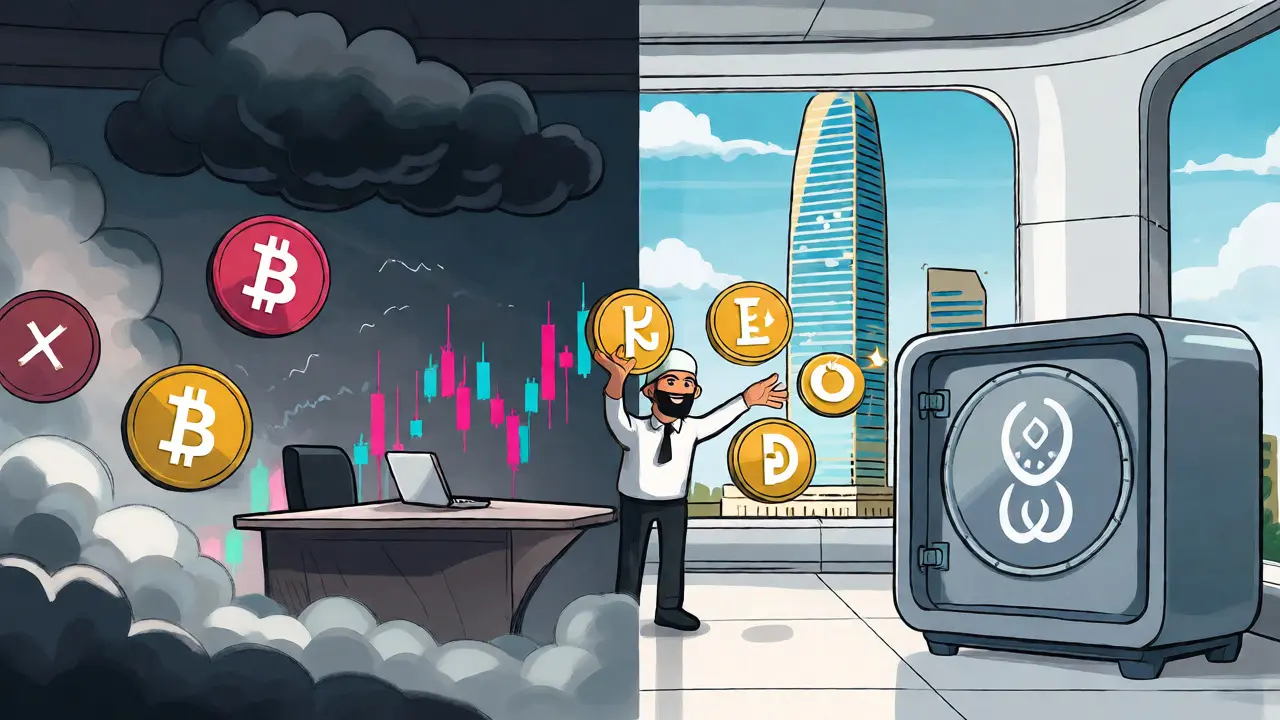
Imagine trying to buy a coffee in Doha with Bitcoin. You can't. In fact, if you're working for a bank or financial institution in Qatar, you're legally barred from even touching it. This isn't just a rumor or a soft guideline; it is hard law. Since February 2018, the Qatar Central Bank has enforced a strict prohibition on cryptocurrency trading and investment for all financial institutions within its jurisdiction. But here is the twist that confuses many outsiders: while Qatar slams the door on volatile coins like Bitcoin and Ethereum, it is quietly opening a massive window for something else-tokenized real-world assets.
This creates a fascinating regulatory paradox. On one side, you have a complete ban on what most people think of as "crypto." On the other, you have a sophisticated legal framework designed to bring blockchain technology into the heart of traditional finance. If you are an investor, a fintech founder, or just someone curious about how Gulf states handle digital money, understanding this distinction is critical. It’s not just about saying "no" to crypto; it’s about saying "yes" to a very specific, controlled version of digital finance.
The Core Prohibition: What Exactly Is Banned?
To understand the landscape, you first need to know what is actually prohibited. The rules didn't appear out of nowhere. They were solidified in two key moments. First, in 2018, the Qatar Central Bank issued Circular No. (6), which explicitly stopped banks and financial firms from dealing in cryptocurrencies. Then, in December 2019, the Qatar Financial Centre Regulatory Authority (QFCRA) expanded this by banning virtual asset services within the Qatar Financial Centre (QFC).
The ban covers exchanging virtual assets for fiat currencies, transferring them, keeping them in custody, and offering services related to issuing new tokens. Crucially, this applies to what regulators call "Excluded Tokens." These are defined as assets that don't represent a right in any property other than the token itself, or those that act as a substitute for currency. This category explicitly includes:
- Bitcoin and major cryptocurrencies: High-volatility assets used primarily for speculation.
- Stablecoins: Yes, even USDT or USDC are banned under current interpretations because they function as payment substitutes.
- Central Bank Digital Currencies (CBDCs): Even state-backed digital money falls under this exclusion until specifically authorized.
If you try to trade these through a local bank, your transaction will likely be blocked. If you work in compliance at a Qatari firm, verifying that a client's funds aren't tied to these prohibited assets adds significant overhead. A 2025 survey showed that 78% of financial services firms reported higher compliance costs compared to regional competitors because of this verification burden.
The Pivot: Introducing Regulated Asset Tokenization
If Qatar hates crypto, why are they building blockchain infrastructure? The answer lies in the QFC Digital Assets Regulations 2024, enacted in September 2024. This framework represents a strategic shift. It doesn't lift the ban on cryptocurrencies. Instead, it creates a safe harbor for "utility-focused tokenization of real assets."
Think of it this way: Qatar doesn't want you gambling on meme coins. But it absolutely wants you to own a fraction of a skyscraper in Lusail City using blockchain technology. The new regulations allow for the creation of digital tokens that represent ownership rights in tangible things like:
- Commercial real estate towers.
- Islamic finance products, such as sukuk.
- Bonds and commodities.
- Intellectual property rights and carbon credits (in future phases).
These are not speculative assets. Their value is tied to physical reality. The QFC provides a regulatory sandbox where businesses can test these models. For example, Barwa Real Estate Company successfully tokenized a commercial property worth QAR 150 million in early 2025. The result? Settlement times dropped from 30 days to just 48 hours. That is efficiency, not speculation.
Why Qatar Takes This Approach
You might ask, "Why not just follow Dubai?" The United Arab Emirates has established the Virtual Assets Regulatory Authority (VARA) and captured nearly 68% of the GCC's crypto trading volume. Qatar’s approach is more conservative, aligning with its broader financial tradition. Dr. Ibrahim Al-Hashimi, a finance professor at Qatar University, notes that this framework reflects a "sophisticated understanding" of the difference between speculative crypto and utility-based tokenization.
The primary drivers behind this stance include:
- Financial Stability: The Qatar Central Bank prioritizes protecting the local financial system from the wild swings of crypto markets. Governor Sheikh Bandar bin Mohammed Al Thani has stated that their framework ensures sustainable growth over short-term market participation.
- Sharia Compliance: Islamic finance principles discourage excessive uncertainty (gharar) and speculation. Tokenizing real assets fits neatly into Sharia-compliant structures, whereas pure crypto speculation often does not.
- Economic Diversification: Under Qatar National Vision 2030, the country aims to diversify beyond oil. Blockchain offers efficiency gains for traditional sectors without introducing systemic risk.
However, this caution comes at a cost. Critics argue that by excluding stablecoins, Qatar fragments its own financial markets. How do you pay for a tokenized asset if you can't use digital cash? Currently, settlements must go through traditional fiat rails, creating friction that blockchain was supposed to eliminate.
How Qatar Compares to Its Neighbors
Context matters. Qatar sits in the middle of a regulatory spectrum in the Gulf Cooperation Council (GCC). Some countries embrace everything; others ban everything. Qatar picks a narrow path in between.
| Country | Crypto Trading Status | Tokenization Status | Regulatory Body |
|---|---|---|---|
| Qatar | Prohibited for financial institutions | Permitted & Regulated (QFC) | Qatar Central Bank / QFCRA |
| UAE | Licensed & Regulated | Licensed & Regulated | VARA / ADGM / DIFC |
| Kuwait | Total Ban | Ban | Central Bank of Kuwait |
| Bahrain | Licensed Exchanges Allowed | Regulated | Central Bank of Bahrain |
| Saudi Arabia | Framework Issued (No Licenses Yet) | Pilot Programs | Capital Market Authority |
As you can see, Qatar is stricter than the UAE and Bahrain but more open than Kuwait. Unlike Saudi Arabia, which is still drafting its licensing regime, Qatar has already implemented concrete rules for tokenization. This gives Qatar a first-mover advantage in the niche of institutional-grade digital assets, even if it misses out on the retail crypto boom.

Practical Implications for Investors and Businesses
If you are looking to enter the Qatari market, here is what you need to know. For individual traders, the situation is frustrating. There are no locally regulated exchanges. If you want to trade Bitcoin, you must use offshore platforms. This exposes you to higher fees-often around 2.5% more per transaction due to cross-border costs-and complex KYC hurdles. A Reddit user from Doha recently noted that being a citizen means paying a premium for access that neighbors enjoy locally.
For businesses, the opportunity lies in the QFC sandbox. Implementing a tokenization project isn't cheap or quick. Expect a timeline of 6-8 months for full compliance and setup costs averaging QAR 850,000 ($233,500 USD). You will need:
- Legal opinions confirming the underlying asset's validity.
- Technical specifications for the blockchain infrastructure.
- Specialized staff trained in both traditional finance and blockchain mechanics.
Interestingly, 63% of compliance officers surveyed said they needed specialized training to navigate these rules. The learning curve is steep, but the prize is access to a growing institutional market. As of March 2025, 47 international asset managers had formally inquired about operating under this framework.
The Future Outlook
Will Qatar ever lift the ban? Don't hold your breath. Industry analysts project the prohibition on cryptocurrencies will remain through 2030. However, the definition of "digital assets" may expand. The QFC roadmap identifies carbon credits, art collections, and intellectual property as next targets for tokenization.
There is also public pressure. A 2025 survey found that 68% of young Qataris (aged 18-35) support limited legalization of cryptocurrencies. Politicians are aware of this. Discussions at the Qatar Economic Forum suggest ongoing debates about "advanced legislative frameworks," but these are likely focused on refining tokenization rather than embracing speculative trading.
In short, Qatar has chosen quality over quantity. It may lose the flashy, high-volume crypto trades to Dubai, but it positions itself as a serious hub for secure, regulated, and efficient digital finance. For investors who prefer stability over speculation, that might be exactly what they are looking for.
Can I buy Bitcoin in Qatar?
You cannot buy Bitcoin through local Qatari banks or financial institutions due to the Qatar Central Bank's prohibition. Most residents use offshore exchanges that accept international cards or transfers, though this involves higher fees and additional compliance checks.
Is stablecoin usage allowed in Qatar?
Currently, stablecoins like USDT and USDC are classified as "Excluded Tokens" under the QFC Digital Assets Regulations 2024 because they serve as substitutes for currency. Therefore, they are generally prohibited for financial institutions, similar to other cryptocurrencies.
What is the difference between crypto and tokenization in Qatar?
Crypto refers to volatile, speculative assets like Bitcoin, which are banned. Tokenization involves creating digital representations of real-world assets like real estate or bonds. Qatar bans the former but actively regulates and encourages the latter to improve financial efficiency.
Which authority regulates digital assets in Qatar?
The Qatar Central Bank (QCB) oversees general banking prohibitions, while the Qatar Financial Centre Regulatory Authority (QFCRA) manages the specific regulations for tokenized assets within the Qatar Financial Centre (QFC) zone.
Are there licensed crypto exchanges in Qatar?
No, there are currently no locally licensed cryptocurrency exchanges for retail trading. The QFC allows for tokenization platforms, but these deal in asset-backed tokens rather than tradable cryptocurrencies like BTC or ETH.