ProtonSwap Fee Calculator
Calculate your ProtonSwap trading fees based on your XPR staking level. Remember: 0.3% total trading fee, with discounts for XPR stakers.
ProtonSwap isn’t another name you hear on every crypto podcast. You won’t find it on CoinMarketCap’s top 100 exchanges. No Reddit threads buzzing about it. No YouTube tutorials walking you through the interface. That’s not an accident - it’s a sign. ProtonSwap is a niche player, built for one thing: swapping tokens on the Proton blockchain. And if you’re not already deep in that ecosystem, you might be better off looking elsewhere.
What Exactly Is ProtonSwap?
ProtonSwap is a decentralized exchange (DEX) running on the Proton blockchain. Unlike centralized exchanges like Kraken or Binance, you don’t deposit your coins into a wallet they control. Instead, ProtonSwap connects your wallet directly to smart contracts. When you swap XPR for another token on the network, the trade happens peer-to-peer through code - no middleman, no custodial risk.
The big selling point? Zero gas fees. The Proton blockchain was built to fix Ethereum’s slow, expensive transactions. It uses a proof-of-stake model with instant finality. That means your swap confirms in under a second, and you don’t pay a single dollar in network fees. That’s rare, even among DEXs.
How Does ProtonSwap Make Money?
ProtonSwap doesn’t charge users directly. Instead, it takes a tiny cut from every trade: 0.3% total. That’s split two ways:
- 0.2% goes to liquidity providers - the people who lock up tokens to make trading possible.
- 0.1% goes to XPR stakers - people who hold and stake the native Proton token.
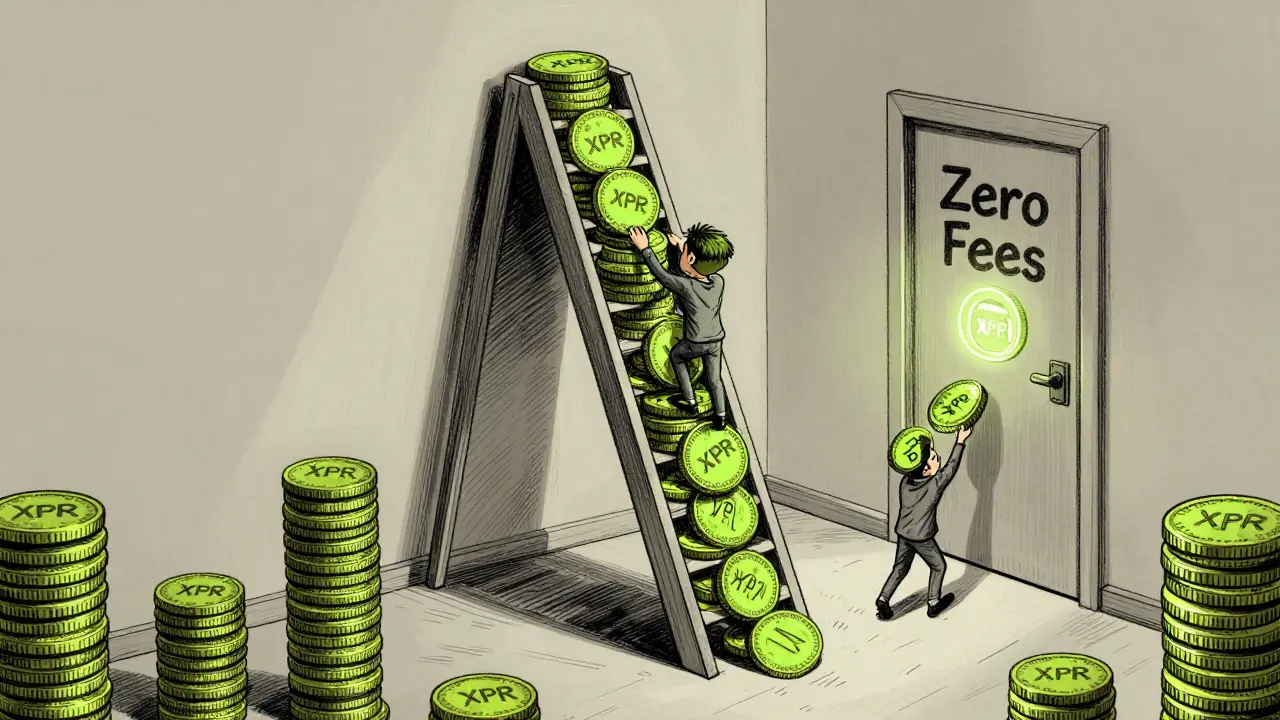
Here’s where it gets interesting: if you stake XPR, you get big discounts on those fees. Staking 100,000 XPR cuts your trading fee by 33%. Staking 1 million? 66% off. And if you stake 10 million XPR - which is worth roughly $1.5 million at current prices - you pay zero trading fees.
That’s not a feature for casual users. That’s a reward for whales. If you’re not sitting on millions in XPR, you’re still paying the full 0.3%. And unlike Uniswap or SushiSwap, where fee discounts are minor or non-existent, ProtonSwap’s system pushes you toward holding and locking up a lot of the native token just to trade cheaply.
What Tokens Can You Trade?
This is the biggest limitation. ProtonSwap only supports tokens built on the Proton blockchain. That means you can’t trade Bitcoin, Ethereum, Solana, or even popular tokens like Chainlink or Aave. You’re stuck with what’s on Proton: XPR, Proton’s native token, and a handful of other tokens issued by projects that chose to build on Proton.
Compare that to a multi-chain DEX like 1inch or Jupiter, which pulls liquidity from dozens of blockchains. Or even a centralized exchange like Kraken, which supports over 400 coins. ProtonSwap doesn’t just limit your options - it locks you into a single ecosystem. If you want to trade anything outside Proton, you need to use a bridge or another exchange first.
Is There Any User Data?
Here’s the uncomfortable truth: nobody knows how many people use ProtonSwap.
CoinMarketCap lists it as “Untracked.” That means no volume, no liquidity, no price history. No charts. No order book depth. Nothing. That’s not because it’s too new - it’s because the platform doesn’t report data to aggregators. It could be low volume. It could be intentional secrecy. Either way, it’s a red flag.
You won’t find reviews on Trustpilot. No discussions on Crypto Twitter. No Reddit threads. No YouTube walkthroughs. Even the official website lacks a blog, FAQ, or support page. That’s not a sign of a mature product. It’s a sign of something either very early, very quiet, or not ready for public scrutiny.
Who Is This For?
ProtonSwap isn’t for beginners. It’s not for traders who want to buy Bitcoin or swap ETH for USDC. It’s not for people who want to check their portfolio’s performance on CoinGecko.
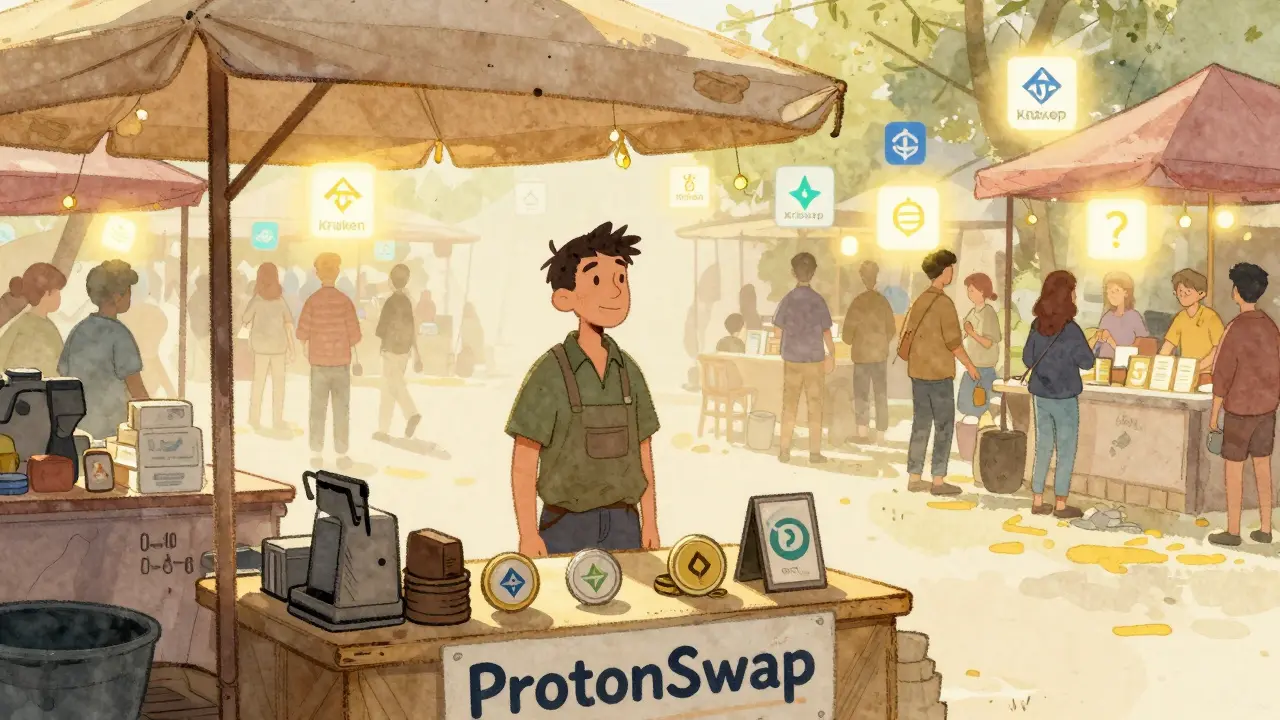
It’s for one group: users who already hold XPR and want to trade other Proton-native tokens without paying gas fees. Think of it like a local farmers market. You can’t buy apples from California here - but if you’re in the neighborhood and want to trade your homegrown peaches for someone else’s tomatoes, it’s perfect.
If you’re building a DeFi app on Proton, or holding tokens from a Proton-based project, then ProtonSwap is your only real option. If you’re just trying to diversify your crypto portfolio? There are dozens of better, more transparent, more liquid exchanges out there.
The Bottom Line: High Risk, Very Narrow Use Case
ProtonSwap has a clever design. Zero gas fees? Great. Fee discounts for stakers? Smart incentive. Direct wallet integration? Check.
But here’s what it’s missing: transparency, liquidity, and user trust.
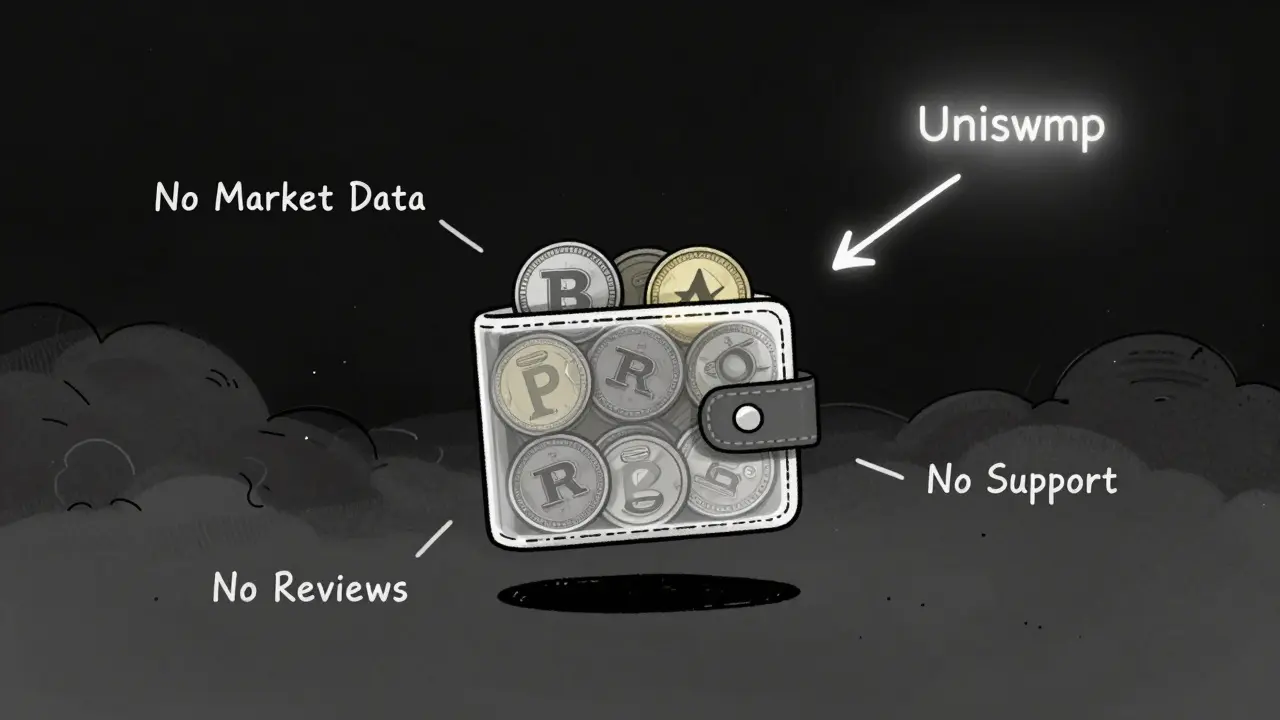
Without market data, you can’t tell if the price you’re getting is fair. Without reviews, you can’t know if the platform is secure. Without support, you’re on your own if something goes wrong. And without cross-chain support, you’re stuck in a tiny ecosystem.
ProtonSwap feels like a tool built for insiders - developers and early adopters who believe in the Proton blockchain’s future. But for everyone else? It’s a dead end.
If you’re already deep in the Proton ecosystem and need to swap tokens quickly and cheaply, give it a try. But don’t expect it to replace your main exchange. And never put more money into it than you’re willing to lose - because if this platform fades, your tokens might vanish with it.
ProtonSwap vs. Other Exchanges
| Feature | ProtonSwap | Uniswap (Ethereum) | Kraken | Swyftx |
|---|---|---|---|---|
| Blockchain | Proton only | Ethereum | Multichain | Multichain |
| Gas Fees | None | High (ETH network) | None on deposits/withdrawals | None on deposits/withdrawals |
| Trading Pairs | Dozens (Proton-only) | Thousands | Over 410 | Over 300 |
| Fee Discounts | Up to 100% with XPR staking | No discounts | Volume-based tiered fees | Volume-based tiered fees |
| Market Data Available | No | Yes | Yes | Yes |
| User Reviews | None publicly available | Thousands | Extensive | Extensive |
| Regulatory Status | Unclear | Unregulated DEX | Licensed (US, EU, Canada) | ASIC-registered (Australia) |
Should You Use ProtonSwap?
Ask yourself these questions:
- Do I already hold XPR or other Proton-native tokens?
- Am I okay with zero market data and no way to verify prices?
- Do I trust a platform with no public reviews, no support team, and no roadmap?
- Am I willing to stake millions of XPR to get fee discounts?
If you answered “yes” to all four, go ahead. But if you’re unsure? Stick with exchanges that show you their numbers, answer your questions, and let you trade what you want.
ProtonSwap isn’t a scam. It’s just not for you - unless you’re already living inside its walls.
Is ProtonSwap safe to use?
ProtonSwap uses smart contracts on the Proton blockchain, which has never been hacked. That’s good. But safety isn’t just about code - it’s about transparency. With no public audits, no support team, and no user reviews, you’re trusting something with zero external validation. If you lose funds, there’s no customer service to help you. Use only what you can afford to lose.
Can I trade Bitcoin or Ethereum on ProtonSwap?
No. ProtonSwap only supports tokens built on the Proton blockchain. You can’t trade Bitcoin, Ethereum, Solana, or any other major cryptocurrency directly. You’d need to first convert your BTC or ETH to a Proton-compatible token using a bridge or another exchange, then move it to ProtonSwap.
Why doesn’t CoinMarketCap track ProtonSwap?
CoinMarketCap only tracks exchanges that provide verified trading data. ProtonSwap doesn’t share its volume, liquidity, or price feeds publicly. That could mean low activity, technical limitations, or a deliberate choice to avoid regulatory scrutiny. Either way, it means you can’t verify if the prices you see are real or manipulated.
How much XPR do I need to stake to get zero fees?
You need to stake 10 million XPR to get a 100% trading fee discount. At current prices, that’s around $1.5 million. This isn’t a feature for average users - it’s a reward for major holders who are deeply invested in the Proton ecosystem.
Is ProtonSwap better than Uniswap?
Only if you’re trading Proton-native tokens and want zero gas fees. Uniswap supports thousands of tokens across Ethereum and other chains, has massive liquidity, and transparent data. ProtonSwap has no liquidity data, no token variety, and no user base. For most people, Uniswap is far more useful and reliable.
Where can I buy XPR to use ProtonSwap?
XPR is available on a few smaller exchanges like Proton’s own wallet, and occasionally on platforms like Bitrue or Gate.io. But it’s not listed on major exchanges like Coinbase or Kraken. You’ll need to use a less regulated exchange and transfer it to a Proton-compatible wallet like Proton Wallet or XPR Wallet.
What happens if ProtonSwap shuts down?
If the team abandons the platform, your tokens stay in your wallet - you won’t lose them. But you won’t be able to trade them on ProtonSwap anymore. You’d need to find another exchange that supports Proton tokens, or wait for someone else to build a competing DEX. There’s no backup plan.
ProtonSwap feels like that one local diner that only serves pancakes and coffee - great if you’re in the neighborhood and craving that exact thing, but you’re not gonna find a burrito or sushi there. I’ve been using it for my XPR swaps and honestly? Zero gas fees are a game changer when you’re trading small amounts all day. No more watching your balance shrink from network fees. I wish more chains would copy this.
But yeah, if you’re trying to trade BTC or ETH? Don’t even bother. You’ll waste more time bridging than you’ll save in fees. Stick to the ecosystem if you’re in it. It’s not for everyone, but it’s perfect for the people who actually need it.
It is imperative to recognize that the absence of market data does not necessarily imply malicious intent; rather, it may reflect a deliberate design philosophy centered on privacy and minimalism. The Proton blockchain, being optimized for efficiency and low overhead, may intentionally eschew third-party aggregation to preserve its operational integrity. One must evaluate not merely the presence of metrics, but the underlying architecture that enables trustless interaction. In this context, ProtonSwap is not deficient - it is intentional.
Zero gas fees are real. The staking discounts are real. The lack of liquidity data? Also real. This isn’t a scam, it’s a niche tool. If you’re not already holding XPR, you don’t need this. If you are, it’s the only way to move tokens on-chain without paying for gas. Simple.
I’ve spent the last six months digging into ProtonSwap and honestly, I’m impressed by the quiet elegance of it. No flashy marketing, no influencer hype - just clean code and a clear incentive structure. The fact that staking XPR reduces your fees isn’t predatory, it’s elegant economics. It rewards long-term commitment. Most DEXs just want your trades; ProtonSwap wants you to build with them.
Yes, the liquidity is thin. Yes, you can’t trade Bitcoin. But if you’re building a DeFi app on Proton or holding tokens from Proton-native projects, this is your only real option. And that’s not a flaw - it’s focus. The real question is: are you in the ecosystem, or just browsing the supermarket?
Of course CoinMarketCap doesn’t track it - they’re all in bed with the big exchanges. This is a decentralized alternative to Wall Street’s crypto racket. They don’t want you to know about something that doesn’t report to them. The fact that it’s not on Kraken or Coinbase? That’s proof it’s working. They’re scared of a system where you don’t need to beg for permission to trade. The real scam is trusting centralized platforms that freeze your funds and sell your data.
ProtonSwap is the future. And if you’re not using it, you’re being manipulated by the system.
10 million XPR to get zero fees? That’s not a feature - it’s a gate. You’re not trading, you’re paying membership dues. This isn’t DeFi, it’s a pay-to-play club for the ultra-rich. And the fact that no one knows how many people use it? That’s not privacy, it’s obfuscation. You’re trusting code written by people who don’t even have a support page. If this goes down, your tokens vanish. And you won’t even get an email saying sorry.
Why are we even talking about this? It’s a tiny platform with no data and no users. If it was good, it’d be everywhere. It’s not. End of story. Americans need to stop chasing every obscure crypto project that says 'zero fees.' You think this is revolutionary? It’s just a side project with a fancy website. Stick to what works. Kraken. Coinbase. Even Binance. At least they answer their phones.
The design philosophy behind ProtonSwap is noteworthy. By eliminating gas fees and aligning incentives through staking, the protocol encourages long-term participation within its ecosystem. While liquidity constraints and lack of third-party data are legitimate concerns, these are not necessarily flaws - they are trade-offs inherent to a focused, non-aggregating model. The platform’s value proposition is clear: efficiency for insiders. For outsiders, it remains irrelevant. This is not a failure of the system, but a reflection of its intended scope.
No market data means no transparency. No transparency means no trust. No trust means no adoption. It’s that simple. You can’t build a financial system on secrecy. This isn’t a startup - it’s a black box. And black boxes don’t survive in crypto. People will move on. Mark my words.
THIS IS A SCAM!!! NO ONE KNOWS WHO RUNS THIS!!! NO SUPPORT PAGE!!! NO REVIEWS!!! YOU’RE ALL JUST GIVING YOUR MONEY TO A GHOST!!!
WHY ISN’T THIS ON COINMARKETCAP???
THEY’RE STEALING YOUR TOKENS!!!
STOP TRADING HERE!!!
I’ve been using ProtonSwap for a few months now as part of a small Proton-based DeFi project. The zero gas fees make daily swaps between tokens a breeze - no more waiting for Ethereum congestion or paying $50 to move $200. The fee discount system isn’t elitist - it’s a smart way to align incentives. If you’re building on Proton, you’re already invested in its success. Why wouldn’t you stake to help the network?
Yes, it’s niche. But so was Uniswap in 2018. Not everything needs to be a global exchange. Sometimes, the best tools are the quiet ones.
ProtonSwap is a paradigmatic triumph of decentralized governance and economic alignment. The 0.3% fee structure, with its tiered redistribution to liquidity providers and XPR stakers, constitutes a novel mechanism of value capture that subverts the extractive models of centralized exchanges. The absence of public market data is not a deficiency - it is an ontological assertion of sovereignty: the network operates outside the surveillance capitalism of CoinMarketCap and its corporate enablers. To dismiss this as 'opaque' is to misunderstand the very essence of decentralization - which is not transparency to outsiders, but resilience from within. This is not a DEX for the masses. It is a bastion for the committed.
Zero gas fees? Yes please. I’ve been using this for my XPR swaps and it’s smooth as butter. No drama, no fees, no waiting. If you’re in the Proton ecosystem, this is your best friend. If you’re not? Then yeah, stick with Uniswap or Kraken. But don’t knock it just because it’s not for you.
Oh wow, another 'hidden gem' that only works if you already own millions. Congrats, you’ve built a luxury car that only billionaires can afford to drive. Meanwhile, the rest of us are stuck paying $50 in gas to swap $100 of ETH. Real innovative. Real inclusive. 🙄
ProtonSwap: because why make DeFi accessible when you can make it a VIP club?
There is a metaphysical elegance in ProtonSwap’s silence. It does not seek validation through volume metrics or public scrutiny - it exists as a quiet testament to the possibility of self-sustaining systems. The absence of data is not emptiness - it is a refusal to be measured by the instruments of a broken paradigm. To judge it by the standards of centralized exchanges is to misunderstand its purpose. It is not meant to be seen - it is meant to be used, quietly, by those who already know why they are here.
You’re telling me people are actually using this? With no audits, no reviews, and no way to verify prices? This isn’t DeFi - it’s a crypto cult. You’re not trading tokens, you’re signing up for a loyalty program run by a shadowy team with zero accountability. If you’re not staking millions, you’re just feeding the whales. And if you are? You’re already part of the problem.
Y’all are overthinking this. It’s a tiny DEX. It’s not supposed to be the next Uniswap. If you’re on Proton, it’s the only way to swap without paying fees. If you’re not? Don’t use it. Simple. Stop acting like this is some deep conspiracy. It’s just a tool. Use it or don’t. No need to turn it into a movie.
I’ve been holding XPR for a while and just tried ProtonSwap last week. Honestly? It’s chill. No drama. No crazy fees. I swapped my PROTON tokens for some other Proton project tokens and it was instant. No stress. I don’t care if it’s not on CoinMarketCap - I just wanted to move my tokens cheaply. And it worked. Sometimes the quiet ones are the ones you need.
zero gas fees is the real deal. i’ve been using it for my xpr swaps and it’s been smooth. no one talks about it because most people are still stuck on ethereum and think everything has to be huge. but if you’re in the proton world? this is gold. not perfect, but way better than paying $20 to swap $100. i’m not staking 10 mil, but i’m staking 50k and got like 15% off. not bad for a side hustle. just don’t expect a support chat.