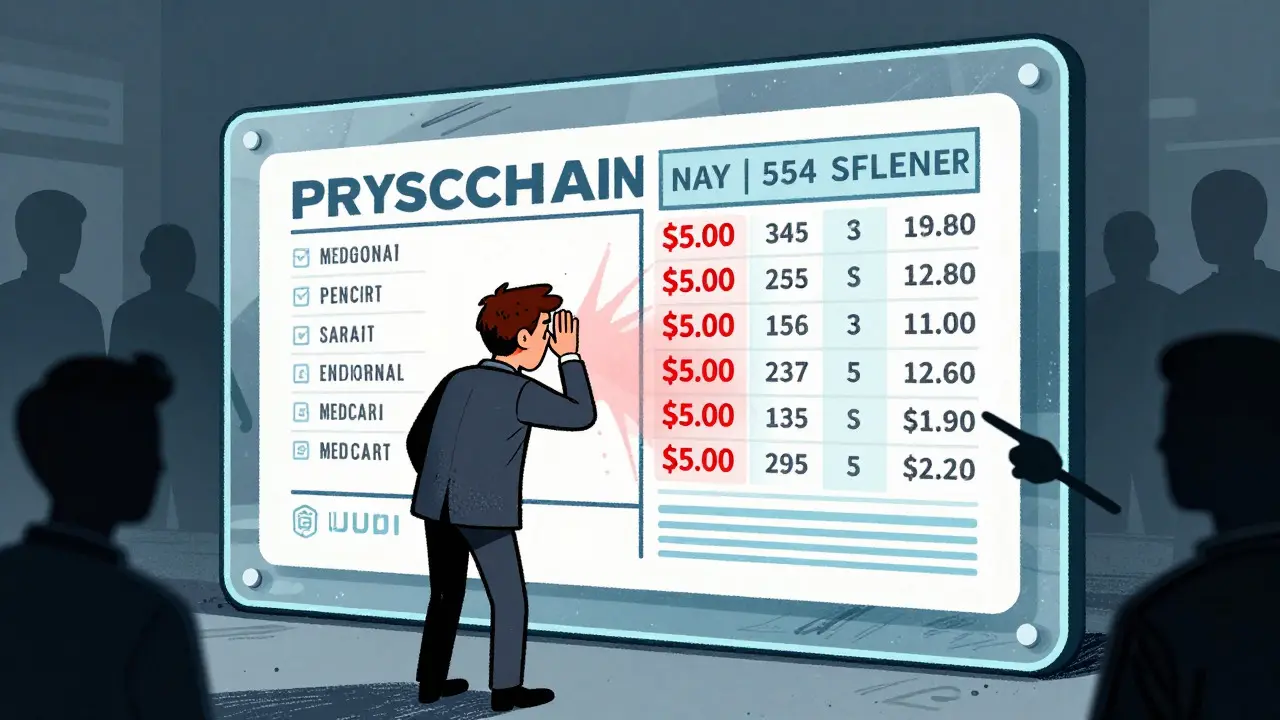
Imagine signing a contract where everyone in the world can read every detail-your salary, your medical history, or your supplier’s pricing strategy. That is the reality of most public blockchains today. While transparency builds trust, it kills business utility. This is exactly why privacy-preserving smart contracts have become one of the most critical developments in blockchain technology. They allow you to execute agreements on a decentralized network while keeping the sensitive data hidden from prying eyes.
You don’t need to choose between the security of blockchain and the confidentiality required by real-world business anymore. By using advanced cryptography, these contracts verify that a transaction is valid without revealing what that transaction actually is. It sounds like magic, but it is math. And understanding how it works is essential if you are looking to build secure enterprise applications or protect your digital assets in 2026.
The Core Problem: Why Transparency Is Not Always Good
When Vitalik Buterin and others launched Ethereum, they prioritized transparency. Every transaction on the Ethereum Virtual Machine (EVM) is visible to anyone with an internet connection. For a charity donation, this is perfect. Donors want to see their money go to the right place. But for a bank settling interbank loans, or a hospital sharing patient records, total visibility is a nightmare.
In 2022, Gartner surveyed enterprises about blockchain adoption barriers. The result was stark: 78% cited privacy concerns as a major hurdle. If competitors can see your supply chain costs on-chain, your competitive advantage vanishes. If patients know their diagnosis is publicly linked to their wallet address, they will never use the system. Traditional smart contracts treat all data as public state. Privacy-preserving smart contracts change this by separating public verification from private execution.
This framework laid the groundwork for modern solutions. It proved you didn’t need a separate private blockchain to get privacy. You could keep the security of a public ledger while locking the data behind cryptographic doors.
How Zero-Knowledge Proofs Make Privacy Possible
The engine behind most privacy-preserving smart contracts is the Zero-Knowledge Proof (ZKP). Specifically, Non-Interactive Zero-Knowledge Proofs (NIZKs). Let’s break down what that means in plain English.
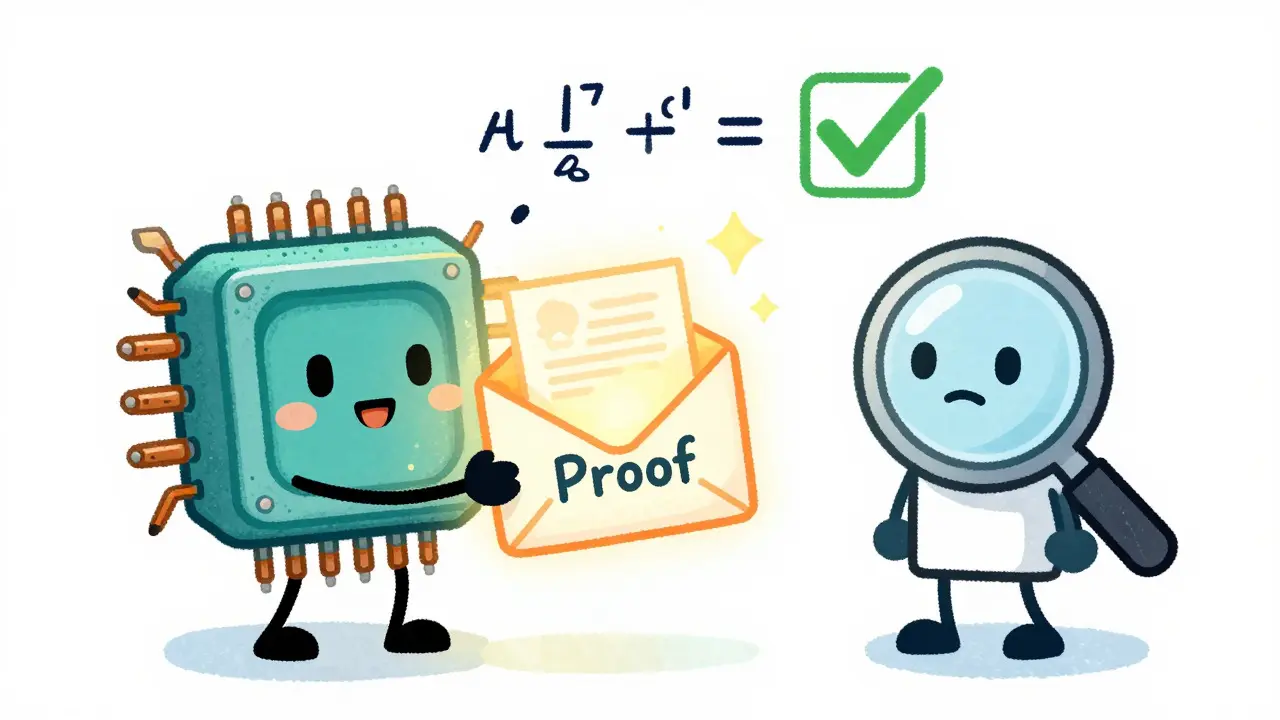
A ZKP allows one party (the prover) to convince another party (the verifier) that a statement is true without revealing any information beyond the validity of the statement itself. Think of it like proving you are over 18 without showing your driver’s license. You just show a "Yes" or "No" output generated by a machine that checked your ID locally. The verifier sees the "Yes," but never sees your name, birthdate, or photo.
In the context of smart contracts, here is how it works:
- Private State Management: Instead of storing data directly on the blockchain, the contract stores encrypted commitments. These are hashes or mathematical representations of the data.
- Proof Generation: When a user wants to execute a function (like transferring funds), their device generates a ZKP. This proof demonstrates that they own the funds and that the transfer follows the contract rules, without revealing the amount or the recipient.
- On-Chain Verification: The proof is sent to the blockchain. The network verifies the math. If the proof is valid, the state updates. If not, it rejects the transaction.
Projects like Aztec Protocol, founded in 2018, have built entire ecosystems around this. They use a custom language called Noir to help developers write these complex proofs more easily. Similarly, Aleo uses a language called Leo, which is a privacy-focused variant of Rust. These tools abstract away some of the heavy cryptography, but the underlying principle remains the same: verify the logic, hide the data.
Performance Trade-offs: The Cost of Secrecy
There is no such thing as a free lunch in cryptography. Adding privacy comes with significant computational costs. When you run a standard Solidity contract on Ethereum, the gas cost is relatively predictable. When you add ZKPs, the complexity skyrockets.
Benchmarking data from Aztec Protocol shows that generating a single proof can take 1.5 to 3.5 seconds on standard hardware. With hardware acceleration, this drops to 0.3-0.8 seconds. Compare that to milliseconds for a standard transaction. Furthermore, the computational overhead is roughly 20 to 40 times higher than transparent contracts. This means higher gas fees-often 15% to 25% more expensive on Ethereum-and slower throughput.
Why do companies accept this? Because for high-value B2B transactions, the cost of a data leak far exceeds the extra gas fee. JPMorgan’s Quorum platform (now part of ConsenSys) successfully used privacy-preserving contracts for interbank settlements. They kept counterparty identities and amounts secret from competitors while still maintaining regulatory auditability through selective disclosure mechanisms. For them, the speed penalty was worth the confidentiality.
Implementation Challenges for Developers
If you are a developer, moving from traditional smart contracts to privacy-preserving ones is a steep learning curve. A survey by ConsenSys Academy found that developers need 8 to 12 weeks of dedicated study to become proficient in ZK-based development, compared to just 2 to 4 weeks for standard Solidity.
The biggest headache? Debugging. In a transparent contract, if something breaks, you can look at the blockchain explorer and see exactly what went wrong. In a privacy-preserving contract, the state is encrypted. As one developer noted on Ethereum Stack Exchange, debugging a corrupted nullifier set in a Hawk implementation took three weeks instead of the usual three days. You are essentially blind to the internal state unless you have the private keys to decrypt it locally.
Here are the top challenges reported by developers in 2023:
- Debugging Encrypted State: 78% of developers cited this as their primary difficulty.
- Integration Complexity: 63% struggled to connect these new contracts with existing enterprise legacy systems.
- Proof Generation Overhead: 57% faced issues managing the time and resources needed to generate proofs client-side.
To mitigate this, frameworks like Hawk provide compilers that automatically generate the necessary cryptographic protocols. However, you still need to understand concepts like Unspent Transaction Outputs (UTXOs) and nullifier sets to prevent double-spending attacks. It is not enough to just know JavaScript or Python; you need a grasp of number theory and circuit design.
Use Cases: Where Privacy Wins
Not every application needs privacy. Public governance votes or charitable donations benefit from transparency. But several sectors are rapidly adopting privacy-preserving smart contracts because confidentiality is non-negotiable.
| Industry | Primary Need | Suitability for Privacy Contracts | Key Benefit |
|---|---|---|---|
| Financial Services | Confidentiality of trades and counterparties | High (4.2/5) | Prevents front-running and market manipulation |
| Healthcare | Patient data protection (HIPAA/GDPR) | High | Secure sharing of records without exposing PII |
| Supply Chain | Proprietary pricing and logistics | Medium-High | Protects trade secrets while verifying authenticity |
| Public Sector | Transparency and accountability | Low (2.1/5) | Minimal; citizens prefer open ledgers |
| Charity/NGO | Donor trust and visibility | Low | Minimal; donors want to see impact |
In healthcare, for example, Mayo Clinic ran a pilot in 2021 using blockchain for patient data management. By using privacy-preserving techniques, they ensured that sensitive identifiers and treatment details remained encrypted. Authorized providers could verify compliance and access rights without seeing the raw medical data on the public ledger. This solved the tension between interoperability and privacy laws like GDPR.
In finance, the ability to hide transaction amounts prevents "front-running," where bots see a large pending buy order and jump ahead to drive up the price. Privacy contracts neutralize this attack vector, creating a fairer market environment.
Security Risks and Regulatory Hurdles
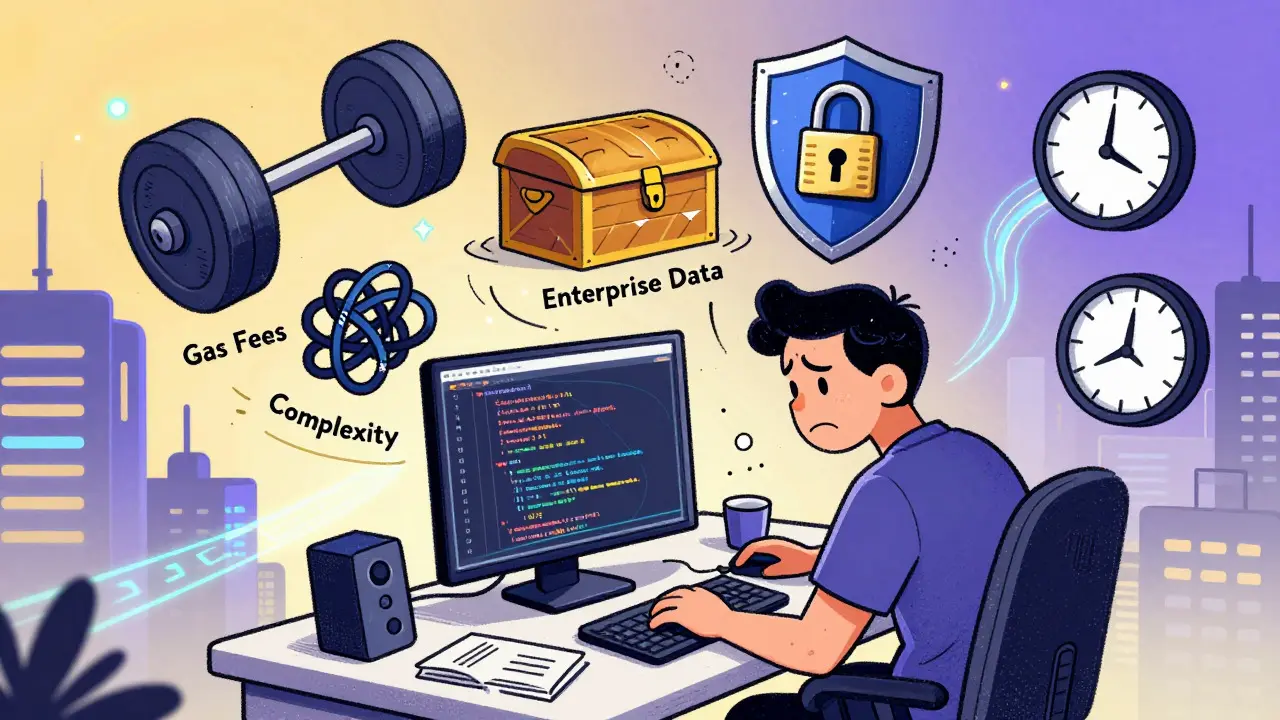
Adding privacy adds complexity, and complexity introduces bugs. Dr. Sarah Jamie Lewis, Executive Director of the Open Privacy Research Society, warned that over-engineered privacy solutions can create false confidence. A 2022 security audit by Electric Coin Company found that 63% of early privacy-preserving contract implementations had vulnerabilities in their selective disclosure mechanisms.
Common flaws include timing side-channel leaks during proof generation and improper management of nullifier sets. If a nullifier is reused incorrectly, it can lead to double-spending. If a timing leak occurs, an attacker might infer private data based on how long the proof took to generate. These are subtle, hard-to-find bugs that require expert auditors.
Regulators are also watching closely. The Financial Action Task Force (FATF) issued guidance in 2021 stating that privacy-enhancing technologies must not prevent compliance with anti-money laundering (AML) obligations. This has created a tension for financial institutions. They want privacy from competitors, but they need transparency for regulators. The solution lies in "selective disclosure"-where the contract can reveal specific data points to authorized auditors (like a government agency) while keeping them hidden from the general public. This feature is becoming a standard requirement in enterprise deployments.
The Future: Scaling and Standardization
The landscape is evolving fast. Ethereum’s integration of "proto-danksharding" (EIP-4844) in the Deneb upgrade significantly reduced data availability costs for ZK-rollups by approximately 90%. This directly benefits privacy contracts, which often rely on publishing large amounts of off-chain data on-chain for verification. Lower costs mean wider adoption.
Furthermore, new languages and frameworks are making development easier. Aztec Protocol’s version 3.0 introduced "programmable privacy," allowing developers to specify exactly which data elements remain private versus public for each function. This granular control addresses the all-or-nothing approach of earlier systems.
Market projections are bullish. The global market for blockchain privacy solutions is expected to grow from $1.2 billion in 2022 to $6.8 billion by 2027. By 2026, Gartner predicts that 30% of large enterprises will use privacy-enhancing computation for sensitive data. We are moving past the experimental phase into mainstream enterprise adoption.
If you are building on blockchain, ignoring privacy is no longer an option. Whether you are protecting intellectual property, complying with GDPR, or securing financial trades, privacy-preserving smart contracts offer the only viable path forward. The technology is complex, and the learning curve is steep, but the payoff in security and trust is immense.
What is the main difference between a transparent smart contract and a privacy-preserving one?
In a transparent smart contract, all inputs, outputs, and state changes are visible to anyone on the blockchain. In a privacy-preserving smart contract, the data is encrypted or represented by cryptographic commitments. Only a zero-knowledge proof is published on-chain, which verifies that the transaction is valid without revealing the underlying data.
Are privacy-preserving smart contracts more expensive to run?
Yes. Generating and verifying zero-knowledge proofs requires significantly more computational power than standard transactions. This results in higher gas fees (typically 15-25% more on Ethereum) and slower transaction speeds due to the time needed for proof generation.
Which programming languages are used for privacy-preserving contracts?
You typically cannot use standard Solidity. Instead, specialized languages are required. Popular options include Noir (used by Aztec Protocol), Leo (used by Aleo), and Circom. These languages are designed to compile code into arithmetic circuits suitable for zero-knowledge proof generation.
How do regulators view privacy-preserving blockchain technology?
Regulators like the FATF require that privacy technologies do not hinder Anti-Money Laundering (AML) efforts. Therefore, successful enterprise implementations often include "selective disclosure" features, allowing authorized auditors to view private data while keeping it hidden from the public.
Is it difficult for a beginner developer to learn privacy-preserving smart contracts?
It is quite challenging. Unlike traditional smart contract development, which takes a few weeks to learn, mastering privacy-preserving contracts requires understanding cryptography, circuit design, and specialized toolchains. Expect a learning curve of 8-12 weeks for proficiency.
They want your soul not just your data. 🕵️♂️ The whole blockchain thing is a honey trap for the NSA and Big Tech to track every single breath you take while pretending it's 'anonymous'. You think zero-knowledge proofs hide anything? Please. They just encrypt the leash around your neck so tighter. Wake up sheeple! 👁️
The premise that transparency is inherently detrimental to enterprise utility is, frankly, a reductive oversimplification of complex socio-economic dynamics. Furthermore, the assertion that privacy-preserving mechanisms are the panacea ignores the fundamental epistemological crisis of verifying truth without public scrutiny. It is merely obfuscation dressed in cryptographic finery.
Hey hey! Let's cut through the noise folks! 🚀 This tech is actually pretty rad when you get past the hype. I've been tinkering with Noir on Aztec and yeah, the learning curve is steep as hell but once it clicks its like unlocking a superpower. Debugging is a pain in the ass no doubt about it but hey thats life right? Just keep at it and you'll see the light! 💡
Stop wasting time on this pseudo-science!!! Solidity is fine!!! Why complicate things??? You need math skills not magic tricks!!! Learn Rust properly or go home!!!
i mean its cool i guess but like why do we need all this extra stuff cant we just trust the banks to not look at our stuff lol jkjk but seriously seems like a lot of work for something that might break anyway
Oh wow, another day, another way to hide money from the man! 😂📉 I suppose if you're trying to move dirty laundry off-chain this is perfect. But for the rest of us? Just use cash and disappear into the woods. 🌲🏃♂️
the irony is that by hiding everything we lose the ability to verify anything truly matters maybe privacy is just another form of isolation we are building walls instead of bridges
yo this is huge news guys!!! finally some real progress in the space!!! im gonna start coding rn lets gooo!!! 🔥🔥🔥
why does everyone care so much about privacy its just numbers on a screen nobody cares what you buy or sell stop being so dramatic and insecure already its pathetic really
American innovation again!!! Leading the world in security and freedom!!! Who needs foreign interference when we have ZKPs!!! Buy American crypto!!! 🇺🇸🇺🇸🇺🇸
keep pushing forward team we can do this together one step at a time