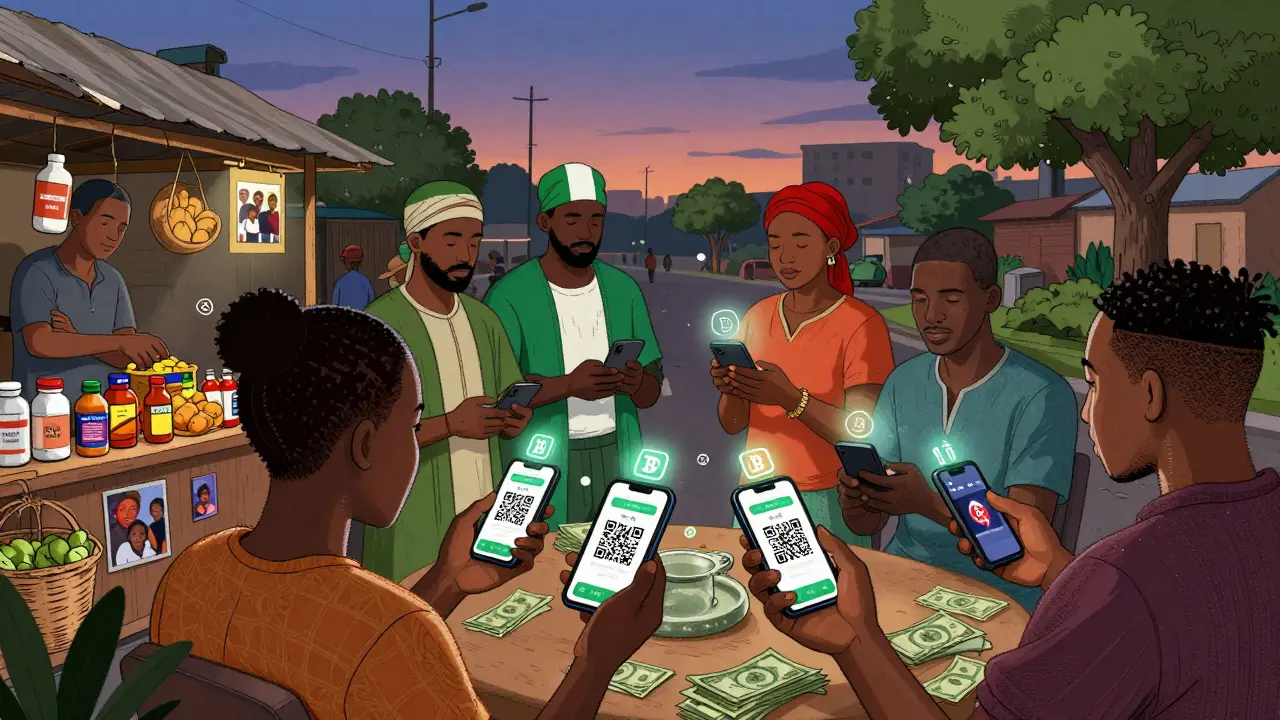
When you live in a country where banks won’t touch crypto, and the government says Bitcoin is illegal, where do you turn? For millions, the answer is P2P crypto trading. It’s not a loophole-it’s a lifeline. In places like Nigeria, Iran, Venezuela, and Pakistan, people aren’t using P2P crypto to gamble or speculate. They’re using it to feed their families, pay for medicine, or send money to relatives abroad. And yet, global regulators are making it harder every day.
Why P2P Trading Survives Where Centralized Exchanges Don’t
Centralized exchanges like Binance or OKX can be shut down by a single government order. But P2P trading? It’s decentralized by design. No server. No headquarters. Just two people, one phone, and a digital wallet. In countries with outright crypto bans-like China, Algeria, or Egypt-this is the only way most people still trade crypto. Even when banks freeze accounts and police raid homes, P2P trades keep happening. The numbers don’t lie. Between 2023 and 2025, the number of emerging markets with outright crypto bans dropped from 19% to just 12%. That sounds like progress. But here’s the catch: 88% of those countries still impose heavy restrictions. Some ban crypto banking. Others block stablecoin transfers. A few require users to register every single P2P trade with the government. That’s not freedom-it’s surveillance with a side of friction.How OFAC Sanctions Are Shaping the Underground
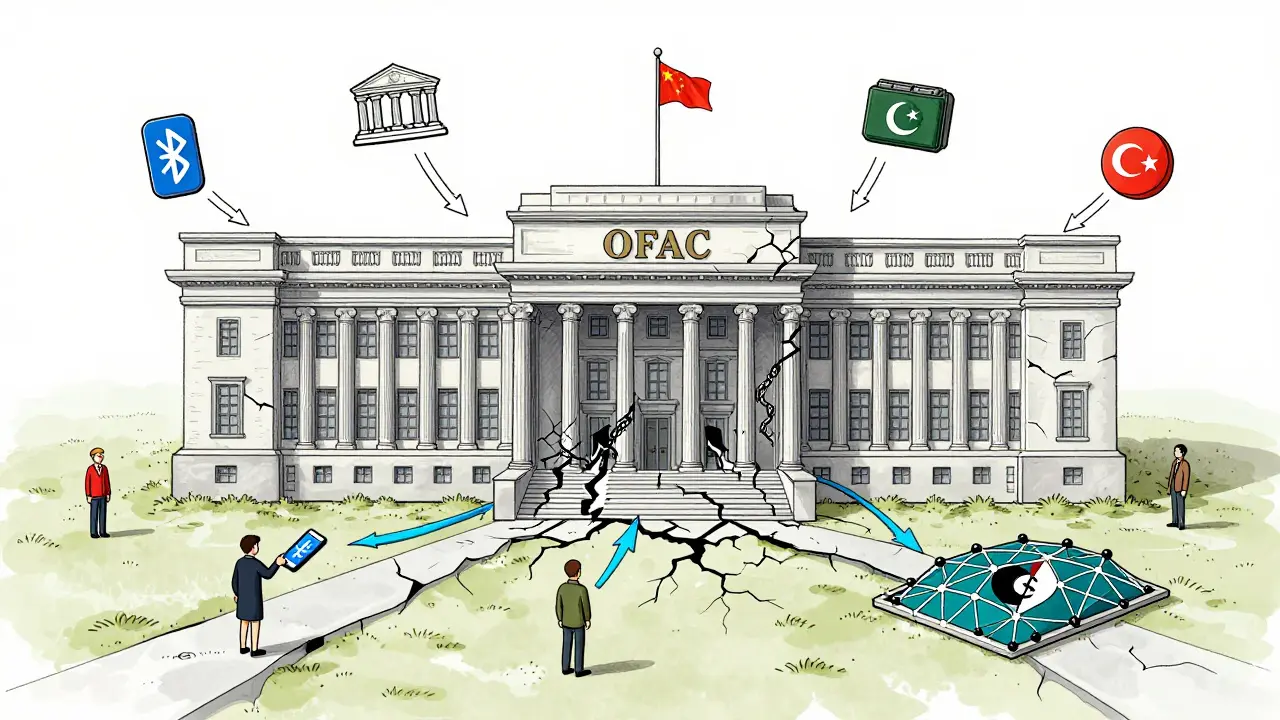
The U.S. Office of Foreign Assets Control (OFAC) didn’t set out to crush P2P crypto. But its sanctions have had the exact opposite effect of what they intended. When OFAC added Russian and Iranian crypto exchanges to its sanctions list in 2023, it didn’t stop trading. It just pushed it deeper underground. Here’s what happened: Russian P2P volumes dropped 60%. Iranian volumes fell by 58%. But here’s the twist-global P2P volume didn’t collapse. It shifted. Traders moved from centralized platforms to Telegram groups, WhatsApp networks, and local cash meetups. The result? A 21% drop in formal remittance flows through crypto, but no real drop in actual money movement. People are just finding new ways to send value. In 2024 alone, $740 million in stablecoins were frozen by OFAC enforcement. Nine out of ten U.S.-based exchanges automatically blocked wallets tied to the Specially Designated Nationals list. That sounds clean and legal. But for someone in Tehran trying to pay for insulin, it’s a death sentence. No bank. No PayPal. No crypto. No way out.Country-by-Country: Who’s Banning, Who’s Tolerating
Not all restricted countries are the same. Some ban crypto outright. Others create gray zones.- China: Still completely bans crypto transactions. No P2P trading allowed. But underground markets thrive in border cities like Shenzhen and Kunming.
- Iran: Officially allows crypto mining but bans trading. Yet, P2P platforms like LocalBitcoins and Paxful still operate via VPNs. Daily trading volume remains above $15 million.
- Nigeria: Binance was banned in 2023. The SEC arrested executives. But P2P trading using Naira surged 300% in 2024. People trade directly-cash for BTC-through market stalls and motorbike couriers.
- Pakistan: No outright ban. The central bank allows P2P trading under strict reporting rules. Every trade must be logged. Still, daily volume hit $8 million in early 2026.
- Vietnam: Decriminalized crypto in 2025. No more jail time for trading. But you can’t use it to buy coffee. P2P trading is legal, taxed, and growing fast.
- Argentina: Legalized crypto for international trade in 2025. P2P volumes jumped 45% in six months. People now use Bitcoin to pay for soy exports.
How Exchanges Are Pulling the Plug
Major platforms aren’t just reacting to governments-they’re helping them. Binance shut down its services in the Netherlands after a €3.3 million fine. In Canada, it left entirely after being fined $4.32 million for AML violations. The UK revoked all its permissions. Belgium ordered it to stop operations. These aren’t random decisions. They’re compliance plays. OKX, one of the largest P2P platforms, now blocks users in over 20 countries. Its restrictions include:- High-sanctioned: Afghanistan, Iran, North Korea, Syria, Cuba
- Complete bans: Algeria, Bangladesh, Bolivia, Nepal
- Selective restrictions: India, Japan, Malaysia, Nigeria, Uzbekistan
- Conflict zones: Crimea, Donetsk, Luhansk
The Rise of the Unregulated Workarounds
When the big platforms shut down, people don’t stop trading. They adapt. In Nigeria, traders now use local P2P apps built on Telegram. No KYC. No identity checks. Just a phone number and a bank transfer. In Venezuela, traders meet in public parks with cash and QR codes. In Iran, crypto traders use “proxy wallets”-accounts held by friends in Turkey or the UAE-to receive funds, then send crypto back home via decentralized bridges. DeFi platforms are catching on too. Around 42% of decentralized finance protocols started blocking OFAC-flagged addresses in 2024. Tornado Cash, once a privacy tool, was sanctioned. Its usage dropped 48%. But new mixers popped up overnight. New wallets. New addresses. New ways to hide. The truth? You can’t ban technology. You can only make it harder, slower, and more dangerous.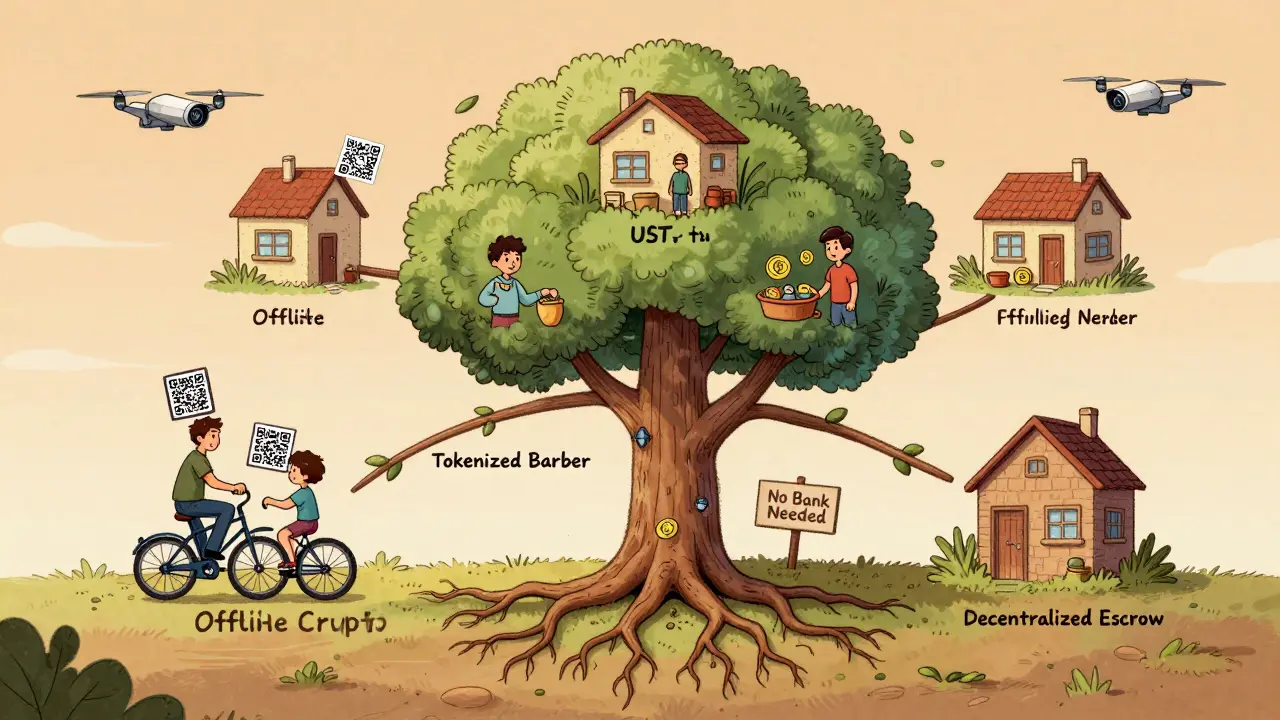
What This Means for the Future
The global crackdown on P2P crypto isn’t about stopping crime. It’s about control. Regulators don’t want people to move money without permission. They don’t want banks to lose influence. They don’t want citizens to bypass the system. But here’s what they’re not seeing: P2P crypto isn’t going away. It’s getting smarter. In 2026, we’re seeing a new wave of tools:- Offline P2P networks: Bluetooth-based crypto transfers that don’t need internet.
- Tokenized barter systems: Local communities trade goods for crypto without ever touching a bank.
- Decentralized escrow: Smart contracts that hold funds until both parties confirm delivery-no middleman needed.
What You Can Do If You’re in a Restricted Country
If you’re reading this because you’re stuck in a country where crypto is restricted, here’s what actually works:- Use local P2P platforms-not global ones. They’re less monitored.
- Trade in stablecoins like USDT or USDC. They’re easier to move and convert.
- Keep small amounts in cold wallets. Don’t store large sums on apps.
- Use burner wallets for each trade. Never reuse addresses.
- Meet in public, cash-only. Avoid digital traces.
Is P2P crypto trading legal in restricted countries?
It depends. In countries like China, Iran, or Algeria, outright bans make P2P trading illegal. In others like Nigeria or Pakistan, it’s tolerated under heavy oversight. In places like Vietnam and Argentina, it’s legal with reporting requirements. The law isn’t always clear-and enforcement varies wildly. Many users operate in a gray zone where they’re not prosecuted unless they’re large-scale or draw attention.
Why do P2P volumes drop when sanctions are applied?
Sanctions don’t stop trading-they just make it harder. When exchanges freeze wallets or block IPs, users lose access to large platforms. But instead of quitting, they move to smaller, less regulated channels: Telegram, WhatsApp, cash meetups, and local apps. The official volume numbers drop because those channels aren’t tracked. The real volume? It’s still there, just invisible to regulators.
Can I still use Binance or OKX in a restricted country?
If your country is on their restricted list, you won’t be able to create an account or complete verification. Even if you already have one, your P2P trading features may be disabled. Some users try to bypass this with VPNs, but that’s risky. Exchanges now track wallet behavior-not just IP addresses. If your wallet has ties to sanctioned addresses, you’ll be blocked, even if you’re not in a restricted country.
What’s the safest way to trade crypto in a banned country?
The safest method is offline, cash-based P2P trading. Use local platforms that don’t require registration. Trade small amounts. Use new wallets for each transaction. Never link your real identity. Stablecoins like USDT are easiest to convert and move. Avoid mixing services-they’re heavily monitored. And never store large sums on any app.
Are there any countries where P2P crypto is growing despite restrictions?
Yes. Nigeria saw a 300% rise in P2P volume after Binance was banned. Vietnam’s volume jumped 40% after decriminalization in 2025. Argentina’s P2P trading surged after legalizing crypto for international trade. Even in Iran, where the government bans trading, daily P2P volume remains above $15 million thanks to underground networks. Demand always finds a way.
How do OFAC sanctions affect everyday users?
They don’t just target criminals. If you received crypto from someone who once traded with a sanctioned entity-even years ago-you could get locked out of exchanges. Your wallet could be frozen. Your bank might refuse your transfers. You don’t need to be involved in crime to be affected. The system casts a wide net, and innocent users pay the price.
Will P2P crypto trading disappear in restricted countries?
No. History shows that when governments restrict access to financial tools, people innovate. From underground banking in the 1980s to encrypted messaging today, people find ways to move value without permission. P2P crypto isn’t going anywhere. It’s just getting more decentralized, more anonymous, and more resilient.
People just keep finding ways to survive, huh? Wild.
Let me tell you something-this whole P2P thing isn’t about freedom, it’s about desperation dressed up like a revolution. I’ve seen it. My cousin in Lagos trades BTC for naira cash under a bridge every Friday. No receipts. No paper trail. Just a guy with a backpack and a phone. And now the U.S. government is freezing wallets because someone once sent a transaction to a wallet that touched a Russian node? Come on. This isn’t regulation-it’s digital McCarthyism. We’re punishing grandmas who need insulin because their nephew once used a mixer in 2021. The system is broken. Not the people.
Interesting how you call it a lifeline. What if it’s just the first step toward a black market economy that eventually replaces the state? Who’s to say this isn’t the quiet collapse of fiat, not a triumph of freedom? Maybe we’re not seeing innovation-we’re seeing the unraveling. And no, I don’t think regulators are wrong. They’re just late.
One must consider the ontological implications of decentralized value transfer in the context of late-stage capitalist surveillance architecture. The individual, stripped of institutional financial intermediaries, becomes not a free agent, but a node in an emergent, unregulated network of peer-to-peer dependency. This is not liberation-it is the privatization of risk under the illusion of autonomy. One cannot escape the state by fleeing to a blockchain; one merely transplants the state’s logic into a more opaque, less accountable form. The moral calculus remains unchanged: power, now distributed, is still power.
You think this is about people feeding their families? Please. The real P2P users aren’t the ones buying insulin-they’re the ones laundering drug money through Nigerian market stalls and calling it ‘remittances.’ The numbers you’re quoting? They’re inflated by criminal networks. The real tragedy isn’t that people are getting cut off-it’s that the system is being weaponized by cartels and sanctions evaders. And you’re romanticizing it. That’s not empathy. That’s complicity.
As someone from India, I’ve seen this firsthand. My aunt in Mumbai uses USDT to send money to her sister in Bangladesh-no bank, no fees, no waiting. She doesn’t even know what a blockchain is. She just knows it works. And yes, the government watches. But they don’t stop it. Because they know: if they shut it down, people will starve. Maybe the answer isn’t to ban it… but to regulate it with dignity.
The institutional inertia here is staggering. We’re operating within a framework that assumes centralized financial intermediation is the default. But P2P crypto isn’t a workaround-it’s a paradigm shift. We’re witnessing the emergence of a post-intermediary economic layer. The real disruption isn’t technological; it’s epistemological. Users are no longer asking permission-they’re constructing alternative ontologies of value. The challenge for regulators isn’t enforcement-it’s irrelevance.
Oh wow, so now we’re giving out medals to people who use Telegram to trade Bitcoin for cash? Let me guess-next you’ll be defending ransomware gangs as ‘entrepreneurs of resilience.’ This isn’t survival. It’s anarchy with a side of stablecoins. And guess what? The people who actually get hurt are the ones who don’t have tech-savvy friends or VPNs. The poor? They’re still stuck with $500 in Naira that’s worth $0.50. Meanwhile, you’re all over here calling it a revolution. It’s not. It’s chaos with a hashtag.
What if the real story isn’t the trading? What if it’s the silence? The fact that no one talks about how many people have been arrested, disappeared, or lost everything just for holding a wallet? We focus on volume. On numbers. On ‘workarounds.’ But we never talk about the bodies behind the data. The man in Tehran who got jailed for sending $200 to his daughter. The woman in Nigeria who was beaten for using a QR code. This isn’t innovation. It’s a silent war. And we’re all just scrolling past it.
So let me get this straight-you’re saying the government is the villain because they’re trying to stop people from sending money to terrorists? And yet, you’re fine with a system where anyone with a phone can move value without oversight? That’s not freedom. That’s a loophole with a cult following. You want to talk about control? Look at who’s really in control: the people who built the apps, the Telegram admins, the wallet providers. They’re not heroes. They’re gatekeepers with better PR.
Y’all act like this is some underground rebellion. Bro. It’s just people using apps that don’t ask for ID. That’s not resistance. That’s convenience. And yeah, OFAC is a mess. But so is every system built by humans. You’re not fighting the system-you’re just using the glitch in it. And eventually, they’ll patch it. Then what? You gonna start trading with Bluetooth? Cute.
I just want to say-I’m so proud of these people. 😭👏 You’re all so brave. I cried when I read about the mom in Venezuela meeting strangers in the park to trade cash for BTC. That’s love. That’s courage. That’s what real community looks like. 🙏❤️ Please don’t let the system break you. I’m rooting for you. Every single one. 💪
Why are we even having this conversation? The real issue isn’t crypto. It’s that governments are still trying to control money. Money is a social contract. Not a product. Not a commodity. A contract. And when you treat it like a thing to be regulated instead of a system to be evolved, you create exactly this: chaos, black markets, and desperation. The solution isn’t more bans. It’s rethinking money itself.
OMG. I just found out my cousin in Nigeria has been trading crypto for THREE YEARS. And I thought MY life was hard. Like. She’s a single mom. No bank. No credit. And she’s using Bitcoin to pay for her kid’s school fees? I’m literally sobbing. This is the most beautiful thing I’ve ever seen. 🥹💔 We need to fund these women. Like, now. Send me your P2P app links. I’m starting a GoFundMe.
People are so naive. You think these underground trades aren’t being used for child trafficking? For arms? For terror funding? Every time someone says ‘it’s just for medicine,’ I laugh. Because the same wallets move drugs, guns, and ransomware payments. You can’t have a black market and then pick which crimes you’re okay with. It doesn’t work like that. This isn’t Robin Hood. It’s chaos with a blockchain.
They’re not banning crypto. They’re banning trust.
My ex works for a compliance firm. He told me something I’ll never forget: ‘We don’t block wallets because they’re dangerous. We block them because they’re inconvenient.’ The real enemy isn’t the user. It’s the cost of monitoring. They’d rather shut down a billion people than hire five more analysts. So yes-people are surviving. But they’re surviving because the system is too lazy to stop them. That’s not freedom. That’s negligence.