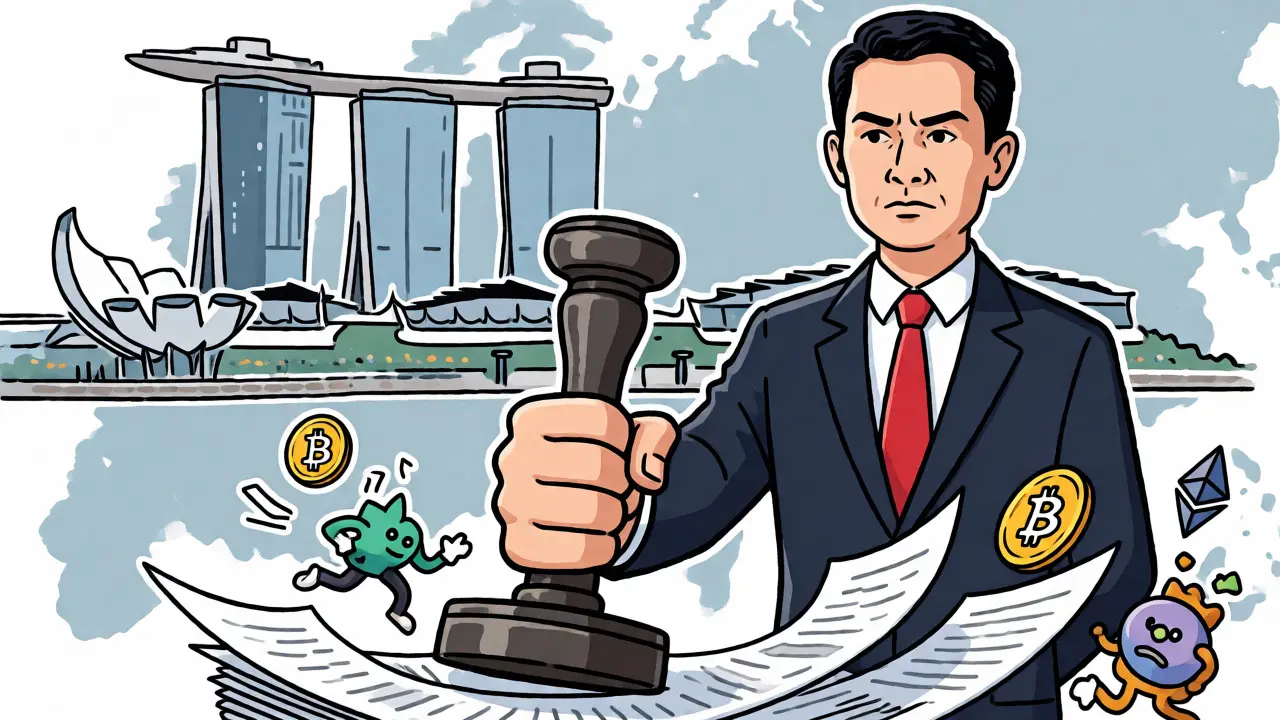
Think you can set up shop in Singapore, slap a "crypto-friendly" sticker on your website, and serve clients in London or New York while dodging the heavy lifting of local regulation? If so, the Monetary Authority of Singapore (MAS) has some bad news for you. As of mid-2025, that loophole is firmly shut. The MAS has tightened its grip on digital token service providers (DTSPs), effectively ending the era of easy entry for crypto firms looking to borrow Singapore’s financial prestige without doing the hard work of actual oversight.
This isn't just a minor tweak to the rulebook. It is a fundamental shift in how one of Asia’s most important financial hubs views digital assets. If you are running a crypto business with any footprint in Singapore-even if your servers are elsewhere and your users never visit Marina Bay Sands-you need to understand the new reality. The rules are strict, the deadlines were brutal, and the penalties for getting it wrong are severe.
The End of Regulatory Arbitrage
For years, Singapore was the go-to jurisdiction for crypto companies wanting credibility. You register there, get a provisional license, and then operate globally. But regulators noticed a pattern: many firms were using Singapore as a reputation shield while operating under much looser rules overseas. This practice, known as regulatory arbitrage, meant that a company could claim "regulated by MAS" while serving customers in jurisdictions with zero consumer protection.
The MAS decided enough was enough. In June 2025, they announced that new licenses would only be issued in "extremely limited circumstances." Why? Because the risk of money laundering and terrorism financing remains too high when you can't fully see where the money is going. The goal now is clear: protect Singapore’s standing as a trusted financial hub, even if it means fewer crypto companies call it home.
Who Needs a License Now?
Here is the part that trips people up. You don't need to have physical offices in Singapore to fall under MAS jurisdiction. Under Section 137 of the Financial Services and Markets Act 2022 (FSMA), the rules apply extraterritorially. That means if your company is incorporated in Singapore, or if you are an individual operating from Singapore, you need a Digital Token Service Provider (DTSP) license. Period.
It doesn't matter if your clients are all in Europe. It doesn't matter if your blockchain nodes are in Texas. If the legal entity or the operational brain is in Singapore, MAS wants to regulate you. This move closes the gap that allowed offshore-focused exchanges to ignore local compliance costs.
| Requirement | Details | Impact |
|---|---|---|
| Licensing Status | New licenses rarely issued; existing ones must comply strictly. | High barrier to entry for new startups. |
| Compliance Officer | Must appoint a qualified officer based in Singapore. | Salary costs SGD 150k-250k annually. |
| Capital Thresholds | Mandatory minimum capital reserves depending on activity. | Ties up liquidity for smaller firms. |
| Travel Rule | Data exchange required for transactions over SGD 1,500. | Requires specialized software integration. |
| Consumer Protection | No credit card purchases; mandatory risk disclosures. | Reduces retail volume but increases safety. |

The Travel Rule and AML Burdens
If you think collecting emails at signup is enough, you are mistaken. The MAS enforces the Travel Rule rigorously through Notice PSN02. For any transaction exceeding SGD 1,500 (roughly USD 1,100), platforms must collect and exchange specific data about both the sender and the receiver. We are talking names, identification numbers, and account details.
This sounds simple until you try to implement it across different blockchains and counterparty exchanges. Not every platform speaks the same language. Integrating systems that can handle this real-time data exchange isn't cheap. Industry estimates suggest implementation costs can range from SGD 50,000 to SGD 200,000, depending on your transaction volume. For a small startup, that is a make-or-break expense.
On top of that, Anti-Money Laundering (AML) protocols are no longer optional checkboxes. They require active monitoring. You need annual independent audits and robust cybersecurity standards. The MAS isn't just asking for paperwork; they want proof that you are actually watching the flow of funds.
Consumer Protections That Bite
Singapore has also stepped up its game on protecting regular users. Updated regulations from September 2024 introduced strict limits on how retail investors can interact with crypto. One major change? You generally cannot buy cryptocurrencies using credit cards anymore. This ban aims to prevent consumers from leveraging debt into volatile assets they might not understand.
Platforms must also perform customer suitability assessments. Before letting someone trade, you have to assess their risk tolerance and knowledge. It adds friction to the user experience, sure, but it aligns crypto trading more closely with traditional investment products like stocks or bonds. The message from MAS is clear: crypto is risky, and we won't let platforms hide that fact behind slick marketing.

Penalties and the Cost of Non-Compliance
What happens if you ignore these rules? The consequences are harsh. Fines can reach up to SGD 200,000 (approximately USD 147,000). Worse yet, you face potential imprisonment for responsible officers. And perhaps most damaging for business continuity, you may be forced to cease operations immediately.
There was no long grace period for the latest round of enforcement. When MAS set the deadline of June 30, 2025, for full compliance, it gave firms only four weeks' notice from the initial announcement. This abrupt timeline shocked many industry players. Analysts noted a significant drop in crypto job postings in Singapore during early 2025, partly due to firms scaling back or exiting because they couldn't meet the sudden compliance demands.
Is Singapore Still Crypto-Friendly?
Let's be honest: Singapore is no longer the "wild west" for crypto. It is now one of the most stringent regulatory environments globally. While jurisdictions like Switzerland or the UAE continue to attract crypto firms with more flexible frameworks, Singapore prioritizes stability and integrity over rapid growth.
Experts predict that only 15 to 20 existing license holders will maintain full compliance under the new regime, down from nearly 200 firms that had previously applied or held provisional status. This consolidation means the remaining players will likely be larger, better-capitalized entities with elite compliance infrastructure. For those who stay, the benefit is a powerful stamp of approval. Being MAS-regulated signals to global partners that your house is in order.
But is it worth the cost? For a small project trying to bootstrap, probably not. For an established institution wanting a safe harbor in Asia, absolutely. The choice depends entirely on your scale and your appetite for regulatory overhead.
Do I need a MAS license if my crypto firm serves only overseas clients?
Yes. Under Section 137 of the Financial Services and Markets Act 2022, MAS applies extraterritorial oversight. If your company is incorporated in Singapore or operates from within Singapore, you must obtain a Digital Token Service Provider (DTSP) license regardless of where your customers are located.
What is the Travel Rule requirement for Singapore crypto platforms?
Implemented via Notice PSN02, the Travel Rule requires platforms to collect and exchange sender and receiver information (names, IDs, account details) for any transaction exceeding SGD 1,500. This ensures transparency in cross-border transfers and helps combat money laundering.
Can I still buy cryptocurrency with a credit card in Singapore?
Generally, no. Consumer protection regulations updated in September 2024 prohibit high-risk practices, including the use of credit cards to purchase cryptocurrencies. This measure prevents consumers from taking on debt to invest in highly volatile assets.
How difficult is it to get a new crypto license in Singapore now?
It is extremely difficult. Since June 2025, MAS stated it would issue licenses only in "extremely limited circumstances." New applicants must demonstrate elite compliance infrastructure and a strong operational justification. Most new entrants find the barrier to entry prohibitive compared to previous years.
What are the penalties for failing to comply with MAS crypto regulations?
Non-compliance can result in fines up to SGD 200,000 (approx. USD 147,000), potential imprisonment for responsible officers, and mandatory cessation of operations. There are typically no transitional periods or grace periods for serious breaches.