
Remember when you could buy Bitcoin with a burner email and zero questions asked? Those days are officially gone. If you try to deposit funds into a major centralized exchange today, the first thing you’ll see isn’t a trading chart-it’s a request for your passport, a selfie, and proof of address. This shift from anonymous trading to strict KYC (Know Your Customer) requirements is the single biggest change in how we interact with digital assets.
In 2026, KYC isn’t just a bureaucratic hurdle; it’s the foundation of the entire crypto economy. With 92% of centralized exchanges now fully compliant, the industry has moved past the 'wild west' era. For users, this means faster verification times-averaging just 3.5 minutes-but also stricter privacy trade-offs. For exchanges, failing to implement robust KYC protocols invites massive fines, bans, and a loss of institutional trust. Understanding what these requirements actually entail helps you navigate onboarding smoothly while protecting your digital assets.
The Regulatory Shift: Why KYC Became Mandatory
To understand why your ID is suddenly required for a token swap, you have to look at the global regulatory framework. The turning point came when the Financial Action Task Force (FATF) updated Recommendation 15 in 2019. This update explicitly applied Anti-Money Laundering (AML) and Counter-Terrorism Financing (CFT) obligations to virtual assets. It treated crypto exchanges as Virtual Asset Service Providers (VASPs), placing them on equal footing with traditional banks.
This wasn't just a suggestion; it was a mandate that rippled through national laws. In the United States, the Bank Secrecy Act legally forces crypto companies to verify identities to prevent illicit finance. Similarly, the European Union’s Anti-Money Laundering Directive 6 (AMLD6) established rigorous standards for member states. The result? Most regulated platforms now block deposits or withdrawals until you pass these checks. While some decentralized or unregulated exchanges in jurisdictions with weak AML laws still operate without KYC, they are increasingly isolated from the mainstream financial system, making them risky for anyone holding significant value.
How Modern KYC Verification Works
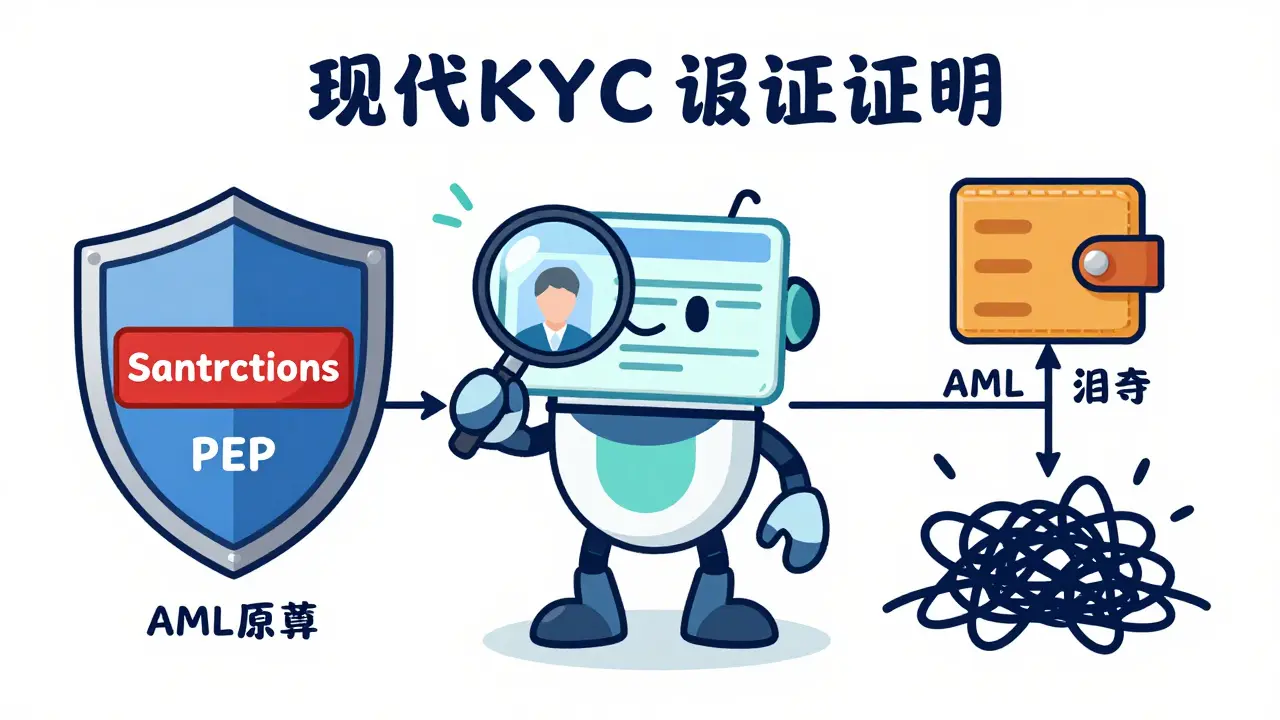
Gone are the days of emailing blurry scans of driver's licenses that took weeks to process. Modern KYC implementation operates through three distinct pillars, powered by artificial intelligence and machine learning. First, there is identity verification. This answers the question, "Who is this person?" You upload a government-issued ID, and AI algorithms check for holograms, font consistency, and signs of tampering. Simultaneously, you take a live selfie. Biometric matching technology compares your facial features against the photo on your ID in real-time, ensuring you are physically present and not using a deepfake or a static image.
The second pillar is AML and PEP screening. Once your identity is confirmed, the system asks, "Should we be doing business with them?" Automated tools scan your name against global sanctions lists, databases of Politically Exposed Persons (PEPs), and adverse media sources. Sophisticated fuzzy matching algorithms catch near-matches and aliases, minimizing false positives that would otherwise flood compliance teams with irrelevant alerts. This step ensures the platform isn't inadvertently facilitating money laundering or terrorist financing.
The third pillar involves wallet and transaction monitoring. This addresses "What are they doing?" By connecting your verified identity to your on-chain behavior, exchanges use blockchain analysis tools to monitor for suspicious patterns. If you receive funds from a wallet linked to ransomware or darknet markets, the system flags it immediately. This continuous monitoring is crucial for maintaining the integrity of the platform and protecting other users from interacting with illicit actors.
User Experience: Speed vs. Privacy
The tension between the cryptocurrency industry's original promise of anonymity and current regulatory requirements creates a complex user experience. On the positive side, technology has made the process remarkably fast. Average verification times on major exchanges have dropped to 3.5 minutes in 2026, down from seven minutes in 2023. Users often praise the improved security and fraud protection, noting that they feel more confident depositing large sums on platforms that know who they are. In fact, 58% of US crypto users prefer platforms with strict KYC for this very reason.
However, friction remains. Privacy concerns are the most frequent complaint. Users worry about data breaches and how their personal information is stored. Edge cases also cause delays; if your document quality is poor, or if you're an international user with a less common ID type, manual review can extend the wait time significantly. Additionally, the requirement to link your legal identity to your wallet history feels intrusive to many who entered crypto specifically to escape traditional surveillance. Balancing this need for transparency with the right to privacy is one of the hardest tasks for platform designers today.
| Platform Type | KYC Requirement | Average Verification Time | Primary Risk Factor |
|---|---|---|---|
| Centralized Exchange (CEX) | Mandatory Full KYC | 3.5 Minutes | Data Breach Exposure |
| Decentralized Finance (DeFi) | Optional / Partial | N/A (Self-Custody) | Smart Contract Vulnerabilities |
| Unregulated Offshore Exchange | None or Minimal | Instant | Fraud and Scams |

The Rise of Institutional Adoption
KYC has evolved from a compliance checkbox into a competitive differentiator. Institutional investors, who manage billions in assets, require robust identity verification before engaging with any platform. Currently, 67% of institutional investors cite strong KYC protocols as a deciding factor when choosing a crypto partner. They cannot risk associating their brand with platforms that facilitate illicit activity.
This demand has driven innovation in the KYC solutions market. Providers like Sumsub, iProov, and KYC-Chain offer specialized technologies tailored for digital assets. These tools integrate seamlessly with blockchain analysis platforms like Chainalysis, providing a holistic view of user risk. The trend is moving toward standardized international KYC data sharing protocols, which would allow users to verify their identity once and reuse that credential across multiple platforms, reducing redundancy while maintaining security.
Future Outlook: Closing the DeFi Gap
As we move through 2026, the regulatory net is tightening further. Regulators are focusing on closing compliance gaps, particularly in Decentralized Finance (DeFi). While only 41% of DeFi platforms offered optional KYC processes last year, this number is expected to rise as pressure mounts. Long-term viability for any crypto service will depend on its ability to implement robust, user-friendly KYC systems without sacrificing speed. Advanced AI-driven risk scoring and privacy-preserving verification methods, such as zero-knowledge proofs, may soon allow users to prove they are legitimate without revealing their full identity to the exchange.
Why do crypto exchanges require KYC?
Exchanges require KYC to comply with global Anti-Money Laundering (AML) regulations, such as those set by the FATF and local laws like the Bank Secrecy Act in the US. It helps prevent fraud, money laundering, and terrorist financing, while also protecting the platform from regulatory shutdowns.
Is my personal data safe during KYC verification?
Reputable exchanges use encrypted storage and secure third-party providers like Sumsub or iProov to handle sensitive data. However, no system is entirely immune to breaches. Users should choose well-established, regulated platforms with transparent privacy policies to minimize risk.
Can I trade crypto without completing KYC?
On most centralized exchanges, you can only trade with limited functionality or small amounts without full KYC. For unrestricted trading, fiat deposits, and withdrawals, full identity verification is mandatory. Some decentralized platforms allow non-KYC trading, but they lack buyer protection and are harder to use for beginners.
How long does KYC verification take?
With modern AI-driven tools, average verification time on major exchanges is around 3.5 minutes. However, if your documents are unclear or trigger manual review due to unusual details, it can take several hours or even days.
What happens if I fail KYC verification?
If you fail KYC, your account may be restricted or frozen. Common reasons include mismatched names, expired IDs, or suspected fraud. You usually need to resubmit clearer documents or provide additional proof of address to resolve the issue.