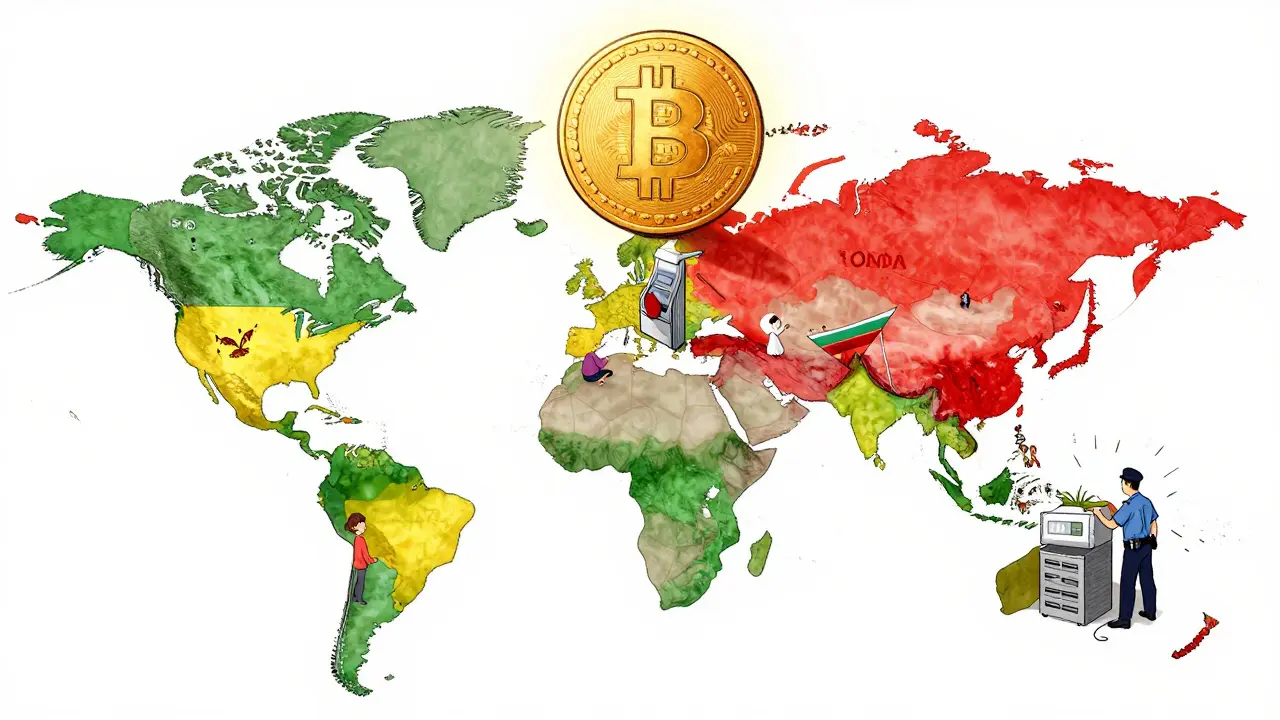
Is cryptocurrency legal? It depends where you are. In one country, you can buy Bitcoin at a convenience store. In another, holding it could land you in jail. There’s no global rulebook - just a messy patchwork of laws that change faster than the price of Ethereum.
Three Ways Countries Handle Crypto
By 2025, the world had settled into three clear camps when it came to cryptocurrency. About 42% of countries had full, clear rules in place. Another 31% had partial rules - they let you own crypto but slapped on restrictions. And 27% either banned it outright or hadn’t done anything at all.
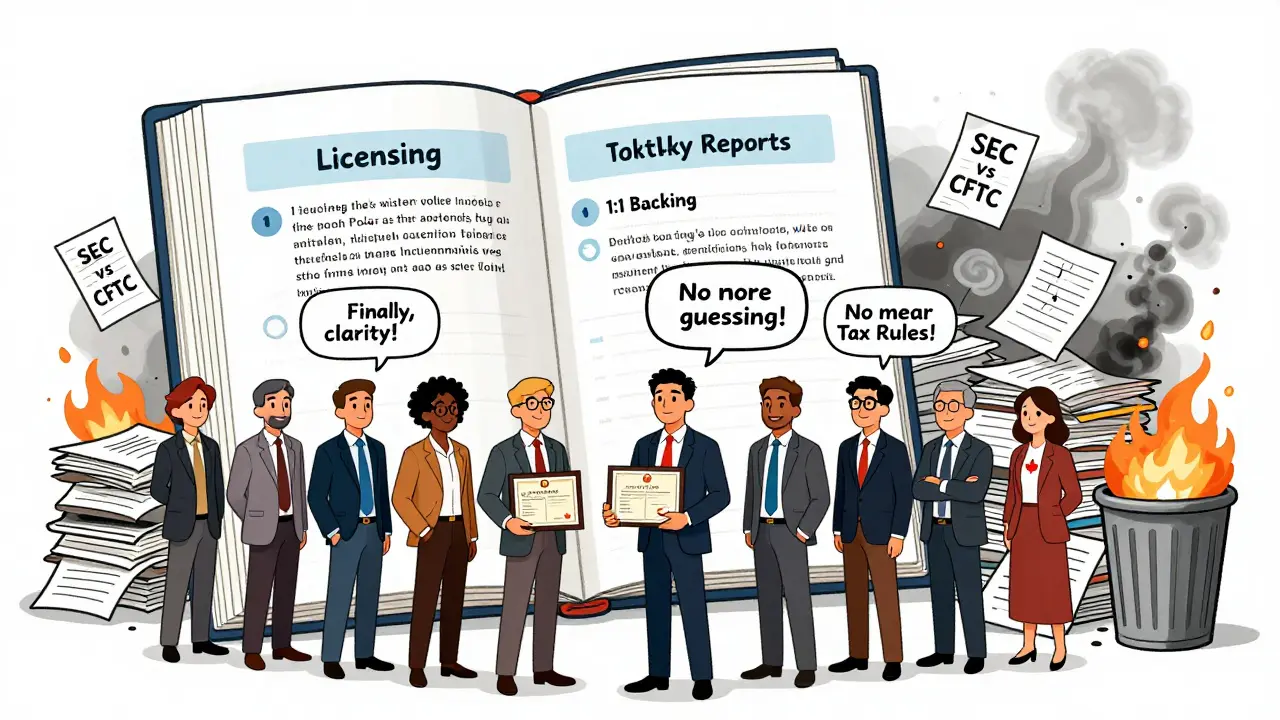
The biggest shift came in December 2024, when the European Union’s MiCAR regulation went live. It’s the first time a major economy created a single, unified set of rules for everything from Bitcoin to stablecoins. Under MiCAR, crypto exchanges must be licensed, stablecoins must be backed 1:1 by cash or safe assets, and companies must publish monthly reports. It’s strict, but it’s clear. And now, countries from Canada to Singapore are using it as a template.
Meanwhile, the United States passed the GENIUS Act in July 2025. It targets payment stablecoins - the kind used for everyday transactions. Now, any company issuing a stablecoin in the U.S. must hold enough cash or short-term Treasury bonds to cover every coin in circulation. They need monthly audits and public reports. It’s not perfect - the SEC and CFTC still fight over who controls what - but it’s the clearest federal step forward yet.
Where Crypto Is Fully Legal (And Regulated)
If you want to run a crypto business or trade without fear, these places are the safest bets.
- European Union: MiCAR covers 27 countries. No more guessing. Exchanges, wallets, and token issuers all need licenses. Stablecoins? Backed or banned.
- Japan: Regulated since 2017. You need a license from the Financial Services Agency. Crypto is treated as property, not currency. Taxes apply on gains.
- Switzerland: Crypto-friendly since day one. Zug, known as "Crypto Valley," hosts over 1,000 blockchain firms. No capital gains tax if you hold longer than one year.
- Singapore: The Monetary Authority of Singapore requires Payment Services Act licenses. Minimum capital? SGD 1 million. Compliance costs? Around SGD 240,000 a year. But it’s worth it - 78% of crypto firms say Singapore is their top choice for operations.
- United Arab Emirates: Dubai’s Virtual Assets Regulatory Authority (VARA) licenses crypto firms. Abu Dhabi has its own sandbox. Crypto is taxed at 0% for individuals - a big draw for global investors.
These places don’t just allow crypto - they build infrastructure for it. Banks open accounts for crypto firms. ATMs are common. Tax rules are published. People know what’s allowed.
Where It’s Legal But Messy
Some countries say crypto isn’t illegal - but they won’t protect you either.
In South Africa, the Reserve Bank says virtual currency has no legal status. But the tax office treats Bitcoin as an intangible asset. That means you pay capital gains tax if you sell for profit. No one’s stopping you from buying - but if you get scammed, you’re on your own.
India and Pakistan are two of the top countries for crypto adoption. Over 40% of adults in each have used crypto. But India’s 30% tax on gains and 1% TDS (tax deducted at source) make trading expensive. No one’s banned it, but the government keeps threatening to. People still use it - because remittances and inflation make it worth the risk.
Kenya saw crypto adoption jump to 54% of the population after the Central Bank issued its first guidance in March 2024. Before that? Total uncertainty. Now, exchanges operate with warnings - not licenses. Users report faster transactions and lower fees than traditional money transfer services. But if your exchange shuts down? No compensation. No recourse.
In these places, crypto thrives despite the rules - not because of them. People use it to send money home, protect savings from inflation, or bypass banking fees. The government looks the other way… until it doesn’t.
Where Crypto Is Banned or Blocked
Some countries don’t just discourage crypto - they make it impossible to use.
Namibia banned banks from handling crypto in 2017. No exchanges. No deposits. No payments. A user on X posted in August 2025: "Trying to use crypto for cross-border payments here is impossible. I lost 15-20% in fees switching to Western Union."
Zimbabwe is a mess. The central bank banned banks from dealing with crypto. But the High Court overturned it. The bank appealed. So right now? It’s legal… but banks still won’t touch it. You can buy Bitcoin - but you can’t cash out through a bank. You’re stuck with peer-to-peer trades or risky over-the-counter deals.
Angola hasn’t banned crypto. But the government warns people not to use it. No one’s prosecuted anyone - but no one’s protected them either. It’s a gray zone where you can own it, but you can’t trust it.
In China, crypto trading and mining are banned. Exchanges are shut down. But people still use peer-to-peer apps like LocalBitcoins. The government doesn’t arrest individuals - but they crush any company trying to operate legally. Mining? If you’re caught running a farm, they’ll cut your power and fine you.
What’s Different About Stablecoins?
Not all crypto is treated the same. Bitcoin? Sometimes ignored. Stablecoins? Everywhere, regulators are watching.
Why? Because stablecoins are meant to act like money. If a stablecoin loses its peg - like TerraUSD did in 2022 - it can trigger panic. That’s why 68% of regulated countries now require 1:1 backing. The U.S. GENIUS Act and EU MiCAR both demand it. Algorithmic stablecoins - ones that use code to keep their value - are banned in most places.
Only 22% of jurisdictions allow algorithmic stablecoins - and even then, they’re tightly controlled. The rest? Either banned or ignored. If you’re building or using a stablecoin in 2026, you need to know: if it’s not backed by cash or short-term bonds, it’s probably illegal in major markets.

How Regulation Affects Real People
It’s not just about businesses. It’s about your money, your freedom, your security.
Users in regulated countries report 63% higher satisfaction with crypto exchanges. Why? Faster withdrawals - 2.1 days on average vs. 5.7 in unregulated zones. Better customer support. Clear rules. No surprises.
In Portugal, you pay no capital gains tax after holding crypto for one year. Adoption jumped 47% after the rule changed in 2024.
In Germany, short-term gains (under one year) are taxed up to 42%. Trading volume for quick flips dropped 31% compared to long-term holds. People stopped day-trading. They started holding.
And in the U.S., crypto entrepreneurs are moving to Switzerland. Reddit threads from October 2025 show founders leaving California for Zug, Switzerland - not because it’s cheaper, but because the rules are clear. One founder wrote: "I spent 18 months trying to get a license from the SEC. In Zurich, I got mine in 6 weeks. I’m not going back."
The Big Picture: What’s Next?
The global crypto landscape is moving toward more rules - not fewer.
The G20 is pushing for all member countries to implement the "Travel Rule" by 2027. That means exchanges must share sender and receiver info on transfers over $1,000 - just like banks do. 62% already have it in place.
The EU is preparing to regulate DeFi protocols with over 1 million users in June 2026. That could mean smart contracts need to comply with anti-money laundering rules. No more anonymous lending pools.
In the U.S., two bills are moving: the Stablecoin Trust Act (expected in Q2 2026) and the FIT Act. The FIT Act would split crypto into two buckets: securities (SEC) and commodities (CFTC). That might finally end the agency turf wars.
And the data shows it’s working. Since 2022, crypto-related crime has dropped 68% as a share of total transactions. Why? Because regulated exchanges report suspicious activity. Banks check IDs. Governments track wallets.
But here’s the catch: compliance costs are up 38% for crypto firms operating across borders. On average, a single company must follow 7.3 different regulatory systems. That’s why startups are flocking to places like Singapore and Switzerland - not because they’re cheap, but because they’re predictable.
What You Need to Know Right Now
If you’re holding crypto in 2026, here’s your checklist:
- Know your country’s stance. Is it legal? Regulated? Banned?
- If you’re trading - know your tax rules. Holding periods, rates, reporting requirements.
- If you’re using stablecoins - make sure they’re backed by cash or short-term bonds. Avoid algorithmic ones unless you’re in a country that explicitly allows them.
- If you’re running a business - don’t assume your home country’s rules apply overseas. You may need a license in every market you serve.
- If you’re in a gray zone - assume you’re on your own. No insurance. No legal recourse if things go wrong.
There’s no global crypto law. But there’s a global trend: clear rules win. Countries that make it safe and simple attract users, businesses, and innovation. The rest? They’re just watching from the sidelines - or trying to shut it down.
The future of crypto isn’t about technology. It’s about trust. And trust only comes when the rules are fair, clear, and enforced.
Is cryptocurrency legal in the United States?
Yes, cryptocurrency is legal in the U.S., but it’s heavily regulated. The GENIUS Act (2025) requires stablecoin issuers to hold 1:1 reserves in liquid assets and undergo monthly audits. The SEC and CFTC split oversight - the SEC handles tokens seen as securities, while the CFTC regulates Bitcoin and Ethereum as commodities. Tax rules apply: capital gains are taxed based on how long you held the asset. No federal ban exists, but state-level rules vary.
Which countries have banned cryptocurrency?
No country has banned owning cryptocurrency outright - but some ban its use. Namibia prohibits banks from handling crypto. China bans trading and mining. Egypt and Iraq ban it under religious law. Nigeria restricts bank transactions. Zimbabwe’s central bank banned banking use, but courts overturned it - leaving a legal gray zone. In these places, you can still buy crypto peer-to-peer, but you can’t use banks, exchanges, or payment systems.
Are stablecoins legal everywhere?
No. Stablecoins are the most regulated part of crypto. In the EU, U.S., Japan, and Singapore, they must be backed 1:1 by cash or short-term bonds. Algorithmic stablecoins (like TerraUSD) are banned in most places. Only 22% of jurisdictions allow them under strict limits. Countries without clear rules often treat them as unregulated securities - which can trigger enforcement actions. If you’re using a stablecoin, check its backing - if it’s not cash-backed, it’s likely illegal in major markets.
Can I be taxed on cryptocurrency even if it’s legal?
Yes. Legal doesn’t mean tax-free. Most countries treat crypto as property, not currency. Selling, trading, or using it to buy goods usually triggers capital gains tax. Germany taxes short-term gains up to 42%. Portugal eliminates tax after one year. India charges 30% plus 1% TDS. Even in places like South Africa, where there’s no specific crypto law, the tax office still requires you to report gains. Ignoring taxes can lead to penalties - even if owning crypto is allowed.
Why do some countries allow crypto while others ban it?
It comes down to control. Countries with strong financial systems - like the U.S., EU, and Singapore - want to regulate crypto to protect consumers, prevent crime, and keep financial stability. Countries with weak institutions or high inflation - like Kenya and Nigeria - let it thrive because people use it to bypass broken banking systems. Countries that ban it - like China or Namibia - fear losing control over money flows, capital flight, or undermining their currency. It’s not about the tech - it’s about power, stability, and fear.
What happens if I use crypto in a country where it’s banned?
In most cases, individuals aren’t arrested just for holding crypto. But if you use it to pay for goods, run an exchange, or move money out of the country, you risk fines, asset seizures, or legal trouble. In China, mining farms get shut down. In Namibia, banks freeze accounts linked to crypto. In Egypt, using crypto can be considered a religious violation. Even if you’re not prosecuted, you’ll face blocked access to banks, no legal recourse if you’re scammed, and no way to cash out safely.
bro just bought my first btc on binance last week and my bank flagged it as "suspicious activity" 😭 like i just bought a bag of chips not a digital asset lmao
The real story here isn't regulation-it's trust. Governments don't fear crypto because it's volatile. They fear it because it removes their monopoly on money. When people can bypass central banks, the power dynamic shifts. And that terrifies institutions built on control, not innovation.
so the us and eu are now the crypto police? cool. guess i'll just keep my coins in a drawer like a 1998 kid with a usb drive
MY LIFE IS A LIE. I MOVED TO PORTUGAL JUST TO AVOID TAXES AND NOW THEY’RE GIVING ME A TAX BREAK FOR HOLDING CRYPTO?! I’M CRYING IN MY TACO BOWL. THIS ISN’T REAL LIFE.
you people are idiots. crypto is for degens. if you cant handle inflation, get a job. stop gambling with digital glitter.
i use crypto to send money to my fam in india. banks take 3 days and charge 15%. crypto? 10 mins, 1%. yeah its messy but its working. dont tell me to stop.
in india, we dont use crypto because we like tech. we use it because our banks charge 10% to send money to our cousins in the uk. if you think this is about speculation, you've never seen a mother send her last 5000 rupees to her son in dubai.
so the EU made rules… and suddenly everyone’s copying them? classic. it’s not about innovation-it’s about who gets to write the rulebook. the US is still stuck in bureaucratic wrestling. Meanwhile, Singapore’s just collecting checks from everyone who fled the chaos.
it’s funny how we treat crypto like it’s new, but money has always been about trust. gold had it, paper had it, now code has it. the question isn’t whether crypto is legal-it’s whether we’re ready to trust a system that doesn’t need a central authority to hold it together.
the notion that regulation equals safety is a fallacy. regulation equals control. and control, historically, always precedes censorship. MiCAR isn’t protecting consumers-it’s consolidating power under a single bureaucratic umbrella.
you think stablecoins are safe? check the audit reports. most of them are using shell companies to fake reserves. the SEC doesn't even know what they're looking at. and you're calling this 'trust'? this is a house of cards built on accounting magic and wishful thinking.
WHEN THE BANKS START BLOCKING YOUR WALLET, AND THE GOVERNMENT STARTS TRACKING YOUR WALLET ADDRESS, AND YOUR FRIEND GETS FROZEN FOR USING A PEER-TO-PEER APP… YOU REALIZE THIS ISN’T FREEDOM-IT’S A SURVEILLANCE STATE WITH A COIN ON THE SIDE.
people keep talking about how regulated markets are better but nobody talks about how much it costs to comply. i know a guy who started a crypto exchange in canada and spent 18 months and half a million dollars just to get licensed. meanwhile in nigeria his friend runs the same business from his bedroom with a vpn and a whatsapp group. who’s really serving the people? the guy with the license or the guy who just gets it done?
if you’re using crypto to avoid taxes, you’re a criminal. period. the government didn’t create this system so you could dodge your responsibilities. stop pretending this is about freedom-it’s about selfishness.
what happens when the next TerraUSD crash happens in a country with no regulations? People lose everything. But here’s the thing-when people lose everything, they don’t blame the algorithm. They blame the government. And that’s when civil unrest starts. We’re not just regulating money-we’re regulating social stability. And we’re not ready for that responsibility.