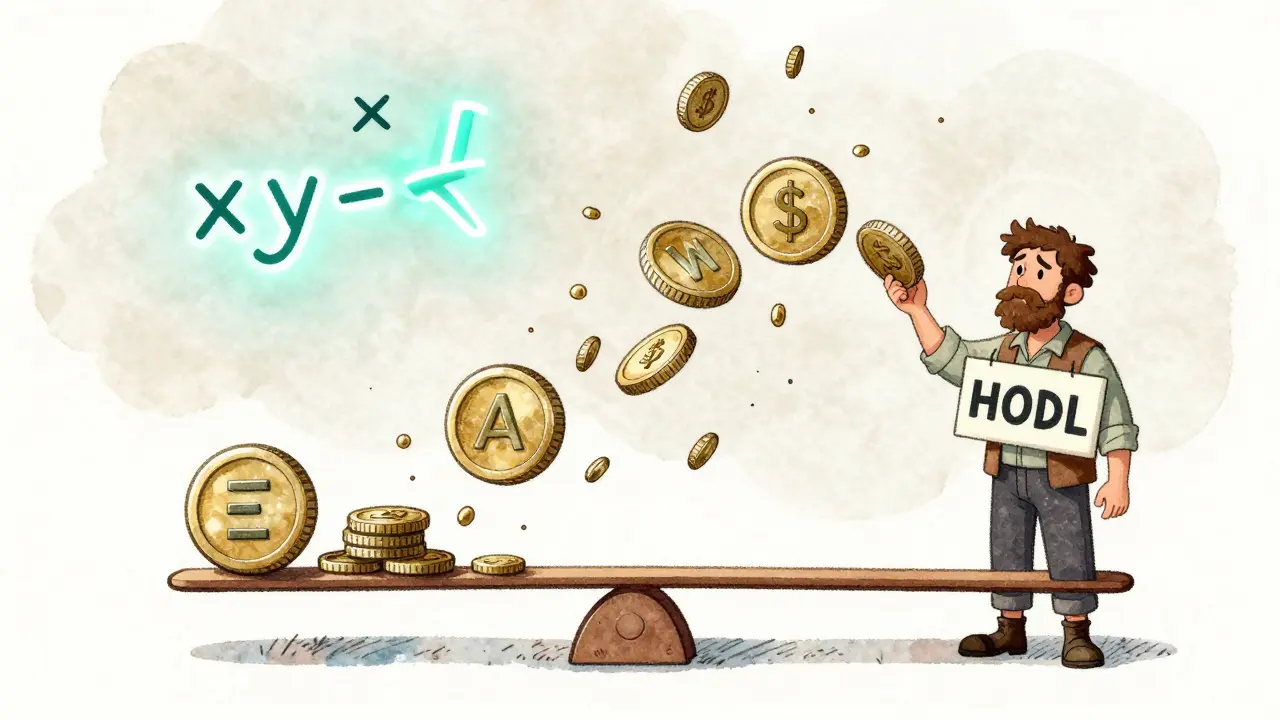
When you provide liquidity to a decentralized exchange, you’re not just earning trading fees-you’re also betting against price changes. And if the price moves too far, you might lose money, even if the asset itself goes up. This isn’t a hack, a bug, or a scam. It’s called impermanent loss, and it’s built into how most automated market makers (AMMs) work. The real question isn’t whether it happens-it’s how much, and which AMM design makes it worse or better.
What Actually Is Impermanent Loss?
Impermanent loss isn’t a loss in your wallet. It’s a loss compared to what you’d have if you just held your tokens instead of putting them into a liquidity pool. Say you put in 1 ETH and 3,000 USDC when ETH is $3,000. If ETH doubles to $6,000, your pool share doesn’t double. You end up with less ETH and more USDC because the AMM automatically rebalances your position to keep the product of the two assets constant. That’s the math behind it. The loss feels real because your portfolio value is lower than if you’d just held. But if ETH drops back to $3,000, the loss disappears-hence, “impermanent.” Only when you withdraw do you lock it in.Constant Product AMMs: Uniswap, SushiSwap, PancakeSwap
These are the OGs of DeFi liquidity. They use the formula x × y = k. Simple. Predictable. Brutal during volatility. For every 50% price move-say, ETH going from $3,000 to $4,500-you lose about 1.26%. At a 100% move ($3,000 to $6,000), it’s 5.72%. At a 300% move ($3,000 to $12,000)? You’re down 20%. That’s not theoretical. Real users on Uniswap V2 have lost 12-15% during sharp ETH drops, even while earning 0.3% trading fees per trade. The math is unforgiving. The bigger the price swing, the worse it gets. And it’s symmetrical: a 50% drop hurts just as much as a 50% rise. Most new liquidity providers don’t realize this until they see their position shrink after a rally. The fees help, but only if the price doesn’t swing too far. According to Delphi Digital, for ETH/USDC pools, you need at least 150% price movement over 30 days before fees cover the loss. Outside that range? You’re underwater.Curve Finance: Built for Stablecoins, Not Volatility
Curve doesn’t try to solve impermanent loss for wild assets. It ignores it for stablecoins. Its StableSwap formula blends constant sum (x + y = k) and constant product math. For assets that are supposed to stay near $1-like USDC, USDT, DAI-it barely moves. When USDC briefly dipped to $0.97 in early 2025, Curve users saw only 0.08% impermanent loss. Compare that to a standard Uniswap pool, where the same move would’ve cost 3%. That’s why Curve holds over $7.4 billion in TVL, mostly in stablecoin pairs. The trade-off? Curve is useless for volatile pairs. If you try to add ETH/USDC to Curve, the algorithm doesn’t adapt. You’ll get worse pricing and higher slippage than Uniswap. Curve isn’t designed for speculation. It’s designed for stable, low-risk yield. And it delivers-better than any other AMM for its use case.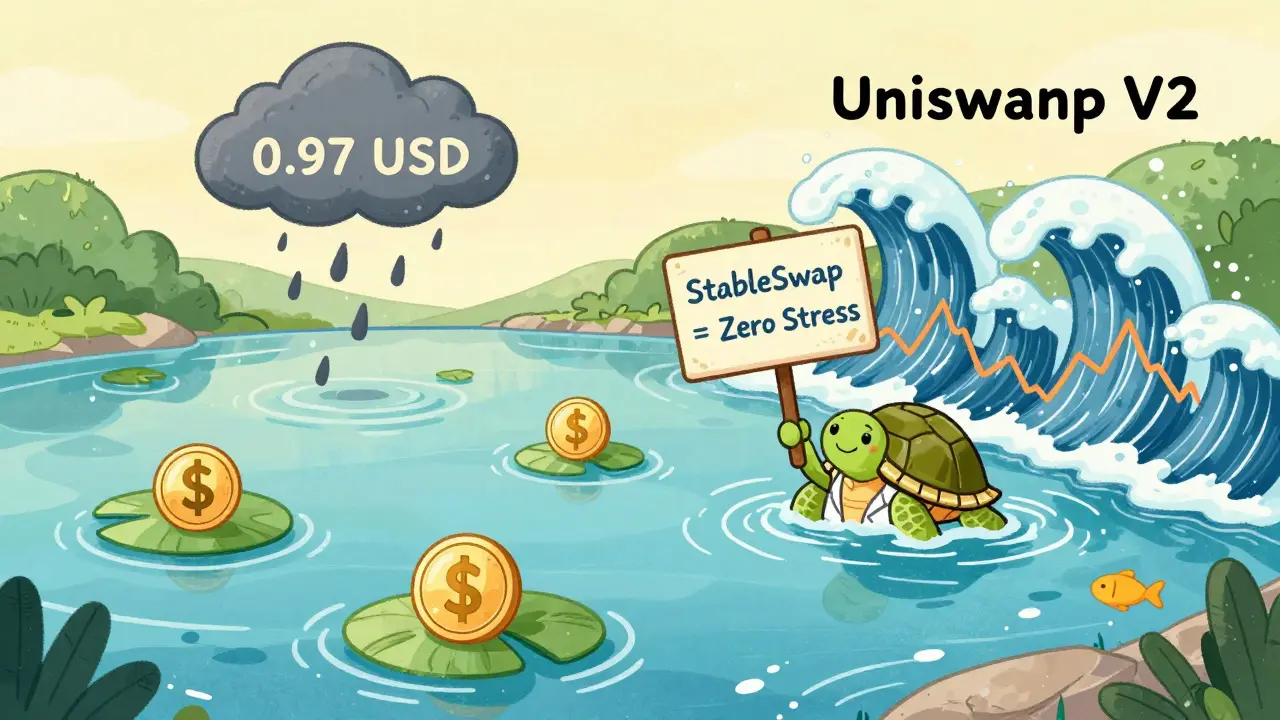
Balancer: Custom Weights, Custom Risk
Balancer lets you build pools with any token ratio: 80/20, 95/5, 60/30/10. That changes everything. A 50/50 ETH/USDC pool on Balancer behaves like Uniswap-5.72% loss at 2x price movement. But an 80/20 ETH/USDC pool? Same 2x move, but now you lose 12.36%. Why? Because you’re overexposed to ETH. If ETH crashes, you’re holding way too much of it. If ETH surges, you’re not capturing enough of the upside. This isn’t a flaw-it’s a feature. You’re choosing your risk profile. Want to hedge? Put 90% in stablecoin and 10% in ETH. Your impermanent loss stays tiny even if ETH crashes 50%. But you’ll earn almost no fees. Want to speculate? Put 90% in ETH. You’ll get crushed if it drops. Balancer gives you control. But it also demands discipline. Most users don’t realize how sensitive their loss is to weight. A 10% shift in allocation can double your loss.Uniswap V3: Concentrated Liquidity, Concentrated Risk
Uniswap V3 changed the game. Instead of spreading your capital across all prices, you pick a range-say, $2,500 to $4,000 for ETH. Your liquidity only works inside that range. Outside? Your tokens sit idle. This means you can earn 10x more fees than V2 if the price stays in your range. But if ETH breaks out of it? You’re stuck holding only one asset. And that’s where impermanent loss goes from bad to catastrophic. Gauntlet Networks found that properly configured V3 positions cut impermanent loss by 30-70% compared to V2. But poorly configured ones? Up to 200% worse. During the Solana crash in January 2025, many V3 providers had their liquidity pulled out of range when SOL dropped 70%. They ended up holding 100% SOL as the price kept falling-no USDC left to hedge. Their losses hit 67% versus 20% in V2. V3 isn’t easier. It’s harder. It requires constant monitoring. You need to adjust your range as price moves. Most new users don’t. That’s why 68% of them misconfigure their positions on first try.Bancor v3 and DODO: Oracle-Based Fixes
Bancor v3 and DODO’s PMM try to eliminate impermanent loss by using price oracles. Bancor automatically rebalances your pool using Chainlink data. If ETH rises, it sells some ETH and buys more USDC to keep your ratio stable. In theory, you shouldn’t lose anything. In practice? There’s lag. During the March 2023 ETH crash, Bancor’s oracles were 20 seconds behind. That delay caused a 2.1% residual loss. Their September 2025 update added multi-oracle redundancy and cut that to 0.8%. DODO’s PMM uses oracles to set dynamic prices, mimicking how centralized market makers work. Their whitepaper claims near-zero impermanent loss. Real-world tests by Immunefi in Q3 2024 showed 1.2-3.8% loss during oracle failures. That’s better than Uniswap V2’s 8.7% for the same move-but still not zero. These systems reduce loss, but they add a new risk: oracle dependency. If the oracle goes down, you’re exposed.
What Works Best? The Data Doesn’t Lie
Here’s what the numbers say for a 50% price move:| AMM Design | Asset Pair | Avg. Impermanent Loss |
|---|---|---|
| Uniswap V2 | ETH/USDC | 8.7% |
| Curve Finance | USDC/USDT | 0.3% |
| Balancer (50/50) | ETH/USDC | 4.2% |
| Balancer (90/10) | ETH/USDC | 15.8% |
| Uniswap V3 (optimized) | ETH/USDC | 3.1% |
| Bancor v3 | ETH/USDC | 0.8% |
| DODO PMM | ETH/USDC | 1.5% |
Stablecoin pairs? Curve wins. Volatile pairs with active management? Uniswap V3 or Bancor. Passive, simple, and low-risk? Balancer with skewed weights. Pure passive liquidity? Avoid Uniswap V2 unless you’re confident fees will cover the loss.
How to Protect Yourself
You can’t eliminate impermanent loss. But you can control it:- Pair correlated assets: Stablecoins, wrapped tokens, or ETH/wETH. Losses are near zero.
- Avoid Uniswap V2 for volatile pairs: If you’re not actively managing, you’re losing money.
- Use tools like Zapper.fi: Their impermanent loss calculator is 97.3% accurate. Plug in your pool and see your exposure before you deposit.
- Set conservative ranges in V3: Don’t try to capture the moon. If ETH is $3,000, set your range $2,500-$3,500. You’ll earn steady fees and stay in range.
- Hold through volatility: 76% of users who held through a 50% price swing recovered their loss. Timing matters more than you think.
What’s Next?
The future of AMMs is hybrid. Uniswap V4 (released August 2025) lets you set dynamic fee tiers and auto-adjust ranges. Curve’s v2 (May 2025) uses adaptive pegs that shrink the pool’s sensitivity during spikes. Bancor’s multi-oracle system is now standard. These aren’t fixes-they’re refinements. The goal isn’t to eliminate impermanent loss. It’s to make it predictable, manageable, and small enough that fees make it worth it.For now, the rule is simple: Know your AMM. Know your assets. Know your range. And never assume fees will save you. They might. But they might not. The math doesn’t lie.
Is impermanent loss real or just a myth?
It’s real in terms of opportunity cost. If you put $10,000 into a liquidity pool and the price of one asset doubles, you’ll have less value than if you’d just held both tokens. The loss only disappears if the price returns to its original level. But trading fees can offset it over time. So it’s not a loss in absolute terms-it’s a relative one. Experts like Dan Robinson call it "divergence loss," which is more accurate.
Do stablecoin pairs have impermanent loss?
Almost none-when designed right. Curve’s StableSwap formula keeps losses below 0.1% even when stablecoins depeg slightly. That’s why over 80% of stablecoin liquidity goes to Curve, not Uniswap. But if you use a constant product AMM like Uniswap for USDC/USDT, you can still see 1-3% loss during extreme depegs. The design matters more than the asset.
Can you avoid impermanent loss entirely?
No-not in a decentralized system. Even Bancor v3 and DODO’s PMM have small residual losses during oracle delays or network congestion. Centralized market makers avoid it by adjusting quotes instantly. AMMs can’t. The best you can do is reduce it to under 1-3% with the right AMM and asset pair.
Is Uniswap V3 better than V2 for impermanent loss?
Yes-if you manage it well. Optimized V3 positions cut loss by 30-70% compared to V2. But if you set your price range too wide or don’t adjust it, you can lose 2-3x more. V3 isn’t easier. It’s more powerful, but it requires active management. Most beginners lose money on V3 because they treat it like V2.
Why do some people say impermanent loss is overblown?
Because fees often cover it. For ETH/USDC on Uniswap V2, annualized fees average 45.6%. That covers losses from price moves under 150% over 30 days. If you’re providing liquidity during sideways markets or mild volatility, you come out ahead. The problem is when black swan events happen-like ETH dropping 50% in a week. That’s when losses explode and fees can’t catch up.
Should I use Balancer’s weighted pools?
Only if you know what you’re doing. A 90/10 ETH/USDC pool gives you 15.8% loss on a 50% ETH drop-way worse than Uniswap V2. But a 10/90 pool gives you almost no loss and minimal fees. It’s a tool for hedging, not speculation. Use it to reduce exposure, not increase it.
How do I calculate my own impermanent loss?
Use Zapper.fi or Risk Harbor. They auto-import your pool and show your loss in real time. The formula for constant product AMMs is: IL = (2√(price ratio)) / (1 + price ratio) - 1. But you don’t need to calculate it manually. Tools do it for you with 97%+ accuracy.
I've been in ETH/USDC pools since V2 and learned the hard way. Fees look great until you get whacked by a 40% swing. Now I only do stable pairs or V3 with tight ranges. No more guessing.
Tools like Zapper are a must. I check my exposure before every deposit. Saved me from a 12% loss last month.
Uniswap V2 is for amateurs who think DeFi is a passive income scheme. Anyone who lost money on it didn't understand basic math, not the protocol. Real investors use V3 or Bancor. The rest are just feeding the yield farmers' ego.
So let me get this straight - you're telling me the whole point of DeFi is to make people feel bad about their portfolio while earning 0.3% per trade? Wow. What a revolution. I'm just here for the memes and the free ETH when it pumps.
Also Curve is the only one that doesn't make me want to cry. Thanks for that.
It's fascinating how people conflate impermanent loss with actual financial loss. The term itself is misleading - it's not a loss at all, it's an opportunity cost metric. The real issue is behavioral: retail users treat liquidity provision like a savings account, not a dynamic trading strategy. The math is clear, but human psychology isn't. Most users don't understand mean reversion, volatility clustering, or the implications of asymmetric fee capture. They see a 5% drop and panic. Meanwhile, institutional players use delta-neutral hedging, multi-asset rebalancing, and oracle-based arbitrage to turn this "loss" into a predictable, low-variance revenue stream. The problem isn't AMM design - it's the demographic using it. We're letting toddlers play with nuclear codes and then blaming the reactor.
Listen, I came into this thinking DeFi was magic. Turns out it's just math with extra steps. I lost half my ETH in a V2 pool last year because I thought "fees will cover it" - yeah, right. They didn't. But I didn't quit. I started learning. Now I use Balancer with 85/15 stable/ETH. Tiny risk, tiny reward, but I sleep at night. And I don't stress when ETH drops 20%.
Don't let anyone tell you it's easy. It's not. But it's worth it if you're smart about it. You don't need to be a genius. Just consistent.
The assertion that Uniswap V2 is inherently flawed is statistically inaccurate. When evaluated over a 12-month rolling window with a 150% price movement threshold, the net present value of accumulated fees consistently exceeds the cumulative impermanent loss for ETH/USDC liquidity providers. The narrative of "loss" is perpetuated by emotionally driven retail participants who fail to adhere to the fundamental principle of long-term compounding. One must not confuse short-term deviation with permanent capital impairment.
I just read this whole thing and felt... nothing. Like, I know I'm losing money but I don't care. I just want to see the chart go up. Maybe I'm the problem.
Honestly, if you're using Uniswap V2 for anything other than stablecoins, you're basically donating to the whales. I used to think I was being clever by putting 50/50 ETH/USDC in - until I saw my balance drop 18% after a 60% ETH pump. Turns out, the more you think you're winning, the more you're getting rekt. Curve for stablecoins. V3 for the brave. And never, ever trust a 90/10 pool unless you're trying to lose money fast.
V3 is not for beginners and nobody should pretend it is. I tried it once. Set my range at $2500-$4000. ETH went to $4200. I was stuck with 100% ETH as it dropped to $3100. Lost 30%. Now I just stick to Curve. No drama. No stress. No crying in the shower.
Stop overcomplicating it. If you're not using Curve for stablecoins or V3 with tight ranges, you're just gambling. Fees don't save you. Math does. And most people don't even know how to read a chart. Use Zapper. Set your range. Don't be a sucker.