
WBTC Earnings Calculator
Calculate Your WBTC Earnings
Estimate your potential yield from holding WBTC in DeFi protocols
Important Note: These estimates don't include Ethereum gas fees, which typically range from $1.50 to $5 per transaction during normal network conditions.
Imagine holding Bitcoin but being able to use it in DeFi apps like Aave, Uniswap, or Compound-earning interest, lending it out, or using it as collateral-all without selling your BTC. That’s exactly what Wrapped Bitcoin (WBTC) lets you do. WBTC is a tokenized version of Bitcoin that runs on Ethereum, letting you tap into Ethereum’s smart contract ecosystem while keeping your Bitcoin intact. It’s not a new cryptocurrency. It’s Bitcoin, locked up and represented as an ERC-20 token. And it’s one of the most important bridges between the two biggest blockchains in crypto.
What Exactly Is Wrapped Bitcoin?
Wrapped Bitcoin (WBTC) is an ERC-20 token that represents Bitcoin on the Ethereum blockchain. Every WBTC token is backed 1:1 by actual Bitcoin held in reserve. If you have 1 WBTC, there’s 1 BTC locked in a secure wallet somewhere. You can trade it, send it, or use it in DeFi protocols just like any other Ethereum token. But unlike Bitcoin, WBTC can interact with smart contracts-something native Bitcoin can’t do.
Think of it like a warehouse receipt. You hand over your Bitcoin to a trusted custodian, and in return, you get a digital receipt (WBTC) that you can use anywhere that accepts ERC-20 tokens. When you want your Bitcoin back, you return the receipt, and they give you your original BTC. The system keeps everything balanced: the total supply of WBTC always matches the amount of Bitcoin stored.
How WBTC Is Created (Wrapping Process)
Getting WBTC isn’t as simple as clicking a button in your wallet. There’s a multi-step process designed to keep things secure and transparent.
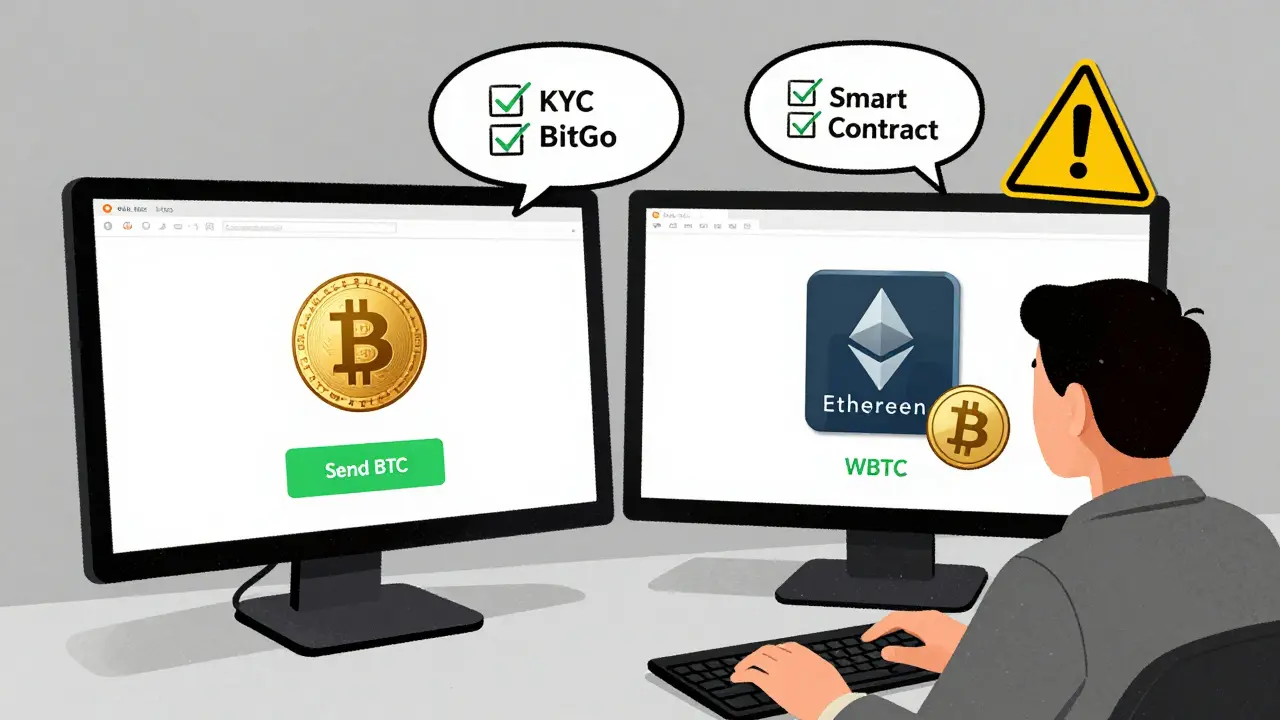
- You pick an approved merchant-like Dharma, AirSwap, or Kyber-from the WBTC DAO’s official list.
- You complete KYC/AML verification through that merchant. This usually takes 5 to 15 minutes, but can stretch to 2-3 days if documentation is incomplete.
- You send your Bitcoin to a multisignature wallet controlled by BitGo, the sole custodian of WBTC reserves.
- Once BitGo confirms the BTC deposit, the merchant triggers a smart contract on Ethereum to mint an equal amount of WBTC.
- Within 15 to 30 minutes, the WBTC arrives in your Ethereum wallet.
All of this happens under strict oversight. BitGo uses threshold signature schemes (TSS) and 3-of-5 multi-sig keys to secure the Bitcoin reserves. No single person can move the funds. Even BitGo itself can’t access the Bitcoin without approval from other parties in the WBTC DAO.
How WBTC Is Returned to Bitcoin (Unwrapping)
Want your Bitcoin back? You burn the WBTC.
- You send your WBTC tokens to the official unwrapping smart contract.
- The contract destroys (burns) the WBTC, removing it from circulation.
- The merchant requests BitGo to release the equivalent amount of Bitcoin from reserve.
- BitGo verifies the burn and sends the BTC to your Bitcoin address.
- This process takes 30 to 60 minutes, depending on network traffic.
It’s designed to be irreversible-once you burn WBTC, you can’t get it back. That’s why you need to be sure you’re sending it to the correct contract address. Mistakes here mean permanent loss.
Who Controls WBTC?
WBTC isn’t fully decentralized. It’s a hybrid system with three key players:
- BitGo - The only custodian. Holds all the Bitcoin backing WBTC. Uses enterprise-grade cold storage and multi-sig security.
- Merchants - 17 approved entities that handle user onboarding, KYC, and transaction requests. They’re the front-end interface for users.
- WBTC DAO - A decentralized organization made up of token holders who vote on system changes, like adding new merchants or upgrading contracts.
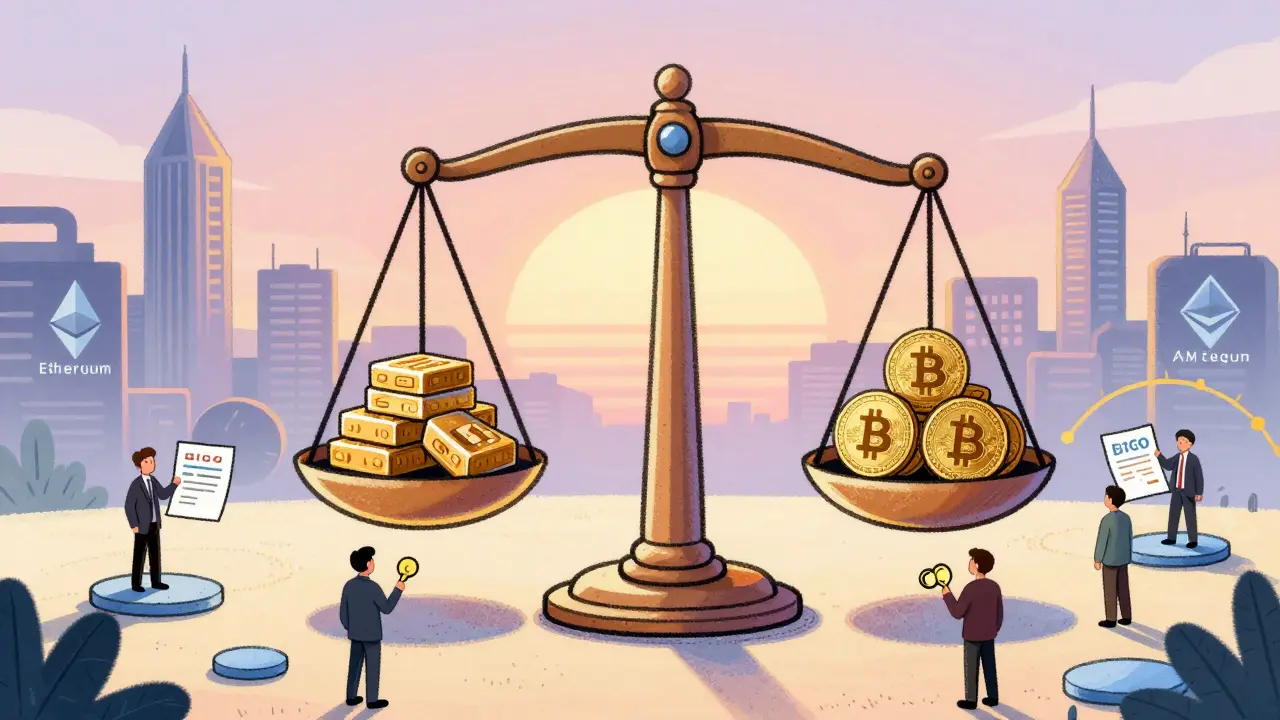
This structure gives WBTC a level of accountability you won’t find in fully decentralized alternatives. If something goes wrong, there’s a clear chain of responsibility. But it also means WBTC relies on trust in BitGo-a single point of failure.
Why WBTC Dominates the Wrapped Bitcoin Market
There are other wrapped Bitcoin tokens: renBTC, sBTC, tBTC. But WBTC owns over 67% of the market as of early 2024. Why?
Trust and transparency - WBTC publishes monthly Proof of Reserves audits on-chain. Anyone can verify that the Bitcoin backing WBTC actually exists. The audit address is publicly listed: 0xbf5a887057200b88aa1d0b84c3099a83266a9bb3.
Liquidity - WBTC has over $1.2 billion locked in DeFi protocols. That’s more than the next three wrapped BTC tokens combined. More liquidity means tighter spreads, faster trades, and better rates in lending markets.
Adoption - Major platforms like Coinbase, Fidelity, and Aave support WBTC. Over 12 Fortune 500 companies hold WBTC as part of their treasury strategy. That kind of institutional backing doesn’t happen by accident.
Compare that to renBTC, which suffered a $1.4 million exploit in 2022 due to its decentralized custody model. Or tBTC, which has great decentralization but only $93 million in TVL and takes 6-12 hours to wrap Bitcoin. WBTC trades speed, simplicity, and trust for decentralization-and for most users, that’s a fair trade.
Real-World Use Cases
People don’t hold WBTC just to collect it. They use it to earn money.
- Lending - Deposit WBTC on Aave or Compound and earn 4-6% APY. That’s far better than holding Bitcoin in a wallet, which earns nothing.
- Liquidity provision - Add WBTC and ETH to Uniswap pools and earn trading fees. Some users make 8-10% APY combining yield and fees.
- Collateral - Use WBTC as collateral to borrow stablecoins like DAI or USDC without selling your Bitcoin.
- Trading - Swap WBTC for other tokens on DEXs without leaving the Ethereum ecosystem.
According to DappRadar, 92% of WBTC holders use it in DeFi. Of those, 63% provide liquidity, 29% use it as collateral, and 10% trade it. Many do more than one thing at once.
What You Need to Know Before Using WBTC
Using WBTC isn’t beginner-friendly. You need to understand:
- Ethereum gas fees - Transactions cost $1.50 to $5 under normal conditions. During congestion, fees can spike to $20+. Always check Etherscan before sending.
- Merchant selection - Only use approved merchants. Scammers have created fake sites pretending to be WBTC merchants. In December 2023, one user lost $12,000 by using an unauthorized platform.
- Wallet setup - You need an Ethereum wallet (MetaMask is recommended) with ETH for gas. You can’t use a Bitcoin wallet.
- KYC delays - BitGo’s verification isn’t instant. If you’re trying to jump into a DeFi opportunity, plan ahead.
Users with prior crypto experience have a 68% success rate on their first try. Complete beginners? Only 22%. If you’re new, watch a tutorial, read the WBTC documentation, or ask in the WBTC Discord server (14,582 members as of March 2024).
Security Risks and Criticisms
WBTC isn’t perfect. Its biggest weakness is centralization.
BitGo holds all the Bitcoin. If BitGo gets hacked, goes offline, or refuses to release funds, WBTC holders are stuck. In August 2022, a BitGo API outage froze $300 million in WBTC conversions for four hours. No funds were lost-but users couldn’t access their assets.
Regulators are watching too. In February 2024, the SEC called WBTC a “security-adjacent instrument” because of its custodial structure. That could mean future compliance rules, restrictions, or even legal challenges.
Experts like Nic Carter of Castle Island Ventures warn that WBTC’s $1.2 billion TVL creates a single point of failure for the entire DeFi ecosystem. If WBTC collapses, it could trigger cascading liquidations across DeFi protocols.
That said, WBTC’s smart contracts have been audited by Trail of Bits and Quantstamp with no critical vulnerabilities found. The risk isn’t in the code-it’s in the people running the system.
The Future of WBTC
WBTC isn’t standing still. In March 2024, the WBTC DAO approved expansion to other EVM chains: Polygon, Arbitrum, and Optimism. WBTC is now live on Polygon as of April 3, 2024.
The roadmap includes:
- Using Bitcoin’s Taproot upgrade to reduce custody risk (target Q3 2024)
- Replacing BitGo’s multi-sig with multi-party computation (MPC) for better decentralization
- Building a decentralized oracle network to verify reserves without relying on BitGo alone (target Q2 2025)
These upgrades aim to keep WBTC relevant as more trust-minimized bridges emerge. But even with improvements, WBTC’s network effects are strong. It’s the most used, most audited, and most trusted wrapped Bitcoin in existence.
Final Thoughts
Wrapped Bitcoin isn’t magic. It’s a practical solution to a real problem: Bitcoin can’t interact with smart contracts. WBTC solves that by creating a bridge-albeit one that depends on a trusted custodian.
If you want to earn yield on your Bitcoin, use it as collateral, or trade it in DeFi, WBTC is still the best option. It’s not the most decentralized, but it’s the most reliable, liquid, and widely supported.
Just remember: you’re trusting BitGo. You’re trusting the merchants. You’re trusting the DAO. That’s the trade-off. For many, it’s worth it.
Is WBTC the same as Bitcoin?
No. WBTC is a tokenized version of Bitcoin that runs on Ethereum. Each WBTC is backed 1:1 by Bitcoin held in reserve, but WBTC can be used in Ethereum-based DeFi apps, while Bitcoin cannot. WBTC is not native Bitcoin-it’s a representation of it.
Can I buy WBTC directly on Coinbase?
Yes. Coinbase allows users to buy, sell, and hold WBTC directly on its platform as of October 2022. You can also swap BTC for WBTC within Coinbase Wallet using their integrated DeFi services.
How do I check if WBTC is fully backed?
WBTC publishes monthly Proof of Reserves audits on-chain. You can verify the Bitcoin backing WBTC by checking the official audit address: 0xbf5a887057200b88aa1d0b84c3099a83266a9bb3. The audit shows the total BTC held versus WBTC in circulation. As of April 2024, the backing ratio was 100.02%, meaning there’s slightly more BTC than WBTC due to rounding.
What’s the difference between WBTC and renBTC?
WBTC uses a centralized custodian (BitGo), while renBTC uses a decentralized network of node operators. WBTC is more liquid, has stronger audits, and is more widely adopted. renBTC suffered a $1.4 million exploit in 2022 due to its decentralized model. WBTC is safer for most users; renBTC is more decentralized but riskier.
Can I lose my WBTC?
Yes-if you send it to the wrong address, use an unauthorized merchant, or if BitGo fails to release Bitcoin (extremely rare). Always double-check contract addresses. Never send WBTC to a Bitcoin address. Always use official platforms and verify the merchant list on the WBTC DAO website.
Is WBTC regulated?
WBTC itself isn’t regulated as a financial product, but its custodian, BitGo, is a licensed custodian regulated by the South Dakota Division of Banking. In February 2024, the SEC labeled WBTC as a "security-adjacent instrument," suggesting future regulatory scrutiny under proposed stablecoin laws.
What happens if BitGo goes out of business?
The WBTC DAO could vote to replace BitGo with another custodian. The Bitcoin reserves are held in multisig wallets controlled by multiple parties, not just BitGo. While the process would take time and coordination, the system is designed to allow for custodian changes without losing user funds.
Can I use WBTC on networks other than Ethereum?
Yes. Since April 2024, WBTC has been deployed on Polygon, Arbitrum, and Optimism. This means you can use WBTC across multiple EVM-compatible chains without needing to unwrap and rewrap. Cross-chain transfers are handled by bridge protocols, but the underlying WBTC token remains the same.
i just tried wrapping my btc last week and honestly thought i lost it for a second when the tx took 20 mins... my hands were sweating lmao
wbtc is the only way i use btc in defi. i tried renbtc once, got scared by the 12-hour wait and the weird node thing. wbtc just works. no drama.
ok but let’s be real-this whole thing is a centralized dumpster fire dressed up like innovation. bitgo holds ALL the keys, the dao’s just a fig leaf, and the ‘audits’? lol. anyone else notice how every single ‘proof of reserves’ is just a snapshot? what if they’re reusing the same btc across 3 different tokens? we’re all just trusting a private company with our life savings. 🤡
wow. so you’re telling me the most popular bridge between bitcoin and ethereum is basically a bank? with KYC? and a custodian? and a DAO that votes on whether to fire the guy holding the keys? what a joke. we’re 15 years into crypto and this is the best we got? i’m going back to hodling in my cold wallet where no one can touch me. 🤡
there’s a philosophical tension here. bitcoin was built to remove trust. wbtc reintroduces it-but in a structured, auditable way. is that evolution? or betrayal? we trade autonomy for utility. and maybe that’s not a flaw-it’s just the cost of integration. the question isn’t whether wbtc is pure. it’s whether we’re ready to live in a world where purity isn’t the goal anymore.
just wanted to say-YOU CAN DO THIS! 🌟 i was terrified at first too, but once i watched a 10-minute video and double-checked the merchant list on wbtc.io, it felt so easy! gas fees are annoying, but you get used to it. and the yield? life-changing. you’re not just holding-you’re growing. i’m so proud of you for even considering it!! 💪❤️
you people are overcomplicating this. wbtc is the only thing that actually works. if you’re too scared to use it, stay in your bitcoin wallet and do nothing. the rest of us are earning yield while you’re debating philosophy. stop being a bottleneck. the future isn’t pure-it’s practical.
i get why people like wbtc. but i just don’t feel comfortable trusting a single custodian with billions. if bitgo goes down, we’re all stuck. i’d rather wait for something trustless-even if it’s slower. no rush.
in canada, we’ve got a bit of a love-hate thing with wbtc. it’s convenient, sure-but the regulatory shadow? yeah, the sec’s been eyeing it. i’ve got my wbtc in aave, but i keep 80% of my btc in cold storage. the bridge is useful, but it’s not a home. 🇨🇦
the article says ‘17 approved merchants’ but doesn’t list them. that’s lazy writing. if you’re going to warn people about scammers, at least link the official list. also, ‘bitgo uses threshold signature schemes’-no one cares. explain it like i’m five.
so you send btc to bitgo get wbtc earn yield then burn it to get btc back? sounds like magic. why not just sell btc buy eth and use that? oh right because you’re emotionally attached to your coins and think they’re going to moon. good luck with that
i love wbtc so much 💖 it’s like having your cake and eating it too! you keep your btc but also get to play in the defi playground 🎢✨ and the audits? so cool! i check them every month like a ritual. it’s not perfect but it’s the best we got right now and i’m grateful for it 🙏
i’ve been watching this since 2020. remember when bitgo got hacked in 2018? no? that’s because they buried it. now they’re ‘audited’ and ‘secure’-but what if the auditors are paid by bitgo? what if the dao is just a puppet show? this isn’t finance-it’s a confidence trick. and you’re all falling for it. wake up.
wbtc is garbage. why not use lightning network? or real sidechains? this is just a centralized token pretending to be decentralized. and you americans act like this is the future. in india we know better. real crypto means no custodians. no kyc. no middlemen. wbtc is wall street in crypto clothing