
You’ve probably heard the stories. Someone bought Bitcoin at $10,000, held it, and became a millionaire. But there’s another side of the crypto market that doesn’t get as much hype but offers incredible power for those who understand it: cryptocurrency options trading. It’s not just about buying and holding coins anymore. It’s about betting on where prices are going-up, down, or sideways-without actually owning the asset.
If you’re tired of watching your portfolio drop 20% in a day and feeling helpless, options might be the tool you’ve been missing. They act like insurance policies or strategic bets that let you control large amounts of value with a small upfront cost. But here’s the catch: they are complex. One wrong move can wipe out your premium instantly. This guide breaks down exactly how crypto options work, why they matter in 2026, and how you can start using them without blowing up your account.
What Are Cryptocurrency Options?
At its core, an option is a contract. Specifically, it gives you the right, but not the obligation, to buy or sell a cryptocurrency at a specific price by a specific date. Think of it like putting a deposit on a house. You pay a fee to lock in the price. If the housing market crashes, you walk away and only lose the deposit. If the market soars, you buy the house at the locked-in low price and profit from the difference.
In the crypto world, this concept has exploded. The broader crypto derivatives market now sees annual trading volumes surpassing $1 trillion. That’s more active than many traditional stock markets. Unlike spot trading, where you own the actual Bitcoin or Ethereum in your wallet, options are derivatives. Their value is derived from the underlying asset, but you never have to custody the coin itself. Exchanges hold the contracts on your behalf, reducing the risk of hacking your personal wallet while trading.
Why does this matter? Because options give you flexibility. You can make money when prices go up, when they go down, or even when they stay flat. Spot traders are stuck hoping for one thing: price appreciation. Options traders have a whole playbook.
The Anatomy of an Option Contract
To trade effectively, you need to speak the language. Every option contract has four key components that determine its value and potential payoff:
- The Underlying Asset: This is what the option is based on, such as Bitcoin (BTC) or Ethereum (ETH).
- The Strike Price: The predetermined price at which you can buy or sell the asset. This is your target.
- The Expiration Date: The deadline. After this date, the contract becomes worthless if not exercised.
- The Premium: The cost you pay upfront to buy the option. This is your maximum possible loss.
The premium isn’t static. It fluctuates constantly based on three main factors: the current price of the underlying crypto, how much time is left until expiration, and the volatility of the market. High volatility means higher premiums because the chance of a big price swing increases.
Calls vs. Puts: Choosing Your Direction
There are two primary types of options, and choosing between them depends entirely on your market outlook.
Call Options give you the right to buy the asset at the strike price. You buy calls when you are bullish-you expect the price to rise. For example, if Bitcoin is trading at $50,000 and you think it will hit $60,000 next month, you buy a call option with a strike price of $55,000. If BTC goes above $55,000, your option gains value.
Put Options give you the right to sell the asset at the strike price. You buy puts when you are bearish-you expect the price to fall. If you think Bitcoin is overvalued at $50,000 and will crash to $40,000, you buy a put option with a strike price of $45,000. As the price drops below $45,000, your put option becomes more valuable.
| Feature | Call Option | Put Option |
|---|---|---|
| Market Outlook | Bullish (Price Up) | Bearish (Price Down) |
| Right Granted | Right to Buy | Right to Sell |
| Profit Potential | Unlimited (as price rises) | Limited (price can only drop to zero) |
| Max Loss | Premium Paid | Premium Paid |
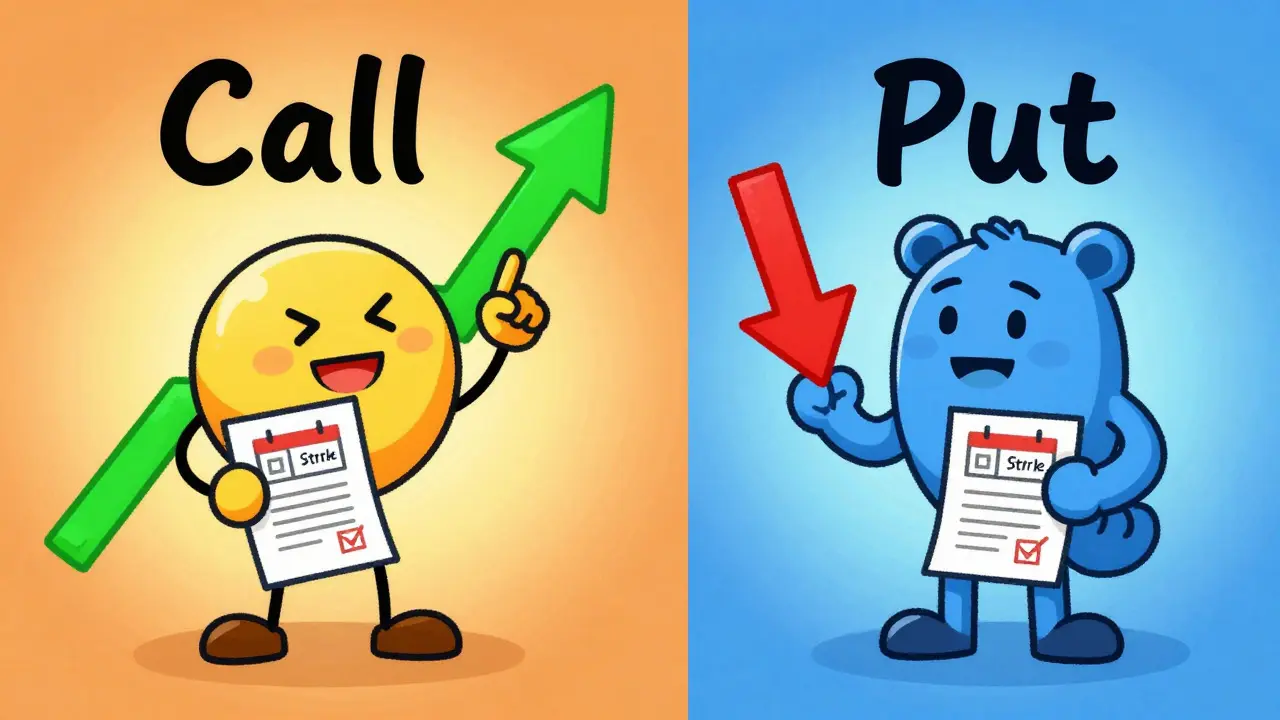
A Real-World Example: How Profits Work
Let’s look at a concrete scenario to see how the math plays out. Imagine Bitcoin is currently trading at $50,000. You believe it will surge in the next month due to positive regulatory news. Instead of buying $50,000 worth of Bitcoin, you decide to trade options.
You purchase a Call Option with the following terms:
- Strike Price: $52,000
- Expiration: 30 days from now
- Premium Cost: $1,000
Your break-even point is $53,000 ($52,000 strike + $1,000 premium). Here are the possible outcomes:
- Bitcoin rises to $60,000: You exercise your right to buy at $52,000. Your profit is $8,000 per Bitcoin ($60k - $52k), minus the $1,000 premium. Net profit: $7,000. Compare this to spot trading, where you’d need to invest $50,000 to make similar returns. With options, you controlled the position for just $1,000.
- Bitcoin stays at $50,000: The option expires worthless. You lose your $1,000 premium. In spot trading, you’d still own the Bitcoin, waiting for it to recover. With options, the loss is capped and immediate.
- Bitcoin drops to $40,000: Same result as staying flat. You lose the $1,000 premium. Your downside is limited regardless of how far the price falls.
This leverage is double-edged. It amplifies gains, but it also means time is against you. If the price doesn’t move in your direction before expiration, you lose everything.
Risk Management: Why Options Are Safer Than You Think
Many beginners fear options because they sound complicated. However, compared to direct crypto investment, buying options (being the buyer) is actually less risky in terms of capital exposure. When you buy a coin, you can lose 90% of its value if it crashes. When you buy an option, you can only lose the premium you paid.
This characteristic makes options excellent for hedging. Suppose you own $100,000 worth of Ethereum and worry about a short-term dip. You can buy Put Options on Ethereum. If the price crashes, the profit from your puts offsets the loss in your holdings. If the price rises, you only lose the small premium paid for the "insurance." This strategy protects your portfolio without forcing you to sell your assets and trigger tax events.
However, beware of selling options (writing options). Sellers collect the premium but take on unlimited risk if the market moves against them. For beginners, sticking to buying calls and puts is the safest entry point.

Exercise Styles: American vs. European
Not all options are created equal. The style of exercise determines when you can use your contract.
U.S.-Style Options allow you to exercise the contract at any time between purchase and expiration. This offers maximum flexibility, especially in volatile crypto markets where prices can spike overnight.
European Options can only be exercised on the expiration date. While less flexible, they often have tighter bid-ask spreads and lower premiums because the seller knows exactly when they might be assigned. Most major crypto exchanges offer both styles, so check the contract specifications before trading.
Getting Started: Practical Steps for 2026
The crypto options landscape in 2026 is mature. Major exchanges offer user-friendly interfaces, diverse settlement mechanisms (fiat or crypto), and robust educational resources. Here’s how to start safely:
- Choose a Reputable Exchange: Look for platforms with high liquidity and clear regulatory compliance. Liquidity ensures you can enter and exit positions easily without wide slippage.
- Start with a Demo Account: Most platforms offer virtual trading environments. Practice buying calls and puts with fake money. Get comfortable with the interface and the concept of time decay.
- Understand the Greeks: Learn basic concepts like Delta (price sensitivity) and Theta (time decay). Time decay eats into your profits every day the option gets closer to expiration.
- Start Small: Begin with simple directional bets. Avoid complex multi-leg strategies like iron condors or straddles until you master the basics.
- Set Stop-Losses: Even though your max loss is the premium, define when you’ll cut losses early if the thesis changes.
Educational resources are abundant. Read whitepapers, watch tutorials, and join communities focused on derivatives trading. The complexity of options pricing models requires dedicated learning, but the payoff in strategic flexibility is worth the effort.
The Future of Crypto Options
We are seeing increased institutional adoption of crypto options. Hedge funds and family offices use them to hedge their massive spot positions. At the same time, decentralized finance (DeFi) protocols are launching non-custodial options platforms, allowing users to trade without giving up control of their keys. This democratization of sophisticated tools is lowering barriers to entry.
Regulatory clarity in major jurisdictions is also improving, making it safer for retail traders to participate. As the market grows, expect more underlying assets beyond Bitcoin and Ethereum, including stablecoins and altcoins, to have liquid options markets.
Options trading isn’t for everyone. It demands discipline, education, and emotional control. But for those willing to learn, it offers a powerful way to navigate the volatile crypto markets with precision and limited risk. Start small, stay educated, and always respect the premium.
Is options trading better than spot trading?
It depends on your goals. Spot trading is simpler and suitable for long-term holders. Options trading offers leverage, hedging capabilities, and the ability to profit from falling markets, but it is more complex and carries the risk of losing the entire premium if the trade expires out-of-the-money.
What is the maximum loss in crypto options trading?
For option buyers, the maximum loss is limited to the premium paid for the contract. You cannot lose more than what you initially invested. For option sellers, the risk can be significantly higher, potentially unlimited depending on the strategy used.
Do I need to own Bitcoin to trade Bitcoin options?
No. Options are derivative contracts. You do not need to hold the underlying asset in your wallet. The exchange handles the contract execution and settlement, which may occur in fiat currency or digital assets depending on the platform.
What is the difference between American and European options?
American-style options can be exercised at any time before expiration, offering more flexibility. European-style options can only be exercised on the expiration date. In crypto, American options are popular due to market volatility, but European options may offer cheaper premiums.
How do I calculate my break-even point?
For a call option, add the premium paid to the strike price. For a put option, subtract the premium paid from the strike price. The underlying asset must reach this break-even price for you to start making a profit after expiration.