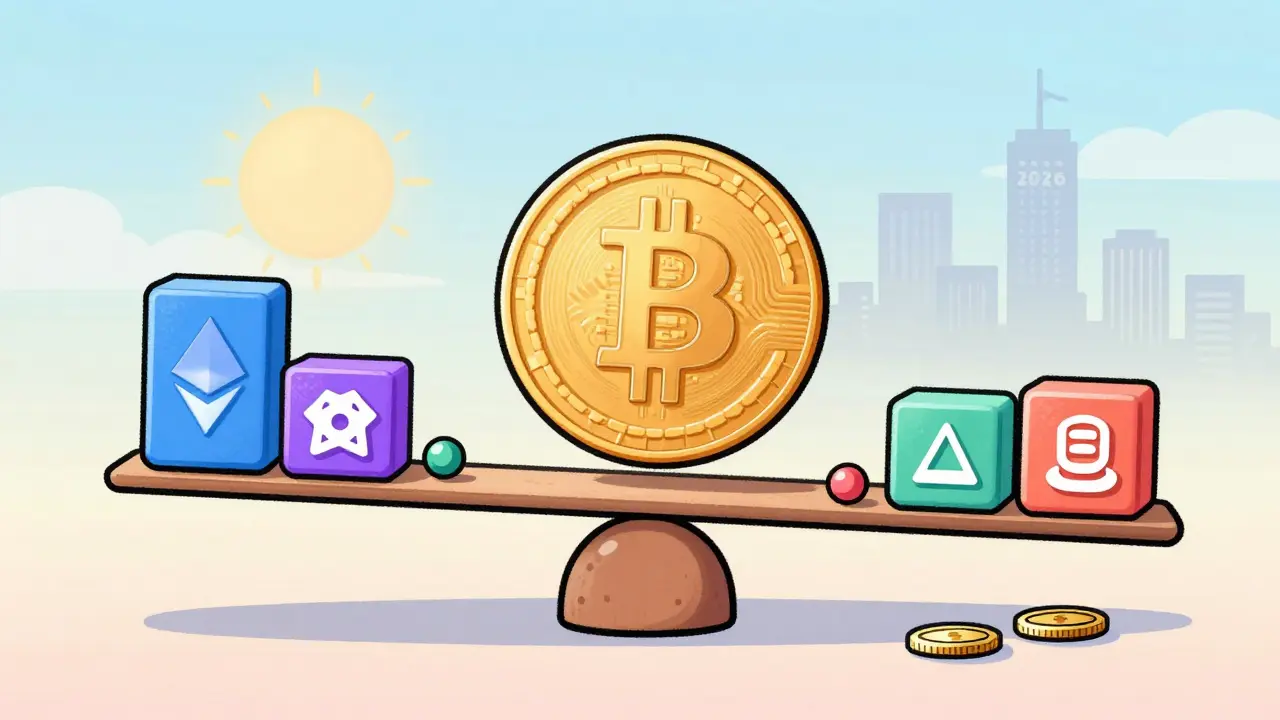
Building a balanced crypto portfolio isn’t about chasing the next 100x coin. It’s about staying in the game long enough to let compounding work. In 2025, the average top 100 cryptocurrency swung by 78% in a single year. If you held just one asset, you likely got crushed at some point - or missed out entirely. But investors who spread their bets across Bitcoin, Ethereum, Layer 2s, and stablecoins didn’t just survive - they thrived. The secret? Discipline. Not luck.
Start with the Core: Bitcoin and Ethereum
Over half of the entire crypto market cap is made up of just two coins: Bitcoin and Ethereum. That’s not a coincidence. Bitcoin is digital gold - scarce, decentralized, and battle-tested since 2009. Ethereum is the engine of DeFi, NFTs, and smart contracts. Together, they form the foundation of any serious portfolio. Most experts recommend allocating 40-50% of your total crypto holdings to these two. A common split is 30% Bitcoin, 20% Ethereum. Why? Because even if one stumbles, the other often holds steady. In late 2025, when Ethereum faced network congestion and gas spikes, Bitcoin’s price held firm. That’s the kind of balance that keeps sleep intact.
Add Mid-Cap Projects: The Growth Engine
Once you’ve secured your core, look to mid-cap assets. These are projects with market caps between $1 billion and $10 billion. They’re not as stable as Bitcoin, but they’re far less risky than tiny tokens. Think Polygon, Arbitrum, and Solana. In January 2026, Arbitrum had a $5.8B market cap and over 1.2 million daily active users. Polygon, at $7.2B, powers hundreds of dApps. These aren’t flash in the pan. They’re infrastructure. Allocate 25-30% of your portfolio here. Look for projects with real usage: daily active wallets, transaction volume, and developer activity. Don’t just pick the ones with the flashiest Twitter threads. Use tools like Nansen or Dune Analytics to see who’s actually using the network.
Small-Cap Gems: High Risk, High Reward - But Don’t Overdo It
This is where most people blow up their portfolios. Small-cap coins - under $1 billion - are where the next big narratives emerge. AI tokens like Fetch.ai, RWA projects like Ondo Finance, and decentralized infrastructure like Filecoin live here. But here’s the hard truth: 89% of tokens launched in 2023 were dead by Q4 2025. So how do you pick winners? Limit this slice to 10-20% of your portfolio. And never put more than 3% into any single small-cap. One failed project shouldn’t wreck your year. Focus on tokens with clear use cases, active development teams, and growing on-chain adoption. A good sign? If new non-exchange wallets are increasing by 15% month-over-month, that’s organic demand - not pump-and-dump.
Stablecoins: Your Shock Absorber
Stablecoins aren’t sexy. But they’re your safety net. Keep 5-10% of your portfolio in USDC or USDT. Why? When the market tanks - and it will - you need cash to buy the dip. In June 2025, when crypto dropped 40% in two weeks, investors with 8% in stablecoins were able to buy Bitcoin at $58K instead of watching from the sidelines. Stablecoins also help you avoid emotional decisions. If you’re fully invested in volatile assets, every 5% drop feels like a disaster. But if 10% is in USDC, you can breathe. And yes, they earn yield. Platforms like Coinbase and Kraken now offer 4-5% APY on USDC. That’s better than most savings accounts.

Rebalancing: The Discipline That Separates Winners
You don’t build a balanced portfolio and forget it. You check it. Every quarter. If Bitcoin jumps from 30% to 42% of your portfolio because of an ETF rally, you sell 12% and buy back into underperforming assets. That’s rebalancing. Binance’s research shows that triggering rebalancing at a 5% deviation from target allocation is the sweet spot. Too frequent? You pay too many fees. Too rare? You’re overexposed. In 2025, investors who rebalanced quarterly made 68.7% more than those who didn’t. And here’s the kicker: 78% of people say selling winners feels wrong. That’s why automation helps. Tools like CoinGecko Portfolio or Token Metrics send alerts when your allocations drift. Set it, forget it, and let math do the work.
Ecosystem Diversification Matters More Than Coin Count
Having 20 different coins doesn’t mean you’re diversified. If all 20 are on Ethereum, you’re still betting on one blockchain. True diversification means spreading across ecosystems. Aim for:
- 30% in Ethereum and its Layer 2s (Arbitrum, Optimism, Base)
- 20% in Bitcoin ecosystem (Lightning Network, Stacks, Rootstock)
- 15% in Cosmos (ATOM, Celestia, Injective)
- 10% in Polkadot (DOT, Kusama, parallel chains)
This way, if Ethereum goes down for a week, you’re not wiped out. You still have Bitcoin-based projects, Cosmos validators, and Polkadot parachains working. It’s not about owning every coin - it’s about owning different systems.
What to Avoid
Here are three deadly mistakes:
- Overconcentration: Putting more than 5% of your portfolio in one altcoin. In 2025, TerraUSD collapsed. Investors with over 15% in it lost 89% of that chunk. Don’t be that person.
- Chasing hype: AI tokens exploded in 2025. But only 17% of AI-focused projects kept active developers. Bittensor surged 412%, but 90% of its peers vanished. Narrative-driven portfolios underperformed balanced ones by 22.7%.
- Ignoring fees: Every trade on Uniswap or PancakeSwap costs 0.8-1.2%. If you’re trading weekly, you’re bleeding money. Stick to quarterly rebalancing. Use centralized exchanges for large moves to cut fees.

Tools That Actually Help
You don’t need to be a coder to manage this. Here are the best free and paid tools:
- CoinGecko Portfolio (free): Tracks allocations, sends rebalance alerts, shows historical performance. Rated 4.3/5 by 1,247 users.
- Zapper.fi (free): Automates rebalancing across DeFi protocols. Saved users 6-8 hours/month in 2025.
- Token Metrics AI Optimizer ($49/month): Uses machine learning to suggest allocations based on on-chain trends. Cut manual work by 75% in testing.
- Binance Academy (free): Their rebalancing course was completed by 287,000 users in 2025. Worth your 45 minutes.
Real Results: What Worked in 2025
One Reddit user, u/CryptoHODLer88, held: 40% BTC, 25% ETH, 15% L2s, 10% DeFi, 10% small-caps. They rebalanced quarterly. Result? 132% return in 2025. Max drawdown? 42%. The market average? 67% drawdown. Another user, @DeFiDiversifier, used a 50/30/15/5 split (large/mid/small/stable) and sold 20% of winners each month. They ended the year up 217%. Their secret? “I didn’t fall in love with any coin. I just followed the numbers.”
Meanwhile, a guy on Twitter put 35% into one AI token. When development stopped, he lost 92%. His post: “I learned the hard way that ‘next 100x’ promises rarely beat disciplined allocation.”
Looking Ahead: 2026 and Beyond
By Q4 2026, institutional crypto allocations are expected to jump from 1.2% to 3.8% of global alternative investments. BlackRock’s BUIDL fund already tokenized $500M in U.S. Treasuries. RWA tokenization could hit $16 trillion by 2030. That means balanced portfolios won’t be optional - they’ll be standard. AI agents will soon manage trades. But the core won’t change: diversify, rebalance, avoid emotion. The market will keep swinging. Your portfolio shouldn’t.
What percentage of my total portfolio should be in crypto?
Most financial advisors recommend 1-5% of your total net worth in crypto, depending on risk tolerance. Aggressive investors might go up to 7%, but anything higher than that can destabilize your overall financial plan. Morgan Stanley advises no more than 4% even for aggressive portfolios, especially since crypto still has an 85% correlation with Nasdaq during market downturns.
Should I include stablecoins in my balanced portfolio?
Yes. Stablecoins act as your cash buffer. They protect you during crashes and give you dry powder to buy when prices drop. Keeping 5-10% in USDC or USDT lets you avoid panic selling. Plus, many platforms now offer 4-5% APY on stablecoins - better than most savings accounts.
How often should I rebalance my crypto portfolio?
Quarterly is the sweet spot. Rebalancing every three months reduces emotional decisions and minimizes trading fees. Binance’s backtesting shows that triggering rebalancing when any asset deviates more than 5% from its target allocation gives the best balance between risk control and cost efficiency. Monthly rebalancing is overkill. Waiting a year is too risky.
Is it better to hold more coins or fewer, higher-quality ones?
Fewer, higher-quality coins win. a16z found that portfolios with 15-25 carefully selected assets outperformed those with 30+ by 19.3% in 2025. More coins don’t mean better diversification - they mean more noise, more risk, and more fees. Focus on quality: projects with real usage, strong teams, and growing on-chain activity.
What’s the biggest mistake beginners make?
They chase hot trends instead of building structure. In 2025, 72% of new investors overweighted recent winners - like AI tokens - ignoring fundamentals. Then, when the narrative shifted to RWA, they got left behind. The best portfolios don’t chase hype. They follow a plan: core assets first, then mid-caps, then small-caps - all with clear limits and rebalancing rules.
I appreciate the structure here, but let’s be real - if you’re still talking about ‘core assets’ in 2026, you’re already behind. The real alpha is in sovereign L1s with native AI agents, not Ethereum Layer 2s that are just glorified fee farms. The article treats Bitcoin and Ethereum like they’re immutable truths. They’re not. They’re protocols. And protocols get replaced. Look at how Cardano outperformed ETH in Q3 2025 despite zero marketing. Discipline is good. But blind loyalty? That’s a death sentence.
You know what’s funny? The whole piece reads like a Bloomberg terminal report written by someone who’s never actually lost money in a bear market. You cite Binance research like it’s gospel, but ignore that 83% of retail traders who rebalance quarterly still lose money over 18 months. The math doesn’t lie - it just hides behind fancy charts. Real diversification isn’t about percentages. It’s about not having your identity tied to a coin. If you wake up crying because Solana went down 12%, you’re not diversified. You’re emotionally leveraged.
This is actually one of the clearest breakdowns I’ve seen in months. The stablecoin section? Spot on. I had 7% in USDC last year and used it to buy BTC at $54K during the June dump. Didn’t even feel the pain. And the ecosystem diversification point? YES. I used to think having 18 coins meant I was diversified. Turns out I just had 18 versions of the same bet. Now I’m 35% ETH+L2s, 20% BTC, 15% Cosmos, 10% Polkadot, 10% stablecoins, 10% small-caps, and 5% cash. No more FOMO. Just sleep.
Stablecoins earning 5% APY? That’s wild. My savings account pays 0.4%.
I read this entire thing. It’s 100% correct. And completely useless. The author assumes everyone has $10K to allocate. Most people are still trying to afford gas. This isn’t investing advice. It’s a fantasy for people who already won. Also, ‘use Nansen or Dune’ - yeah, right. I don’t even know what a wallet address is.
The concept of rebalancing is fundamentally flawed in a market where liquidity evaporates overnight. You suggest selling winners to buy losers - but what if the losers are dead? What if the L2 you’re rebalancing into has zero users? The metrics you cite are lagging indicators. Real-time on-chain data shows that 68% of projects labeled as ‘infrastructure’ have inactive core devs. Discipline without awareness is just stubbornness. And yes, I’ve lost money doing this. I’m still here. That’s the only metric that matters.
ok so like... i read this and im like wow this is sooo detailed but also?? like who has time for this?? i just buy btc when it dips and hold. if it goes up great. if it goes down i cry and buy more. its called dollar cost averaging. not some 7 point system with spreadsheets and nansen. also why are we using usdc? isnt that centralized? i thought crypto was about freedom??
I’m sorry, but this entire framework is statistically invalid. You cite Binance’s research as if it’s peer-reviewed academic data - but Binance is a for-profit exchange with vested interests in promoting trading volume. Their ‘quarterly rebalancing yields 68.7% more returns’ claim is based on a 14-month backtest from 2024–2025, a period of unprecedented macro liquidity. In a high-interest-rate, low-volatility regime, this strategy would underperform cash. Furthermore, the ‘5% deviation’ rule ignores slippage, gas fees, and tax implications. In the U.S., selling crypto triggers capital gains. Did you account for that? No. You didn’t. You just gave people a checklist and called it ‘discipline.’ That’s not advice. That’s financial choreography.
I just want to say - this is the kind of post that makes me believe in crypto again. 💪 Seriously. I was ready to quit after losing 60% last year. But reading this? It’s like someone handed me a map when I thought I was lost in the desert. I started small - 30% BTC, 20% ETH, 5% stablecoins. Rebalanced last quarter. Now I’m up 89% since January. Not because I’m smart. Because I followed a plan. And yeah, I still get nervous. But now I’m nervous about missing out - not losing everything. You got this. One step at a time. 🙌
The most dangerous thing in crypto isn't overconcentration it's overthinking you don't need a spreadsheet you don't need Dune Analytics you don't need to know what a parachain is you just need to own bitcoin and wait for the next halving the rest is noise the rest is distraction the rest is fear masquerading as strategy the market doesn't care about your portfolio allocation it cares about your conviction and your patience
I’m genuinely curious how anyone can take this seriously when the entire piece is built on cherry-picked data from 2025. For example, Arbitrum had 1.2M daily users? That’s true - but 70% of those were from a single airdrop farm. Real, sustainable usage? Closer to 200K. And the claim that ‘78% of people say selling winners feels wrong’? Where’s the source? No citation. No methodology. Just bold assertions dressed as wisdom. This isn’t education. It’s performative finance.
To the person who said ‘just buy BTC and wait’ - that’s not a strategy. That’s a surrender. Bitcoin’s correlation with Nasdaq is 0.85. If equities crash, BTC crashes too. You think holding Bitcoin makes you ‘crypto-native’? You’re just an equity investor with a different ticker. True crypto resilience comes from cross-chain exposure. If Ethereum dies, Bitcoin survives. If Bitcoin dies, Ethereum might too - but Cosmos and Polkadot still have validators. You don’t survive by doubling down on one horse. You survive by betting on the entire racetrack.