Imagine trying to send money abroad, only to find your digital wallet frozen because of a government rule you didn’t even know existed. For millions of Iranians, this isn't a hypothetical nightmare; it's their daily reality when dealing with global cryptocurrency markets. The Office of Foreign Assets Control (OFAC), a division of the U.S. Department of the Treasury, has turned the transparent nature of blockchain technology into a powerful enforcement tool. By 2026, the landscape for Iranian crypto access to major exchanges has shifted from simple geo-blocking to sophisticated, address-level surveillance that makes traditional evasion tactics nearly impossible.
If you are an Iranian resident looking to trade, or a developer building financial tools, understanding these restrictions is not just about compliance-it’s about survival in the digital economy. The rules have tightened significantly since 2015, and recent actions in late 2025 show exactly how far the U.S. government will go to cut off financial lifelines to sanctioned entities.
The Evolution of OFAC’s Digital Enforcement
To understand why accessing exchanges is so difficult today, we need to look at how the rules changed. It started back on April 1, 2015, when OFAC established its cyber-related sanctions program. Initially, this targeted individuals involved in malicious cyber activities. But as Iran’s state-sponsored hackers began using Bitcoin to launder ransomware payments-most notably through the SamSam scheme-the focus sharpened on cryptocurrency facilitators.
A historic turning point came on November 28, 2018. For the first time ever, OFAC published specific digital currency addresses linked to sanctioned Iranian individuals. These two individuals were accused of helping convert Bitcoin ransoms into Iranian Rial. This move signaled a massive shift: the U.S. government was no longer just blocking countries; they were mapping the blockchain itself. Experts noted at the time that while this was impressive, users might switch to privacy coins like Monero or Verge to hide their tracks. They did, but OFAC adapted.
By 2026, the strategy has evolved from targeting single wallets to dismantling entire networks. The transparency of public blockchains like Bitcoin and Ethereum means every transaction leaves a permanent record. OFAC uses this data to build a web of connections, identifying not just the end-user, but the intermediaries, mixers, and exchanges that help them move funds.
How Exchanges Are Forced to Comply
You might wonder, "Why should a crypto exchange based in Europe or Asia care about U.S. laws?" The answer lies in the dollar and the banking system. Most centralized exchanges (CEXs) rely on fiat on-ramps and off-ramps connected to the traditional banking network. If an exchange ignores OFAC sanctions, it risks being cut off from the global financial system entirely.
The consequences for non-compliance are severe. Take the case of ShapeShift AG. In September 2025, the platform agreed to pay $750,000 to settle civil liability for sanctions violations. Between 2023 and 2025, ShapeShift allowed users from Iran, Cuba, Sudan, and Syria to exchange approximately $12.5 million in cryptocurrency. Even though ShapeShift had ceased operations in 2021, the penalties followed the legacy of the protocol. This sent a clear message to all market makers and liquidity providers: if you facilitate transactions for sanctioned nations, you will be fined, regardless of where your servers are located.
As a result, major international exchanges like Binance, Coinbase, and Kraken have implemented aggressive geo-blocking and enhanced due diligence measures. They don’t just check your IP address anymore. They use blockchain analytics firms to screen wallet addresses against the Specially Designated Nationals (SDN) list in real-time. If your wallet has ever interacted with a known sanctioned address-even years ago-you may find yourself blacklisted from creating an account.
| Mechanism | Description | Effectiveness Against Evasion |
|---|---|---|
| IP Geo-Blocking | Blocks access based on user location data. | Low (easily bypassed with VPNs) |
| KYC/AML Checks | Requires government ID and proof of residence. | Medium (requires fake documents) |
| Wallet Screening | Checks deposit addresses against OFAC SDN lists. | High (permanent blockchain record) |
| Transaction Monitoring | AI-driven analysis of fund flow patterns. | Very High (detects complex laundering) |
The Shadow Banking Network and Recent Crackdowns
When direct access to mainstream exchanges is blocked, demand doesn’t disappear; it goes underground. This is where the "shadow banking" networks come in. In September 2025, OFAC targeted a massive $600 million Iranian shadow banking network. This wasn’t just a few rogue traders; it was a sophisticated infrastructure involving front companies in Hong Kong, the UAE, and China.
For example, Alpha Trading Co. in Hong Kong acted as a financial hub, while Blue Sky General Trading LLC in Dubai used the city’s commercial openness to funnel money. These entities helped launder over $100 million in oil proceeds for Iran’s military apparatus, specifically the Islamic Revolutionary Guard Corps-Qods Force (IRGC-QF). To do this, they utilized cryptocurrency to break the trail of paper money.
OFAC’s response was precise. They designated specific cryptocurrency addresses belonging to key facilitators like Arash Estaki Alivand. The designations included five specific addresses: two on Ethereum (such as 0xe3d35f68383732649669aa990832e017340dbca5) and three on Tron. By publishing these addresses, OFAC effectively marked them as toxic. Any legitimate exchange that interacts with these wallets risks secondary sanctions. This forces even unregulated platforms to avoid these funds, shrinking the available liquidity for sanctioned users.
The Cat-and-Mouse Game: Garantex vs. Grinex
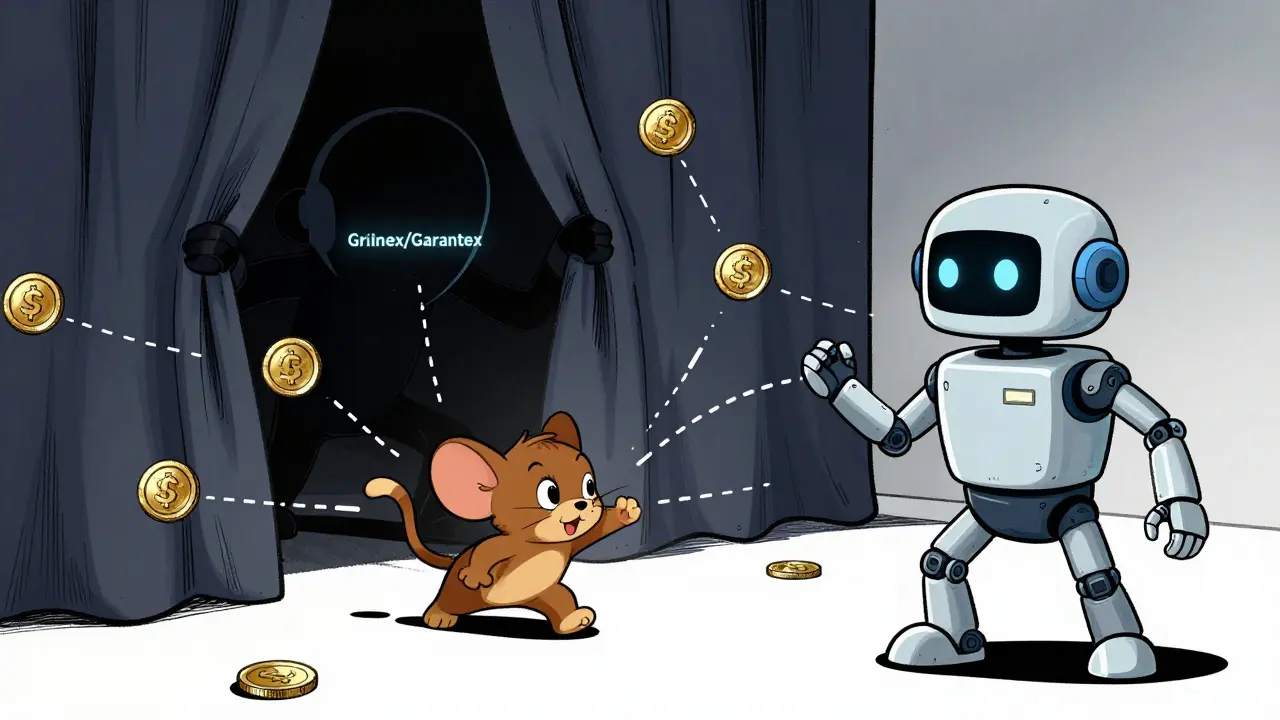
One of the most fascinating aspects of this conflict is the resilience of sanctions-evasion platforms. When one door closes, another opens-often immediately. A prime example occurred in March 2025. Law enforcement agencies, led by the U.S. Secret Service, took down Garantex, a darknet-friendly exchange known for serving sanctioned customers.
But instead of disappearing, the operators created a successor platform called Grinex within days. Grinex explicitly marketed itself as the replacement for Garantex, even transferring customer deposits automatically. They introduced a new token, A7A5, backed by the Russian ruble and issued by a Kyrgyzstani firm, to help users regain access to their accounts. Since its creation, Grinex has facilitated billions of dollars in transactions.
This illustrates a critical challenge for regulators: decentralized finance (DeFi) and offshore jurisdictions make it hard to permanently shut down these services. However, the cost of using these alternatives is high. Users face higher fees, lower liquidity, and significant security risks. Unlike regulated exchanges, there is no insurance or recourse if Grinex gets hacked or shuts down again.
What This Means for Everyday Iranian Users
So, what does this mean for you if you live in Iran and want to buy Bitcoin or Ethereum? The path is narrow and fraught with risk.
- Mainstream Exchanges Are Off-Limits: You cannot simply sign up for Coinbase or Binance. Their KYC (Know Your Customer) requirements require valid identification from non-sanctioned countries. Attempting to use fake documents can lead to permanent bans and loss of funds.
- Peer-to-Peer (P2P) Risks: Many Iranians turn to P2P trading platforms. While these allow direct transfers between users, they are increasingly monitored. If you receive funds from a wallet that has touched a sanctioned address, your own wallet can get flagged. This creates a "contagion" effect where clean funds become tainted.
- Privacy Coins Are Not a Silver Bullet: Moving to Monero or Zcash seems logical, but many exchanges delisted these coins due to regulatory pressure. Furthermore, converting privacy coins back to fiat currency is extremely difficult without triggering red flags at the receiving bank.
- Decentralized Exchanges (DEXs): Platforms like Uniswap do not require KYC. However, you still need to bridge funds onto the Ethereum or other chains. If your source of funds is traced to a sanctioned entity, the assets can still be frozen if they interact with any centralized service later.
The practical impact is a reduction in accessibility. Iranian users are forced to pay premiums to middlemen who specialize in navigating these gray areas. These "crypto brokers" charge high fees for their expertise and risk, making cryptocurrency trading expensive and inefficient compared to pre-sanction eras.
Future Outlook: AI and Blockchain Analytics
Looking ahead to the rest of 2026 and beyond, the gap between evasion and detection is closing. Industry observers predict a continued escalation in both sides' sophistication. On the enforcement side, artificial intelligence and machine learning are being integrated into transaction pattern analysis. These tools can detect subtle behaviors-like "smurfing" (breaking large transactions into small ones) or complex mixing patterns-that human analysts might miss.
On the evasion side, we are seeing more innovation in cross-chain bridges and decentralized identity protocols. However, the fundamental tension remains: blockchain is transparent by design. Every time a sanctioned user tries to "clean" their crypto by swapping it multiple times, they leave more data points for OFAC to analyze.
For businesses and developers, the takeaway is clear. Implementing comprehensive risk-based sanctions compliance controls is no longer optional. Real-time screening of wallet addresses against the SDN list is the bare minimum. Companies that fail to adapt will face the same fate as ShapeShift: heavy fines and reputational damage. For individual users in sanctioned regions, the era of easy, anonymous crypto access is over. The digital border is now drawn in code, and it is being enforced with unprecedented precision.
Can I use a VPN to access US-based crypto exchanges from Iran?
Using a VPN to hide your IP address is not enough. Major exchanges perform Know Your Customer (KYC) checks that require government-issued ID. If your ID shows you are from Iran, your account will be rejected or banned. Additionally, blockchain analytics can trace wallet activity back to sanctioned entities regardless of your IP address.
What happens if my wallet interacts with a sanctioned address?
If your wallet receives funds from an address on the OFAC SDN list, your wallet may become "tainted." Centralized exchanges often freeze accounts associated with tainted wallets to avoid secondary sanctions. This can result in the permanent loss of your funds and potential legal issues if you attempt to withdraw them.
Are privacy coins like Monero safe from OFAC tracking?
While privacy coins offer better anonymity than Bitcoin or Ethereum, they are not immune to scrutiny. Many centralized exchanges have delisted privacy coins due to regulatory pressure. Furthermore, if you try to convert privacy coins into fiat currency or other assets through a regulated channel, the transaction will likely be flagged and blocked.
Why did ShapeShift get fined in 2025?
ShapeShift AG was fined $750,000 in September 2025 for allowing users from sanctioned countries, including Iran, to exchange approximately $12.5 million in cryptocurrency. This case set a precedent that protocols and exchanges must implement robust sanctions screening, even if they operate as non-custodial platforms.
What is the Grinex exchange?
Grinex is a cryptocurrency exchange created in March 2025 as a successor to Garantex after law enforcement action against the latter. It was designed to continue serving sanctioned customers by transferring deposits and using a new token (A7A5) to restore account access. It operates in a legal gray area and carries high risks for users.
It is truly fascinating how the digital realm, once promised as a borderless utopia of financial freedom, has become the most heavily policed frontier in modern history. The meticulous tracking of wallet addresses by OFAC demonstrates an unprecedented level of surveillance that extends far beyond traditional banking systems. One must consider the ethical implications of such pervasive monitoring on individual privacy rights. 🧐
The article correctly identifies that simple geo-blocking is obsolete; the real barrier is the immutable ledger itself. Every transaction leaves a permanent footprint, effectively turning every user into a potential target for scrutiny if they interact with sanctioned entities. This creates a chilling effect on innovation and legitimate trade alike. 😟
I find it rather ironic that technology designed to liberate people from state control is now being used to enforce state control with greater precision than ever before. The case of ShapeShift serves as a stark warning to all developers and entrepreneurs operating in this space. Compliance is no longer optional; it is existential. 📉
About time someone wrote about this reality check. These sanctions are necessary and effective because they cut off the funding for terrorist organizations like the IRGC-QF. You think I care about some guy in Tehran trying to buy Bitcoin? Absolutely not. My priority is national security and stopping money from flowing to enemies of the United States. 💪
The fact that exchanges like Binance and Coinbase are stepping up their game is exactly what we need. They should be thanking OFAC for making them comply or face ruin. If you are involved in shady dealings, you deserve to have your assets frozen. It is that simple. No excuses. 🇺🇸
People complaining about 'privacy' here are likely just criminals looking for loopholes. Privacy coins are tools for laundering, nothing more. We need stricter laws, not looser ones. Keep these bad actors out of our financial system.
oh wow, another day another way the gov tries to control everything lol. its kinda funny how they think they can stop money flow when its all digital now. but yeah, i guess if you live in iran you are basically stuck unless you want to risk losing everything. which is pretty harsh tbh.
i mean, who even reads these long articles anymore? just skimmed it and saw 'sanctions' and 'bitcoin'. sounds like a mess. the whole idea of 'shadow banking' is just people doing what they gotta do to survive. its not about terrorism, its about inflation killing your savings at home. but sure, blame the crypto users instead of the central banks messing up the economy again. 🙄
also, grinx replacing garantex so fast? thats just capitalism working as intended. if there is a profit to be made, someone will take the risk. regulators are always one step behind, always chasing their tails.
This is a critical analysis of the current geopolitical landscape affecting cryptocurrency adoption. It is imperative that we recognize the sophistication of modern enforcement mechanisms. The transition from IP-based blocking to address-level screening represents a paradigm shift in regulatory compliance. 🚀
We must applaud the diligence of exchanges like Kraken and Coinbase for implementing robust KYC/AML protocols. Their actions protect the integrity of the global financial system. However, we must also acknowledge the humanitarian impact on ordinary citizens who are caught in the crossfire of international politics. There must be a balance between security and accessibility.
For those interested in navigating this complex environment, education is key. Understanding the SDN list and blockchain analytics is no longer niche knowledge; it is essential literacy. Let us continue to push for transparent and fair regulations that do not punish the innocent while targeting the guilty. Stay informed and stay compliant! 💼
The article provides a comprehensive overview of the evolving regulatory framework surrounding Iranian cryptocurrency access. It is evident that the reliance on centralized exchanges has created significant vulnerabilities for users in sanctioned jurisdictions. The implementation of wallet screening technologies by major platforms underscores the inevitability of compliance measures.
Furthermore, the distinction between peer-to-peer trading risks and decentralized exchange limitations highlights the complexity of maintaining anonymity in a transparent ledger system. Users must exercise extreme caution when engaging in any form of cryptocurrency transaction that involves funds originating from or destined for sanctioned entities. The legal ramifications are severe and well-documented.
In conclusion, the era of effortless cross-border transactions via cryptocurrency is effectively over for residents of sanctioned countries. Adaptation to these new realities is necessary for anyone seeking to participate in the digital economy without facing legal repercussions.
My heart breaks reading this. Imagine being unable to send money to your family abroad or save for your future because of rules you had no part in creating. It is absolutely devastating for millions of hardworking people who just want to survive. 😢
The technical details are scary, yes, but the human cost is what really hits home. These aren't just 'wallets' or 'addresses'; they are livelihoods. When OFAC freezes accounts, they are freezing hope. The mention of the $600 million shadow network feels like a drop in the ocean compared to the daily struggles of regular Iranians trying to pay for medicine or food.
We need empathy, not just enforcement. Technology should bridge gaps, not widen them. It is tragic that innovation in blockchain has been co-opted primarily as a tool for exclusion rather than inclusion. Please remember the humans behind the data points. ❤️
This whole situation is a total disaster for anyone trying to use crypto for what it was supposed to be: freedom. But hey, surprise surprise, the government found a way to crush it. Again.
I tried using a VPN once, thought I was slick, right? Wrong. Got banned within hours. Who knew? Now everyone knows that 'decentralized' is just a buzzword until the feds show up. The Grinex thing is wild though. It’s like whack-a-mole but with billions of dollars. You smash one, two more pop up. It’s entertaining in a dark, dystopian way.
But seriously, if you’re in Iran, good luck. You’re playing a game where the house always wins and the cards are stacked against you. Just don’t say I didn’t warn you about the ‘tainted’ wallets. One wrong move and poof, your life savings are gone. Classic.
Let us be clear about what is actually happening here. This is not merely about 'compliance' or 'security.' This is about hegemony. The United States is using its control over the dollar and the SWIFT system to extend its reach into the digital domain. By forcing exchanges to comply with OFAC sanctions, they are ensuring that no alternative financial system can emerge that challenges American dominance. 🌍
The targeting of Iranian citizens is a pretext for broader strategic goals. The mention of 'terrorist financing' is often a convenient narrative to justify economic warfare. Meanwhile, the deep state continues to monitor every transaction, building a database of global financial behavior. The transparency of the blockchain is not a feature; it is a trap set by the architects of the current monetary order.
We must remain vigilant. The next step will likely be Central Bank Digital Currencies (CBDCs) that allow for even greater control. Do not let them normalize this surveillance. Question the motives behind these 'necessary' restrictions.
i mean, its kinda crazy how much power these tech companies have now. like, binance decides who gets to trade and who doesnt. its basically private governance. not sure if thats better or worse than govt rules, but its definitely weird.
also, the part about privacy coins being delisted makes sense from their perspective, i guess. they dont wanna deal with the heat. but it sucks for people who just want some privacy. maybe we need better tech that protects privacy without hiding crimes? idk, im not a dev. just seems like a lose-lose for normal folks.
anyway, thanks for sharing this info. its helpful to know what the risks are. gonna stick to my local bank for now lol. too risky for me.
lol u guys r still talking about 'freedom' in crypto? wake up. the matrix is watching. 👁️
every tx is tracked, every wallet is tagged. OFAC got ur number. u think monero saves u? nah, they just delisted it cause its annoying for them. its all about control. the elites want u poor and dependent on their fiat system. crypto was supposed to break the chains but now its just another tool for surveillance capitalism.
shape shift fine? pfft. small price to pay for the empire. they will keep squeezing till theres nothing left. join the resistance or stay silent. ur choice. 🤡💸