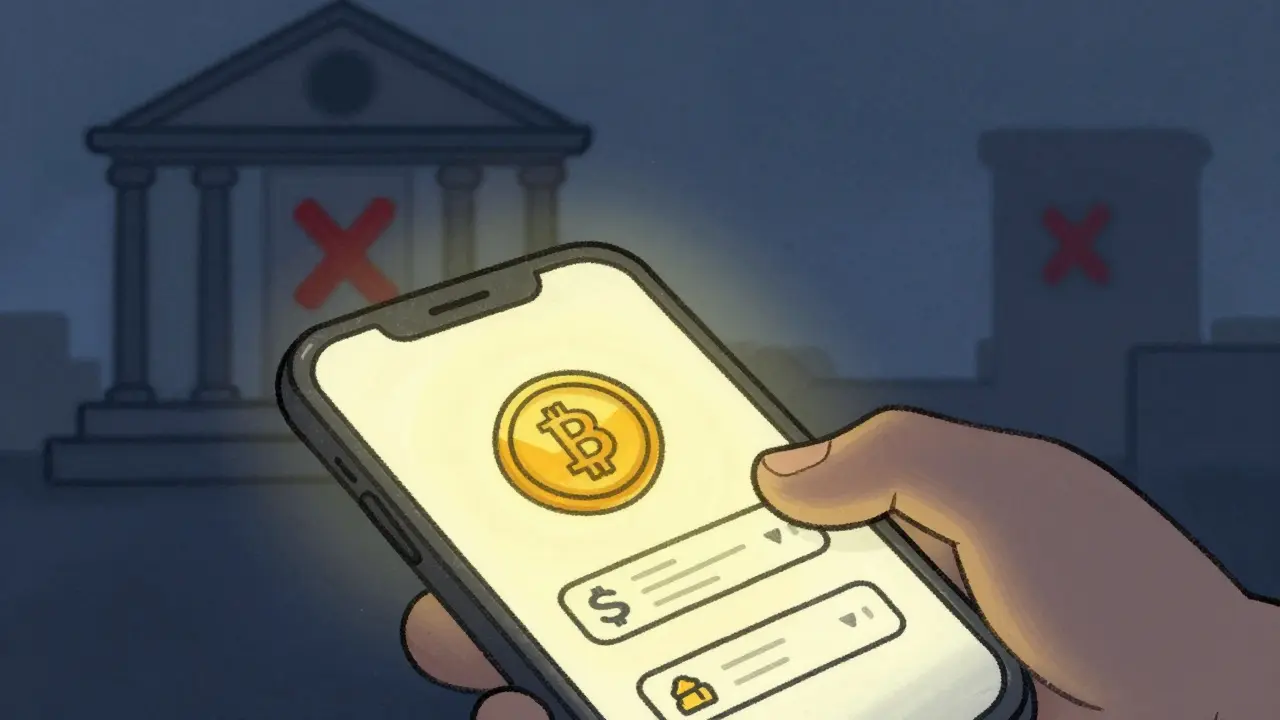
The Central Bank of Egypt (CBE) introduced Law No. 194 of 2020, which bans issuing, trading, or promoting digital currencies without prior approval. But here’s the catch: the law doesn’t explicitly say cryptocurrency is illegal. It just requires licenses that the CBE hasn’t issued for any exchange. This creates a legal gray zone. Banks refuse to process crypto-related transactions, so Egyptians have to find workarounds.
Despite these restrictions, Egypt’s crypto market is growing fast. By 2025, it’s expected to hit $690 million in revenue with 11.3 million users. That’s a 9.72% penetration rate. People aren’t using centralized exchanges-they’re trading directly with each other through P2P platforms.
So how does P2P trading work? It’s simple: buyers and sellers connect directly. No bank intermediaries. For example, someone in Cairo might sell Bitcoin for Egyptian pounds (EGP) via mobile money. Another person buys it using Vodafone Cash. The platform handles the escrow, holding the crypto until payment is confirmed. This bypasses banks entirely.
Bybit is a global cryptocurrency exchange that offers P2P trading in Egypt with zero transaction fees and Arabic language support. It supports over 1,700 cryptocurrencies and provides Shariah-compliant trading options for Muslim users. The platform also uses cold storage for security and allows deposits via bank transfers, credit cards, and mobile money.
Binance is another major player. It allows EGP deposits via bank transfers and mobile money. While it charges a 0.1% trading fee, it offers more liquidity and faster transaction speeds. Both platforms provide two-factor authentication and cold storage to protect user funds.
Security is critical because there’s no legal protection. If a platform gets hacked or freezes accounts due to regulatory pressure, traders lose money with no recourse. Most Egyptians avoid keeping large sums on exchanges. Instead, they use hardware wallets for long-term storage.
Payment methods vary. Bank transfers are common, but banks often block crypto-related transactions. Mobile money services like Vodafone Cash and Orange Money are popular. Some traders even meet in person for cash transactions. This flexibility is why P2P works-it adapts to Egypt’s banking restrictions.
Risks are real. In 2024, several Egyptian traders reported frozen accounts on international platforms after new regulatory rumors. Banks sometimes flag crypto-related transactions as suspicious, leading to account freezes. Customer support from foreign platforms can be slow, especially during crises.
Looking ahead, the Egyptian government is exploring blockchain for land registration and digital IDs. But for cryptocurrency itself, the CBE remains cautious. Experts believe P2P trading will continue to dominate until clear regulations emerge. Until then, Egyptians will keep finding ways to trade crypto underground.
| Platform | Supported Payment Methods | Fees | Cryptocurrency Selection | Security Features |
|---|---|---|---|---|
| Bybit | Bank transfers, mobile money, cash | Zero fees for P2P trades | Over 1,700 cryptocurrencies | Two-factor authentication, cold storage |
| Binance | Bank transfers, mobile money | 0.1% trading fee | Over 500 cryptocurrencies | Two-factor authentication, cold storage |
Is cryptocurrency illegal in Egypt?
No, cryptocurrency itself isn’t illegal in Egypt. However, the Central Bank of Egypt’s Law No. 194 of 2020 prohibits issuing, trading, or promoting digital currencies without prior approval. Since no licenses have been issued, most trading happens in a gray area. While not explicitly banned, it’s technically non-compliant with current regulations.
How do Egyptians bypass banking restrictions for crypto?
They use peer-to-peer (P2P) platforms like Bybit and Binance. These platforms allow direct trades between users, using payment methods banks don’t associate with crypto. Mobile money services like Vodafone Cash, cash transactions, and sometimes even encrypted messaging apps for coordination help avoid bank scrutiny. Banks often block crypto transactions, but P2P traders find ways to move funds without triggering bank filters.
What are the safest P2P platforms for Egyptian traders?
Bybit and Binance are the most trusted. Bybit offers zero fees for P2P trades, Arabic support, and Shariah-compliant options. Binance has higher liquidity and faster transactions. Both use two-factor authentication and cold storage for security. Traders avoid platforms without strong security features since there’s no legal recourse if funds are lost.
What risks come with underground crypto trading in Egypt?
The biggest risk is regulatory crackdowns. In 2024, some traders had accounts frozen when banks flagged transactions. Banks may block funds or freeze accounts entirely. There’s also no legal protection for disputes-unlike regulated markets. Traders must constantly monitor regulatory changes and use secure payment methods to avoid scams.
How do payment methods like mobile money work for crypto trades?
Mobile money services like Vodafone Cash or Orange Money allow instant transfers without bank involvement. Traders agree on a trade, then send EGP through mobile money. The P2P platform holds the crypto in escrow until payment confirmation. This avoids bank scrutiny since mobile money transactions aren’t flagged as crypto-related. It’s fast and works even when banks block crypto transactions.
This 'gray area' nonsense is dangerous. The Central Bank's law is crystal clear-any crypto activity without a license is illegal. Period. Banks refusing transactions isn't a workaround-it's the law. Stop deluding yourselves.
Oh sure, 'gray area'-classic government move to avoid responsibility. They'll ban it when they're ready. Trust me, I've seen this before.
Honestly, banks are just slow to adapt. Mobile money like Vodafone Cash is the real solution here. But yeah, security is still a huge concern. Just saying.
This is actually really cool! P2P trading is the future, especially where banks are stuck. Mobile money is making it possible for everyday people to participate. Keep pushing forward!
It's great to see people finding ways to work around the restrictions. P2P platforms like Bybit are making it safer. Let's hope regulations catch up soon.
Conspiracy theories are everywhere 😂. The government isn't hiding anything-it's just trying to protect people. But hey, maybe they're just lazy? 🤷♂️
Mobile money? That's not safe. People get scammed all the time. You're naive. Banks block crypto for a reason. Stop being so trusting.
The future is here! 🚀 But let's be real-this is just a temporary fix. Without regulation, it's all chaos. We need structure. 💥
Your comments are alarmingly simplistic. The government's stance is entirely justified. National security is paramount. This 'P2P' activity is a threat to economic stability. I suggest you reconsider your position.
I think it's important to acknowledge the challenges here. While P2P trading offers solutions, there are real risks. Let's stay informed and cautious. It's a complex situation, but there's hope for progress.
Totally agree! 🔥 Safety first, but also embrace innovation. P2P is the way to go for now. Keep pushing for better solutions! 💪
This is such a dope situation! The P2P movement is like, totally changing the game for Egyptians. Mobile money is the bomb. But yeah, security is a thing. Let's keep it real and stay safe. 🌈
P2P is the only way forward.
Let me elucidate the intricacies of this situation. The Central Bank of Egypt's Law No. 194 of 2020, while prohibiting the issuance, trading, or promotion of digital currencies without prior approval, does not explicitly criminalize cryptocurrency per se. This creates a regulatory limbo where banks, as prudent institutions, refuse to process transactions related to crypto, thus forcing individuals into peer-to-peer platforms. However, the reality is that these platforms, while circumventing banking restrictions, introduce significant risks such as lack of legal recourse in case of fraud or platform failure. Moreover, the reliance on mobile money services like Vodafone Cash introduces additional vulnerabilities, as these systems are not immune to technical glitches or security breaches. Furthermore, the global nature of cryptocurrency markets means that Egyptian traders are subject to international regulatory pressures that can lead to sudden account freezes or asset seizures. It is imperative for users to understand that while P2P trading may offer a temporary solution, it is not a sustainable or secure method for conducting financial transactions in the long term. The government's cautious approach, though frustrating for some, is actually a necessary measure to protect the broader economy from the volatility and potential illicit activities associated with unregulated crypto markets. Additionally, the lack of clear regulations leaves traders in a precarious position where they must navigate a complex web of unspoken rules and potential legal consequences. The reliance on foreign platforms like Bybit and Binance also raises concerns about data privacy and the potential for foreign interference in domestic financial systems. It is also worth noting that the rapid growth of the crypto market in Egypt, projected to reach $690 million by 2025, is happening despite the absence of a clear regulatory framework, which could lead to unforeseen consequences. The government's current stance appears to be one of deliberate ambiguity, perhaps to avoid making a hasty decision that could either stifle innovation or expose the economy to significant risks. In the absence of clear guidelines, it is the responsibility of individual traders to exercise extreme caution and seek professional advice before engaging in any crypto-related activities. Furthermore, the use of mobile money for crypto transactions may seem convenient, but it also opens the door to increased surveillance by both government and private entities, which could have serious implications for personal freedoms. Ultimately, the situation in Egypt regarding cryptocurrency is a microcosm of the global struggle to balance innovation with regulation, and until a comprehensive framework is established, the risks will continue to outweigh the benefits for most participants.
Banks are obsolete? Nah, they're just adapting slowly. Let's work together to find solutions! 🌟
Crypto in Egypt is like a puzzle. Banks are stuck, but P2P is the key. Not sure if it's the right way, but it's working for now.
You're absolutely right about the regulatory limbo. But let's think deeper. Is this really about legality, or is it about power? The government fears losing control. They don't want people to have financial autonomy. This is why they're dragging their feet. It's not about safety-it's about control. And until we address that, P2P will keep being a band-aid solution. But hey, maybe I'm overthinking it. 😅