Imagine trying to buy a coffee with Bitcoin. The transaction fee costs more than the latte itself. It’s a frustrating reality for many crypto users on Ethereum Mainnet, where gas fees can spike unpredictably. Now, picture an alternative where that same swap costs fractions of a cent. That is the promise of Honeyswap, a decentralized exchange built specifically for low-cost trading on the Gnosis Chain.
If you are looking for high-frequency trading or massive liquidity pools like those found on Uniswap, Honeyswap might not be your first stop. But if you care about keeping your money instead of paying network validators, this platform deserves a closer look. Let’s break down what Honeyswap actually offers, who it serves, and whether it fits into your DeFi strategy in 2026.
What Exactly Is Honeyswap?
Honeyswap launched in September 2020 as a fork of Uniswap V2. Instead of building from scratch, the developers took the proven codebase of Uniswap and deployed it on the Gnosis Chain (formerly known as xDai Chain). This choice was strategic. Ethereum is secure but slow and expensive during peak times. Gnosis Chain is fast, stable, and incredibly cheap to use because it uses a Proof-of-Stake consensus mechanism with a fixed block reward structure.
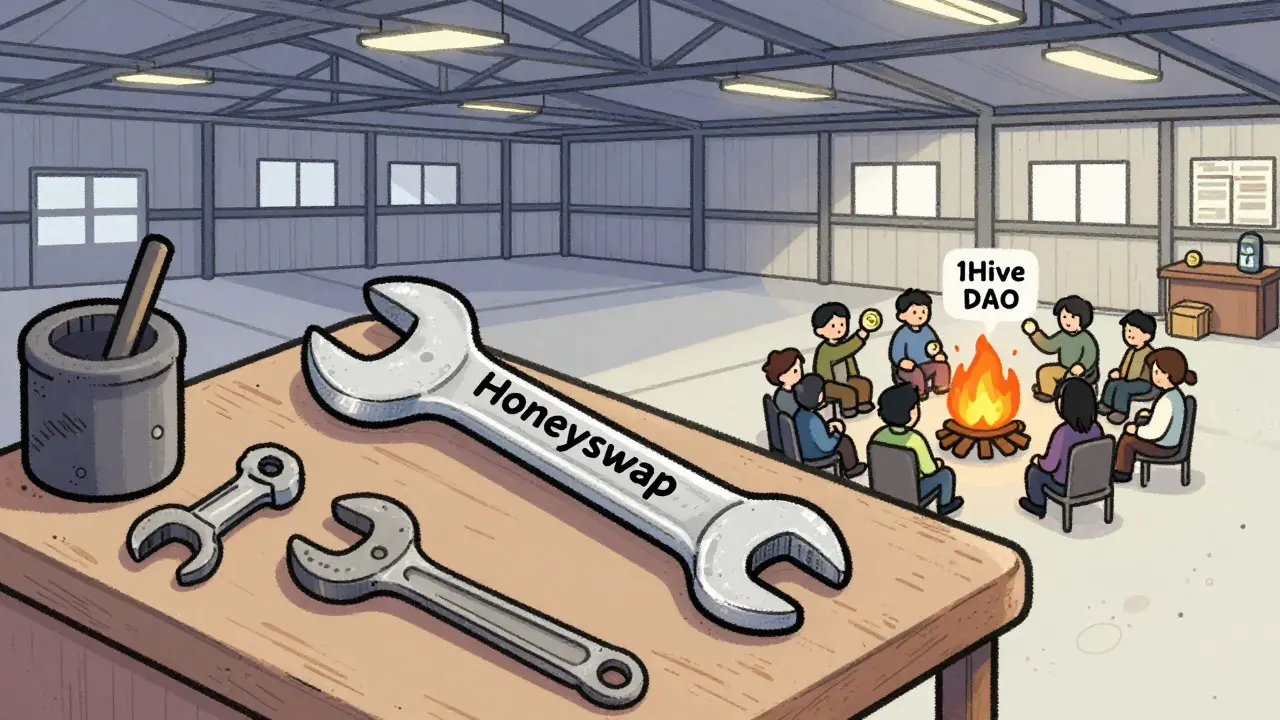
The platform is governed by the 1Hive DAO, a decentralized autonomous organization that manages the protocol through the HNY token. This means no single company controls Honeyswap. Instead, token holders vote on upgrades, fee structures, and future developments. It operates across multiple EVM-compatible networks now, including Polygon, with plans to expand further. The core idea is simple: provide a familiar Uniswap-like experience without the wallet-draining gas fees.
How Does Honeyswap Work? The Fee Structure Explained
Understanding the economics of a DEX is crucial before you deposit funds. Honeyswap charges a standard 0.30% fee on every swap. Here is exactly where that money goes:
- 0.25% goes directly to liquidity providers (LPs). These are the people providing the assets in the pool so you can trade against them.
- 0.05% goes to the protocol fund. This supports development and operations.
There is a twist, though. A portion of these fees is allocated to buy back and burn or distribute tokens. Specifically, 1/12 of the swap fees support the global Honey (HNY) token, the governance and utility token of the 1Hive ecosystem, while another 1/12 supports the local Comb token on specific chains. This dual-token model attempts to balance global community incentives with local chain activity.
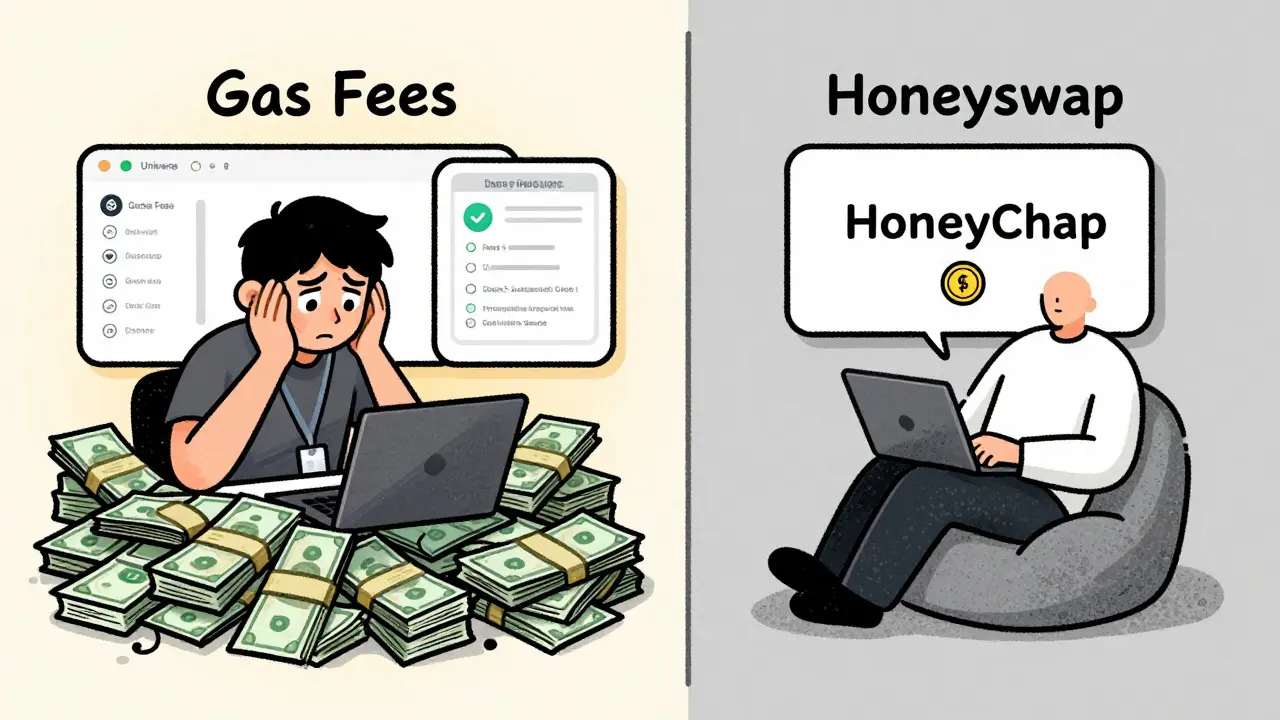
For you, the trader, this means your cost per transaction is predictable. You pay 0.30%, regardless of network congestion. On Ethereum, you might pay 0.30% plus $20 in gas. On Honeyswap via Gnosis Chain, you pay 0.30% plus roughly $0.01 in gas. That difference adds up quickly if you are active.
Liquidity and Trading Volume: The Reality Check
Here is where we need to be honest. Honeyswap is not a market mover. As of mid-2026, its Total Value Locked (TVL) sits around $1.04 million. To put that in perspective, Uniswap often holds over $5 billion in TVL. Honeyswap handles approximately $31,000 to $32,000 in daily trading volume.
| Metric | Honeyswap | Uniswap (Estimate) |
|---|---|---|
| Total Value Locked (TVL) | ~$1.04 Million | $5+ Billion |
| Daily Volume | ~$32,000 | $Billions |
| Average Gas Fee | < $0.01 | $5 - $50+ |
| Supported Chains | Gnosis, Polygon | Ethereum, Arbitrum, Optimism, Base, etc. |
This low volume has pros and cons. The pro? Slippage is manageable for small trades. If you are swapping $100 worth of tokens, you will likely get a fair price. The con? If you try to move $10,000 in one go, you might face slippage above 2%. There simply aren’t enough deep liquidity pools to absorb large orders without moving the price significantly. Honeyswap currently supports about 26 coins and 40 trading pairs. It is niche, not broad.
User Experience and Security
Security is non-negotiable in DeFi. Honeyswap’s smart contracts have been audited by CertiK, a leading blockchain security firm, which provides a baseline of trust. Since it is a fork of Uniswap V2, it inherits the battle-tested architecture of one of the most used protocols in history. However, always remember that in DeFi, you are responsible for your own keys. If you connect your wallet to a phishing site pretending to be Honeyswap, no audit will save you.
In terms of user experience, Honeyswap is straightforward. You connect a compatible wallet like MetaMask, WalletConnect, or Fortmatic. The interface is clean and resembles other Uniswap forks. You select your input token, output token, and approve the transaction. It is not flashy, but it works. Documentation is available, though some users find it less beginner-friendly than major competitors. Support comes primarily through community channels like Discord, with response times averaging 12-24 hours. Don’t expect a customer service hotline.
Who Should Use Honeyswap?
Honeyswap isn’t for everyone. Here is a quick guide to help you decide if it fits your needs:
- Use Honeyswap if: You want to make micro-transactions, test new strategies without burning cash on gas, or specifically hold assets on the Gnosis Chain. It is also ideal for users who prioritize privacy and decentralization over convenience.
- Avoid Honeyswap if: You are a high-volume trader, need deep liquidity for large positions, or require instant execution with zero slippage. For those needs, stick to larger DEXs on Ethereum Layer 2s or centralized exchanges.
Future Outlook: Can Honeyswap Grow?
The platform is expanding. Plans include integration with Arbitrum and other EVM chains. The 1Hive DAO continues to push for broader adoption. However, challenges remain. With only ~$20,000 in annual protocol revenue, funding professional development teams is difficult. The project relies heavily on community passion and volunteer effort. Industry analysts suggest that for smaller DEXs to survive, they need to either capture a unique niche (which Honeyswap does on Gnosis) or innovate significantly. Regulatory pressures in the EU and US could also impact how DEXs operate, though non-custodial platforms like Honeyswap generally face fewer immediate hurdles than centralized ones.
Final Verdict
Honeyswap fills a specific gap in the crypto ecosystem. It proves that you don’t need to pay exorbitant fees to participate in DeFi. If you value low costs and community governance over massive scale, it is a solid option. Just go in with eyes open: the liquidity is thin, and the volume is modest. Treat it as a specialized tool in your belt, not your entire toolbox.
Is Honeyswap safe to use?
Yes, Honeyswap is considered safe due to its audited smart contracts by CertiK and its foundation on the battle-tested Uniswap V2 codebase. However, as with any decentralized exchange, users must ensure they connect their wallets to the official website to avoid phishing scams. The platform is non-custodial, meaning you retain control of your funds until the moment of the swap.
What is the minimum amount to trade on Honeyswap?
There is no strict minimum set by the protocol, but practically, you should start with amounts large enough to cover the tiny gas fee on Gnosis Chain (usually less than $0.01). Because of lower liquidity, very small trades might result in poor pricing due to the fixed fee structure relative to the trade size. Trades under $10 are generally discouraged unless you are testing the interface.
How do I get Gnosis Chain (xDai) to use Honeyswap?
You can acquire Gnosis Chain native tokens (GNO or xDai) by using a bridge. The most common method is using the official Gnosis Bridge to transfer ERC-20 tokens from Ethereum Mainnet to Gnosis Chain. Alternatively, you can buy supported tokens on other exchanges and withdraw them to a Gnosis Chain address if the exchange supports it.
Does Honeyswap charge hidden fees?
No, Honeyswap is transparent about its fees. The standard swap fee is 0.30%. Additionally, you pay the network gas fee, which on Gnosis Chain is negligible. Always check the "Slippage Tolerance" setting before confirming large trades, as low liquidity can cause the final execution price to differ slightly from the estimated price.
Can I earn rewards by providing liquidity on Honeyswap?
Yes, liquidity providers earn 0.25% of the swap fees generated by their pool. Additionally, depending on the specific pool and current incentives, you may earn Comb tokens or other rewards. However, be aware of Impermanent Loss, a risk inherent to all AMM liquidity provision, especially when token prices diverge significantly.