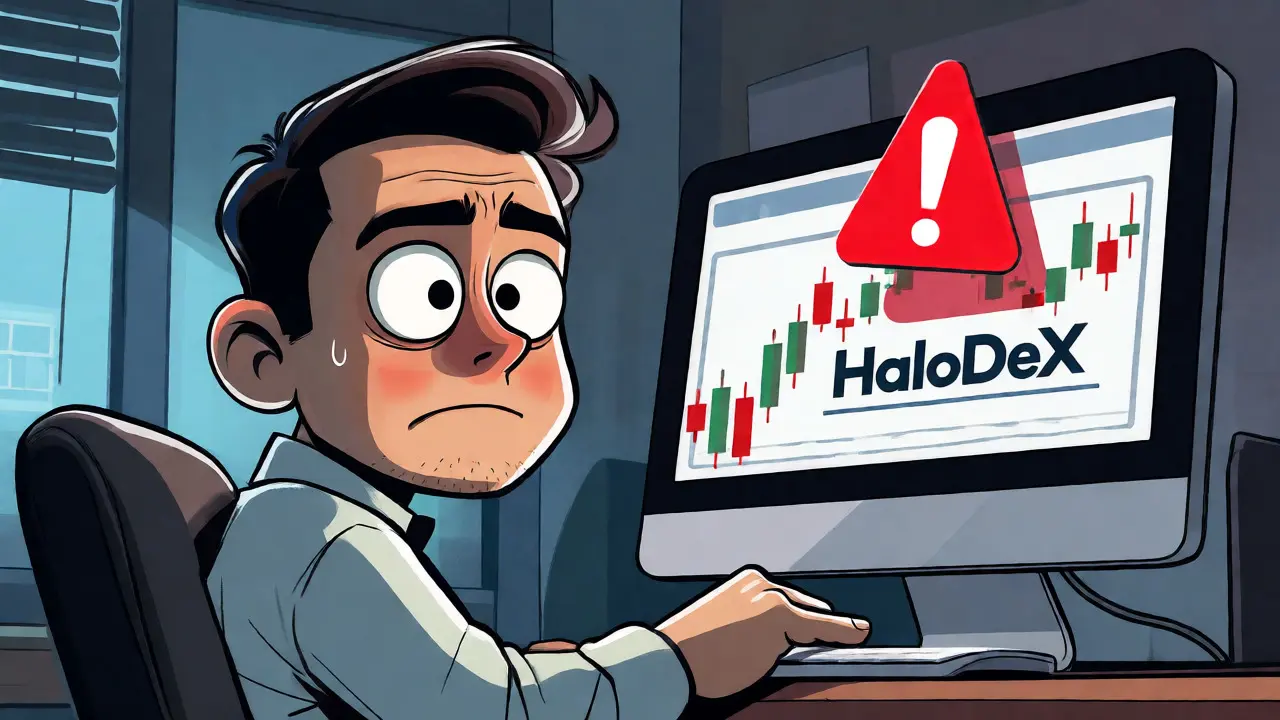
You’re staring at a chart, ready to make a move, and you spot HaloDeX advertising maker fees as low as 0.10%. It sounds tempting, doesn't it? Cheaper trading costs are the holy grail for active traders. But before you transfer your hard-earned Bitcoin or Ethereum into this platform, there is a glaring red flag waving in your face: HaloDeX is listed as "untracked" on major data aggregators like CoinMarketCap. In the crypto world, being untracked isn’t just a technical glitch; it’s often a warning sign of opacity, low liquidity, or potential operational risks. This review cuts through the marketing fluff to tell you exactly what HaloDeX offers, where it falls short compared to giants like Binance or Kraken, and whether those lower fees are worth the extra hassle.
What Exactly Is HaloDeX?
HaloDeX is a centralized cryptocurrency exchange that focuses exclusively on crypto-to-crypto trading pairs. Unlike Coinbase or Kraken, which let you link a bank account and buy Bitcoin with dollars, HaloDeX assumes you already own cryptocurrency. You cannot deposit fiat currency (like USD, EUR, or NZD) directly. This design choice immediately filters out beginners who need an on-ramp from traditional banking. Instead, HaloDeX targets users who already hold assets elsewhere and want to trade one digital coin for another.
The platform operates on a standard order book model, meaning buyers and sellers place limit or market orders that match against each other. While the interface looks functional, it lacks the polished, feature-rich experience found on top-tier exchanges. There is no mobile app for iOS or Android, forcing you to rely entirely on a web browser. For many traders, especially those checking prices on the go, this is a significant inconvenience. The lack of an app suggests a limited development budget or a very small user base, neither of which inspires confidence in long-term stability.
Fee Structure: Are They Actually Cheap?
Let’s talk numbers, because this is likely why you clicked on this review. HaloDeX uses a maker-taker fee model, which is standard across the industry but implemented here with specific rates:
- Taker Fee: 0.20% per trade. This applies when you execute a market order that removes liquidity from the book.
- Maker Fee: 0.10% per trade. This applies when you place a limit order that adds liquidity and waits to be filled.
At first glance, a 0.10% maker fee looks competitive. However, you must consider the hidden costs. Because HaloDeX does not support fiat deposits, you have to buy your crypto on another exchange (paying their fees) and then pay network gas fees to withdraw it to HaloDeX. If you are trading small amounts, these external costs can easily outweigh the savings from the lower trading fee. Furthermore, while HaloDeX claims no additional withdrawal fees beyond blockchain network costs, the reliability of their withdrawal processing is questionable due to reported slow customer support responses.
| Feature | HaloDeX | Binance/Kraken | Coinbase |
|---|---|---|---|
| Fiat On-Ramp | No (Crypto only) | Yes | Yes |
| Mobile App | No | Yes | Yes |
| Volume Status | Untracked | Tracked & Verified | Tracked & Verified |
| Regulatory License | Unknown/None cited | Multiple Jurisdictions | US Regulated |
| User Reviews | Negligible | Thousands | Thousands |

The "Untracked" Problem: Why Volume Matters
This is the most critical section of this review. As of late 2025, HaloDeX maintains an "untracked" status on CoinMarketCap. What does this mean for you? It means CoinMarketCap does not verify HaloDeX’s trading volume. Usually, this happens for two reasons: either the exchange has such low volume that it doesn’t meet reporting standards, or it fails to provide transparent data required by aggregators.
In the post-FTX era, transparency is non-negotiable. When an exchange is untracked, you cannot see if the liquidity is real. You might see a price for Token X on HaloDeX, but if there are no actual buyers or sellers, you could get stuck holding an asset you can’t sell without moving it elsewhere. Established platforms like Bybit or OKX process billions in monthly volume, ensuring that when you click "sell," someone is there to buy. With HaloDeX, you are entering a thin market. Slippage-the difference between the expected price and the executed price-can be significantly higher, eating into your profits.
Security and Trust: A Due Diligence Warning
There is virtually no independent expert analysis of HaloDeX. Major crypto news outlets like CoinDesk or Cointelegraph haven’t covered it. More importantly, there are almost zero user reviews on Trustpilot. Compare this to Binance, which has over 18,000 reviews, or even newer competitors with hundreds of comments. The silence is deafening.
Reddit discussions about HaloDeX are sparse, with fewer than 20 comments across all relevant subreddits. One notable complaint mentions a 72-hour wait for customer support regarding a withdrawal issue. In crypto, time is money. If your funds are stuck for three days while the market crashes, that delay alone could cost you more than any fee savings. Furthermore, there is no public evidence of HaloDeX complying with recent regulatory frameworks like the EU’s MiCA regulations or US SEC transparency mandates. Without proof-of-reserves or clear licensing, your assets carry a higher counterparty risk.

Who Should (and Should Not) Use HaloDeX?
Despite the warnings, is there a case for using HaloDeX? Yes, but it’s narrow.
You might consider HaloDeX if:
- You are an experienced trader who already holds crypto in a self-custody wallet.
- You are looking for obscure altcoins that aren’t listed on major exchanges.
- You understand the risks of untracked volume and are willing to test with small amounts.
You should avoid HaloDeX if:
- You are new to crypto and need to buy coins with cash.
- You value customer support and quick resolution times.
- You require regulatory protection or insurance on your holdings.
- You trade large volumes where slippage matters.
Final Verdict: Proceed with Caution
HaloDeX offers a low-fee environment for crypto-to-crypto trading, but it comes packaged with significant friction and risk. The lack of fiat integration, absence of a mobile app, and "untracked" volume status create a barrier that most casual investors won’t want to cross. The savings on trading fees are real, but they are offset by the inefficiency of moving funds in and out, plus the potential for poor execution due to low liquidity.
If you are determined to try it, treat it as a speculative playground rather than your primary vault. Deposit only what you can afford to lose or have locked up temporarily. For the vast majority of users, sticking with regulated, high-volume exchanges like Kraken, Coinbase, or Binance remains the safer, more efficient path in 2026.
Can I buy Bitcoin with my credit card on HaloDeX?
No. HaloDeX does not support fiat on-ramps. You cannot use credit cards, bank transfers, or PayPal to purchase cryptocurrency directly on the platform. You must deposit existing cryptocurrency from another wallet or exchange.
Is HaloDeX safe to use?
Safety is difficult to confirm due to its "untracked" status on major data sites and lack of verifiable security audits. There is no public record of major hacks, but also no public proof of reserves or regulatory licensing. Users report slow customer support, which increases operational risk during emergencies.
Does HaloDeX have a mobile app?
No, as of late 2025, HaloDeX does not offer dedicated mobile applications for iOS or Android. Trading must be conducted via a web browser on a desktop or mobile device.
Why is HaloDeX marked as "untracked" on CoinMarketCap?
Exchanges are marked untracked when they fail to meet CoinMarketCap's requirements for volume verification. This usually indicates insufficient trading activity, lack of API access for data verification, or failure to comply with transparency standards regarding anti-wash-trading measures.
Are HaloDeX fees cheaper than Binance?
HaloDeX charges 0.10% for makers and 0.20% for takers. Binance often offers similar or lower rates (starting around 0.10% or less with BNB discounts), plus it has much higher liquidity. When factoring in deposit/withdrawal costs from other exchanges, HaloDeX may not actually be cheaper overall.
It is absolutely laughable that you Americans still fall for these shady offshore exchanges when we have world class infrastructure right here in India, honestly the audacity to trust a platform with zero regulatory oversight while our RBI has been cleaning up the mess for years is beyond me, I mean look at the fees, 0.10% maker fee sounds nice until you realize you are paying network gas fees and depositing from another exchange just to trade obscure altcoins that nobody actually wants, it’s like buying a Ferrari engine and putting it in a bicycle frame, completely pointless and frankly embarrassing for anyone who thinks they are being smart about their portfolio, why bother with HaloDeX when you can just use a proper regulated entity that doesn’t require you to jump through hoops just to move your own money around? It really shows a lack of understanding of how global finance works when you prioritize saving a few cents on fees over the security of knowing your assets aren’t going to disappear into some guy’s pocket in a jurisdiction that doesn’t even care if you exist.
I appreciate the detailed breakdown, especially regarding the liquidity risks; it is crucial for new traders to understand that low volume often equals high slippage.
However, I would gently suggest adding more context about the specific blockchain networks supported, as withdrawal costs vary significantly between Ethereum mainnet and Layer 2 solutions, which could impact the overall cost efficiency mentioned in the review.
Sure, let's ignore the fact that this place has less user reviews than my local gas station has customers in an hour. "Untracked" isn't a badge of honor, it's a red flag the size of Texas. You're trading pennies on the dollar while risking your shirt because you think you found a secret hack. It's not a hack, it's a trap.
omg yes!! i tried them last month and the support took foreverrrr 😩 but the interface was kinda clean?? idk maybe im just desperate for low fees lol
This is super helpful info! :) I’ve been looking for alternatives to Coinbase since their fees are getting ridiculous lately. Do you know if they list any meme coins or mostly major caps? Would love to hear more details on the UI experience too! :)
Oh please, spare me the corporate fear-mongering. Just because CoinMarketCap doesn't track them doesn't mean they're a scam, it means they're independent! Maybe they don't want to pay CMC's extortionate listing fees? This review reads like it was written by someone who gets paid by Binance affiliates to trash competitors. Typical bias.
We must ask ourselves... what is value?
Is it the number on the screen, or the peace of mind knowing your keys are truly yours? If the exchange is untracked, is it even real? Or is it merely a shadow play of numbers?
The silence of the data is deafening, and in that silence, one finds the true nature of risk...
It is morally irresponsible to recommend platforms without clear regulatory compliance. We have seen enough disasters. If you cannot prove reserves, you do not deserve custody of public funds. Period.
Too risky for me. Sticking to Kraken.
I've been digging into the API documentation for HaloDeX because I'm trying to automate some arbitrage strategies, and honestly, the latency seems higher than expected compared to larger venues. It makes me wonder if the matching engine is hosted on shared servers or something similar, which could explain the occasional lag during peak hours. Also, the lack of fiat on-ramp is a huge friction point for anyone not already deep in the crypto ecosystem, effectively limiting their addressable market to existing holders who might be looking to rotate profits rather than enter fresh capital. I'm curious if anyone else has noticed discrepancies in order book depth during volatile periods, because that thin liquidity mentioned in the review definitely feels real when you try to execute anything above $5k in a single block.
You people worry too much about 'regulations' and 'licenses'. In Nigeria, we survive on trust and community. If the fees are low, I will take the risk. Why should I pay Binance 10x more just so they can pretend to be safe? Give me the 0.10% maker fee any day. The system is rigged against small traders anyway.
Great analysis. I think for experienced users who already hold crypto, the lack of app is annoying but manageable via mobile browser. The key takeaway is definitely the liquidity check before moving large sums.
Actually, I disagree with the premise. Low volume does not inherently mean bad execution if you are using limit orders. Market makers will still fill your limits if the price is right. The review assumes everyone uses market orders, which is lazy thinking. If you are disciplined, HaloDeX is fine. If you are lazy, stick to Coinbase.
To add to the technical discussion, the absence of a native mobile app suggests that their development resources are focused entirely on the backend matching engine. This is common for smaller exchanges that rely on web-based interfaces. However, users should verify if the web interface supports two-factor authentication (2FA) via hardware keys, as SMS-based 2FA is vulnerable to SIM swapping attacks, which is a critical security consideration for any centralized exchange holding significant balances.
Basic stuff. Everyone knows small exchanges are risky. No need for a long article to tell us the obvious. Just don't put your life savings there. Simple.
The author presents a fair assessment. One must exercise extreme caution. The lack of verifiable proof-of-reserves is a disqualifying factor for prudent investors. I concur with the recommendation to avoid unless testing with negligible amounts.
Wake up!!!
Why is it untracked??? Because they are hiding the wash trading!!! They are printing fake volume to make it look liquid!!! It’s all connected!!! The same guys who run the banks are behind this!!! Don’t give them your Bitcoin!!! They want to confiscate it!!! The 'untracked' status is a feature, not a bug, it hides the manipulation from the sheep!!! Trust nothing!!! Verify everything!!! But you won't listen, will you??? You’ll just keep feeding the machine!!!