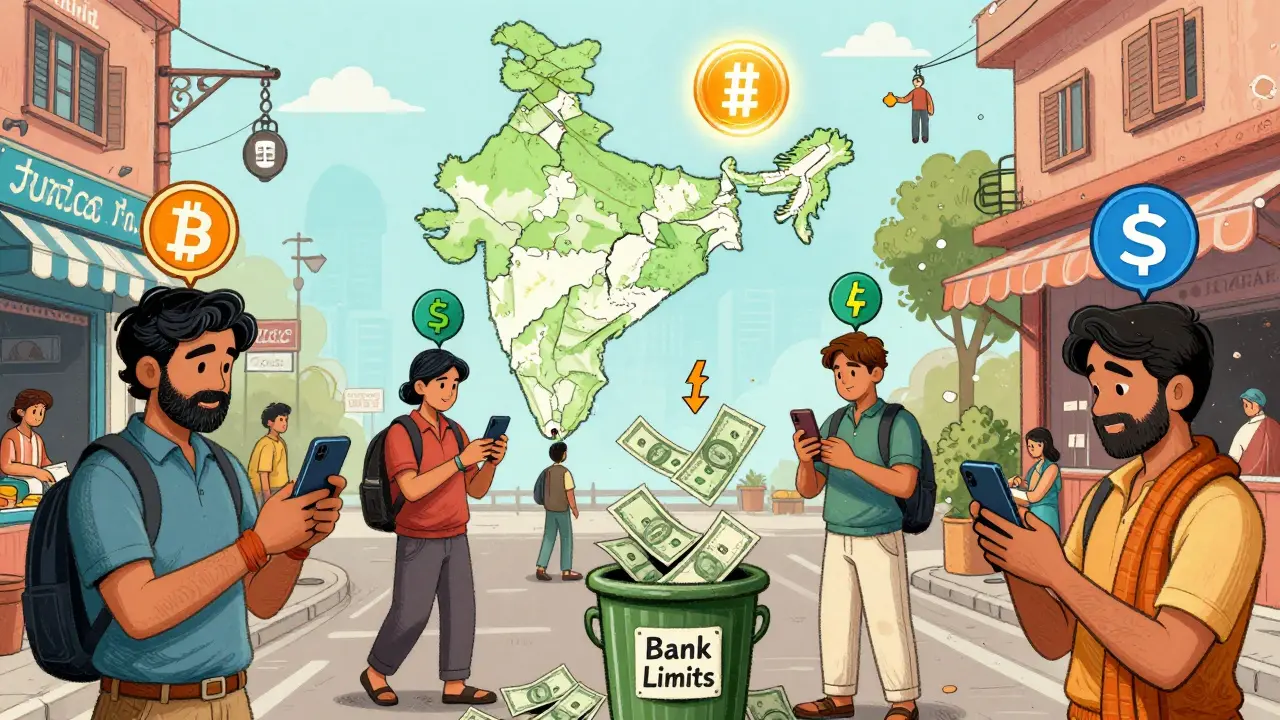
By 2025, cryptocurrency isn’t just a niche experiment-it’s a financial reality for over 1 billion people worldwide. The way countries stack up in global crypto adoption tells a story not just about technology, but about economics, regulation, and survival. Some nations lead because of innovation. Others lead because their citizens have no other choice. The latest data from Chainalysis, ApeX Protocol, and Henley & Partners reveals a world where adoption isn’t uniform-it’s fractured by geography, policy, and need.
India Tops the List, But Not Because of Tech
India holds the number one spot on the Chainalysis Global Crypto Adoption Index 2025 for the third year in a row. That’s not because of fancy apps or government support. It’s because over 100 million Indians use crypto to move money, hedge inflation, and bypass banking limits. The country’s massive population means even low per-person usage adds up to the highest total transaction volume. People buy Bitcoin on local exchanges. They send remittances through crypto bridges. They trade stablecoins to avoid rupee depreciation. This isn’t speculation-it’s necessity.The U.S. Climbs to Second Place: ETFs Changed Everything
The United States jumped from fifth to second in 2025. Why? Spot Bitcoin ETFs. Once institutional investors could buy Bitcoin through traditional brokerage accounts, the flow of capital changed. Billions poured in. Banks started offering crypto custody. Pension funds added Bitcoin to their portfolios. Chainalysis now tracks institutional activity separately-transfers over $1 million-and the U.S. leads there. This isn’t just retail adoption anymore. It’s Wall Street moving in. The regulatory clarity from the SEC, though still imperfect, gave institutions the green light to participate without fear of sudden crackdowns.Small Countries, Huge Adoption: The Per-Capita Leaders
If you look at adoption per person, the leaderboard looks completely different. Ukraine leads, followed by Moldova, Georgia, Jordan, and Hong Kong. These aren’t wealthy nations. Many have unstable currencies, war-torn economies, or weak banking systems. Crypto isn’t a luxury here-it’s a lifeline. Ukrainians use crypto to receive international aid. Moldovans send earnings home from abroad using Bitcoin and USDT. Georgia’s crypto-friendly laws attract remote workers and digital nomads. In these places, owning crypto isn’t trendy-it’s survival.Singapore and UAE: The Crypto Hubs Built on Policy
Singapore tops ApeX Protocol’s "crypto obsession" index with a score of 100. Why? 24.4% of its population owns crypto, and it leads the world in search volume-2,000 crypto-related queries per 100,000 people. The government doesn’t just tolerate crypto; it builds infrastructure around it. Clear licensing, tax neutrality, and a thriving blockchain startup scene make it a magnet for global talent. The UAE isn’t far behind. With 25.3% ownership and 210% growth since 2019, Dubai has become a crypto capital. Visa and Mastercard now issue crypto-linked cards there. Banks open accounts for crypto firms. It’s not luck-it’s strategy.
Why Nigeria Dropped to Sixth Despite Progress
Nigeria was once the global leader in crypto adoption. In 2023, it was #1. By 2025, it’s sixth. Why? The Central Bank’s crackdown on crypto transactions forced users underground. Banks blocked accounts. Exchanges moved offshore. But people didn’t stop using crypto-they just got smarter. Peer-to-peer (P2P) trading exploded. Local apps like Paxful and Binance P2P became lifelines. The official numbers dropped because Chainalysis measures centralized service activity. But the real usage? It’s still massive. Nigeria’s drop shows how measurement methods can mislead. When regulators try to kill crypto, people adapt-not disappear.The Asia-Pacific Surge: 69% Growth in Transaction Value
The Asia-Pacific region didn’t just grow in 2025-it exploded. Transaction value jumped 69% year-over-year. India, Vietnam, and Indonesia drove most of this. Vietnam, in particular, has been in the top five for five straight years. Why? Young, tech-savvy populations. High mobile internet penetration. And a deep distrust of traditional banks after past financial crises. Many Vietnamese use crypto for daily purchases, not just savings. Local merchants accept USDT. Delivery apps let you pay in Bitcoin. It’s becoming part of the economy, not just a side hustle.Institutional Adoption Is Now a Separate Metric
Chainalysis didn’t just update its ranking in 2025-it rewrote its rules. It removed the retail DeFi sub-index. Why? Because measuring decentralized finance activity across borders is messy. Most users don’t interact with smart contracts directly. Instead, it added a new pillar: institutional-sized transfers over $1 million. This change reflects reality. Crypto isn’t just for individuals anymore. Hedge funds, asset managers, and even sovereign wealth funds are buying. Ukraine, Moldova, Slovenia, and Estonia now rank highest in institutional activity. These are small countries-but they’re where big money goes. Why? Low taxes, strong legal protections, and crypto-friendly banking.
The Hidden Players: Latin America and the Middle East
Brazil sits at #5 in the Chainalysis index. Venezuela, despite its economic collapse, ranks #9 in per-capita adoption. Why? Inflation. Venezuelans use crypto to buy groceries. Brazilians use it to avoid capital controls. In the Middle East, Jordan and Yemen show surprising adoption. Remittances from workers abroad are often sent in crypto. Cash transfers are slow. Banks are unreliable. Crypto is faster, cheaper, and harder to block. These aren’t tech-forward nations. They’re desperate ones. And crypto is filling the gap.Ownership Numbers: 12.4% of the World Now Holds Crypto
Triple-A’s 2025 data shows global crypto ownership hit 12.4%. That’s up from 6.8% in 2024. Over 1 billion people now own some form of cryptocurrency. The U.S. leads in ownership percentage at 15.56%. The demographic? Mostly men (61%), but women’s participation is rising fast. The largest group? People aged 25-34. They’re the first generation that grew up with digital money. They don’t see crypto as risky. They see it as normal.What the Indices Don’t Tell You
All these rankings have blind spots. Chainalysis relies on web traffic and centralized exchange data. That misses private wallets, privacy coins, and peer-to-peer networks. ApeX Protocol tracks search volume-but that’s interest, not ownership. Henley’s index only counts crypto millionaires seeking residency. None of them capture underground usage. In countries like Iran, Russia, or Zimbabwe, crypto use is huge-but hidden from official metrics. The real story isn’t in the numbers. It’s in the gaps.The Future Isn’t About Adoption-It’s About Integration
The next phase of crypto adoption won’t be about more people buying Bitcoin. It’ll be about how deeply it’s woven into everyday systems. Payroll in crypto. Taxes paid in stablecoins. Insurance policies backed by on-chain data. Countries that build this infrastructure-like Singapore, the UAE, and Estonia-will lead. Those that try to ban it will see usage go underground. The real winners aren’t the ones with the most users. They’re the ones who made crypto invisible, reliable, and essential.Which country has the highest crypto adoption in 2025?
According to the Chainalysis Global Crypto Adoption Index 2025, India has the highest overall crypto adoption, with over 100 million users. However, if measured by per-capita usage, Ukraine leads, followed by Moldova and Georgia. Singapore leads in crypto obsession based on search activity and ownership rates.
Why did the U.S. jump to second place in the crypto adoption ranking?
The U.S. moved to second place because of the approval of spot Bitcoin ETFs in early 2024. This allowed institutional investors-pension funds, hedge funds, and banks-to easily buy Bitcoin through traditional financial platforms. The inflow of billions in institutional capital, combined with clearer regulatory guidance from the SEC, made crypto a legitimate asset class in the eyes of Wall Street.
What’s the difference between Chainalysis and ApeX Protocol rankings?
Chainalysis measures actual transaction volume across centralized services, DeFi, and institutional transfers. It focuses on usage, not interest. ApeX Protocol uses search volume, ownership surveys, and trading activity to rank countries by "crypto obsession." Singapore ranks #1 on ApeX because people search for crypto constantly and own it in high numbers-even if transaction volume isn’t the highest.
Why is Ukraine ranked so high in per-capita adoption?
Ukraine’s high per-capita adoption is driven by war-related needs. After Russia’s invasion, traditional banking systems were disrupted. Crypto became a way to receive international aid, pay soldiers, and transfer money across borders without relying on unstable local banks. The government also embraced crypto, accepting donations in Bitcoin and issuing digital identity systems tied to blockchain.
Does high crypto ownership mean a country is crypto-friendly?
Not always. Countries like Nigeria and Vietnam have massive crypto usage but restrictive or unclear regulations. High ownership often happens despite government policy, not because of it. True crypto-friendliness means legal clarity, tax neutrality, banking access, and infrastructure support-something Singapore and the UAE have built. Ownership without policy leads to underground markets, not innovation.
How many people globally own cryptocurrency in 2025?
Approximately 12.4% of the global population owns cryptocurrency, which equals over 1 billion people. This is up from 6.8% in 2024. The U.S. leads in ownership percentage at 15.56%, while India has the largest total number of users-over 100 million.
Is crypto adoption growing faster than traditional finance?
Yes. From 2018 to 2023, the cryptocurrency sector grew at a compound annual growth rate (CAGR) of 99%. Traditional payment methods, like credit cards and bank transfers, grew at just 8% during the same period. This gap shows crypto isn’t just a parallel system-it’s replacing parts of the old financial infrastructure, especially in emerging markets.
Why did Chainalysis remove the retail DeFi sub-index in 2025?
Chainalysis removed the retail DeFi sub-index because it was overcounting niche behavior. Most retail users don’t interact directly with DeFi protocols-they use centralized exchanges. Measuring DeFi activity was inaccurate due to privacy tools, cross-chain bridges, and inconsistent data. The shift to institutional metrics better reflects the real shift in crypto usage: from speculative retail trading to professional, institutional adoption.
Can you trust crypto adoption rankings?
They’re useful, but incomplete. Rankings rely on data from centralized exchanges and web traffic, which miss peer-to-peer trading, privacy coins, and underground usage. Countries with strict regulations may appear low even if crypto is widely used. The best way to understand adoption is to look at multiple indices together-Chainalysis for usage, ApeX for interest, and Henley for institutional mobility-and ask: who’s actually using crypto, and why?
What’s next for global crypto adoption?
The next phase is integration, not expansion. Countries will compete to make crypto part of everyday systems: payroll, taxes, insurance, and cross-border payments. The winners will be those that build legal infrastructure-not those with the most users. Expect more nations to offer digital residency, crypto-friendly banking, and tax incentives for blockchain businesses. Adoption will slow in places that ban it, and accelerate where it’s enabled.
India on top? Of course. 💪 When your rupee’s slipping and banks won’t let you move money, crypto isn’t a choice-it’s oxygen. I’ve seen my cousin in Pune use USDT to pay for groceries, send cash to his sister in Bangladesh, and even buy a used scooter. No bank needed. Just a phone and a Wi-Fi signal. 🌏📱
I’m from the U.S. and I’ve got to say-I didn’t realize how much of this was about survival, not speculation. Seeing Ukraine and Moldova lead in per-capita adoption really hit me. This isn’t about getting rich. It’s about staying alive.
India’s number one-not because of tech, not because of policy… but because people refused to be trapped! 💥 The moment banks started blocking transfers, the moment inflation ate wages, the moment salaries became meaningless… that’s when crypto became the new rupee. And you know what? It’s beautiful. People didn’t wait for permission. They just… did it. 🌟
The U.S. jumped to second because ETFs made it easy for rich people to buy Bitcoin without touching a blockchain. That’s not adoption-that’s financial theater. Meanwhile, real people in Nigeria and Vietnam are using crypto to eat. But hey, if you’re a hedge fund manager, why bother with reality?
Let’s get real-crypto isn’t about charts or tokens. It’s about freedom. Freedom from banks that charge you $10 to send $50. Freedom from governments that print money into oblivion. Freedom to move your wealth without asking permission. This isn’t a trend. It’s a revolution. And it’s just getting started. 🔥
I find it fascinating how Chainalysis ignores privacy coins and P2P networks entirely. The data is fundamentally flawed. If you’re measuring adoption by centralized exchange traffic, you’re measuring what regulators want you to see-not what’s actually happening. The real crypto economy is invisible. And that’s exactly how it should be.
What struck me most is how the same technology serves such wildly different needs. In India, it’s inflation hedging. In Ukraine, it’s war survival. In Singapore, it’s smart city infrastructure. In Nigeria, it’s circumventing banking bans. Crypto doesn’t change-it’s the people who change how they use it. That’s the real story. Not rankings. Not metrics. Humanity.
ukraine and moldova on top? makes sense. i mean, when your country is being bombed and your bank is frozen, you dont care about nft art. you care about sending money to your family. i saw a video of a guy in kharkiv using btc to pay for medicine. no banks. no delays. just a qr code. thats power. 🤯
The U.S. didn’t 'adopt' crypto. It monetized it. Wall Street turned Bitcoin into a financial instrument, not a tool. Meanwhile, real people are building parallel economies. The real winners? The ones who never had to ask permission.
I work with remittance companies. Before crypto, sending $500 to the Philippines took 3 days and $40 in fees. Now? 12 minutes. $3. And the recipient gets it in USDT. That’s not innovation. That’s justice. Crypto isn’t replacing banks-it’s replacing exploitation.
It’s important to note that institutional adoption doesn’t equate to societal adoption. The U.S. ranking reflects capital flow, not accessibility. Meanwhile, in countries like Vietnam and Indonesia, crypto is integrated into daily commerce-merchants accept it, delivery apps support it, and young people use it as their primary savings vehicle. The future isn’t ETFs. It’s decentralized, peer-to-peer, and embedded in everyday life.
I’ve lived in three countries. In the U.S., crypto was a gamble. In India, it was a lifeline. In Brazil, it was how people paid rent. The same tech. Three completely different meanings. That’s the beauty of it. It doesn’t care about borders. It only cares about need. And right now, need is louder than regulation.
I just want to say thank you to everyone in Ukraine, Nigeria, and India who kept using crypto even when the government tried to shut it down. You didn’t fight with guns. You fought with wallets. And you won. That’s the quietest revolution I’ve ever seen.
This whole thing is a scam. The U.S. government is using ETFs to funnel money into Bitcoin so they can track everyone. Chainalysis? They’re a CIA front. Ukraine’s 'adoption'? They’re using crypto to fund covert ops. Nigeria? The CIA is behind their P2P surge. You think people are using crypto for freedom? No. They’re being manipulated. The real power is in the surveillance. And they’re watching you right now.
The data is misleading because it conflates transaction volume with meaningful adoption. A billion transactions can be generated by one bot. A million users can be inflated by fake wallets. The real metric is: how many people are using crypto as their primary financial system? Not as a side hustle. Not as a speculation. As their bank. That number? Probably under 50 million. The rest is noise.
Why are we celebrating countries where people use crypto because they have no other option? That’s not progress. That’s collapse. If you’re using Bitcoin to buy bread because your currency is worthless, you’re not adopting innovation-you’re surviving disaster. And we should be fixing the system, not glorifying its failure.
The institutional shift is significant, but it’s also a double-edged sword. When hedge funds dominate, decentralization erodes. The original ethos of crypto-permissionless, trustless, sovereign-gets replaced by compliance, KYC, and custodial wallets. The real pioneers? The P2P traders in Lagos, the USDT merchants in Hanoi, the remittance workers in Manila. They’re still the heartbeat.
U.S. is second? LOL. You mean the country that banned crypto for 5 years, then turned around and let Wall Street turn it into a futures market? Meanwhile, India has 100 million users and zero ETFs. The real adoption is where the people are-not where the regulators are. Also, why is everyone ignoring that 69% growth in APAC? That’s where the future is. Not in Manhattan.
Crypto isn’t winning because it’s better. It’s winning because the old system is broken. Banks are greedy. Governments are printing. Inflation is a tax on the poor. And people? They’re not waiting for permission. They’re building their own economy-one Bitcoin, one USDT, one P2P trade at a time. This isn’t a bubble. It’s a rebellion. And it’s beautiful.
I’m curious-how do we measure adoption in countries where crypto is illegal but widely used? Like Iran or Russia? Chainalysis doesn’t track darknet P2P. ApeX doesn’t count offline wallet transfers. So are those countries invisible? Or are they the most honest ones? Because they’re using crypto despite the system, not because of it.