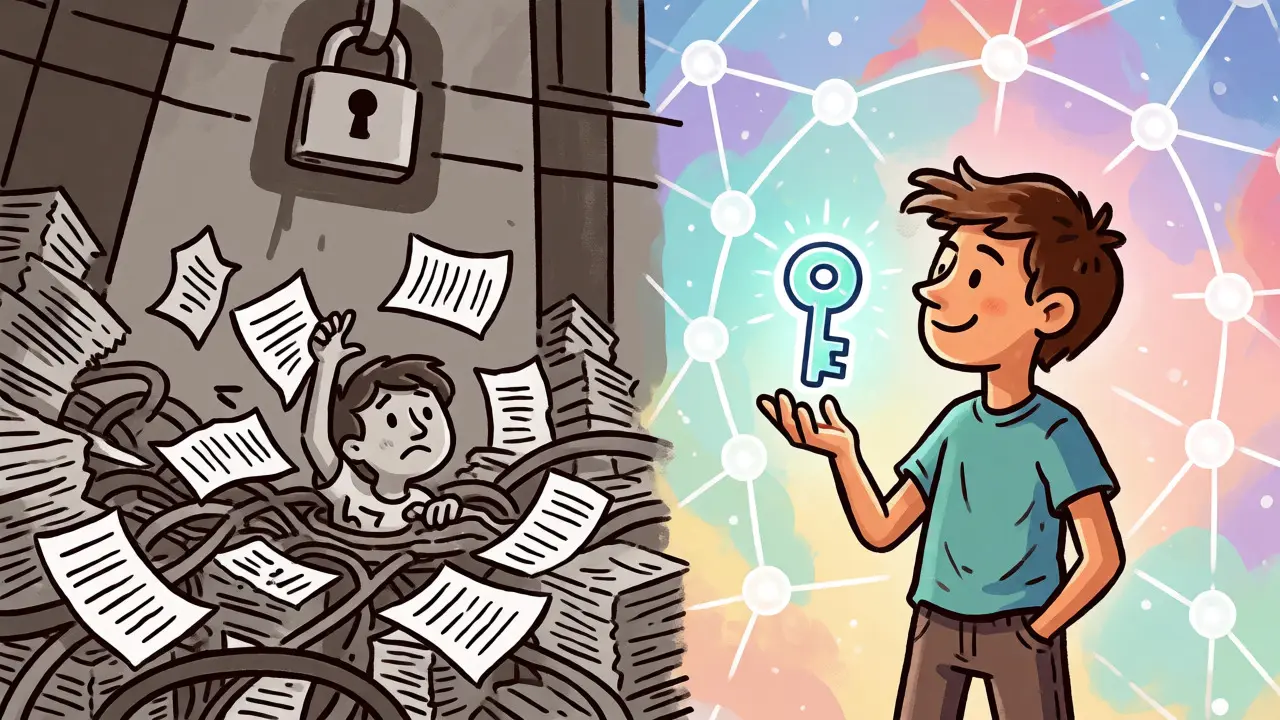
Imagine losing your passport, driver’s license, and bank cards in a house fire. In the traditional world, you’d spend weeks navigating bureaucratic hell to replace them. But what if your identity wasn’t a physical object or a file on a corporate server, but a cryptographic key in your pocket that no single entity could revoke? That is the promise of digital identity on blockchain. It shifts power from centralized authorities to you, letting you own, control, and verify who you are without handing over your data to every website you visit.
This isn't just tech hype. With 81% of data breaches linked to weak login credentials according to Verizon’s 2022 report, the current model is broken. We are moving toward a system where your identity is portable, private, and secure by design. Here is how this shift is happening right now and what it means for your digital life.
The Shift From Centralized Silos to Self-Sovereignty
For decades, we’ve relied on centralized identity management. You create an account, and a company stores your name, email, and password in their database. If they get hacked, your data leaks. If they shut down, your history vanishes. This model creates single points of failure. Self-sovereign identity (SSI) flips this script. Defined by experts at the Identity Management Institute, SSI allows individuals to own their digital identities using cryptographic keys rather than relying on central authorities like Facebook or banks.
The core technology enabling this is the Decentralized Identifier (DID). Unlike a username tied to a specific platform, a DID is a unique hash embedded directly into a blockchain block. It belongs to you, not the service provider. When you use a DID, you don’t give a website your password; you prove you control the key associated with that ID. This eliminates the need for passwords entirely, removing the primary vector for most cyberattacks.
How Verifiable Credentials Work Under the Hood
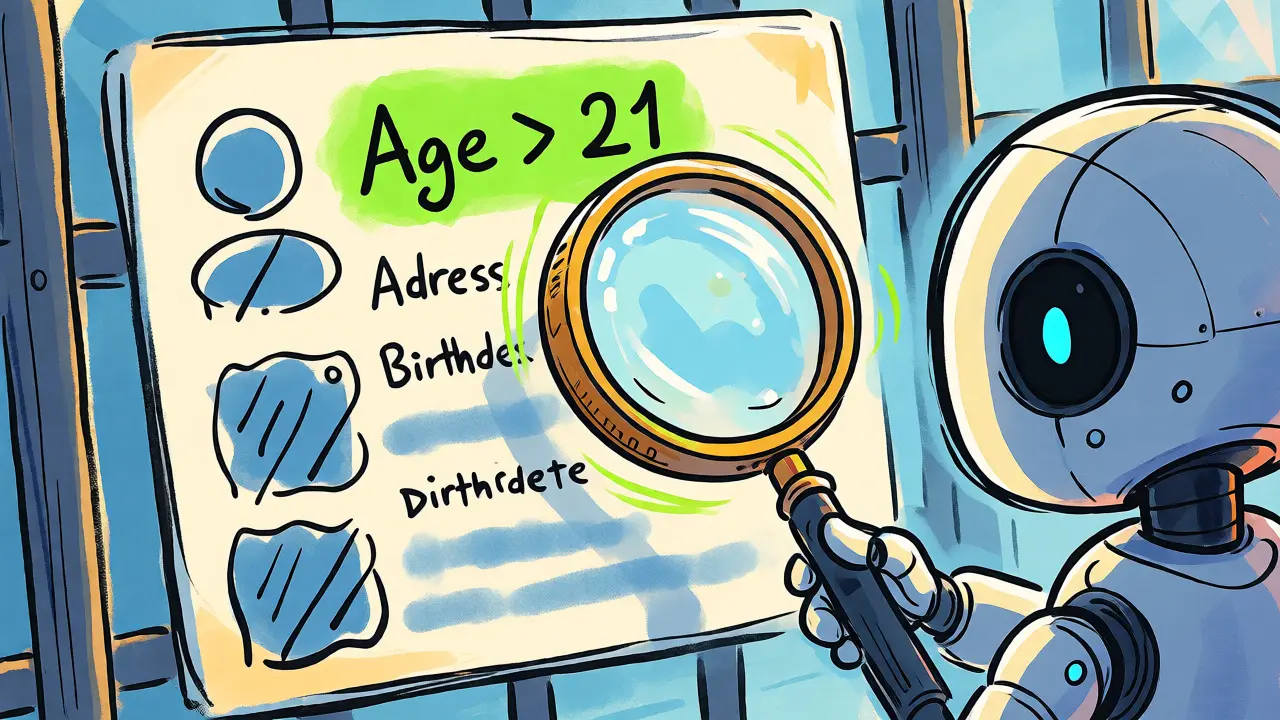
If DIDs are the usernames, Verifiable Credentials (VCs) are the documents. Think of a VC as a digital diploma, driver’s license, or credit score that has been cryptographically signed by a trusted issuer-like a university or government agency. The beauty of VCs is that they allow for selective disclosure. You can prove you’re over 21 without revealing your exact birth date or address.
This privacy-preserving verification relies heavily on Zero-Knowledge Proofs (ZKPs). ZKPs allow one party to prove to another that a statement is true without revealing any information beyond the validity of the statement itself. For example, Polygon ID uses ZKPs to let users prove their age or citizenship status instantly, completing verification in 2-5 seconds compared to the 30-60 seconds required by traditional manual checks. This speed and privacy combination is why enterprises are piloting these systems aggressively.
Real-World Adoption: Where It’s Working Now
We aren’t waiting for the future; parts of it are already here. The European Union’s European Blockchain Services Infrastructure (EBSI) program has processed over 1.2 million verified credentials across member states as of late 2024. Students can share academic records digitally across borders without carrying paper transcripts. Similarly, Estonia’s digital identity system, which integrated blockchain components in 2023, reported a 92% reduction in fraud after streamlining cross-border transactions.
In the private sector, results are mixed but promising. Healthcare providers using blockchain-based onboarding have seen patient intake times drop from 45 minutes to 8 minutes. However, consumer adoption faces hurdles. A major US bank abandoned a $12.7 million pilot project due to regulatory uncertainty, highlighting that legal frameworks often lag behind technical capabilities. As of Q3 2025, only 37% of global jurisdictions have clear rules for blockchain identity, creating a fragmented landscape for international users.
Key Challenges: Usability and Regulation
Despite the security benefits, user experience remains a significant barrier. Managing private keys is not intuitive for the average person. A 2024 usability study found that 62% of non-technical users struggle with key management, and 34% of early adopters experienced lockouts because they lost their recovery phrases. If you lose your key, you lose your identity. There is no "forgot password" button in a truly decentralized system.
| Feature | Traditional Centralized ID | Blockchain-Based SSI |
|---|---|---|
| Data Ownership | Held by service provider | Held by user via private keys |
| Verification Time | 30-60 seconds (manual/auto) | 2-5 seconds (cryptographic) |
| Breach Risk | High (single point of failure) | Low (distributed ledger) |
| User Control | Minimal (terms of service apply) | Full (selective disclosure) |
| Implementation Cost | Lower initial setup | Higher complexity, long-term savings |
Solutions are emerging to mitigate these risks. Social recovery mechanisms allow trusted friends or family members to help restore access if a key is lost, blending decentralization with human safety nets. Biometric integration, such as Worldcoin’s iris scanning protocol which registered 2.3 million users by mid-2024, also aims to simplify authentication while adding a layer of proof-of-personhood.
The Role of AI and Future Interoperability
Looking ahead, the convergence of AI and blockchain identity will define the next decade. By 2025, AI agents are expected to monitor how your digital identity interacts across platforms, optimizing security and personalization automatically. Imagine an AI that notices an unusual login attempt from a new device and requests additional verification via your mobile wallet before granting access.
Interoperability is the final frontier. Currently, different blockchain networks operate in silos. Standards like the W3C Decentralized Identifier specification, finalized in 2022, are critical for ensuring that a credential issued on Ethereum works seamlessly on Polygon or Hyperledger. Without universal standards, we risk recreating the fragmented web we currently inhabit. The goal is a seamless web where your identity travels with you, recognized and respected by every node in the network.
What happens if I lose my private key?
In a strict self-sovereign model, losing your private key means losing access to your identity permanently. However, modern implementations use social recovery or biometric backups to prevent permanent lockout, allowing you to reconstruct access through pre-designated trusted parties or devices.
Is blockchain identity more secure than passwords?
Yes, primarily because it eliminates shared secrets. Passwords are static and vulnerable to phishing and database leaks. Blockchain identity uses asymmetric cryptography, where your private key never leaves your device, making it nearly impossible for hackers to steal your identity remotely.
Can governments track me with blockchain identity?
Not necessarily. While the blockchain itself is transparent, zero-knowledge proofs allow users to verify attributes (like age) without revealing underlying data. Privacy advocates warn, however, that widespread biometric integration could create tracking risks if not regulated properly.
Which countries lead in blockchain identity adoption?
The European Union leads with its EBSI program and eIDAS 2.0 regulations. Estonia is a pioneer in digital governance, while India has explored integrating Aadhaar with blockchain. The US remains fragmented, with varying state-level legislation.
How fast is blockchain identity verification?
Cryptographic verification typically takes 2-5 seconds, significantly faster than traditional background checks or manual document review, which can take minutes to days depending on the process.