
Imagine a world where a writer gets paid the micro-second a reader opens their article, or a musician owns 100% of their royalties without a record label taking a massive cut. That isn't a futuristic dream; it's the reality of content monetization in 2026. For years, creators have been at the mercy of "algorithmic overlords" and platforms that hold the keys to their revenue. Blockchain is finally flipping the script, moving us from a system of permission to a system of ownership.
The core problem has always been the middleman. Whether it's a streaming service or a social media giant, intermediaries capture the lion's share of the value while creators fight for pennies. By using a decentralized ledger, we're seeing the rise of a direct-to-consumer economy where transparency isn't a feature-it's the foundation. But how does this actually work in practice, and where is the money really moving?
The Shift to Direct Ownership
At the heart of this revolution is Tokenization is the process of converting rights to a real-world asset into a digital token on a blockchain. By turning a song, a video, or an e-book into a token, creators can sell fractional ownership of their work. This means a fan doesn't just buy a copy of an album; they can buy a 1% stake in the future royalties of that album.
This creates a massive liquidity shift. Instead of waiting for a quarterly payout from a distributor, creators can leverage their intellectual property as a financial instrument. We're seeing this move beyond simple NFTs into Real-World Assets (RWA), where the legal ownership of a copyright is tied directly to an on-chain token. This effectively turns creative work into a tradable asset class, similar to how stocks work on the Nasdaq, but accessible to anyone with a digital wallet.
Automating Paydays with Smart Contracts
If tokenization is the "what," then Smart Contracts are the "how." These are self-executing contracts where the terms are written directly into the code. In the old model, you'd submit an invoice and wait 30 days. With smart contracts, the payment is atomic-it happens instantly upon the fulfillment of a condition.
For example, a freelance journalist could set up a contract where 20% of the payment is released upon the first draft, 30% upon the first edit, and the remainder the moment the article is published. There's no chasing clients for checks. This level of automation is being bolstered by Stablecoins, which act as the "internet's dollar," providing a steady value that avoids the wild swings of Bitcoin while allowing for instant global transfers.
| Feature | Traditional Model | Blockchain Model (2026) |
|---|---|---|
| Payment Speed | Days or Weeks | Instant (Atomic Settlement) |
| Ownership | Platform-controlled | Creator-owned (Tokenized) |
| Intermediaries | High (Agencies, Platforms) | Minimal to None |
| Royalty Tracking | Opaque / Manual | Transparent / On-chain |

Scaling for the Masses: Layer 2 and Account Abstraction
For a long time, blockchain was too slow and too expensive for small payments. You can't charge $0.10 for a short poem if the network fee is $5.00. That's where Layer 2 Scaling solutions like Arbitrum and Optimism come in. By processing transactions off the main Ethereum chain and then "rolling them up" into a single batch, these protocols have slashed costs.
But the real game-changer for the average creator is Account Abstraction (specifically ERC-4337). In the past, you needed a complex seed phrase to use a wallet-a nightmare for non-techies. Account abstraction allows for "smart wallets" that feel like a regular app. You can log in with an email or use biometric recovery, meaning creators can focus on their art rather than managing cryptographic keys.
Fighting the AI Tide with Provenance
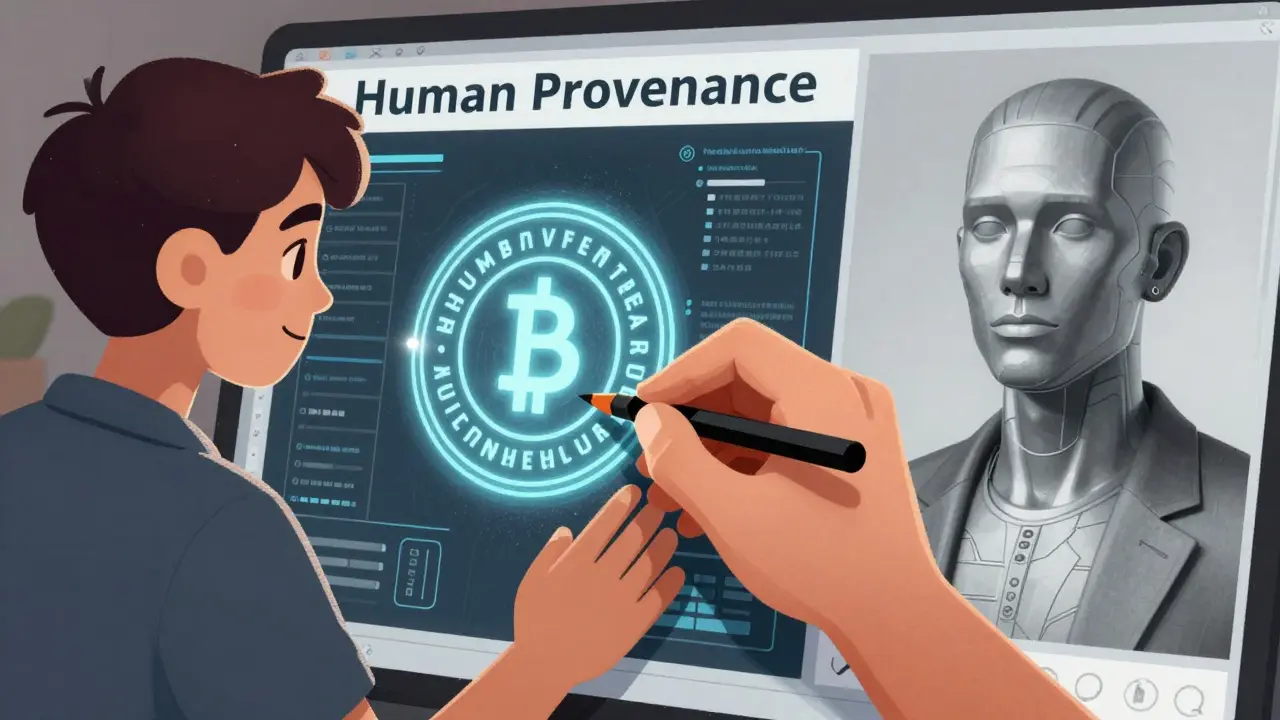
With the explosion of generative AI, the internet is flooded with synthetic content. This has created a new problem: how do you prove a human actually made something? Blockchain is providing the answer through provenance protocols. By timestamping a piece of work on-chain the moment it's created, authors can create an immutable audit trail of authenticity.
Initiatives like the Content Authenticity Initiative are adding credentials to files that record the edit history. This allows creators to command a premium price for "verified human" content. Moreover, we're seeing the rise of federated AI marketplaces. Instead of AI companies scraping data for free, creators can contribute their datasets to a model via blockchain and receive automatic micropayments every time the AI uses their specific style or data to generate a response.
The Institutional Wave and the Path Forward
We've moved past the era of pure speculation. In 2026, the focus is on value realization. Big banks and venture capital firms are no longer just watching from the sidelines; they're building the custody and lending services that allow creators to take loans against their tokenized royalties. When Coinbase acquired Echo in 2025, it signaled a move toward professionalizing how startups and creators raise capital through token sales.
However, it's not all smooth sailing. Regulatory hurdles remain, and the tax implications of receiving tokens instead of fiat currency can be a headache. But the momentum is undeniable. The transition from a centralized web to a decentralized one isn't just about technology-it's about power. The power is shifting back to the people who actually create the value.
Will blockchain replace all existing content platforms?
Not necessarily. It's more likely we'll see hybrid models. Many traditional platforms will integrate blockchain in the background to handle payments and rights, while keeping the user-friendly interface people are used to. The "backend" will be decentralized, but the "frontend" may remain familiar.
How does tokenization actually make money for a creator?
Creators can sell a percentage of their future earnings (royalties) as tokens. This provides an immediate lump sum of capital to fund new projects, while the buyers (fans or investors) earn a share of the ongoing revenue the content generates.
Isn't blockchain too expensive for small payments?
That was true in the past, but Layer 2 solutions (like Arbitrum) and new scaling protocols have reduced transaction fees to fractions of a cent, making micropayments for individual articles or songs economically viable for the first time.
What is the risk of using stablecoins for payment?
The primary risk is the stability of the coin itself and the regulatory environment. While most major stablecoins are now backed by transparent reserves, creators should still diversify their holdings and stay updated on the laws in their specific country regarding digital assets.
How do I get started with blockchain monetization?
Start by exploring Web3 wallets that support account abstraction for a simpler experience. Look for platforms that allow you to mint your work as tokenized assets or join decentralized creator collectives that use smart contracts for revenue sharing.
Next Steps for Creators
If you're a creator looking to move into this space, don't try to do everything at once. Start by setting up a secure digital wallet and experimenting with a few small tokenized releases. If you're managing a team, look into CRM tools like RedPeach that are designed for the transparency needs of the new creator economy. The goal isn't to be a blockchain expert-it's to use these tools to ensure you're getting paid what your work is actually worth.
Actually everyone knows L2s are the only way forward 🚀 The way these smart contracts handle atomic settlement is just wayy superior to the old school banking system lol. People still sleeping on ERC-4337 but it's literally the bridge to mass adoption 💎🙌🔥
The integration of Layer 2 scaling solutions is indeed a pivotal development, as it addresses the scalability bottlenecks that previously hindered micro-transactions... It is truly impressive to see how these protocols reduce costs...!
Typical western gaze trying to define the future of value. You fail to realize that the true synthesis of blockchain and creativity will be led by the east, specifically India, where our intelektual rigor far surpasses these simple tokenization schemes. The metaphysics of ownership are not merely lines of code but a reflection of cultural dominance. Your guide is merely a surface-level observation of a deeper shift that only the truly enlightened can grasp. It is simply amusing to see how the west tries to quantify the spiritual essence of art into fractional shares of a digital ledger. We are not just adopting a tool; we are redefining the very nature of digital existence in a way that renders your traditional models completely obsolete and primitive. The sheer audacity of presenting this as a general guide without acknowledging the geopolitical shift in tech leadership is laughable. One must possess a certain level of cognitive sophistication to understand that the decentralization of power is a mirror to the decentralization of global hegemony. You talk about smart contracts, but you ignore the social contracts that actually govern trust in the real world. Truly an elementary analysis. 🙄
Spot on! For my fellow creators in India and beyond, leveraging the composability of DeFi primitives can really supercharge your royalty streams. If you're looking at RWA tokenization, definitely keep an eye on the oracle reliability to ensure your on-chain data matches the real-world copyright registries. This is an amazing time to be a builder!
Imagine thinking a digital receipt makes you an 'owner' of art. So cute. 🙄 The aesthetic value is lost the second you turn it into a tradable asset class for speculators. This is just capitalism with extra steps. 💅
Oh sure, because we've all had such wonderful experiences with digital assets so far. I'm just so sure that a 'smart wallet' will solve everything and we'll all just live in harmony without any glitches. Totally believable!
The provenance protocols are just a front for the globalist surveillance state to track every single piece of intellectual property created by a citizen of this nation. They want a permanent record of your mind tied to a digital ID. Do not trust the so called smart wallets as they are simply honey pots for the central banks to seize your assets once they finalize the CBDC rollout. This is a trap designed to strip away the last shred of anonymity we have left in the digital realm. Wake up and stop handing the keys to your creativity to a ledger managed by the very institutions they claim to replace. The transparency they promise is actually total visibility for the controllers. It is an absolute affront to our sovereignty and a dangerous step toward a social credit system for artists. We must resist this digital panopticon before it is too late for all of us.
just a heads up for people starting out, dont rush into the complex stuff. just get a basic wallet and try minting one small thing first to see how it feels. its a learning curve but way more chill once you get the hang of it
I appreciate the focus on ownership. It's a quiet but powerful shift.
I find it quite interesting how the intersection of stablecoins and smart contracts could potentially remove the stress of waiting for payments, especially for those of us who work across different time zones and currencies, which often leads to so many unnecessary delays in the traditional banking system that just feel outdated in this modern era.