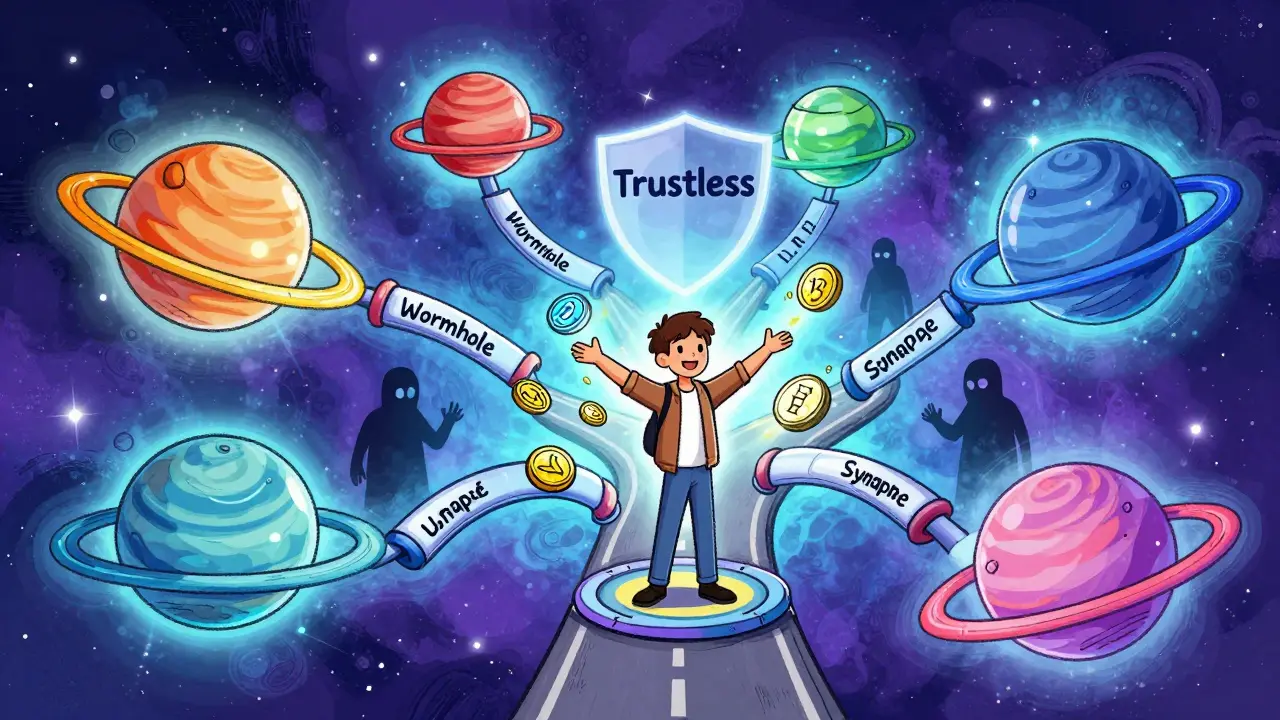
By 2026, if you're still thinking of blockchain as a bunch of isolated networks, you're already behind. The real story isn't about one chain winning - it's about how they all talk to each other. And that conversation? It's happening through blockchain interoperability bridges. These aren't just tools anymore. They're the plumbing of crypto. The pipes that move your ETH from Ethereum to Solana, your USDC from Polygon to Avalanche, and your stablecoins between chains so fast you barely notice the switch.
Five years ago, bridging assets felt like a hack. You'd lock your tokens on one chain, wait for a third-party to confirm, then get fake tokens minted on another. It was slow, risky, and clunky. Today? It's seamless. The bridges have evolved. The old lock-and-mint model? Mostly gone. Now, chains issue native assets directly using new token standards. When you move USDC from Ethereum to Base, you're not getting a wrapped version - you're getting the real thing, minted on-chain with full native support. That’s the new default.
How Bridges Work Now - And Why Trustless Is Winning
There are two main kinds of bridges: trusted and trustless. Trusted ones rely on a small group of operators - often centralized - to verify transactions. Think of them like a bank teller: you hand over your cash, they hold it, and send an equivalent on the other side. Problem? If those operators get hacked or go rogue, your funds vanish. We’ve seen it happen. Multiple times.
Trustless bridges? They use smart contracts and cryptographic proofs. No middlemen. No single point of failure. That’s why the market is shifting hard toward them. Projects like Wormhole and Synapse Protocol now power most of the major cross-chain activity. They don’t hold your money. They just verify that the right data was sent. If the math checks out, your tokens appear on the other chain. No one can stop it. No one can steal it. Just pure code.
Even big players are adapting. Binance Bridge, once the go-to for moving assets between Ethereum and BSC, now supports trustless routing alongside its traditional model. Ava Labs’ Avalanche Bridge delivers sub-second finality using a hybrid approach. The trend is clear: users want speed, but they won’t trade security for it.
The Rise of Aggregators: LI.FI and the Death of Bridge Shopping
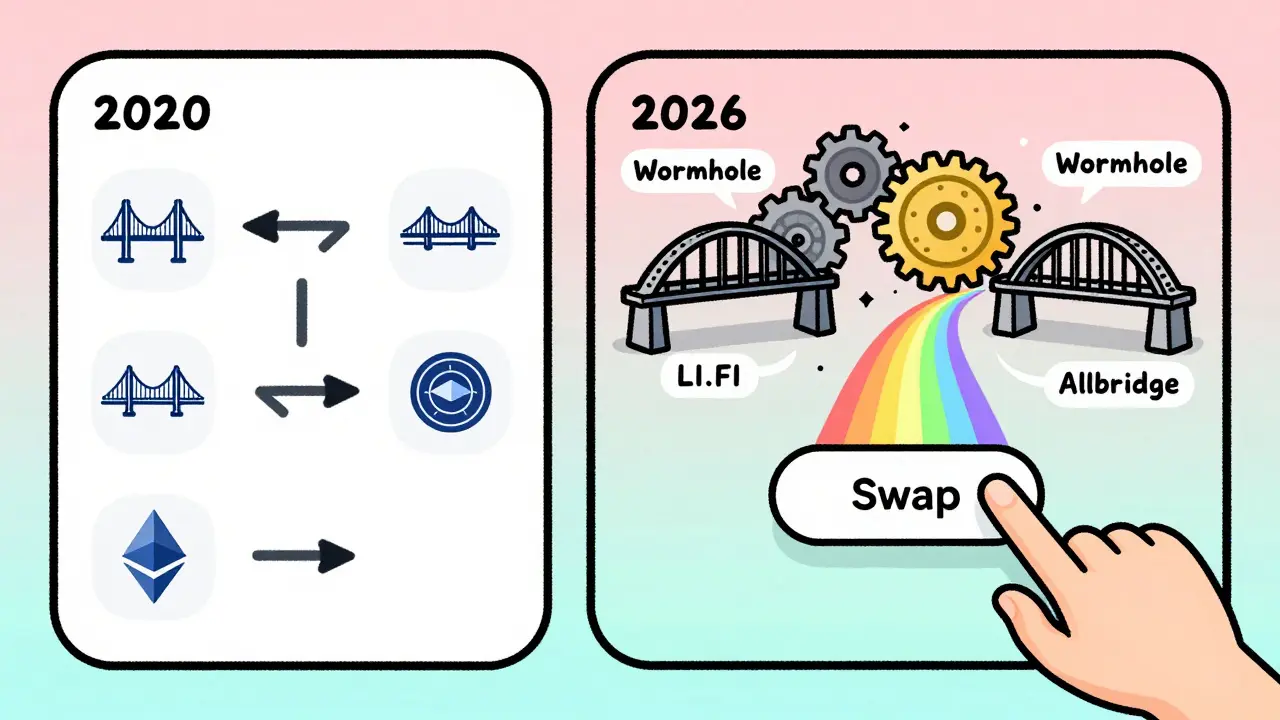
Remember when you had to pick one bridge for each chain? You’d open MetaMask, check if LI.FI was available, then switch to Portal Bridge for Bitcoin, then use Allbridge for Solana? That’s over.
LI.FI changed everything. It doesn’t just connect bridges - it connects everything. It integrates over 20 bridge protocols, 20+ decentralized exchanges, and 60+ blockchains into one interface. Want to swap ETH on Ethereum for USDT on Arbitrum? LI.FI finds the cheapest, fastest path - maybe it uses Wormhole for the bridge, then swaps through Curve on Arbitrum. You don’t care how. You just get the result.
And it’s not just swapping. LI.FI is now embedded in wallets like MetaMask, Rabby, and Backpack. When you click "Swap" in your wallet, LI.FI runs in the background. It’s not an add-on - it’s the default. That’s why it wins over 80% of direct comparisons in speed, cost, and success rate. Polygon’s AggLayer does something similar inside its ecosystem. But LI.FI? It’s the glue between ecosystems. It’s becoming the universal translator.
Stablecoins Are the Lifeblood - And They’re Moving Everywhere
Let’s be real: most cross-chain activity isn’t about Bitcoin or Ethereum. It’s about USDT, USDC, DAI, and other stablecoins. Why? Because they’re the cash of crypto. Traders use them to hedge. Yield farmers use them to move between pools. Institutions use them to settle payments across borders.
That’s why Allbridge Core has exploded. It’s not just another bridge. It’s built specifically for moving stablecoins between EVM and non-EVM chains - like from Ethereum to Solana or from Polygon to Sui. Over 70% of all stablecoin volume crosses through bridges in 2026. And that number is growing.
What’s new? Token standards like ERC-7683 are letting assets carry their own routing rules. A USDC token issued under this standard doesn’t just say "I’m USDC" - it says "I can be moved to Chain X via Bridge Y at cost Z." This means the asset itself knows how to move. No more guesswork. No more manual bridge selection. It just works.
The Next Wave: Settlement, Intent, and Chain Abstraction
Interoperability isn’t just about moving assets anymore. It’s about what you can do after they move.
Take settlement. Imagine you owe someone 10 USDC on Arbitrum and they owe you 5 ETH on Polygon. Instead of two separate bridges, you settle both in one atomic transaction. Netting. It’s already happening. Projects like Symbiosis Finance are building this into their core. They don’t just bridge - they net. You send 10 USDC. You get 5 ETH back. No extra steps. No extra fees.
Then there’s intent-based bridging. Instead of saying "Move my ETH to Solana," you say "I want to earn 8% APY on my ETH using the best yield strategy across all chains." The system finds the path. It bridges, swaps, stakes, and compounds - all in one go. No user input needed. Just your goal.
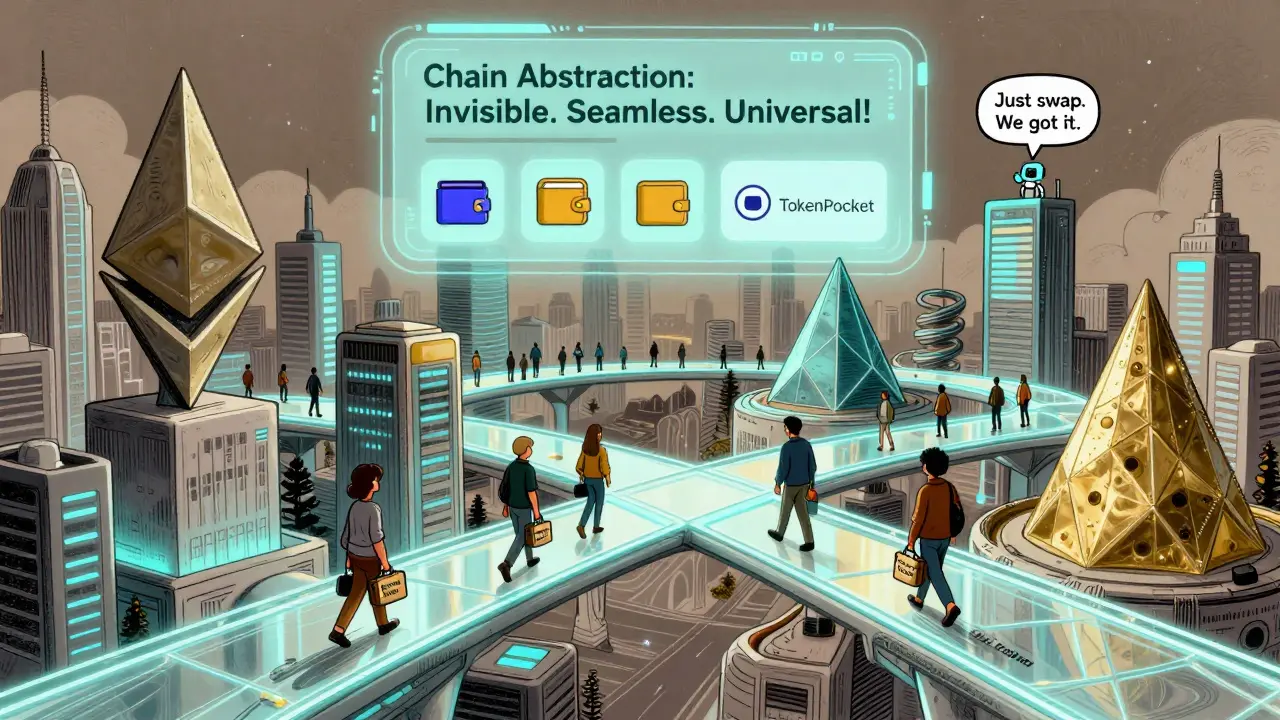
And chain abstraction? That’s the holy grail. In 2026, users don’t care if they’re on Base, Blast, or zkSync. They just want to send ETH, swap tokens, and stake yield. The underlying chain? Invisible. Wallets like TokenPocket and Rabby now hide the complexity. You pick your asset. You pick your action. The bridge, the chain, the gas token - all handled automatically.
What’s Next? The Bridge Ecosystem in 2032
By 2032, blockchain interoperability won’t be a feature. It’ll be the default. Every new chain will launch with native bridge support. Every app will assume multi-chain access. Every wallet will auto-route liquidity.
Here’s what we’ll see:
- Real-world assets like tokenized real estate or bonds will move across chains as easily as USDC. A property on Ethereum can be collateralized on Solana. A bond issued on Polygon can be traded on Cosmos.
- Compliance will be baked in. Bridges won’t just move assets - they’ll verify jurisdiction, KYC, and AML rules on-chain. No more blacklisted addresses. Just smart, rule-based routing.
- Enterprise adoption will explode. Banks, hedge funds, and payment processors will use bridges to settle cross-border transactions in real time. No more SWIFT delays.
- Bridge failures will drop to near zero. With standardized security audits, formal verification, and decentralized validation, the days of $100M hacks are fading.
The market will grow from $202 million in 2024 to over $900 million by 2032. But the real value isn’t in the money. It’s in the freedom. Freedom to use any chain. Freedom to earn anywhere. Freedom to build without borders.
Why This Matters to You
If you’re holding assets on one chain, you’re missing out. The future isn’t multi-chain. It’s omni-chain. Your portfolio should move as freely as your data does on the internet. You shouldn’t have to choose between Ethereum’s security and Solana’s speed. You should have both.
Start using aggregators like LI.FI. Check if your wallet supports cross-chain swaps. Look for tokens issued under new standards like ERC-7683. Don’t just bridge - optimize. The tools are here. The infrastructure is built. The only thing left is for you to move.
What’s the difference between a trusted and a trustless bridge?
A trusted bridge relies on a small group of centralized operators to verify and move assets between chains. If those operators are compromised, your funds are at risk. A trustless bridge uses smart contracts and cryptographic proofs to verify transactions without intermediaries. No one holds your money - the code does. Trustless bridges are now the industry standard because they’re more secure and decentralized.
Why is LI.FI considered the most important bridge aggregator?
LI.FI isn’t just a bridge - it’s a universal router. It connects over 20 bridge protocols and 20+ DEXs across 60+ chains. When you swap ETH for USDT, it finds the cheapest, fastest path - even if it involves multiple bridges and swaps. It’s embedded in major wallets like MetaMask and Rabby, making it the default choice for cross-chain swaps. No other platform matches its coverage, speed, or integration depth.
Are all stablecoins moved the same way across chains?
No. Older bridges used wrapped tokens - fake versions minted on the destination chain. Today, many stablecoins use native token standards like ERC-7683, which let the asset itself carry routing instructions. This means USDC on Ethereum can be moved to Solana as the same token, not a wrapped copy. It’s faster, cheaper, and more secure. Allbridge Core specializes in this exact use case, moving stablecoins between EVM and non-EVM chains with near-zero slippage.
What’s chain abstraction, and why does it matter?
Chain abstraction means you don’t need to know which blockchain you’re on. Your wallet handles gas, bridges, and network switching automatically. You just say "swap this for that" - and it works across any chain. This removes complexity for users and lets apps build without worrying about chain-specific rules. Wallets like TokenPocket and Rabby already offer this. It’s the future of user experience.
Will bridges still be needed in 2030?
Yes - but they’ll be invisible. By 2030, bridges won’t be something you choose. They’ll be the automatic foundation beneath every transaction. New blockchains will launch with interoperability built-in. Assets will carry their own movement rules. The bridge won’t be a tool you use - it’ll be the air you breathe. The question won’t be "How do I bridge?" It’ll be "Which chain should I use?"
It's wild how much has changed in just five years. I remember when bridging felt like playing Russian roulette with your crypto - lock your ETH, pray the operators didn't vanish, then wait 15 minutes for a wrapped token that didn't even behave like the real thing. Now? I click "swap" in MetaMask and five seconds later I'm earning yield on Solana with native USDC. No wrappers, no guesswork. The real win isn't the speed - it's the invisibility. The infrastructure just works. You don't think about bridges anymore. You just use them. That’s true innovation.
And LI.FI? It’s not just a tool - it’s the OS of cross-chain. The fact that it’s embedded in wallets now means the average user doesn’t even know they’re using a bridge. That’s the holy grail: UX so seamless you forget the complexity. The next wave will be intent-based flows - you say "I want 8% APY," and the system finds the path across five chains, settles the net, and handles gas in DAI. No more manual bridge shopping. Just goals.
Stablecoins are the silent engines here. Over 70% of volume? That’s not a fluke. It’s the real demand. People aren’t swapping ETH for SOL because they’re excited about consensus mechanisms. They’re moving USDC because they need liquidity, not drama. And with ERC-7683, the token itself carries routing logic. That’s next-level. The asset knows where to go. The bridge just enables it. No middlemen. No gatekeepers.
By 2030, we won’t talk about "bridges" anymore. We’ll talk about "chains" like we talk about ISPs today. You don’t care if your data went through Verizon or Comcast. You just want it delivered. Same with crypto. The bridges are becoming the invisible plumbing. And honestly? That’s the most beautiful part.
Still, I worry about compliance. If every bridge starts enforcing KYC on-chain, we risk turning DeFi into a gated suburb. The beauty of this tech is its openness. We need to bake in privacy-preserving compliance - not just regulatory checkboxes. Otherwise, we’re just recreating SWIFT with more smart contracts.
I’ve been using cross-chain swaps for years, and honestly, I never thought I’d live to see this day. Back in 2020, I lost $3K because a bridge operator went dark. I was furious. But now? I feel safe. The shift to trustless systems isn’t just technical - it’s psychological. You stop second-guessing every transaction.
I’m from a small town in Ohio. My mom still thinks crypto is a scam. But when I showed her how I moved USDC from Ethereum to Solana in 30 seconds - no paperwork, no bank - she just said, "That’s magic." And you know what? It is. This isn’t just finance. It’s redefining access. People in places without banks can now participate in global markets. That’s huge.
LI.FI changed my life. I used to spend hours comparing fees across five different bridges. Now I just hit "swap" and forget about it. Even my grandma uses it. She’s 72. She doesn’t know what an EVM is. But she knows how to send money to her granddaughter in Mexico. That’s the real win.
And yes, I know some people are scared of chain abstraction. They say it’s too complex. But I say: complexity should be hidden, not glorified. The goal isn’t to make users into blockchain engineers. It’s to make finance accessible. And we’re doing it.
How quaint. You speak of "trustless" bridges as if they’re some divine revelation. The truth? They’re merely more sophisticated illusions. Cryptographic proofs are not infallible. They’re math. And math can be gamed. Formal verification? A marketing buzzword. The same teams that built the "trustless" bridges responsible for the $600M Wormhole exploit are now selling you "enterprise-grade security."
LI.FI? A centralized aggregator masquerading as decentralized. It’s a single point of failure with 20 different names. And ERC-7683? A poorly conceived standard pushed by venture-backed labs with no real-world audit history. You think the asset "knows" how to move? It doesn’t. It’s a metadata field. A suggestion. And someone still has to validate it. Someone always does.
Chain abstraction? A fantasy for the naive. The moment you abstract gas, you abstract accountability. Who pays when the transaction fails? Who bears the loss? The user? The wallet? The aggregator? No one. That’s not innovation - it’s obfuscation. And don’t get me started on stablecoins. USDC is a regulated asset. It’s not crypto. It’s a bank account with a blockchain sticker. You’re not building a new financial system. You’re just automating the old one.
2032? More like 2032: The Year We Realized We Built a Casino With Better UI.
YES. YES. YES. This is the future we’ve been screaming about for years. Stop thinking in silos. Stop choosing chains. Start thinking in flows. The moment you realize that your assets don’t belong to one chain - they belong to YOU - that’s when everything clicks.
LI.FI isn’t just the best aggregator - it’s the first one that actually respects your time. I used to waste hours trying to find the cheapest path from Polygon to Base. Now? I swap, I move, I earn. Done. And the fact that wallets are embedding it? That’s the signal. This isn’t a feature. It’s the default. And if you’re still manually selecting bridges in 2026? You’re not tech-savvy. You’re just stubborn.
Stablecoins are the real MVPs. Not Bitcoin. Not ETH. USDT, USDC, DAI - these are the oil of the new economy. And Allbridge Core? Finally, someone built a bridge that doesn’t treat stablecoins like second-class citizens. Native issuance? Yes. Zero slippage? Yes. Real routing logic? YES.
Chain abstraction is the next frontier. Imagine sending ETH to your friend on zkSync while your wallet auto-pays the gas in SOL. No conversion. No hassle. Just send. That’s not sci-fi. That’s next month’s update. If you’re not building for this, you’re building for 2019.
So I’ve been using LI.FI for a few months now and I just wanted to say - it’s changed everything. I used to be terrified of bridging because I’d always mess up the gas token or pick the wrong bridge and lose half my balance. But now? I just click "swap" and it just works. I don’t even know what’s happening under the hood and I’m fine with that.
Also, I think the ERC-7683 thing is a game changer. I didn’t even know it existed until last week. Now I check if my stablecoins have it before I move them. It’s like the token has a GPS. So cool.
One thing though - I think we need better education. My cousin tried to bridge and picked a random bridge because she didn’t know what LI.FI was. She lost 0.3 ETH. We need more tutorials. Maybe wallets should pop up a little "why this path?" tooltip. Just a thought.
Also, I love how you mentioned chain abstraction. I’ve been using Rabby for a while and I didn’t even realize it was doing all that until you said it. Mind blown. 😅
The evolution of blockchain interoperability is a masterclass in iterative design. The transition from trusted, centralized bridges to trustless, cryptographically verifiable systems represents a paradigm shift in trust architecture. The elimination of counterparty risk through decentralized validation mechanisms is not merely an improvement - it is a structural reconfiguration of financial intermediation.
LI.FI’s integration into core wallet infrastructure signals the maturation of the ecosystem. The aggregation of liquidity pathways across 60+ chains is not an application feature; it is a foundational protocol layer. The reduction of user cognitive load through intent-based routing aligns with the principles of human-centered design in distributed systems.
ERC-7683 introduces a novel paradigm: asset-native routing intelligence. This is not a token standard - it is a metadata layer enabling composability at the asset level. The implications for DeFi primitives - particularly atomic settlement and cross-chain yield optimization - are profound. The future of interoperability lies not in bridging chains, but in enabling assets to navigate them autonomously.
By 2032, interoperability will be indistinguishable from network effects. The distinction between "chain" and "bridge" will dissolve into a unified, intent-driven execution environment. The challenge ahead is not technical - it is institutional. Regulatory frameworks must evolve to accommodate non-location-bound asset sovereignty. The architecture is ready. The policy is not.
I just moved 10000 USDC from Ethereum to Solana in 12 seconds and I didn’t even think about it and now I’m earning 9% on it and I didn’t even know I could do that and I used to think bridges were scary but now I just click and go and LI.FI is magic and I love it
Let’s be brutally honest: this entire narrative is a PR campaign disguised as innovation. The "trustless" bridges? They’re still vulnerable. Look at the recent Synapse exploit - $40M gone. The "native" stablecoins? Still backed by Circle’s bank accounts. The "chain abstraction"? A glossy UI hiding a labyrinth of API calls controlled by a handful of VC-backed teams.
LI.FI? It’s not a protocol. It’s a monopoly in the making. They’ve embedded themselves into every major wallet. No competition. No choice. That’s not decentralization - that’s gatekeeping with better branding.
And don’t get me started on ERC-7683. A standard pushed by a team with zero public audits and a whitepaper written in Notion. The "asset knows how to move"? That’s not intelligence - it’s a hardcoded routing script. You’re not building a decentralized future. You’re building a corporate-controlled payment rail with blockchain branding.
The real story? This isn’t about freedom. It’s about extracting more value from retail users through frictionless, invisible, and unregulated pathways. The $900M market projection? That’s not growth. That’s monetization. And the users? They’re just the fuel.
ok but like why is everyone so obsessed with LI.FI? I tried it once and it sent my ETH to some random chain I never heard of and I lost 0.02 ETH in gas and now I just use portal bridge bc at least I know where my money is going. also why are we pretending all stablecoins are the same? USDC is fine but USDT is still the real king and no one talks about that. also I hate when people say "chain abstraction" like its a thing. I just want to send money without thinking. not be a blockchain dev.
I just moved my entire portfolio across 7 chains in 4 minutes 🚀💸 and I didn’t even sweat 💪🔥 This is the future. We are not just users. We are architects of a new world. 🌐✨ The bridges are alive. The chains are dancing. And we? We’re just here to enjoy the ride. 🎉🙌 #Web3IsHere #NoMoreSilos