
Most countries are still guessing how to handle digital assets, but Japan has already built a fortress. After the devastating Mt. Gox crash in 2014, the Japanese government decided that "moving fast and breaking things" wasn't an option when people's life savings were at stake. Today, the FSA crypto oversight is the regulatory framework managed by the Financial Services Agency of Japan to ensure stability, security, and investor protection in the digital asset market. If you're looking to operate an exchange or invest in the region, you're entering one of the most disciplined financial environments on earth.
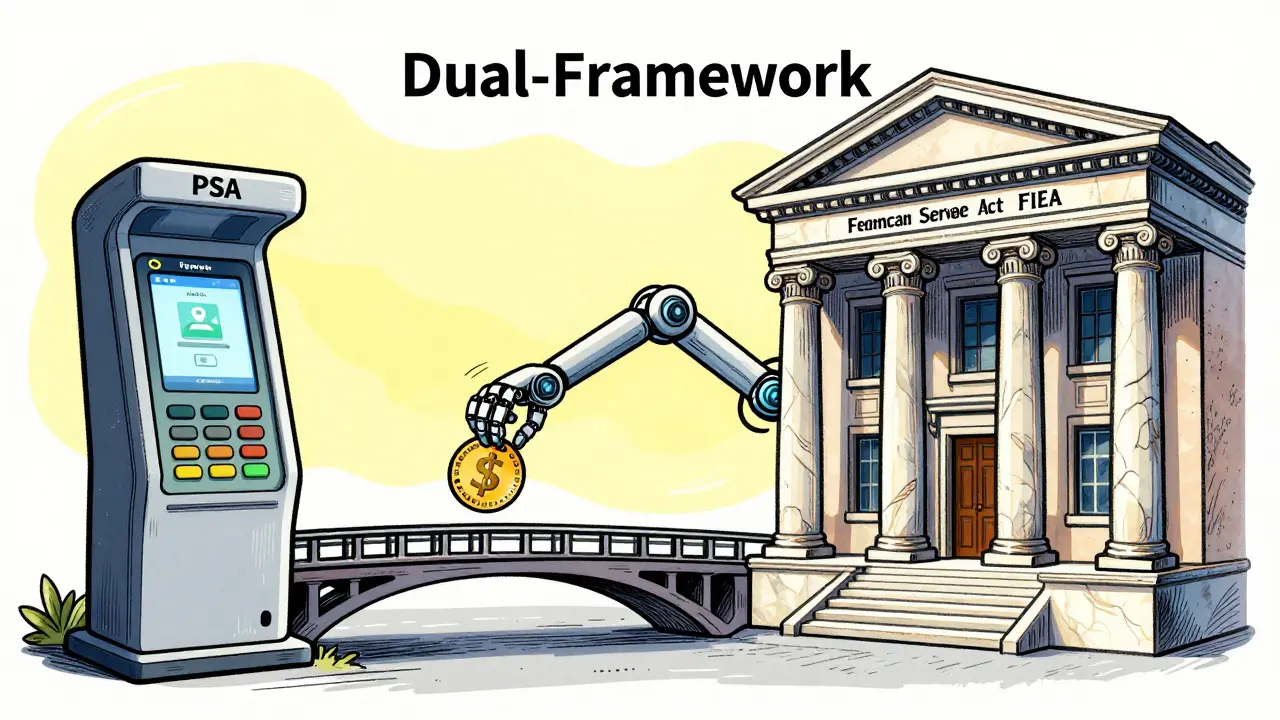
The Dual-Framework System: PSA and FIEA
Japan doesn't just have one set of rules; it uses two distinct legal pillars to trap every possible loophole. For years, the Payment Services Act (PSA) was the main tool. Think of the PSA as the rulebook for "money-like" assets. It defines what a crypto-asset is and mandates that any business dealing with them must register as a Crypto-Asset Exchange Service Provider (CAESP). If you aren't registered with the FSA, you aren't doing business in Japan.
However, as tokens became more complex-offering governance rights or profit-sharing-the PSA wasn't enough. Enter the Financial Instruments and Exchange Act (FIEA). Traditionally used for stocks and bonds, the FIEA is now swallowing the more "investment-heavy" side of crypto. By September 2025, the FSA pushed a landmark shift to bring specific tokens under the FIEA. This means if a token looks like a security, it's treated like one. This change introduces strict insider trading laws and mandatory disclosures that were previously absent in the wild west of crypto.
| Feature | Payment Services Act (PSA) | Financial Instruments & Exchange Act (FIEA) |
|---|---|---|
| Primary Focus | Payment & Exchange Services | Investment & Securities |
| Asset Type | Standard Crypto-assets (e.g., BTC) | Security Tokens / Governance Tokens |
| Key Requirement | FSA Registration & Cold Storage | Detailed Disclosure & Market Conduct |
| Goal | Payment System Stability | Investor Protection & Market Integrity |
Non-Negotiable Compliance Standards
The FSA doesn't do "suggestions." Their requirements are concrete and strictly enforced. One of the biggest hurdles for new exchanges is the asset segregation rule. You cannot mix customer funds with your own operational cash. Period. If an exchange goes bust, the customer's money must be untouched and ready for return.
Then there's the cold storage mandate. The FSA requires exchanges to keep at least 95% of user assets in offline cold wallets. This effectively kills the chance of a massive hot-wallet drain from a single hack. While this makes the internal plumbing of an exchange more complex and slightly slower, it provides a level of security that is virtually unmatched in other global jurisdictions.
Beyond the tech, the humans in charge face a mountain of paperwork. Anti-Money Laundering (AML) and Know Your Customer (KYC) procedures are not just checked boxes; they are scrutinized. The registration process typically takes 6 to 12 months of grueling preparation, and ongoing compliance costs can eat up 15-20% of an exchange's operational budget.
The Role of Self-Regulation
The FSA doesn't work alone. To make the system scalable, they lean on self-regulatory organizations (SROs). The Japan Virtual Currency Exchange Association (JVCEA) and the Japan Security Token Offering Association (JSTOA) act as a bridge between the government and the industry. These groups often set standards that are even stricter than the baseline law.
Why would a company want more rules? Because in Japan, compliance is a badge of trust. When a platform is JVCEA-approved, users know it meets a gold standard of safety. This collaborative approach allows the FSA to update rules quickly without needing a full act of parliament every time a new token trend emerges.
Innovation vs. Control: The DeFi Challenge
You might wonder if all these rules kill innovation. Surprisingly, Japan is trying to find a middle ground. The FSA has established a formal DeFi Study Group. This isn't just a talking shop; it's a recurring meeting between regulators, academics, and developers to figure out how to regulate smart contracts without breaking the decentralized nature of the tech.
The goal is to create a path for regulated crypto ETFs and stablecoins that don't crash the broader economy. By integrating digital assets into the FIEA, Japan is essentially saying: "We want the tech, but we want the safety of the 1930s stock market rules to go with it." This balance is why Japan was among the first to recognize Bitcoin as a legal payment method while simultaneously being the harshest on exchange security.

Looking Ahead: Tax Reforms and Global Influence
The landscape is still shifting. As of late 2025, the FSA proposed tax reforms to make the market more attractive. Bringing crypto into a 20% tax bracket and allowing investors to carry forward losses for three years is a huge win for long-term holders. It shows that the FSA knows when to tighten the screws and when to loosen them to encourage growth.
With the formal FIEA reclassification bill expected in early 2026, Japan is positioning itself as the global blueprint. Other regulators are watching closely. If you can survive the FSA's scrutiny, you can practically operate anywhere in the world. The "Japanese Model" is effectively a stress test for crypto businesses.
What happens if a crypto exchange in Japan fails to follow FSA rules?
The FSA has the power to issue business improvement orders or revoke licenses entirely. Because of strict asset segregation and the 95% cold storage rule, the priority is ensuring that even if the company fails, user funds remain secure and recoverable.
How does the FIEA differ from the PSA regarding tokens?
The PSA treats crypto primarily as a payment method or a digital asset. The FIEA treats tokens as securities. This means tokens under FIEA are subject to much stricter disclosure requirements, insider trading bans, and are governed by laws designed to protect investors in financial markets.
Is it more expensive for users to trade on FSA-regulated exchanges?
Generally, yes. Because compliance costs (AML/KYC and security audits) represent 15-20% of operational expenses, these costs are often passed to the user through slightly higher trading fees compared to unregulated or lightly regulated offshore platforms.
How long does it take to get FSA registration for an exchange?
The process is extensive and typically takes between 6 and 12 months. It requires comprehensive security audits, proof of physical operations within Japan, and detailed documentation of all internal compliance procedures.
What is the purpose of the DeFi Study Group?
The study group brings together the FSA, industry experts, and academics to research how to apply regulatory oversight to decentralized platforms and smart contracts without stifling the innovation inherent in blockchain technology.
Next Steps for Market Participants
If you're a business owner looking to enter the Japanese market, your first move should be engaging a specialized legal firm familiar with the JVCEA guidelines. Don't attempt a "light" version of compliance; the FSA will spot it immediately during the audit phase. Focus on building your cold storage architecture first, as that is the most technically demanding requirement.
For individual investors, the best strategy is to stick with registered CAESPs. While the fees might be a bit higher, the protection offered by the FSA's segregation rules means your assets aren't being gambled with by the exchange's management. In a world of frequent exchange collapses, the Japanese "strict" approach is actually the safest bet for your portfolio.
Sure, let's just let the government hold the keys to the kingdom. Great plan.
The 95% cold storage requirement is a massive operational bottleneck. It sounds secure on paper, but it basically kills the liquidity and speed that make crypto attractive in the first place. If you're forcing a 6-12 month registration window, you're just pushing the real innovation to offshore platforms where the FSA has zero visibility. This isn't stability, it's just stagnation disguised as safety.
Absolute joke. The FSA is just a front for the globalists to implement CBDCs and track every single satoshi you move. These 'protections' are just a way to make sure the big banks stay in control while the retail plebs get squeezed by 20% tax brackets. Total state surveillance masquerading as 'investor protection'. Wake up people, the FIEA is just a leash to keep us from escaping the fiat trap. Probly just a way to funnel funds into black projects anyway.
Oh, look at Japan being so "disciplined." How adorable. I'm sure the 15-20% compliance cost is totally just for "security" and not just a way for bureaucrats to buy fancy lunches. It's so cute that they think a "DeFi Study Group" is going to solve the problem of decentralization. You can't "regulate" a smart contract into submission unless you're just planning to ban it once you've sucked all the value out of the market. Absolute comedy gold.
It's actually really cool to see a country taking the time to get this right. A lot of us just want to know our funds are safe without having to be a blockchain expert. If it means paying a few extra cents in fees to avoid another FTX-style meltdown, I'm all for it. Glad they're bridging the gap between old-school finance and the new world!
This is the way! 🚀 Safety first always. If you want to grow the industry, you need a foundation of trust. Japan is showing the world how to do it. Let's get those regulations standardized globally! 💎🙌
I really think this could be a wonderful example for other countries because it shows that you can actually have digital assets and still protect people's hard-earned money. It's so nice to see a government that doesn't just ignore the problem but actually spends years building a system that works for everyone involved. Even if it takes a little longer to get started, the peace of mind is worth so much more than a quick profit. I hope we see more of this kind of thinking in the US and Europe soon so everyone can feel safe exploring this new technology together.
The emphasis on asset segregation is the most critical part here. For anyone new to this, remember that the tech is great, but the people managing the platforms can be the weakest link. Having a legal mandate that keeps customer funds separate is a huge win for the little guy. It's a great learning point for any aspiring crypto entrepreneur to prioritize transparency over rapid growth.
I believe this balanced approach is exactly what the global market needs right now. By incorporating the FIEA and PSA, Japan is effectively creating a comprehensive safety net that doesn't stifle the underlying technology. It is truly inspiring to see such a collaborative effort between the government and SROs like the JVCEA. This synergy will undoubtedly lead to a more mature and sustainable ecosystem for all participants involved.
Typical Japanese bureaucracy. They take a revolutionary technology and wrap it in so much red tape that it becomes as boring as a government bond. I find it laughable that they think they're "leading the way" when they're basically just applying 1930s rules to a 2025 tech stack. Absolute peak pretentiousness from the FSA to think they've "solved" crypto.
The sheer audacity of suggesting that a 20% tax bracket is a "win" is simply staggering. It is an absolute travesty that the regulatory burden is being shifted onto the end-user via increased fees. The level of administrative incompetence required to take six to twelve months for a registration process is nothing short of a societal catastrophe. One must wonder if the FSA is intentionally hindering growth to maintain a monopoly on financial control. This is an utter disgrace to the spirit of innovation.
It is evident that the masses lack the moral fortitude to handle decentralized assets without a governing hand. The FSA is not merely regulating; they are providing a necessary ethical framework to prevent the inherent greed of the crypto-speculator from destroying the national economy. Those who complain about the "red tape" are simply those who wish to operate in the shadows, devoid of any accountability or professional integrity. It is high time that the rest of the world adopted such a rigorous standard of conduct.
Japan always does things a bit more formally. It's just their way.
I think its grate that they are trying to find a midle ground with the DeFi group. Even if the rules are strict, its better than just banning everything like some other places do. I laove how they are trying to be open to new tech while keeping things safe for people who arent techy.
I can see both sides here. While the strictness is a bit much for some, the stability it brings is a huge plus. I'm moderately optimistic that this will lead to better standards everywhere. It's a tough road for the companies, but the end result should be a safer market for everyone.