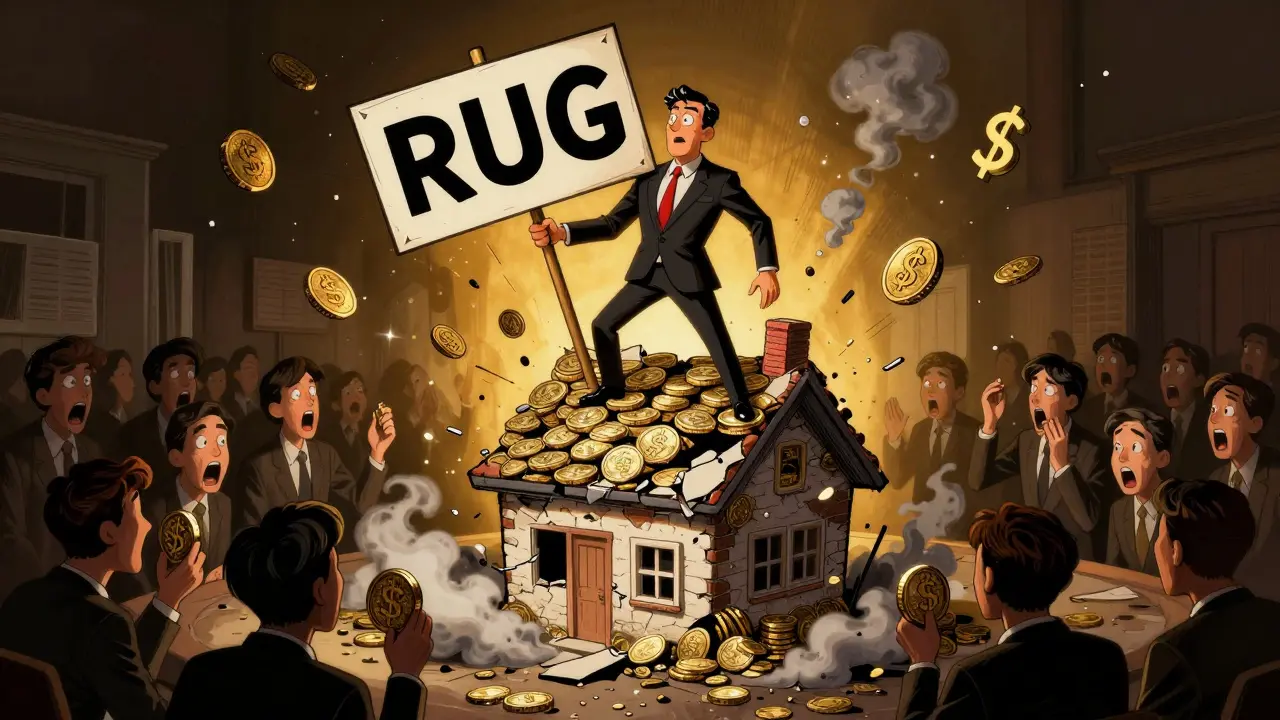
When you hear about someone making a quick fortune in crypto, be careful. Behind every viral meme coin or flashy NFT project, there’s a real chance someone’s already planned to vanish with your money. This isn’t speculation - it’s happened over and over. Rug pull is the most common crypto scam, and it’s cost investors billions. Unlike hacking a wallet or stealing private keys, rug pulls are legal in the gray zone of decentralized finance - until the moment the developers drain the liquidity and disappear.
How a Rug Pull Works
A rug pull happens when a team creates a new cryptocurrency, convinces people to buy it, and then suddenly removes all the money from the trading pool. The token becomes worthless overnight. Investors can’t sell because the smart contract locks them in, or the liquidity is gone. It’s like building a house, inviting people to rent rooms, then burning it down the day after the last tenant pays.
There are two main types. The first is a DeFi rug pull, where the code itself is rigged. Developers set up smart contracts that prevent selling, let them mint unlimited new tokens, or charge 99% fees on trades. The second is an exit scam, where the team runs aggressive marketing - influencers, fake whitepapers, celebrity endorsements - then vanishes after raising millions.
Both types rely on one thing: trust. People invest because they believe in the story. The team looks legit. The Discord is active. The Telegram group has 10,000 members. But none of that matters if the code is a trap.
Thodex: The $2 Billion Exchange Heist
In April 2021, Thodex, Turkey’s largest cryptocurrency exchange, suddenly shut down. Its CEO, Faruk Fatih Özer, vanished with $2 billion in user funds. Over 390,000 people lost everything. The platform had been promoted as safe, regulated, and transparent. Users could withdraw anytime - or so they thought.
Investigators later found Özer had transferred funds to offshore accounts, bought luxury cars, and even booked a flight to Albania. He was arrested in 2022, but most of the money was gone. Thodex wasn’t a DeFi project - it was a centralized exchange. That made the scale of the theft even more shocking. No other single crypto scam in history has taken more than this.
Thodex proved rug pulls don’t need to be anonymous. Sometimes, the scammer is right in front of you - wearing a suit, giving interviews, and running ads.
AnubisDAO: A $58 Million Vanishing Act in 20 Hours
On October 28, 2021, AnubisDAO launched with a DOGE-style logo, no website, and no whitepaper. The team used pseudonyms. Their pitch? A decentralized currency backed by a basket of assets. Sounds vague? That’s because it was.
Within hours, investors poured in nearly $60 million in wrapped Ethereum (wETH). The ANKH token price surged. Then, 20 hours after launch, the liquidity pool was drained. Every single dollar was gone. The developers didn’t bother hiding. They just walked away.
What made AnubisDAO so dangerous was how fast it worked. Most scams take weeks to build hype. This one moved like lightning. It showed how easily a new token can trick people - especially if it’s tied to a trending theme (in this case, Egyptian mythology and meme culture). No audits. No team. No future. Just a quick cash grab.

Squid Game Token: A Meme Coin That Became a Nightmare
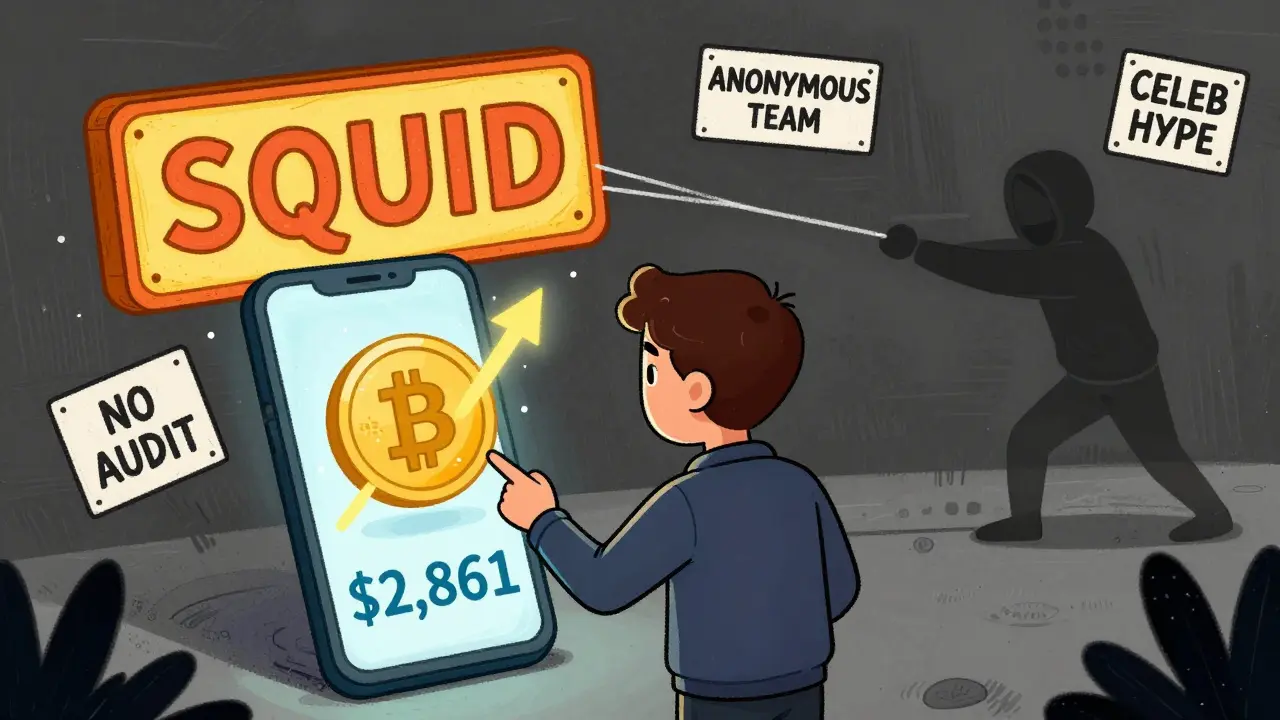
When Netflix’s Squid Game became a global hit, scammers saw their chance. In November 2021, a team launched the SQUID token - a play-to-earn game where you’d earn crypto by playing. It started at $0.01. Within days, it hit $2,861. Thousands rushed in.
Then came the crash. Investors tried to sell - and couldn’t. The smart contract was a honeypot: you could buy, but not sell. The developers had already pulled over $3.38 million. Their Discord and Telegram channels vanished. Their LinkedIn profiles? Deleted. The whitepaper? Full of impossible claims like “AI-powered staking” and “blockchain-based reality games.”
What made Squid Game different was the marketing. They used fake influencers. They built a full website. They even had a “roadmap.” It looked real. But every piece of it was a lie. This became the textbook example of how a rug pull can look like a real project - until it doesn’t.
Bored Bunny NFT: Celebrity Lies and Fake Endorsements
In December 2021, the Bored Bunny NFT project exploded. It promised branded merch, a private metaverse, and 10x returns in days. Even better - it claimed endorsements from Floyd Mayweather, Jake Paul, and David Dobrik. The NFTs sold out in hours, raising 2,000 ETH (worth over $7 million then).
But here’s the truth: the celebrities never owned those NFTs. Blockchain sleuths traced the wallets. All the “celebrity” NFTs were bought by wallets linked to the developers. The whole thing was a front. The project had no team, no roadmap, and no plan. Within months, the floor price dropped from 1.5 ETH to 0.085 ETH. Investors were left holding digital art with no value.
This case showed how NFT rug pulls use social proof. People don’t buy art - they buy status. And scammers know it.
Froggy (FROGGY) and Hawk Tuah: 2024’s Latest Scams
The scams haven’t stopped. In early 2024, FROGGY - a meme coin with a frog logo - rose quickly on X and Reddit. Investors thought it was community-driven. Then, the liquidity vanished. The token crashed 99.95%. It’s now worth less than a penny - and barely trades.
Then came Hawk Tuah. In December 2024, social media influencer Hailey Welch promoted a meme coin named after her viral catchphrase. Within 20 minutes, the token’s market cap dropped from $500 million to $60 million. The U.S. law firm Burwick Law filed a federal lawsuit against Welch and three others. The HAWK token now trades at $0.00064 - down 71% from its peak.
These cases prove something: rug pulls are getting smarter. They use TikTok, X, and YouTube shorts to spread fast. They target new investors who don’t know how to check smart contracts. And they’re getting more brazen - even using real people’s names to make scams look legit.
How to Spot a Rug Pull Before It’s Too Late
You can’t avoid every scam - but you can avoid the big ones. Here’s how:
- Check the liquidity pool. If the devs haven’t locked liquidity for at least a year, run. Use tools like Unicrypt or Team Finance to verify locks.
- Read the smart contract. Use Etherscan or BscScan. Look for functions like setSellFee or mint - if they’re uncontrolled, it’s a trap.
- Verify the team. Do they have LinkedIn profiles? Real names? Past projects? If they’re anonymous or use fake names, it’s a red flag.
- Watch for celebrity hype. If a TikTok star is pushing a token, they’re likely getting paid. They don’t care if you lose money.
- Ask: Who benefits? If the devs own 30%+ of the supply, they can dump anytime. If the token has no use case - no utility, no product - it’s just a bet.
Remember: If it sounds too good to be true, it is. Crypto doesn’t guarantee 10x returns. Real projects take years to build. Scams take hours.
Why Rug Pulls Keep Winning
Over 300,000 scam tokens have been created since 2020. Why? Because it works. Most investors don’t know how to audit code. They follow influencers. They trust Discord mods. They don’t check the blockchain.
Regulators are catching up. The Hawk Tuah lawsuit is a sign. But crypto is global. Scammers operate from countries with weak enforcement. And new investors flood in every day - young, curious, and eager to get rich.
The truth? Rug pulls aren’t going away. They’re evolving. But you can protect yourself. Know the signs. Ask questions. Don’t invest what you can’t afford to lose. And never, ever trust a project that promises easy money.
What is a rug pull in crypto?
A rug pull is a scam where developers create a cryptocurrency, trick investors into buying it, then suddenly remove all the funds from the trading pool. The token becomes worthless, and investors can’t sell their holdings. It’s called a rug pull because the developers literally pull the rug out from under investors.
How much money has been lost to rug pulls?
According to Solidus Labs, over $3 billion has been stolen through rug pulls since 2020. The largest single incident was Thodex in 2021, where $2 billion vanished. In 2021 alone, rug pulls stole more than FTX, Celsius, and Voyager combined.
Can you recover money lost in a rug pull?
Almost never. Once liquidity is drained and tokens are sold, the funds are moved through mixers, converted to Bitcoin, or sent to offshore wallets. Law enforcement rarely recovers funds, especially if the developers are anonymous or located overseas. Legal action, like the Hawk Tuah lawsuit, is rare and takes years.
Are all meme coins rug pulls?
No. Some meme coins like Dogecoin and Shiba Inu have lasted years with real communities and no exit. But most new meme coins launched with hype, no utility, and anonymous teams are high-risk. If a meme coin has no locked liquidity, no audit, and a team that won’t reveal their identity - treat it like a lottery ticket.
How do rug pulls differ from exchange collapses like FTX?
FTX was a centralized exchange that misused customer funds - it was fraud, but not a rug pull. Rug pulls happen in decentralized finance (DeFi) where there’s no company, no CEO, and no regulation. The scam is built into the smart contract. You’re not losing money because a company went bankrupt - you’re losing it because the code was designed to steal.
I've seen this movie before. Just another shiny coin with a Discord full of bots and a whitepaper written in Google Translate. People think they're investing in tech, but they're just betting on someone's next vacation. No audits. No team. Just vibes. And vibes don't pay bills.
You think this is bad? Wait till the next one drops with a TikTok dance challenge and a promise to 'democratize wealth.' They don't even bother hiding anymore. The whole system is rigged to reward the loudest, not the smartest.
I used to think if a project had a cool logo and a hype video it was legit. Then I lost my rent money on a token called 'BANANA PEEL' that vanished in 4 hours. Now I check liquidity locks before I even read the name. It's not about the coin. It's about the code. And most of them? Just garbage with a fancy frontend.
The real crime isn't the rug pulls it's the people who still fall for them. You don't need a PhD to read a smart contract. You just need to stop being lazy and stop trusting influencers who post memes for cash. If you're gonna gamble your life savings on a frog coin at least have the decency to learn how to use Etherscan first
I get why people get sucked in. It's not greed. It's loneliness. Everyone wants to be part of something big. A community. A movement. A win. And scammers know that better than anyone. They don't sell tokens. They sell belonging.
There's a deeper philosophical layer here that rarely gets discussed. The rug pull isn't just a financial crime. It's a collapse of epistemic trust. We used to believe in institutions. Now we believe in anonymous devs with Twitter bios that say 'just vibin.' The real tragedy isn't the lost money. It's that we stopped asking 'why should I trust this?' and started asking 'how fast can I get rich?' We didn't get scammed by code. We got scammed by our own desperation to believe.
I think we're missing the point. The problem isn't just the scams. It's that we treat crypto like a casino and call it innovation. Real blockchain tech is slow, boring, and built by teams who don't need to disappear to make money. The hype cycles? They're just the noise. The signal is in the quiet projects no one talks about. But no one wants to hear that.
I lost everything in 2021 on a token called 'LuckyDoge' 🥲. I cried for a week. But then I started learning. Now I check every contract. I read the code. I look at the dev history. I don't invest in dreams. I invest in transparency. It's not glamorous. But it's the only way to sleep at night.
I'm not mad at the scammers. I'm mad at the system that lets them thrive. Why is there no regulation? Why do exchanges list tokens with zero audits? Why do we treat crypto like a free-for-all when people's life savings are on the line? It's not just about individual responsibility. It's about accountability. And right now? There's none.
Nah bruh u all trippin. The real rug pull is the government and banks keeping all the money. Crypto is the only way out. If u lose money u just not smart enough. I made 100x on a coin called 'NIGERIAWINGS' last year. U just need to go full send. No fear. No limits. Just vibes. 🚀
I'm tired of people acting like they're victims. You bought a token with no whitepaper, no team, and a name that sounds like a Discord bot. You weren't investing. You were gambling. And gambling with your eyes closed? That's not a scam. That's just bad life choices. 🤡
The structural vulnerabilities within decentralized finance are not adequately addressed by current regulatory frameworks. The absence of centralized oversight, combined with pseudonymous actor participation, creates an environment conducive to systemic exploitation. This is not an anomaly; it is an inherent feature of the architecture.
I used to think if a project had a Discord with 50k members it was safe. Then I realized most of those accounts were bots bought for $3 each. I don't judge people who lose money. I just wish we talked more about prevention instead of shame. Education > outrage.
They're not just rug pulling. They're using AI-generated influencers, deepfake videos, and automated bots to manipulate markets. This isn't crypto fraud anymore. It's state-sponsored disinformation. The US government knows. They're just letting it happen to destabilize rival economies. I've seen the documents.
You all are missing the forest for the trees. The real issue isn't rug pulls. It's that you still believe in ownership. Crypto isn't about money. It's about the illusion of autonomy. The smart contract is just the latest religion. And like all religions, it promises salvation to those who don't question the priest.