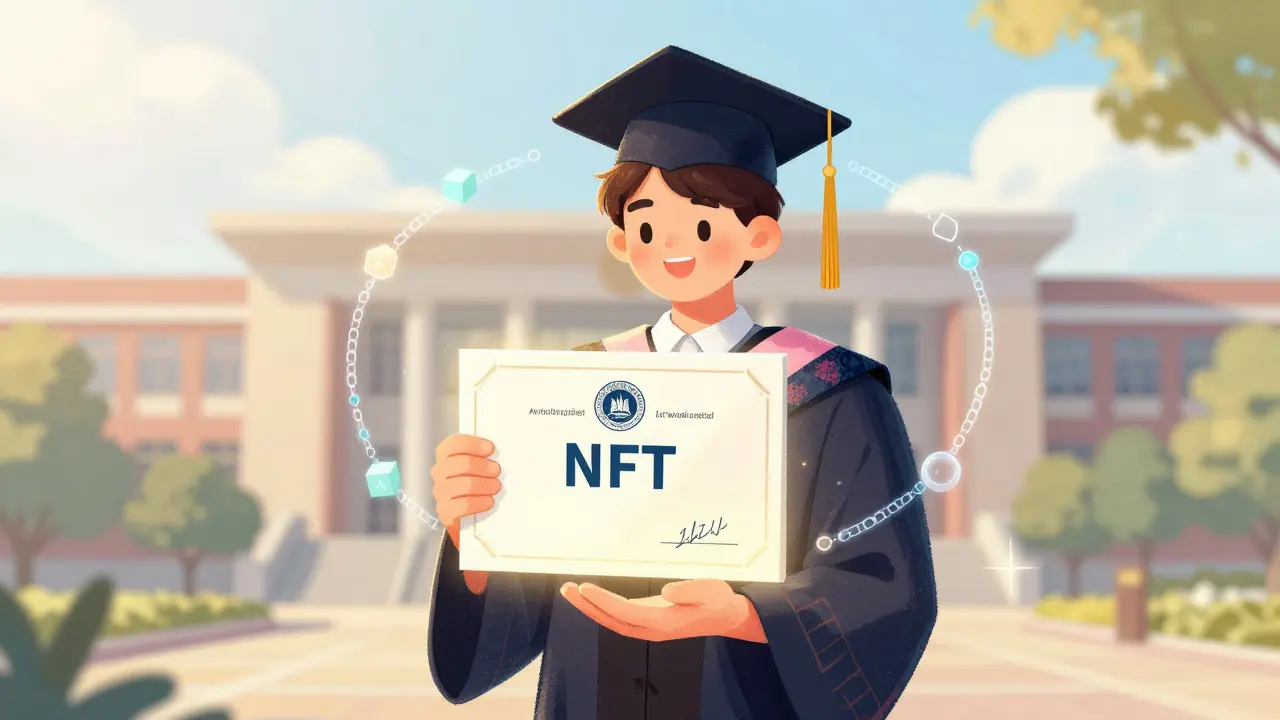
Imagine getting your diploma not as a paper scroll or a PDF file, but as a unique digital token you own outright-something you can instantly show employers, universities, or even governments, with zero chance of forgery. That’s not science fiction. It’s happening right now, and it’s called educational certificates as NFTs.
For decades, academic credentials have been a mess. Paper degrees get lost. PDF transcripts can be edited. Employers wait days, sometimes weeks, just to verify if someone really graduated. And students? They have no real control over their own records. The system is slow, broken, and outdated. NFTs are fixing that.
Unlike Bitcoin or Ethereum, which are interchangeable, NFTs are one-of-a-kind. Each one carries unique data-like your name, degree, graduation date, and the university’s digital signature-locked forever on a blockchain. Once issued, it can’t be changed, copied, or faked. And because it’s stored on a decentralized network, no single company or government controls it. You do.
How NFT Certificates Work
Here’s how it actually works behind the scenes. When you finish a course or graduate, your school doesn’t email you a PDF. Instead, they mint a custom NFT tied to your identity. This NFT doesn’t store the actual certificate image-it stores a link to it, hosted on IPFS, a decentralized file system that’s more reliable than any server. The NFT itself holds metadata: your student ID (hashed for privacy), the program name, the issuing institution, and a cryptographic signature from the university’s blockchain key.
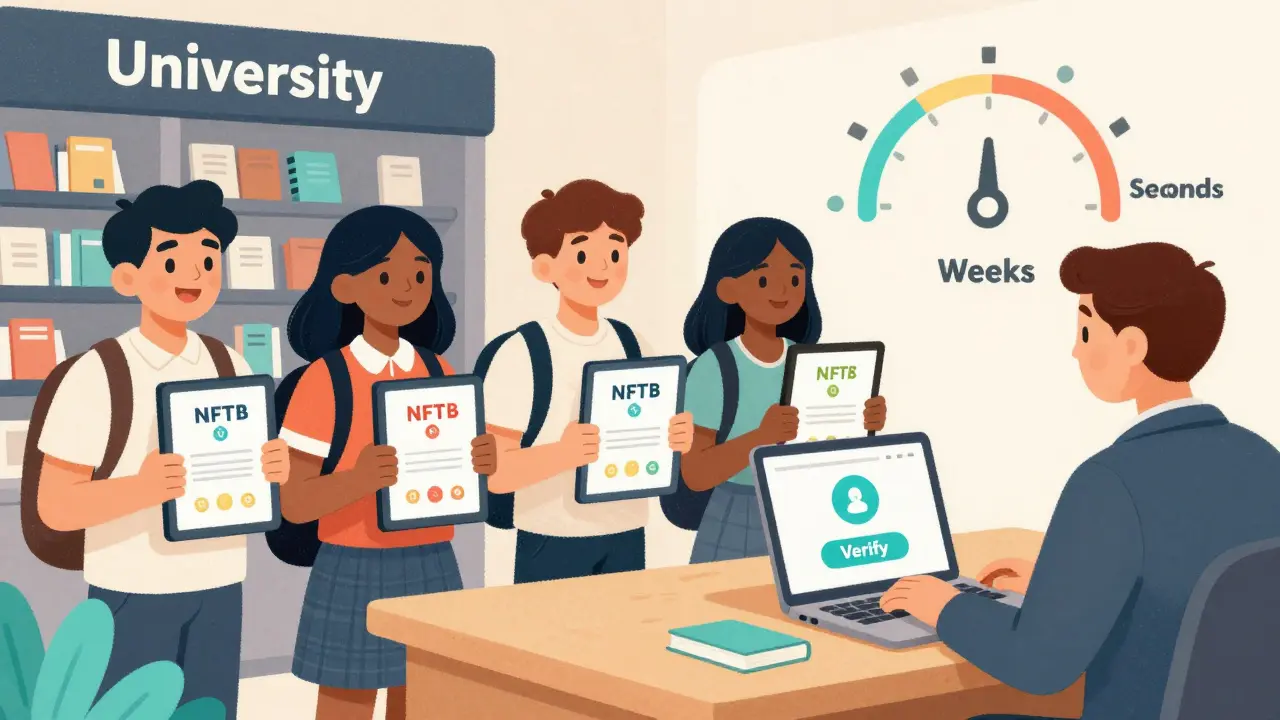
That signature is the magic. It proves the credential came from the real institution, not a scammer. When you share your NFT with a potential employer, they don’t need to call the registrar. They just open their wallet, click “verify,” and the blockchain confirms the signature in under 15 seconds. No forms. No waiting. No fraud.
Most of these systems run on Polygon, not Ethereum. Why? Because Ethereum transactions can cost $1.50 or more. Polygon’s fees are around $0.001. That’s not just cheaper-it makes it practical for schools to issue thousands of certificates without breaking the bank.
Why This Matters More Than You Think
Let’s talk numbers. Industry reports estimate 15-20% of academic credentials submitted for jobs or admissions are fake. That’s one in five. In some countries, it’s worse. Fraud costs institutions and employers billions every year. NFTs cut that to near zero. Once a credential is on the blockchain, it’s permanent and verifiable. No one can alter it. No one can forge it.
But it’s not just about stopping fraud. It’s about giving students power. Right now, if you want to prove your degree to a foreign employer, you might need to send official transcripts through a third-party agency. It takes weeks. With an NFT, you just share a link. Done. International students in New Zealand applying to jobs in Canada? Done in minutes. No more delays from bureaucratic red tape.
And here’s the kicker: you own it. Not your university. Not a cloud service. You. You can share it with five employers, revoke access from one, or archive it for life. No one can take it away unless you lose your private key.
Who’s Doing It Right?
Singapore is leading the pack. Their SkillsFuture initiative rolled out NFT certificates across 23 polytechnics in 2023. Result? A 98% drop in credential fraud. That’s not a small win-it’s a revolution.
Duke University started issuing NFTs for its Master of Engineering in Financial Technology in early 2022. Graduates reported cutting their job search time from months to weeks because employers could verify credentials instantly. One student, u/FinanceGrad123 on Reddit, said their NFT diploma helped them land a role faster than any other candidate because their proof was immediate and unbreakable.
OpenCerts, developed by Singapore’s government, is now the gold standard. It’s open-source, secure, and used by universities worldwide. BCDiploma is another major player, especially in North America, offering plug-and-play NFT credentialing for schools without blockchain expertise.
Even MIT and Stanford are experimenting. MIT integrated NFT diplomas with its alumni career portal in April 2024, letting graduates link their credentials directly to job applications. Stanford’s education department is studying how to make the process more accessible for non-tech students.
The Catch: It’s Not Perfect Yet
Here’s the reality: NFT credentials are powerful, but they’re not magic. They require you to have a Web3 wallet-like MetaMask-and know how to use it. That’s a big barrier. A 2023 study by BCDiploma found 68% of students who weren’t already tech-savvy struggled to claim their NFTs. One art student spent three hours watching YouTube tutorials just to get her diploma on her wallet.
And if you lose your private key? You lose your diploma. No recovery email. No customer service line. That’s why smart schools now give students physical recovery cards-printed QR codes that let them restore access if their phone dies or they forget their password.
Another problem? HR systems. Most companies still use old software that doesn’t know what an NFT is. Gartner found 78% of Fortune 500 companies still rely on legacy systems that can’t verify blockchain credentials. So even if you have the best diploma in the world, your potential employer might not be able to open it.
And then there’s cost. Setting up an NFT system isn’t cheap. Mid-sized universities spend between $75,000 and $120,000 to build the infrastructure, train staff, and onboard students. That’s a lot for a school on a tight budget.
Who Benefits the Most?
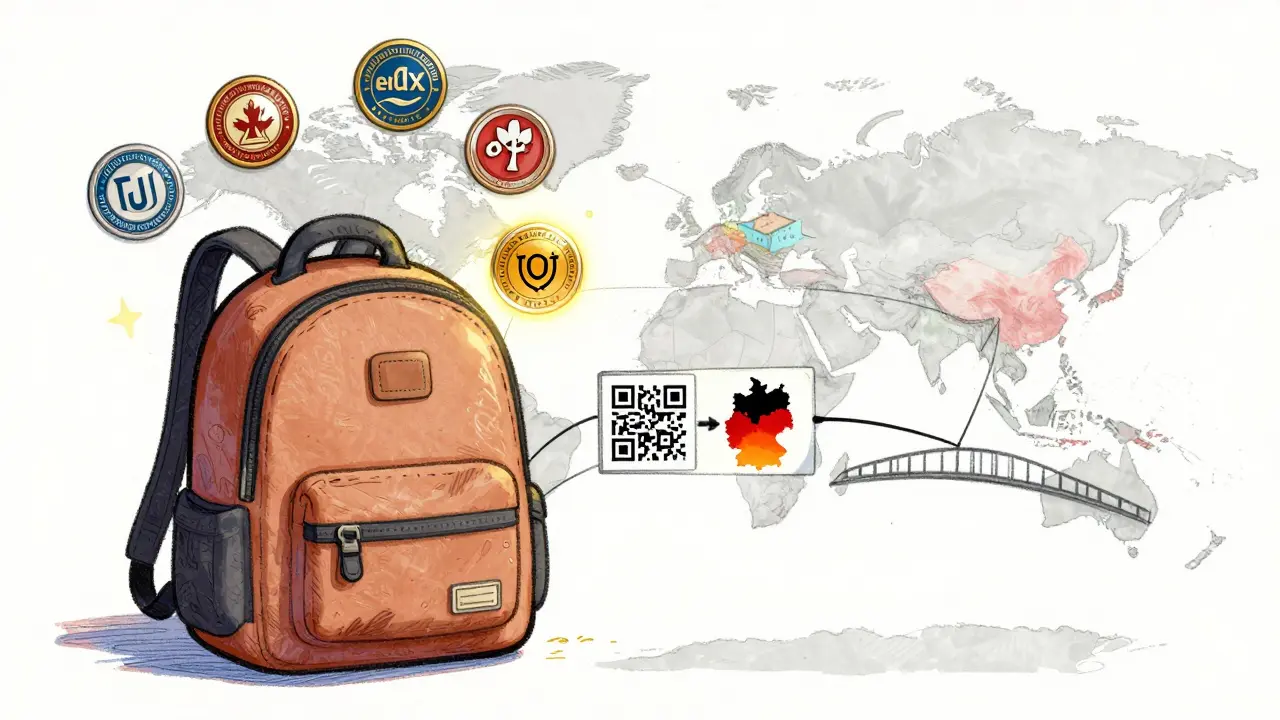
Students who move between countries benefit hugely. International applicants don’t need to pay for credential evaluation services anymore. Employers hiring globally save time and reduce risk. Universities cut down on fraud investigations and verification requests.
But the biggest winners? Lifelong learners. People taking online courses from platforms like Coursera or edX. Right now, those certificates are just images you can screenshot. With NFTs, every micro-credential becomes a verifiable, shareable asset. Imagine building a portfolio of 50 NFT badges from different courses-all in one wallet, all instantly verifiable. That’s the future of upskilling.
It’s also great for people in places where official records are unreliable. In countries with weak education systems or corrupt bureaucracies, NFTs give students a way to prove their skills without depending on broken institutions.
The Road Ahead
Right now, NFT credentials are still in the early adopter phase. Only 34% of U.S. universities are piloting them. Singapore leads with 78%. Europe is slower, held back by GDPR rules around data ownership.
But things are moving fast. OpenCerts just released a wallet-agnostic system in February 2024-meaning students can verify their credentials without even having a wallet. That’s a game-changer. AI tools are being built to translate NFT credentials into different languages automatically. And by 2025, ISO is expected to release the first global standard for blockchain-based credentials.
By 2027, Gartner predicts 60% of universities will offer NFT diplomas. By 2030, the World Economic Forum says 80% of top institutions will have adopted them. The trend is clear: if you want your education to be trusted globally, it needs to be on the blockchain.
The question isn’t whether NFT certificates will replace traditional diplomas. It’s when. And who will be ready when that day comes.
What You Need to Know If You’re a Student
If your school starts issuing NFT diplomas, here’s what to do:
- Get a Web3 wallet (MetaMask or Coinbase Wallet are easiest)
- Write down your recovery phrase-on paper, not in a digital file
- Check if your school offers a simplified claiming tool (some now have one-click claiming)
- Keep a backup of your NFT’s QR code if they give you one
- Share your NFT link only with trusted parties-once it’s out there, you can’t take it back
It’s not hard. But you need to act before your school sends the first email.
What Schools Need to Do
For institutions considering NFT credentials:
- Partner with OpenCerts or BCDiploma instead of building from scratch
- Allocate budget for student education-run workshops, not just emails
- Train your registrar and IT staff on blockchain basics
- Offer physical recovery cards and AI chatbots for support
- Start small: pilot with one program before rolling out campus-wide
The biggest mistake? Assuming students will figure it out on their own. They won’t. Without support, adoption fails.
Are NFT educational certificates really secure?
Yes. NFT certificates are stored on a blockchain, which means they’re cryptographically signed by the issuing institution and cannot be altered after creation. Unlike PDFs or paper diplomas, they can’t be edited, copied, or forged. Every verification check confirms the original signature, making fraud virtually impossible.
Do I need a cryptocurrency wallet to receive an NFT diploma?
Yes, currently. You need a Web3 wallet like MetaMask to receive and store your NFT certificate. However, newer systems like OpenCerts now allow verification without owning a wallet-you can view and share your credential through a secure web link. But to fully own and control it, you still need a wallet.
What happens if I lose my wallet or private key?
If you lose your private key and don’t have a recovery method, you lose access to your NFT diploma permanently. That’s why many schools now provide physical recovery cards with QR codes that can restore your credential. Always store your recovery phrase offline-on paper, not in your email or cloud.
Can employers verify NFT certificates without knowing blockchain?
Yes. Most NFT credential platforms provide a simple verification portal. Employers just paste the NFT link or scan a QR code, and the system shows them the verified details: name, degree, institution, and issue date. No blockchain knowledge is needed-just a browser.
Are NFT diplomas accepted by governments and official bodies?
Not yet universally. Some countries, like Singapore, fully recognize them. Others, like China and India, restrict blockchain-based systems. In the U.S. and EU, adoption is growing, but official recognition is still in progress. The European Commission and U.S. Department of Education are actively developing standards, so acceptance is expected to rise through 2025-2027.
How much does it cost for a university to issue NFT diplomas?
Implementation costs range from $75,000 to $120,000 for mid-sized universities, covering blockchain setup, smart contract development, staff training, and student onboarding. Ongoing costs are low-each transaction on Polygon costs less than a penny. Compared to the $3.2 billion lost annually to credential fraud globally, the investment pays for itself quickly.
Can NFT certificates represent partial completion or micro-credentials?
Most current systems only issue full diplomas. But new platforms like CredentialChain are rolling out AI-powered tools to issue NFTs for individual courses or skills by late 2024. This will let learners build a stackable portfolio of verified micro-credentials-something traditional systems can’t do.
Will NFT diplomas replace traditional degrees?
No-they’ll complement them. The paper degree won’t disappear overnight. But NFTs will become the standard way to prove and share your academic achievements. Think of it like email replacing postal mail: the content (your degree) stays the same, but how you share it changes forever.
so like... you just gotta trust your phone not to die and remember some magic words? kinda wild. i got my high school diploma on paper and it’s still in my drawer. this feels like trading one kind of anxiety for another.
Blockchain solves verification, not access. If your school doesn’t teach students how to use wallets, it’s not innovation-it’s exclusion.
so you’re telling me my aunt in rural Ohio who still uses fax machines is gonna get her GED as an NFT? lol. next they’ll be sending her crypto to pay for her meds. 😂
While the concept is commendable, the digital divide remains a critical concern. In many regions, access to reliable internet and digital literacy are not guaranteed. Implementation must be inclusive, not just innovative.
It’s funny how we treat tech like it’s magic. You own your diploma? Cool. But if you lose your key, it’s gone forever. No appeals. No second chances. Kinda like life, huh? 😅
people still think blockchain is the answer to everything. we dont need to tokenize education we need to fix the system that makes it so expensive in the first place
OMG YES THIS IS THE FUTURE!!! I just got my Coursera badge as an NFT and I shared it on LinkedIn and got 3 DMs in 2 hours!! 🎉✨
Imagine if your entire academic journey-every workshop, every certificate, every failed class-was a colorful NFT badge in your wallet. Like a digital scrapbook of your brain’s weird journey. I’d collect them like Pokémon.
Oh great. So now instead of fraudsters forging paper diplomas, they’ll just steal your private key. Real progress. 🙄
Look, I’ve been in edtech for 15 years. Every time someone says ‘blockchain will fix everything,’ I laugh. Then I check the budget. Then I cry. This is a $100k solution to a $5k problem. Most schools can’t even get their LMS working right. Let’s fix the basics before we tokenize graduation.
Ownership is powerful. But power without support is just a burden. If the system doesn’t help people use it, it’s not liberation-it’s a new kind of gatekeeping.
68% of students struggled? That’s not a UX issue. That’s a failure of the entire premise. If it’s too hard for the average person, it’s not a revolution-it’s a gimmick.
GDPR compliance? Good luck. The EU will never allow a system where data is permanently stored and unchangeable. This is a US-centric fantasy wrapped in blockchain glitter.
Let’s be real-this is just crypto bros repackaging their vaporware under the label ‘education.’ You think a university in Lagos is gonna mint NFTs when they can’t even pay lecturers? This isn’t progress. It’s performative tech.
My cousin in Kenya just got her diploma as an NFT-no agency, no waiting, no fees. She applied to a job in Canada and got hired in 4 days. This isn’t hype. This is life-changing. 🙌
Think about it-what if your entire learning history was a living, breathing, verifiable archive? Not just your degree, but your coding bootcamp, your poetry workshop, your first-aid certification, your volunteer hours-all linked, all yours. You could build a career not just on what you studied, but on what you actually did. Imagine a world where your résumé wasn’t a list of names and dates, but a living mosaic of your growth. That’s not just tech. That’s identity. That’s legacy. And it’s finally possible.
The adoption curve will be slow but inevitable. Institutions that delay will face reputational and operational disadvantages. The global mobility of talent demands a global standard for credentialing. This is not optional-it is structural.
So you’re telling me the solution to credential fraud is to make students responsible for digital security they don’t understand? Brilliant. Let’s just put the burden on the most vulnerable. Classic.
Wait-so I need to buy ETH to get my diploma? And if I forget my password, I lose my entire academic record? And if my wallet gets hacked, I’m just… out of luck? And the university won’t help me? And this is supposed to be better than a PDF? I’m not impressed. I’m terrified.
And now the author replies to the comment about losing your key. Of course they do. They’re the one who wrote the whole thing. They’re the only one who thinks this is a good idea. Congrats. You built a digital tombstone and called it a diploma.